
Table of Contents
We often think of “invention” as the domain of geniuses like Thomas Edison or Nikola Tesla—people who harnessed electricity or revolutionized communication. We imagine complex diagrams, bubbling test tubes, and years of tireless research. But sometimes, invention is just a guy in a bar joking about his pet rock.
The history of capitalism is littered with products that, on paper, look absolutely ridiculous. They are the ideas that make you slap your forehead and say, “Why didn’t I think of that?” or “Who on earth would buy that?” The answer, it turns out, is everyone. These products prove that you don’t need to cure a disease or build a rocket to become a millionaire; sometimes, you just need a catchy jingle, a sense of humor, or the audacity to sell people something they didn’t know they needed.
Here are the top 10 “dumb” inventions that defied logic, mocked the critics, and made their creators spectacularly rich.
1. The Pet That Did Nothing: The Pet Rock
The Millionaire Maker: Gary Dahl (1975)
The “Dumb” Idea: In the mid-70s, advertising executive Gary Dahl was at a bar listening to his friends complain about the hassle of feeding, walking, and cleaning up after their pets. He joked that he had the perfect pet: a rock. It didn’t eat, it didn’t bark, and it never made a mess. The joke should have ended there, but Dahl took it seriously.
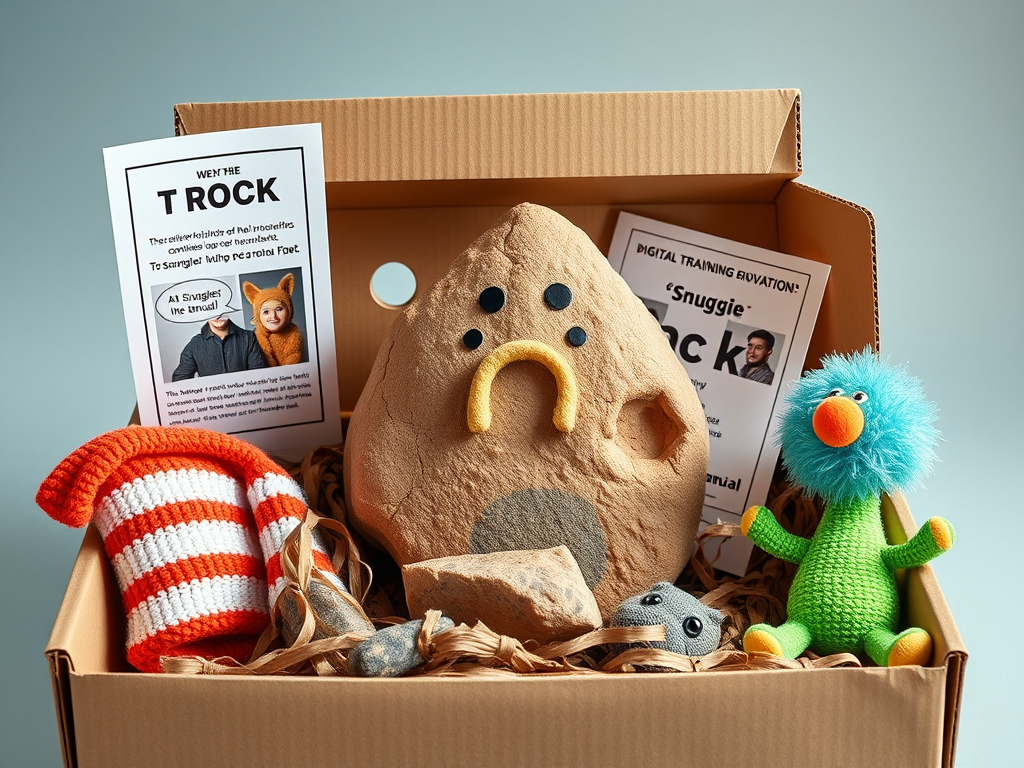
The Reality: Dahl didn’t just sell a rock; he sold a masterclass in marketing. He bought smooth stones from a Mexican beach for pennies and packaged them in a custom cardboard carrying case with air holes (so the rock could breathe) and a straw bed. The real genius was the 32-page “Official Training Manual” included in the box, which taught owners how to get their rock to “sit,” “stay,” and “play dead” (it was very good at that last one).
It cost $3.95, and in just six months, Dahl sold over 1.5 million of them. By the time the fad died, he was a millionaire. It remains the gold standard for “useless” products that succeeded purely on wit and packaging.
2. The Backwards Bathrobe: The Snuggie
The Millionaire Maker: Scott Boilen / Allstar Marketing Group (2008)
The “Dumb” Idea: Blankets have existed for millennia. Robes have existed for millennia. Did humanity really need a hybrid of the two that made you look like a monk in a fleece cult? The Snuggie was essentially a blanket with sleeves, designed for people who wanted to use a remote control without their arms getting cold.
The Reality: The Snuggie wasn’t even the first product of its kind (the “Slanket” came first), but it was the one that understood campy marketing. The commercials were famously over-the-top, showing people struggling to use blankets like they were solving a complex physics equation. The sheer ridiculousness of the product made it a pop culture phenomenon.
It became a gag gift that everyone actually used. To date, over 30 million Snuggies have been sold, generating more than $500 million in revenue. It proved that if you can make people laugh at your product, they might just buy it.
3. The Digital Whoopee Cushion: iFart Mobile
The Millionaire Maker: Joel Comm (2008)
The “Dumb” Idea: When the Apple App Store first launched, it was hailed as a revolutionary platform for productivity and gaming. Joel Comm saw a different opportunity: high-fidelity flatulence. He created an app that did nothing but play different fart sounds, from “The Jack the Ripper” to “The Brown Mosquito.”
The Reality: It was juvenile, gross, and completely useless—and it was an instant smash hit. Priced at $0.99, the app shot to the number one spot in the App Store. At its peak, it was generating over **$10,000 a day** in pure profit.
In just two weeks over Christmas 2008, the app famously pulled in nearly $40,000. It showed that while people love high-tech smartphones, their sense of humor remains decidedly low-brow.
4. The Singing Wall Ornament: Big Mouth Billy Bass
The Millionaire Maker: Joe Pellettieri / Gemmy Industries (1999)
The “Dumb” Idea: Imagine pitching this in a boardroom: “It’s a plastic fish mounted on a plaque, but when you walk past it, it turns its head and sings ‘Take Me to the River’.” It sounds like a nightmare from a haunted seafood restaurant.
The Reality: Big Mouth Billy Bass became the must-have gift of the early 2000s. It was everywhere—from truck stops to the walls of Buckingham Palace (reportedly, Queen Elizabeth II had one). The novelty of a motion-activated singing fish was irresistible to dads everywhere.
In the year 2000 alone, the singing fish generated over $100 million in sales. It was annoying, loud, and kitschy, but it tapped into a specific vein of “dad humor” that turned a piece of plastic into a goldmine.
5. Selling Nothing but Pixels: The Million Dollar Homepage
The Millionaire Maker: Alex Tew (2005)
The “Dumb” Idea: Alex Tew was a 21-year-old student in England who needed money for university. He decided to build a website consisting of a 1000×1000 pixel grid. His plan was to sell the pixels for $1 each to advertisers. The catch? You couldn’t do anything with the pixels other than display a tiny image and a link.
The Reality: It was the ultimate “why would anyone pay for this?” scheme. But because the idea was so novel and audacious, it went viral. Companies bought pixels just to be part of the internet history.
The media coverage snowballed, and within four months, the final pixels were auctioned off. Tew grossed exactly $1,037,100. He essentially sold empty digital real estate and became a millionaire before he even graduated.
6. The Vacuum Haircut: The Flowbee
The Millionaire Maker: Rick Hunts (1988)
The “Dumb” Idea: The Flowbee looks like a terrifying contraption from a sci-fi horror movie. It is a device that attaches to your vacuum cleaner to suck your hair up and cut it at a precise length. The infomercials, featuring the inventor cutting his own hair with a vacuum, were legendary for their awkwardness.
The Reality: Despite being the butt of jokes on Wayne’s World and late-night talk shows, the Flowbee solved a real problem: messy, expensive haircuts. It worked exactly as advertised.
The product has sold millions of units over the decades. It even saw a massive resurgence during the 2020 pandemic when barbershops closed, with superstar George Clooney admitting he has used a Flowbee to cut his own hair for years. What looked like a joke was actually a stroke of practical genius.
7. Pottery That Grows Hair: The Chia Pet
The Millionaire Maker: Joe Pedott (Marketing Genius)
The “Dumb” Idea: Take a terracotta figurine shaped like a ram or a turtle, smear wet seeds on it, and watch it grow green “hair” over a few weeks. It’s a primitive concept that seems more like a kindergarten science project than a commercial product.
The Reality: The Chia Pet is a testament to the power of a jingle (“Ch-ch-ch-Chia!”) and TV advertising. Joe Pedott didn’t invent the concept, but he bought the rights and marketed it into oblivion.
By licensing characters like Shrek, Barack Obama, and The Golden Girls, Chia Pets remained relevant for 40 years. They are the ultimate “I don’t know what to get you for Christmas” gift. With over 25 million units sold, this “dumb” pottery has generated hundreds of millions of dollars.
8. Sunglasses for Dogs: Doggles
The Millionaire Maker: Roni Di Lullo (1997)
The “Dumb” Idea: Putting sunglasses on a dog sounds like something you do for a funny Instagram photo, not a serious business model. When Roni Di Lullo first floated the idea, people laughed. Why would a dog need eye protection?
The Reality: It turned out to be a classic case of finding a niche market. Di Lullo noticed her dog squinting in the bright sunlight and realized that dogs, just like humans, can suffer from UV damage and eye issues.
She designed goggles that fit the canine face shape. They became a hit not just with fashion-conscious pet owners, but with military and police working dogs in sandy or bright environments. Doggles is now a multi-million dollar global brand, proving that pets are the ultimate consumers.
9. The Sticky Octopus: Wacky Wall Walker
The Millionaire Maker: Ken Hakuta (1983)
The “Dumb” Idea: The Wacky Wall Walker was a piece of elastomeric rubber shaped like an octopus. If you threw it against a wall, it would slowly “walk” down as the sticky feet lost and regained their grip. That was it. That was the whole toy.
The Reality: Ken Hakuta received one of these toys from his mother in Japan and saw potential. He bought the rights for practically nothing. After a Washington Post reporter stumbled upon it and wrote a story, the “fad” exploded.
Kellogg’s put them in cereal boxes, and millions of kids (and adults) became obsessed with throwing sticky rubber at their walls. Hakuta made over $80 million from a toy that eventually got covered in lint and stopped working after a week.
10. The Plastic Wishbone: Lucky Break Wishbone
The Millionaire Maker: Ken Ahroni (2004)
The “Dumb” Idea: Thanksgiving has a problem: every turkey only has one wishbone, but there are usually a dozen people at the table. Ken Ahroni’s solution was to manufacture fake, plastic wishbones so everyone could have a crack at breaking one.
The Reality: Critics called it a waste of plastic and a silly commercialization of a tradition. But Ahroni knew that people love tradition—and they hate being left out.
The company sells millions of units every year. It’s a seasonal business that generates millions in revenue annually, proving that you can monetize even the smallest, most specific slice of a holiday tradition.
Further Reading
If you want to understand the psychology behind why these “dumb” ideas succeed and how to market your own, check out these fascinating books:
- “Made to Stick: Why Some Ideas Survive and Others Die” by Chip Heath and Dan Heath – The definitive guide to understanding why some concepts (like the Pet Rock) catch on while “smarter” ones fail.
- “Purple Cow: Transform Your Business by Being Remarkable” by Seth Godin – A marketing classic that explains why standing out (even by being weird) is the only way to win in a crowded market.
- “Pop!: Create the Perfect Pitch, Title, and Tagline for Anything” by Sam Horn – A great resource for learning how to name and pitch an idea so that it captures the public’s imagination instantly.
- “The $100 Startup” by Chris Guillebeau – Inspiring stories of people who turned small investments and simple ideas into sustainable businesses.
Formatting Rules for Outro: Use an H2 Header for “Keep the Discovery Going!” Use H3 Headers for “Watch & Learn on YouTube” and “Listen on the Go on Spotify”. Ensure there is a full blank line between every paragraph and link. Embed the links into the text where indicated. [Begin Outro Text]
Keep the Discovery Going!
Here at Zentara, our mission is to take tricky subjects and unlock them, making knowledge exciting and easy to grasp. But the adventure doesn’t stop at the bottom of this page. We are constantly creating new ways for you to learn, watch, and listen every single day.
Watch & Learn on YouTube
Visual learner? We publish 4 new videos every day, plus breaking news shorts to keep you smarter than the headlines. From deep dives to quick facts, our channel is your daily visual dose of wonder.
Click here to Subscribe to Zentara on YouTube
Listen on the Go on Spotify
Prefer to learn while you move? Tune into the Zentara Podcast! We drop a new episode daily, perfect for your commute, workout, or coffee break. Pop on your headphones and fill your day with fascinating facts.
Click here to Listen on Spotify
Every click, view, and listen helps us keep bringing honest knowledge to everyone. Thanks for exploring with us today—see you out there in the world of discovery!

Leave a Reply