
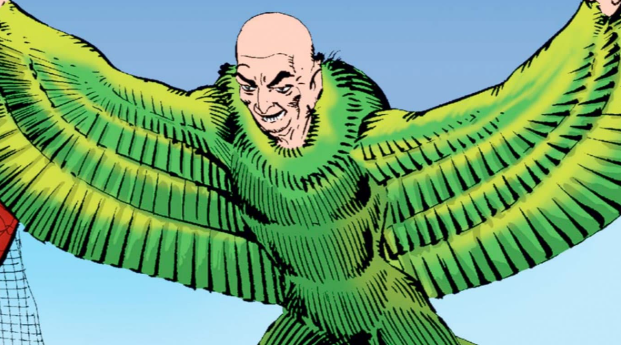
In the pantheon of Spider-Man rogues gallery icons, the Vulture holds a unique and terrifying position. While villains like the Green Goblin represent chaotic madness and Doc Ock embodies scientific hubris, Adrian Toomes—the original Vulture—represents the cold, calculating fury of a man who has been pushed too far by a world that values youth over experience. He is one of the oldest characters in Marvel history, both in terms of his age and his debut, having first appeared in The Amazing Spider-Man #2 back in 1963.
The Vulture is far more than just a “grumpy old man in a bird suit.” He is a brilliant engineer, a ruthless criminal strategist, and a survivor who has cheated death more times than almost any other character in the Marvel criminal underworld. From his high-tech wings to his occasional dips into the Fountain of Youth, Adrian Toomes has evolved from a simple aerial thief into a multi-layered antagonist with a deep-seated hatred for the corporate world.
Whether you were introduced to him through Michael Keaton’s chilling performance in the MCU or you’ve been following his comic book exploits for decades, here are ten deep-dive facts about the Marvel supervillain Vulture.
1. He Was a Victim of “White-Collar” Betrayal
Adrian Toomes didn’t start his life as a criminal; he was a brilliant electronics engineer and the co-founder of a successful firm called Bestman and Toomes. The Vulture origin story is rooted in a classic corporate double-cross. While Toomes was busy perfecting his revolutionary electromagnetic harness, his business partner, Gregory Bestman, was embezzling funds and legally maneuvering Toomes out of the company.
Finding himself elderly, unemployed, and stripped of his life’s work, Toomes discovered that his harness gave him superhuman strength and flight. He didn’t just use it to travel; he used it to take back what he felt was owed to him. This backstory makes him a relatable, albeit extreme, example of “senior citizen rage.” He represents everyone who has ever been discarded by a heartless corporation, giving him an evergreen villain motivation that resonates even more in today’s gig economy.
2. His Harness Grants Him “Static” Super Strength
One of the most common misconceptions is that Adrian Toomes is just a frail man in a suit. However, the Vulture’s electromagnetic harness does much more than just allow him to fly. The harness creates a localized electromagnetic field around his body, which increases his physical strength to superhuman levels and enhances his durability.
Even when he isn’t wearing the suit, the long-term exposure to this field has permanently boosted his constitution. He can lift several tons and take a punch from Spider-Man that would kill a normal man of his age. This “static strength” is a key reason why he remains a formidable Spider-Man antagonist despite being in his late 70s or 80s. He isn’t just flying; he is a pressurized engine of kinetic energy that can snap steel with his bare hands.
3. He Once Sucked the Youth Out of Spider-Man
In a particularly bizarre and dark storyline from the 1990s, Adrian Toomes managed to do what every aging person dreams of: he became young again. Using a device called the “Juvenile Rejuvenator,” the Vulture was able to drain the life force from others to restore his own vitality. During a famous confrontation, he successfully stole the youth of Peter Parker, turning himself into a muscular young man while leaving Peter as a frail, elderly person.
This period of the character’s history highlighted his obsession with immortality. While he eventually reverted to his elderly state, the experience left him even more bitter and desperate. It added a “vampiric” layer to his persona—he isn’t just a bird of prey; he is a parasite who literalizes the idea of the older generation “consuming” the potential of the young to maintain their own power.
4. There Have Been Four Different Vultures
While Adrian Toomes is the definitive version, he isn’t the only one to wear the wings. The mantle of the Vulture has been passed down (and stolen) multiple times. There was Blackie Drago, a cellmate who tricked Toomes into revealing the location of a spare suit; Clifton Shallot, a professor who mutated himself into a literal human-vulture hybrid; and Jimmy Natale, a mutated mob enforcer who could spit acid.
This “legacy of the wings” shows how the Vulture persona has become a symbol of predatory crime in New York. However, Toomes always finds a way to reclaim his title. He famously defeated Blackie Drago just to prove that it’s the man, not the suit, that makes the villain. This territorial nature is classic Vulture behavior—he doesn’t just want to be a criminal; he wants to be the only predator in his sky.
5. He Is a Founding Member of the Sinister Six
When Doctor Octopus first decided to organize Spider-Man’s greatest enemies into a team, the Vulture was one of the first names on the list. As a founding member of the original Sinister Six, Toomes brought aerial superiority and years of tactical experience to the group.
Unlike the more impulsive members like Electro or Sandman, the Vulture often acts as the “wise counselor” (or the cynical critic) of the group. His inclusion in almost every iteration of the Sinister Six proves his status as a top-tier threat. He understands that while Spider-Man is fast, he is tethered to the buildings; the Vulture owns the open air, making him the team’s most effective scout and hit-and-run specialist.
6. He Has a Surprising Soft Spot for His Grandchildren
Despite his cold exterior and murderous tendencies, Adrian Toomes is a family man at heart—in his own warped way. He has a daughter, Valerie Toomes, and a grandson named Malachai. Much of his criminal career has been motivated by a desire to provide for them and ensure they don’t suffer the poverty he faced after being betrayed by Bestman.
This humanizing villain trait makes him more than a caricature. In various stories, he has risked his life and his freedom to protect his family. However, his “protection” is often toxic and violent. This complexity is what makes him such an enduring Marvel antagonist; he believes he is a hero in his own family’s story, fighting against a world that wants to leave his bloodline with nothing.
7. His MCU Version Was Heavily Inspired by “The Tinkerer”
In Spider-Man: Homecoming, the Vulture’s suit is a high-tech exoskeleton made from salvaged Chitauri technology. In the comics, the Vulture also has a long-standing partnership with The Tinkerer (Phineas Mason). The Tinkerer is the one who often provides the upgrades to the Vulture’s wings, incorporating silent propulsion and sharpened metallic feathers.
This connection to the Marvel technological underworld explains how an old man stays ahead of the curve. He isn’t just using 1960s tech; he is constantly iterating. His wings have been upgraded to include diamond-tipped feathers that can be fired like projectiles and thermal-cloaking technology that makes him invisible to radar. He is a high-tech scavenger, turning the “scraps” of the superhuman age into a lethal weapon system.
8. He Once Became a Literal Man-Bird Monster
During the “Brand New Day” era, a new version of the Vulture emerged that leaned heavily into body horror. This version, Jimmy Natale, was a “Red Vulture” who resulted from a botched mutation experiment. Unlike Toomes, who used a suit, Natale had wings growing out of his back and a beak-like maw that could vomit corrosive acid.
Natale was a scavenger who preyed on wounded criminals, making him a “cleaner” for the mob. This darker, more animalistic take on the character served as a stark contrast to Toomes’ intellectual approach. It reminded readers that the Vulture’s lethality can come from many places—whether it’s the cold precision of an engineer or the mindless hunger of a beast. Toomes eventually had to deal with these “pretenders,” further solidifying his place as the one true Vulture.
9. He Is a Master of Silent Flight
One of the Vulture’s greatest advantages isn’t his speed, but his silence. His electromagnetic harness allows him to glide with virtually zero noise. This makes him one of the few Spider-Man villains who can bypass Peter Parker’s Spider-Sense by attacking from a complete “dead zone” of sound and vibration.
In the comics, he often uses this stealth to pull off impossible heists from high-rise buildings. He doesn’t smash through windows; he slides in like a ghost. This stealth-based combat style is why he is so dangerous in an urban environment. He uses the skyscrapers of New York like the canyons of a desert, diving from the shadows of the clouds to snatch his prey before they even hear the wind rustle his feathers.
10. He Has Successfully “Retired” Multiple Times
Unlike many villains who are obsessed with the “cycle” of crime, Adrian Toomes has actually tried to walk away several times. He has attempted to open a repair shop and even tried to live a quiet life in a senior community. However, his pride and his vengeful nature always pull him back.
He cannot stand the idea of being “just an old man.” Every time he sees a hero getting the spotlight or a corporation thriving, his resentment flares up. This makes his story a tragedy of ego. He has the genius to be a billionaire and the strength to be a hero, but he chooses to be a superhuman mercenary because he would rather be feared than forgotten. His “retirement” is never about peace; it’s just a pause while he sharpens his talons for the next strike.
Further Reading
- “The Amazing Spider-Man” #2 by Stan Lee and Steve Ditko – The essential first appearance and introduction of the Vulture.
- “Spider-Man: Funeral for an Octopus” – A great look at the Vulture’s role within the Sinister Six and his aging process.
- “The Spectacular Spider-Man” #186-188 – The “Vulture Redux” storyline where he regains his youth.
- “Spider-Man: Homecoming” (The Art of the Movie) – For those interested in how the comic book tech was adapted into the MCU’s industrial scavenger.


Leave a Reply