In the pantheon of British television, few sitcoms have captured the excruciating, palm-sweating reality of adolescence quite like The Inbetweeners. While many teen dramas opt for a glossier, more romanticized version of high school, creators Damon Beesley and Iain Morris chose to lean into the “cringe.” They focused on four teenage boys in a nondescript London suburb who were neither the “cool” kids nor the social outcasts. They were the ones in the middle—the “Inbetweeners.” This choice resonated with an entire generation because it felt painfully, hilariously authentic.
The show’s success wasn’t built on high-concept plots or exotic locations; it was built on the chemical reaction between four distinct, often deluded, personalities and the specific, rhythmic slang of the British schoolyard. From the bright yellow Fiat Cinquecento to the terrifying presence of Mr. Gilbert, the series created a universe that felt lived-in and deeply relatable. Whether you’re a “Little Lebowski Urban Achiever” of comedy or just someone who enjoys a good “friend!” joke, understanding the history and production of this series reveals why its humor continues to land with a thud of awkward perfection.
1. The “Middle-Ground” Philosophy: Defining the Inbetweener
The title of the show is more than just a catchy name; it represents a specific sociological tier of the British education system. Creators Damon Beesley and Iain Morris intentionally set out to depict the vast majority of students who don’t fit into the two most common television tropes: the popular athletes or the bullied “nerds.” The four protagonists—Will, Simon, Jay, and Neil—exist in a social purgatory. They are “inbetween” childhood and adulthood, “inbetween” cool and uncool, and “inbetween” being successful and failing completely.
This focus on the mundane middle ground is what gives the show its evergreen appeal. By avoiding the extremes of teenage life, the writers tapped into the universal experience of just trying to get through the day without being noticed for the wrong reasons. The characters spend most of their time in suburban living rooms, bus stops, and school corridors, reflecting the reality of teenage boredom. This “middle-ground” philosophy ensured that the humor came from the characters’ desperate attempts to climb a social ladder that they were fundamentally unequipped to handle, leading to the “cringe comedy” that defined the era.
2. The Real-Life Origins of the “Fantastic Four”
The DNA of The Inbetweeners is rooted in the actual experiences of its creators. Many of the most iconic and humiliating moments in the series were lifted directly from the adolescent diaries of Beesley and Morris. For instance, the character of Will McKenzie was inspired by the writers’ own academic “outsider” status, while Jay Cartwright’s pathological lying was based on various school acquaintances who claimed to have unbelievable sexual conquests or connections to the underworld.
The writers’ room was less of a professional environment and more of a “confessional” where they traded stories of their own teenage failures. This authenticity is why the dialogue feels so sharp; it isn’t “written” to sound like teenagers; it is a distilled version of how teenagers actually spoke (and continue to speak) in the UK. This commitment to truth—no matter how embarrassing—allowed the show to bypass the “uncanny valley” of adult-written teen shows. When you see Simon desperately trying to impress Carli D’Amato, you aren’t just watching a script; you’re watching the collective teenage trauma of the writers played out for laughs.
3. The Casting of the “Older” Schoolboys
One of the most surprising facts for new viewers is the actual ages of the actors during production. Despite playing 16-to-18-year-old students, the lead actors were significantly older. Simon Bird (Will) was in his early twenties and had recently graduated from university when the series began. Joe Thomas (Simon) and James Buckley (Jay) were similarly in their twenties, while Blake Harrison (Neil) was the “baby” of the group, though still older than a typical sixth-form student.
This age gap actually worked in the show’s favor. The actors possessed a level of comedic timing and professional maturity that allowed them to lean into the absurdity of the characters without being self-conscious. It also added a subtle layer of visual comedy; the sight of four men who clearly look like adults trying to squeeze into school uniforms and navigate the politics of a playground emphasized how “out of place” they felt in their own lives. Their chemistry was so natural that the audience easily suspended disbelief, accepting them as the bumbling adolescents they portrayed with such pinpoint accuracy.
4. The Iconic (and Disastrous) Yellow Fiat Cinquecento
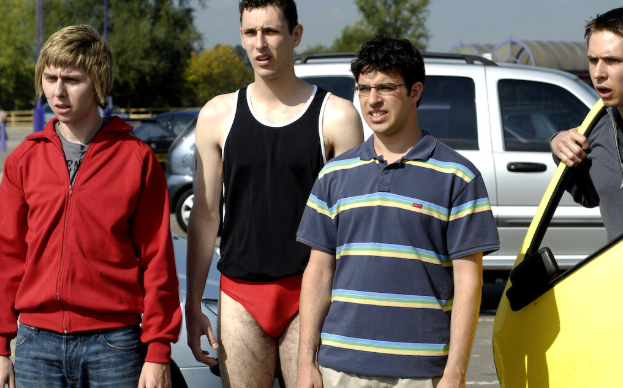
If the show has a fifth main character, it is undoubtedly Simon’s car: the 1996 yellow Fiat Cinquecento Hawaii. The car was chosen specifically for its lack of “cool” factor. Small, underpowered, and painted a shade of yellow that was impossible to miss, it became the mobile stage for some of the series’ funniest moments. Most famously, the car featured a mismatched red door, the result of an “accident” involving a car wash and Jay’s general incompetence.
The car was a nightmare for the actors to film in. The tight quarters meant that the camera crew had to get creative with rigs, and the lack of air conditioning made long filming days in the suburban heat particularly grueling. However, the Fiat served as a perfect metaphor for the boys’ transition into adulthood: it was a symbol of “freedom” that was actually broken, embarrassing, and constantly failing them. The car has since become a piece of television history, frequently appearing at fan events and serving as a warning to teenagers everywhere that any car is better than no car—except, perhaps, a yellow Fiat with a red door.
5. Jay Cartwright: The Art of the Pathological Lie
James Buckley’s portrayal of Jay Cartwright is a masterclass in the “unreliable narrator.” Jay is the character who provides the show with its most outrageous dialogue, constantly spinning tales of his supposed sexual prowess, his “trials” for professional football clubs, and his high-level connections to the “local firm.” The genius of Jay’s character is that neither his friends nor the audience believe a single word he says, yet he continues the charade with unwavering confidence.
This dynamic creates a specific type of comedy where the punchline isn’t just the lie itself, but the pathetic reality that contradicts it. Jay’s behavior is a defense mechanism against his own insecurities and his overbearing father, who is even more of a “lad” than Jay is. Buckley’s performance added a layer of vulnerability to Jay that made him more than just an annoying boaster. Underneath the talk of “clunge” and “Pussay Patrol,” Jay was just as scared and lonely as the rest of them, making his eventual moments of genuine friendship—however rare—feel meaningful.
6. The “Briefcase Wanker” and the Power of the Nickname
The very first episode introduced a term that would follow Simon Bird for the rest of his career: “Briefcase Wanker.” When Will McKenzie arrives at his new state school carrying a briefcase instead of a backpack, he is immediately branded with the moniker. This moment perfectly encapsulates the brutal, simplistic nature of schoolyard bullying. It doesn’t matter that a briefcase is practical or that Will is highly intelligent; the mere fact that he is “different” makes him a target.
The nickname became a cultural phenomenon in the UK, often shouted at Simon Bird by fans in real life. In the context of the show, it established the hierarchy of the school. It showed that Will’s “private school” sensibilities were his biggest liability in the world of Rudge Park Comprehensive. The persistence of the nickname throughout the series serves as a reminder that in the world of The Inbetweeners, you never truly outrun your first impression. It also highlights the show’s linguistic impact, as it popularized a specific style of insulting humor that became synonymous with British teenage culture.
7. Greg Davies and the Terror of Mr. Gilbert
Every great teen comedy needs a formidable authority figure, and The Inbetweeners found theirs in Greg Davies’ Mr. Gilbert. As the Head of Sixth Form, Gilbert was a towering, cynical, and deeply disinterested educator whose only joy seemed to be making Will McKenzie’s life a living hell. Davies, who was a teacher in real life before becoming a comedian, brought an air of terrifying authenticity to the role. His deadpan delivery and sheer physical presence made him the perfect foil for the boys’ antics.
Mr. Gilbert represented the “adult” perspective of the show—one that was entirely over the drama of teenagers. He didn’t have time for their excuses, their “problems,” or their existence. Unlike the “cool teachers” often seen in American media, Gilbert was a man just waiting for his pension, counting down the seconds until he could be rid of the “sh*theads” in his classroom. This dynamic provided a grounding reality to the show; no matter how big the boys’ problems felt to them, to the rest of the world (and Gilbert), they were just a minor, annoying footnote.
8. The Absence of the “Cool Kids”
One of the most brilliant narrative choices in The Inbetweeners was the decision to almost never show the “cool kids” or the “popular crowd” in any significant way. While characters like Carli D’Amato or the school bully Donovan appear, we never get a glimpse into the lives of the truly successful students. The camera remains fixed on the four losers. By keeping the “A-list” of the school as distant, god-like figures, the show intensifies the feeling of isolation that the protagonists experience.
This perspective mimics the actual feeling of being a teenager. When you’re an “Inbetweener,” the popular kids don’t even know you exist. They are like a different species living in the same environment. This choice forced the audience to stay in the trenches with Will and the gang. We are trapped in their small world of failed parties and awkward bus rides, never getting the “payoff” of seeing them finally become cool. They stay exactly where they are—frustrated and on the outside looking in—which is exactly where the comedy thrives.
9. The Geography of Suburban Boredom
The show is set in a fictionalized version of a London suburb, but it was filmed largely in Ruislip and Watford. The choice of location was vital for the show’s aesthetic. It needed to look “boring.” Long rows of semi-detached houses, gray concrete school buildings, and nondescript parks provided the backdrop for the boys’ adventures. This setting is a character in itself; it represents the stagnant, repetitive nature of suburban life that the boys are so desperate to escape.
There is a specific “English-ness” to the geography—the rainy weather, the cramped bedrooms, and the local pubs that they aren’t old enough to be in. This environment creates a sense of claustrophobia that fuels the boys’ desire to do something “legendary,” which almost always results in disaster. By grounding the show in such a recognizable, unglamorous landscape, the creators ensured that the focus remained on the characters’ interactions rather than any external spectacle. It is the comedy of small spaces and limited horizons.
10. The Legacy of “The Cringe”
The Inbetweeners is often cited as a pioneer of the “Cringe Comedy” genre in the UK. Unlike traditional sitcoms where characters might trade witty barbs, much of the humor here comes from the audience’s physical reaction to the characters’ social failures. Whether it’s Simon accidentally exposing himself at a fashion show or Will’s “sophisticated” dinner party turning into a drunken mess, the show asks the audience to look away while they laugh.
This legacy of cringe has influenced countless comedies that followed. It proved that audiences were willing to root for characters who were objectively unlikeable, arrogant, or just plain stupid, as long as their failures felt earned. The show’s ending—which saw the boys finish school and head into an uncertain future—remained true to its core. They didn’t get the girls, they didn’t become popular, and they didn’t really change. They just stayed together, four “friends!” united by their shared history of humiliation. That is the ultimate, landing truth of the series: friendship isn’t about being cool; it’s about having people who were there when you were at your absolute worst.
Further Reading
- The Inbetweeners: The Scripts (Season 1) – Damon Beesley and Iain Morris. A great look at the precision of the dialogue and the timing of the jokes.
- The Inbetweeners: The Complete Book of Deeds – A fun, in-universe guide to the boys’ “achievements” and various humiliations.
- How to Be a Middle-Aged Man – Greg Davies. While not strictly about the show, it captures the voice of the man behind Mr. Gilbert and his comedic philosophy.
- British Sitcoms: From Three Up, Two On to The Office – Various Authors. A broader look at the history of UK comedy that places The Inbetweeners in its historical context.
- Briefcase Wankers and Bus Wankers: 10 Unforgettable Facts Behind the Making of The Inbetweeners

- THE MANDALORIAN – Full Story Recap – Season 1

- Euphoria – Full Story Recap – Season 1

- The Boys – Full Story Recap – Season 1

- The Diabolical Truth: 10 Shocking Secrets Behind The Boys and How They Broke the Superhero Genre