
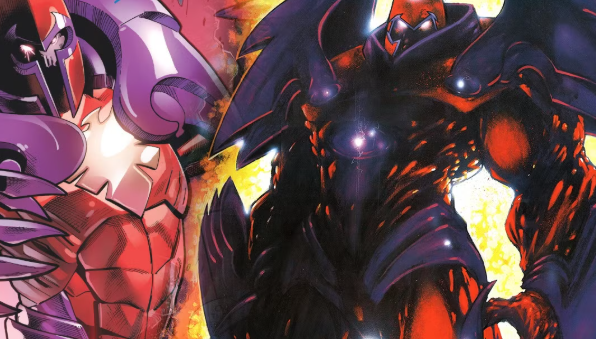
In the mid-1990s, the Marvel Universe faced a threat so immense that it didn’t just challenge the X-Men—it threatened to erase the very concept of heroes from existence. This entity was not an alien god or a time-traveling conqueror; it was a ghost born from the shadows of two of Earth’s most powerful minds. Onslaught remains one of the most controversial and devastating villains in comic book history, serving as the catalyst for an era that fundamentally reshaped the Marvel landscape.
To understand Onslaught is to understand the darkest corners of the human (and mutant) psyche. He is a cautionary tale about what happens when the lines between hero and villain blur into a singular, unstoppable force of destruction. He represents the ultimate “what if” scenario: What if the dream of Charles Xavier and the rage of Magneto were forged into one consciousness? The result was a god-like being that required the combined sacrifice of the Avengers, the Fantastic Four, and the X-Men just to contain. This article explores the intricate history, terrifying power, and lasting legacy of the psionic monster known as Onslaught.
1. A Dark Genesis: The Unholy Fusion of Xavier and Magneto
The origin of Onslaught is a masterclass in psychological horror within the superhero genre. He was not born in a lab or a distant galaxy, but in a moment of absolute moral compromise. During a brutal confrontation between the X-Men and Magneto, the Master of Magnetism committed an act of unspeakable cruelty by ripping the adamantium from Wolverine’s skeleton. Pushed past his breaking point, Professor Charles Xavier did the unthinkable: he used his telepathic powers to “shut down” Magneto’s mind, leaving his old friend in a catatonic state.
However, this psychic intrusion came with a hidden price. During the mental contact, the darkest aspects of Magneto’s psyche—his grief, his lust for vengeance, and his deep-seated cynicism—leaked into Xavier’s own subconscious. There, it merged with Xavier’s long-suppressed frustrations and the “secret” anger he had harbored for decades. This fusion of two diametrically opposed ideologies gave birth to a separate, sentient persona. For a long time, Onslaught remained a dormant shadow within Xavier, a ticking time bomb waiting for the right moment to seize control and manifest in the physical world.
2. The Trigger: A World Falling Apart
While the seeds of Onslaught were planted during the “Fatal Attractions” storyline, he didn’t emerge immediately. Instead, he grew stronger as he fed on the ambient negativity of the world. He was nurtured by the rising tide of anti-mutant sentiment and the various tragedies that befell the X-Men. Every time Xavier felt a flicker of doubt or a surge of rage, Onslaught gained a foothold. He began as a whisper in the back of the Professor’s mind, occasionally influencing his decisions or causing uncharacteristic lapses in judgment.
The entity eventually gained enough strength to project itself as a separate entity, first appearing as a mysterious, armored figure that could effortlessly defeat powerhouses like the Juggernaut. It was a terrifying realization for the X-Men: their greatest enemy was actually their greatest teacher. Onslaught represented the total failure of Xavier’s dream of peaceful coexistence. He was the manifestation of the idea that peace was a lie and that only through absolute, iron-fisted control could the world be “saved.” This psychological weight made the battle against him deeply personal for every member of the X-Men.
3. God-Like Power: A Psionic Juggernaut
Onslaught’s power levels are almost impossible to quantify, as he possessed the combined abilities of the world’s most powerful telepath and the world’s most powerful master of magnetism. This meant he could rewrite the memories of entire populations while simultaneously shifting the Earth’s magnetic poles. However, his abilities went far beyond simple telepathy and magnetism. As a psionic entity, he could manipulate the very fabric of reality and perceive the world in ways that standard mutants could not.
He was capable of creating “psi-armor” that was virtually indestructible, surviving direct hits from Thor’s hammer and the Hulk’s strongest blows. More terrifying was his ability to absorb other powerful beings to augment his own strength. By incorporating the powers of others, he evolved from a mere psychic “ghost” into a physical deity. He could project energy blasts capable of leveling cities and possessed a “danger sense” so acute that he was virtually impossible to surprise. In many ways, Onslaught was the ultimate combatant, possessing the tactical genius of Xavier, the raw power of Magneto, and the lack of restraint found in the most bloodthirsty villains.
4. The Kidnapping of Franklin Richards
To achieve his final form and complete his plan for world domination, Onslaught knew he needed more than just psychic and magnetic power; he needed the power to reshape reality itself. This led him to target Franklin Richards, the young son of Reed and Sue Richards of the Fantastic Four. Franklin is an Omega-level mutant with the ability to create entire universes, and Onslaught viewed the child as the final “key” to his ascension.
By kidnapping Franklin and absorbing him into his mass, Onslaught gained near-omnipotence. He began to transform Manhattan into a twisted reflection of his own will, creating a massive citadel in Central Park that served as the epicenter of his new world order. The stakes were no longer just about mutant rights or the safety of the X-Men; the entire universe was at risk of being unmade and rewritten by a being with the ego of Magneto and the divine mission of a corrupted Xavier. This move forced the Fantastic Four and the Avengers into a war they were fundamentally unprepared for.
5. Incorporating the Ultimate Mutant: Nate Grey
While Franklin Richards provided the reality-warping potential, Onslaught also sought out Nate Grey, the “X-Man” from the Age of Apocalypse. Nate was a being of pure psionic energy, a version of Cable who was never infected by the techno-organic virus and thus possessed limitless psychic potential. Onslaught realized that by combining Nate’s raw energy with Franklin’s reality manipulation, he would become a truly unstoppable, transcendent being.
The capture of Nate Grey allowed Onslaught to shed his physical “shell” and become a creature of pure energy. This made him even harder to fight, as he no longer had a physical body that could be targeted by conventional means. This stage of his evolution represented the total loss of the “human” element of Xavier and Magneto. He was no longer a man with a grudge; he was a natural disaster with a consciousness. The hunt for Nate Grey showed just how calculated and strategic Onslaught was, as he systematically removed every piece of resistance that could possibly stand against him.
6. The Siege of Manhattan and the Citadel
The climax of the Onslaught saga saw New York City transformed into a war zone. Onslaught used his magnetic and psionic powers to create a “Sentinel” army that he programmed to hunt down any who opposed him. He erected a massive, impenetrable dome over the city, trapping the world’s heroes inside with him. This wasn’t just a battle; it was a siege. The visual of the dark, jagged citadel rising out of Central Park remains one of the most iconic images of 90s comic history.
During this time, the heroes were forced into desperate, small-scale guerrilla warfare against a god. The Avengers, the X-Men, and the Fantastic Four had to put aside decades of tension and ideological differences to form a united front. Onslaught’s presence in the city also served a psychological purpose: he wanted the citizens to see their “protectors” failing. By humiliating the heroes on a global stage, he aimed to break the spirit of humanity, proving that their faith in caped icons was misplaced and that only he could provide true order.
7. The Ultimate Sacrifice: The Death of the Avengers and FF
The final battle against Onslaught is legendary for its high cost. As the heroes realized that Onslaught was a being of pure energy, they discovered a horrifying truth: to dissipate that energy, they would have to provide a “container” for it. This container needed to be non-mutant in nature, as adding mutant DNA to Onslaught would only make him stronger. In an act of unparalleled heroism, the members of the Avengers and the Fantastic Four—including icons like Captain America, Iron Man, and Thor—leaped into Onslaught’s energy field.
By using their own life forces to “soak up” the psionic energy, they were able to ground the entity, allowing the X-Men to deliver the final blow. To the world at large, it appeared that the greatest heroes of the Marvel Universe had been killed in an instant. This event left the X-Men as the sole survivors and protectors of a world that now hated and feared them more than ever, as they were the only ones left standing after the “deaths” of the beloved Avengers and Fantastic Four. This sacrifice remains a defining moment in the history of these teams.
8. The “Heroes Reborn” Connection
The fallout of the battle with Onslaught led to one of the most experimental periods in Marvel history. While it appeared the heroes had died, it was later revealed that Franklin Richards had subconsciously used his powers to save them. In the moment of the explosion, Franklin created a pocket universe and transported the Avengers and Fantastic Four there to protect them. This led to the “Heroes Reborn” era, where these characters lived out new lives with modernized origins.
This narrative bridge allowed Marvel to reboot some of its most famous titles while keeping them within the broader continuity. Eventually, the heroes regained their memories and returned to the main Marvel Universe, but the psychic scars of the Onslaught event remained. This connection between Onslaught and the creation of a literal alternate reality highlights the scale of his power. He didn’t just break the heroes; he forced the creation of a whole new world just to ensure their survival.
9. The Evolution of Forms: From Armor to Energy
Onslaught is unique among villains because his physical appearance changed to reflect his internal state. In his initial appearances, he wore a massive, bulky suit of armor that heavily resembled Magneto’s iconic helmet and color scheme, but on a much larger, more monstrous scale. This “Form 1” represented the period when he was still tethered to the physical world and the psyches of Xavier and Magneto. He was a brute, using physical strength and magnetic force to crush his enemies.
As he absorbed Franklin Richards and Nate Grey, he evolved into “Form 2.” His armor became more organic and jagged, and he grew to a height that towered over skyscrapers. Finally, after his physical shell was destroyed, he became “Form 3″—a being of pure, intangible psionic fire. This evolution mirrors the stages of a virus or a biological process, showing how he moved from a “thought” to a “person” to a “force of nature.” Each form required a different tactical approach from the heroes, making the conflict feel like an escalating nightmare that they were constantly losing.
10. The Legacy of Fear and Recurring Threat
Though he was defeated, Onslaught is never truly gone. Because he is a psionic entity born of fundamental human emotions, he has a habit of “respawning” whenever the conditions are right. He has returned in various forms over the years, sometimes as a lingering psychic ghost or as a reformed entity seeking a new host. His legacy is one of constant vigilance; he is the “Boogeyman” of the X-Men, a reminder that their greatest threat isn’t an outside force, but the darkness within their own leadership.
The memory of Onslaught also fundamentally changed how the world viewed Professor Xavier. The revelation that the world’s most prominent advocate for peace was secretly carrying a genocidal monster in his head shattered the public’s trust. It added a layer of complexity to Xavier’s character that persists to this day—the idea that he is a “good man” who is capable of great, world-ending evil. Onslaught remains a benchmark for power levels in the Marvel Universe, a yardstick against which all other “Omega-level” threats are measured.
Further Reading
- X-Men: The Complete Onslaught Epic (Volumes 1-4) by Various Authors
- X-Men: Fatal Attractions by Scott Lobdell, Fabian Nicieza, and various artists
- Onslaught Reborn by Jeph Loeb and Rob Liefeld
- Heroes Reborn: The Return by Peter David and Salvador Larroca
- 10 Things You Should Know About Cable – Marvel Comics

- X-Men ’97 – Full Story Recap – Season 1

- X-Men: The Animated Series 1992 – Full Story Recap – Season 5

- X-Men: The Animated Series 1995 – Full Story Recap – Season 4

- X-Men: The Animated Series 1994 – Full Story Recap – Season 3




