
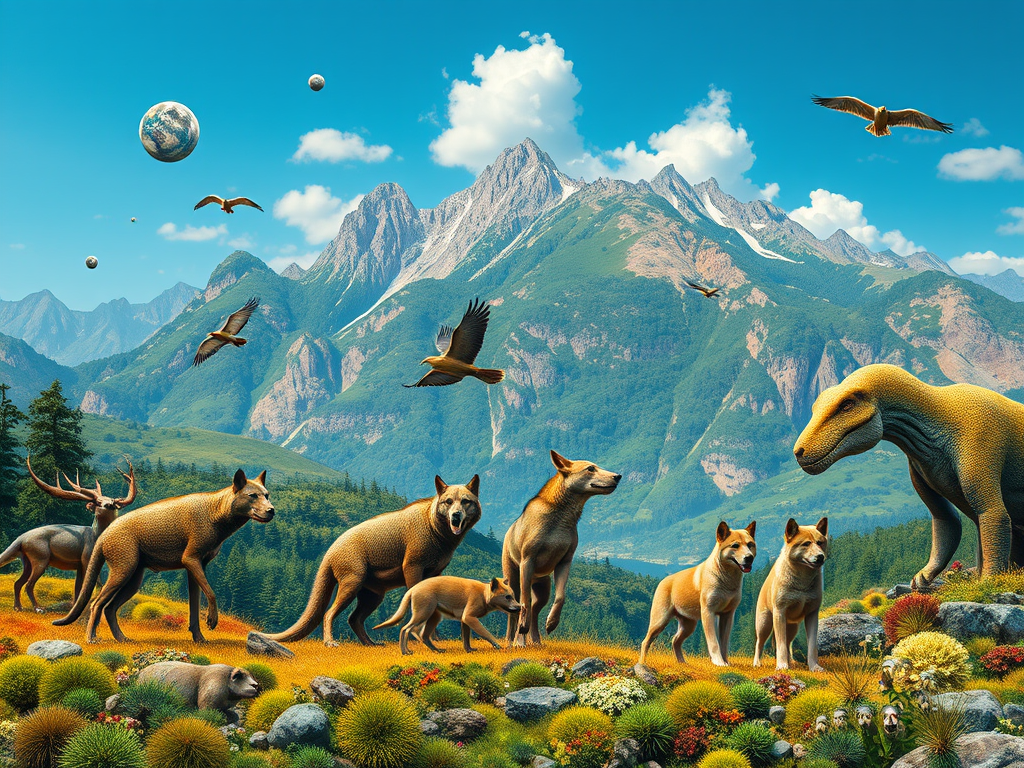
Have you ever looked at a puppy and a wolf and wondered how they’re related? Or seen pictures of ancient dinosaurs and thought about how different they are from animals today? These kinds of questions are all part of a huge and fascinating idea in science called evolution. Simply put, evolution is the process by which all living things change and develop over incredibly long periods of time.
It’s not something that happens to an individual during their lifetime. Instead, it happens to groups of living things, or populations, over many, many generations. Think of it like a giant, sprawling family tree that connects every living thing on Earth, from the smallest bacterium to the largest whale, all the way back to the very first life forms that existed billions of years ago. Understanding what is evolution simple explanation helps us make sense of the amazing variety of life we see around us. It’s a fundamental idea in biology, explaining how life changes over time.
While the whole process can seem complicated, we can break it down into a few key ideas. Here are 10 simple points to help you understand the basics of how life evolves:
1. The Big Idea: Change Over Time is Natural
At its heart, evolution is about change. It’s the understanding that the forms of life on Earth haven’t always been the way they are today. Instead, over millions and billions of years, different types of plants, animals, fungi, and microbes have appeared, changed, and sometimes disappeared (gone extinct).
Think about old photographs of your family. You can see how people looked different in the past compared to today. Now, stretch that idea across vast amounts of time, like the entire history of Earth! Early life forms were very simple. Over countless generations, tiny changes added up, leading to more complex and varied organisms. This fundamental idea that how life changes over time is a natural process driven by simple rules is the starting point for understanding evolution. It’s like a slow-motion movie of life on Earth.
2. Inheritance: Like Passing Down a Recipe
Why do you have some features like your parents or grandparents? Because you inherited traits from them! In the same way, all living things inherit information from their parents that influences what they look like and how they function. This information is like a set of instructions or a recipe book, and it’s stored in something called DNA.
When organisms reproduce, they pass on copies of their DNA to their offspring. This inheritance is crucial for evolution because it means that traits can be passed down through generations. If a parent has a trait that helps them survive, their offspring might inherit that trait too, increasing their chances of survival and reproduction. This passing of traits from one generation to the next is the basic mechanism that allows life to change over time.
3. Variation: Why No Two Are Exactly Alike
Look around at people, animals, or plants of the same kind – they’re not all identical! There’s natural variation within any group of living things. Think about a litter of puppies from the same parents; they’ll all look a little different. This variation comes from small differences in the inherited DNA.
Sometimes, new variations pop up randomly due to tiny changes in DNA called mutations. These mutations can be helpful, harmful, or have no effect at all. Having lots of variation in a population is like having a diverse toolbox. When the environment changes, some individuals might have a variation (a different “tool”) that helps them survive better than others. This natural difference among individuals is the raw material that evolution works with.
4. The Struggle for Survival: Life’s Challenges
The world is a challenging place. Living things need food, water, shelter, and need to avoid being eaten. There’s often competition for these resources. More offspring are usually born than can possibly survive to adulthood and reproduce themselves.
Think about a forest with many young trees growing. Only some will get enough sunlight, water, and nutrients to grow tall and strong. The others might not make it. This struggle for survival means that not every individual in a population will live long enough to pass on their genes. This sets the stage for the next key idea: which individuals are more likely to survive and reproduce depends on their traits.
5. Natural Selection: Nature Picks the Survivors
This is one of the most important parts of evolution explained for kids. Because there’s variation and a struggle for survival, nature effectively “selects” which individuals are most likely to survive and reproduce in a particular environment. If an individual has a trait that gives them an advantage – maybe they can run faster to escape predators, or their camouflage helps them hide, or they can digest a certain type of food better – they are more likely to live long enough to have offspring.
These successful individuals pass on their advantageous traits to their children. Over many generations, these helpful traits become more common in the population, while less helpful traits become less common. This process, called natural selection simplified, is like nature constantly trying out different variations and keeping the ones that work best in that environment. It’s often called “survival of the fittest,” but “fittest” means best able to survive and reproduce in their specific surroundings.
6. Adaptation: Becoming Suited to the Home
When natural selection favors certain traits over time, those traits become more common in a population. If a trait helps an organism survive and reproduce better in its environment, we call it an adaptation. These are the special features that make living things well-suited to where they live and what they do.
Think of a polar bear’s thick fur for cold climates, or a giraffe’s long neck for reaching high leaves, or a fish’s gills for breathing underwater. These are all examples of adaptation in biology explained simply. Adaptations aren’t things organisms try to get; they arise from random variations, and natural selection then favors the individuals who happen to have the variations that are helpful in their environment. Over generations, these helpful adaptations become widespread in the population.
7. Speciation: Branching Off into New Kinds of Life
Over vast amounts of time, as populations adapt to different environments, they can become so different from their original group that they can no longer reproduce with them. When this happens, a new species has formed. This process is called speciation.
Imagine a group of animals gets separated – maybe by a new river or a mountain range. Over many generations, the groups in each different place face slightly different challenges and opportunities. Natural selection might favor different traits in each location. Eventually, the two groups might change so much in their looks, behavior, or genetics that they can no longer breed with each other. This is a simple definition of speciation simple definition: the splitting of one species into two or more new ones, like a branch on the tree of life dividing.
8. Fossils: Clues from the Past
How do we know that life has changed over time? One of the most compelling pieces of evidence of evolution easy to see comes from fossils. Fossils are the preserved remains or traces of ancient organisms, often found in layers of rock.
Imagine digging through layers of sediment like turning pages in Earth’s history book. The deeper you dig, the older the fossils you find. Scientists study fossils to see what ancient life looked like and how it compares to life today. The fossil record shows a progression from simpler life forms in older rocks to more complex ones in newer rocks. We can see transitional fossils that show features of both older and newer groups, providing clear links and showing how different groups of organisms are related and how life changes over time.
9. DNA: The Molecular Blueprint
Another powerful line of evidence for evolution comes from studying DNA, the genetic material in all living things. Remember that DNA contains the instructions for building and operating an organism. By comparing the DNA sequences of different species, scientists can see how similar or different they are at a fundamental level.
Think of DNA like a language. Closely related species, like humans and chimpanzees, have very similar DNA sequences, like two dialects of the same language. More distantly related species have more differences in their DNA, like comparing English to a language like French or even Chinese. The more similar the DNA, the more recently they shared a common ancestor. Studying DNA provides strong support for the idea of common ancestry and shows the genetic changes that have occurred during evolution. It’s like finding the underlying code that connects all life.
10. Common Ancestry: One Big Family Tree
Putting all the evidence together – from fossils to DNA to comparing the anatomy of different species – leads to one of the most profound ideas in evolution: common ancestry. This theory suggests that all life on Earth is related and shares a common ancestor if you go back far enough in time.
Think of your own family tree, tracing back parents, grandparents, great-grandparents, and so on. Now, imagine a tree that goes back billions of years and includes every living thing that has ever existed. All the different species we see today, and all the ones that are extinct, are like different branches and leaves on that single, giant tree. The idea of common ancestry explained easy analogy is that just like you and your cousins share grandparents, humans and apes share a more distant common ancestor, and all mammals share an even more distant one, and all animals share one, and so on, all the way back to the origin of life.
Evolution is a powerful and well-supported scientific theory that explains the incredible diversity of life on Earth. It’s not just an old idea from Charles Darwin; it’s a field of science that is constantly being added to and refined with new discoveries, especially from genetics. Understanding evolution helps us study everything from how diseases spread to how to protect endangered species. It shows us that life is dynamic, interconnected, and has an astonishing history of change and adaptation.
Further Reading
Here are a few books that can help you explore evolution further in an accessible way:
- Charles Darwin’s On the Origin of Species: Abridged Reader’s Edition (Many simplified or abridged versions exist for younger readers)
- Evolution: How We Got to Where We Are by Daniel Loxton
- Your Inner Fish: A Journey into the 3.5-Billion-Year History of the Human Body by Neil Shubin (There is also a young adult version)
Here at Zentara.blog, our mission is to take those tricky subjects and unlock them, making knowledge exciting and easy to grasp for everyone. But the adventure doesn’t stop on this page! We’re constantly exploring new frontiers and sharing discoveries across the digital universe.
Want to dive deeper into more mind-bending Top 10s and keep expanding your world? Come join us on our other platforms – we’ve got unique experiences waiting for you on each one!
- Get inspired by visual wonders and bite-sized facts: See the world through Zentara’s eyes on Pinterest! Pin our fascinating facts and stunning visuals to your own boards. Explore Pins on Pinterest: https://uk.pinterest.com/zentarablog/
- Discover quick insights and behind-the-scenes peeks: Hop over to Tumblr for snippets, quotes, and unique content you won’t find anywhere else. It’s a different flavour of discovery! Follow the Fun on Tumblr: https://www.tumblr.com/zentarablog
- Ready for deep dives you can listen to or watch? We’re bringing our accessible approach to video and potentially audio! Subscribe to our YouTube channel and tune into future projects that make learning pop! Subscribe on YouTube: https://www.youtube.com/@ZentaraUK
- Seeking even more knowledge in one place? We’ve compiled some of our most popular topic deep dives into fantastic ebooks! Find them on Amazon and keep the learning journey going anytime, anywhere. Find Our Ebooks on Amazon: https://www.amazon.co.uk/s?k=Zentara+UK&ref=nb_sb_noss
- Connect with us and fellow knowledge seekers: Join the conversation on BlueSky! We’re sharing updates, thoughts, and maybe even asking you what wonders we should explore next. Chat with Us on BlueSky: https://bsky.app/profile/zentarablog.bsky.social
- Perfect for learning on the move! We post multiple 10-minute podcasts per day on Spotify. Pop on your headphones and fill your day with fascinating facts while you’re out and about! Listen on Spotify: https://open.spotify.com/show/3dmHbKeDufRx95xPYIqKhJ
Every click helps us keep bringing honest, accessible knowledge to everyone. Thanks for exploring with us today – see you out there in the world of discovery!




Leave a Reply