
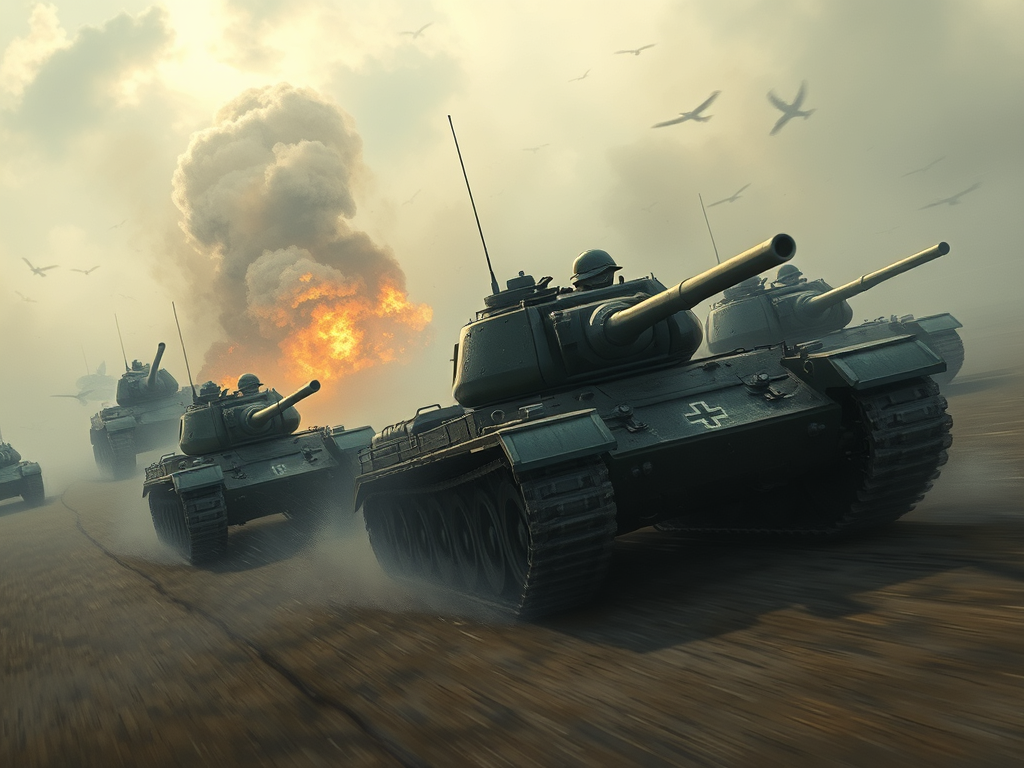
Imagine a boxing match where one boxer doesn’t just try to punch the other, but instead, throws a super-fast combination of punches that lands before their opponent even knows what’s happening. That’s a bit like Blitzkrieg, a German word meaning “lightning war.” It wasn’t just about fighting hard; it was about fighting smart, fast, and with a huge surprise!
In the early days of World War II, the German army seemed unstoppable, sweeping across Europe with astonishing speed. This wasn’t just luck. It was thanks to a revolutionary new way of fighting called Blitzkrieg. Instead of slow, drawn-out battles like in World War I, where soldiers dug into trenches for years, Blitzkrieg aimed for quick, decisive victories. It was a military tactic designed to shock, confuse, and overwhelm the enemy before they could even properly react. Think of it like a perfectly coordinated team playing a game: everyone knows their role, they move together, and they strike at the weakest point with incredible force.
This isn’t about celebrating war, but understanding a powerful piece of history and military strategy. It teaches us about how technology, teamwork, and clever planning can change everything, not just in battles, but in many areas of life. So, let’s dive into the “science” behind this sudden war and discover the ten key ingredients that made Blitzkrieg so effective.
1. Speed is Key: The “Lightning” in Lightning War
At the heart of Blitzkrieg was its incredible speed. Imagine trying to catch a speedy rabbit – the faster it moves, the harder it is to trap. That’s exactly what the German military aimed for. Unlike previous wars where armies moved at the pace of walking soldiers or horses, Blitzkrieg relied on tanks and motorized vehicles. These weren’t just for carrying supplies; they were for carrying fighting troops, artillery, and everything needed to keep moving forward.
Think of a football team making a fast break. They don’t stop to celebrate every small gain; they keep pushing for the touchdown. German forces would punch through enemy lines, not stopping to “tidy up” every small resistance, but instead, racing deep into enemy territory. This rapid movement caused huge confusion for the defenders, who couldn’t figure out where the main attack was coming from or where to send their reinforcements. It was like a sudden, overwhelming flood that left the enemy scrambling to build dams in all the wrong places. This speed was revolutionary and caught many armies completely off guard.
2. Surprise Attack: The Element of Shock
Imagine playing hide-and-seek, and suddenly, the person seeking jumps out from a totally unexpected spot. That’s the power of surprise in Blitzkrieg. It wasn’t just about moving fast; it was about attacking when and where the enemy least expected it. This often meant using clever tricks, like attacking through areas considered too difficult or dangerous for a large army, such as dense forests or mountain ranges.
The goal was to create immediate shock and panic. When an army is surprised, its leaders struggle to make decisions, and their soldiers become disorganized. It’s like a sudden blackout in a busy city – everything grinds to a halt as people try to figure out what’s going on. This element of surprise was crucial for breaking through enemy defenses quickly and preventing them from setting up new ones. It also involved using propaganda and misinformation before an attack, further confusing the enemy and lowering their morale, making them even more vulnerable to the sudden strike.
3. Concentrated Force: The Power of the Spearhead
Instead of spreading their forces out along a long front, Blitzkrieg focused a huge amount of power into a very narrow attack. Imagine trying to break a tough nut. You wouldn’t hit it gently with a hammer everywhere; you’d focus all your force onto one tiny point to crack it open. That’s what “concentrated force” means. The Germans would gather a massive number of tanks, artillery, and motorized infantry in one spot.
This powerful “spearhead” would then smash through the weakest part of the enemy’s defenses. Once a hole was made, it wasn’t just a small crack; it was a wide-open gap. This strategy was designed to overwhelm the enemy at the point of attack, making it impossible for them to hold their ground. It was like a giant battering ram hitting a castle gate again and again in the same spot until it splinters and falls.
4. Combined Arms: Working Together Like a Team
Blitzkrieg wasn’t just about tanks. It was about different parts of the military working together like a perfectly synchronized orchestra. This is known as “combined arms.” Tanks, infantry (foot soldiers), artillery (big guns), and aircraft all played their part, supporting each other to achieve the main goal.
Think of a school play where the actors, the lighting crew, the sound engineers, and the costume designers all work together. If one part is missing or doesn’t do its job, the play won’t be a success. In Blitzkrieg, dive-bombers (planes that fly down quickly to bomb targets) would soften up enemy positions and attack supply lines. Tanks would then spearhead the attack, followed by motorized infantry who would clear out any remaining resistance and secure the area. Artillery would provide covering fire. This teamwork meant that each branch of the military made the others stronger, creating a much more powerful and effective force.
5. Air Power’s Role: Wings of Destruction
The German air force, known as the Luftwaffe, was a vital part of Blitzkrieg. It wasn’t just used for bombing cities far away. Instead, it acted like a flying artillery unit, working closely with the ground troops. Imagine having a giant slingshot that could hit targets from above with pinpoint accuracy. That’s what the Luftwaffe did.
Dive-bombers like the Stuka would scream down from the sky, dropping bombs on enemy strongpoints, artillery positions, and lines of communication. This created even more chaos and destruction, making it harder for the enemy to resist the advancing ground forces. The planes also provided vital information to the ground commanders, spotting enemy movements and helping them plan their next moves. This close air support was a huge advantage, allowing the German army to break through defenses that would have been much tougher otherwise.
6. Radio Communication: Staying Connected on the Go
Imagine trying to play a team sport where no one can talk to each other. It would be a mess! In Blitzkrieg, communication was incredibly important. Tanks were equipped with radios, allowing commanders to talk to each other and to the air force in real-time. This might seem simple now, but it was revolutionary at the time.
Before radios, orders often had to be delivered by messengers, which was slow and unreliable. With radios, commanders could react quickly to changes on the battlefield, redirecting forces, or calling for air support immediately. This constant communication was like having a giant “walkie-talkie network” that kept everyone on the same page, even as they were moving at high speed. It allowed for incredible coordination and flexibility, making the Blitzkrieg a truly dynamic and adaptable fighting style.
7. Bypassing Strongpoints: The Art of the End Run
A key idea in Blitzkrieg was not to get bogged down fighting every single enemy position. Imagine a river with a big, strong dam. Instead of trying to break through the dam, Blitzkrieg would try to find a way around it, letting the water flow freely past. Similarly, German forces would often bypass heavily fortified enemy positions, leaving them isolated and cut off.
The goal was to keep the momentum going, driving deep into the enemy’s rear areas where their command centers, supply depots, and communication hubs were located. By cutting off these vital arteries, the bypassed strongpoints would eventually run out of supplies and be forced to surrender. It was a clever way to avoid costly frontal assaults and keep the “lightning” strike moving forward without interruption.
8. Encirclement: Trapping the Enemy
Once the fast-moving German forces had punched through the enemy lines and raced deep into their territory, they would often perform a “pincer movement.” Imagine two arms of a giant crab slowly closing in on its prey. That’s what a pincer movement looks like on a map. Two armored columns would advance, aiming to meet behind the main enemy forces.
This would create a “cauldron” or “pocket,” trapping large numbers of enemy soldiers. Once encircled, these trapped forces would be cut off from supplies, reinforcements, and escape routes. They would eventually be forced to surrender or be destroyed. This tactic was incredibly effective at capturing large numbers of enemy troops and equipment with relatively few German losses, making the victories even more overwhelming.
9. Disruption and Disorganization: Chaos is a Weapon
Beyond the physical destruction, Blitzkrieg aimed to create massive disruption and disorganization within the enemy’s ranks. Imagine a giant puzzle being shaken up so all the pieces fly apart and can’t be put back together. That’s what the suddenness, speed, and coordinated attacks of Blitzkrieg did to enemy command and control.
By attacking vital communication centers, headquarters, and supply lines, the Germans prevented enemy commanders from understanding what was happening, giving orders, or sending help. This meant that even if individual units were still fighting, they were fighting without direction or support, like a body whose brain has stopped working. This psychological shock and disorganization often led to a rapid collapse of enemy resistance, far more quickly than if the Germans had tried to defeat every single soldier in a frontal battle.
10. Focus on Logistics: Keeping the Engines Running
Even the fastest car needs fuel and maintenance to keep going. The same was true for Blitzkrieg. Moving so many tanks and motorized vehicles at high speed required a constant flow of fuel, ammunition, and spare parts. This often overlooked aspect of military strategy is called “logistics.”
The German military put a lot of effort into ensuring their supply lines kept up with the rapid advances. They used motorized transport units to carry supplies forward, and engineers would quickly repair roads and bridges to keep the flow moving. Without this efficient logistical support, the fast-moving attacks would have quickly ground to a halt. It was the unsung hero of Blitzkrieg, making sure the “lightning” didn’t run out of electricity.
Blitzkrieg was a game-changer in military history, demonstrating how a combination of new technology, innovative thinking, and precise coordination could lead to incredibly swift and decisive victories. It fundamentally changed the way wars were fought, emphasizing speed, surprise, and the overwhelming concentration of force.
Further Reading
- “Blitzkrieg: The German Way of War” by Karl-Heinz Frieser
- “Panzer Leader” by Heinz Guderian
- “World War II for Kids: A History with 21 Activities” by Richard Panchyk
- “Eyewitness Books: World War II” by Simon Adams
Here at Zentara.blog, our mission is to take those tricky subjects and unlock them, making knowledge exciting and easy to grasp for everyone. But the adventure doesn’t stop on this page! We’re constantly exploring new frontiers and sharing discoveries across the digital universe.
Want to dive deeper into more mind-bending Top 10s and keep expanding your world? Come join us on our other platforms – we’ve got unique experiences waiting for you on each one!
- Get inspired by visual wonders and bite-sized facts: See the world through Zentara’s eyes on Pinterest! Pin our fascinating facts and stunning visuals to your own boards. Explore Pins on Pinterest: https://uk.pinterest.com/zentarablog/
- Discover quick insights and behind-the-scenes peeks: Hop over to Tumblr for snippets, quotes, and unique content you won’t find anywhere else. It’s a different flavour of discovery! Follow the Fun on Tumblr: https://www.tumblr.com/zentarablog
- Ready for deep dives you can listen to or watch? We’re bringing our accessible approach to video and potentially audio! Subscribe to our YouTube channel and tune into future projects that make learning pop! Subscribe on YouTube: https://www.youtube.com/@ZentaraUK
- Seeking even more knowledge in one place? We’ve compiled some of our most popular topic deep dives into fantastic ebooks! Find them on Amazon and keep the learning journey going anytime, anywhere. Find Our Ebooks on Amazon: https://www.amazon.co.uk/s?k=Zentara+UK&ref=nb_sb_noss
- Connect with us and fellow knowledge seekers: Join the conversation on BlueSky! We’re sharing updates, thoughts, and maybe even asking you what wonders we should explore next. Chat with Us on BlueSky: https://bsky.app/profile/zentarablog.bsky.social
- Perfect for learning on the move! We post multiple 10-minute podcasts per day on Spotify. Pop on your headphones and fill your day with fascinating facts while you’re out and about! Listen on Spotify: https://open.spotify.com/show/3dmHbKeDufRx95xPYIqKhJ
- Follow us on Instagram for bytesize knowledge! We post multiple posts per day on our official Instagram account.
https://www.instagram.com/zentarablog/
Every click helps us keep bringing honest, accessible knowledge to everyone. Thanks for exploring with us today – see you out there in the world of discovery!




Leave a Reply