
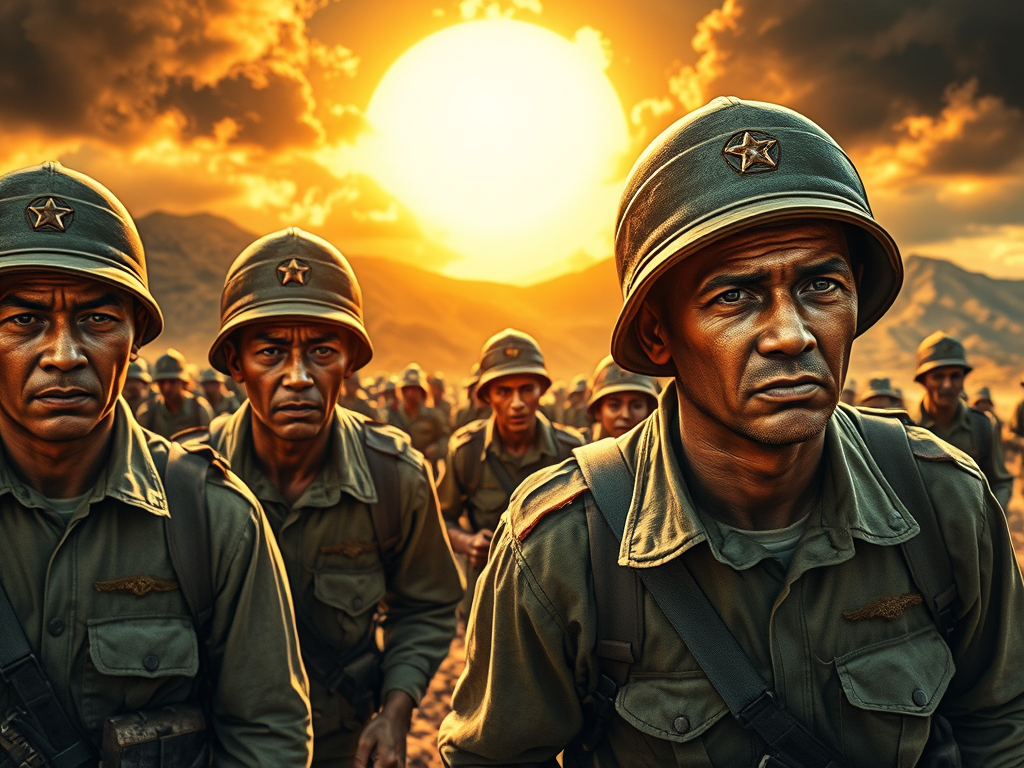
Imagine being a soldier, fighting bravely for months, enduring hunger, disease, and constant danger. Then, imagine being forced to surrender, only to be ordered to march for days and days under a scorching sun, with no food or water, and being beaten or killed if you fell or even asked for a drink. This horrific event was the Bataan Death March, one of the most terrible atrocities of World War II.
In April 1942, after months of fierce fighting against the invading Japanese forces in the Philippines, tens of thousands of American and Filipino soldiers on the Bataan Peninsula were forced to surrender. They were exhausted, sick, and starving, but their ordeal was just beginning. The Japanese Imperial Army, which viewed surrender as a dishonorable act, subjected these prisoners of war (POWs) to an unimaginable ordeal: a forced march of approximately 60 to 65 miles (about 97-105 kilometers) to prison camps. This was not just a march; it was a brutal test of survival where inhumanity reigned.
The Bataan Death March stands as a stark reminder of the horrors of war and the depths of cruelty that can occur. Yet, it also highlights the incredible resilience of the human spirit, as many endured against unimaginable odds. The stories of those who survived, both American and Filipino, are a powerful testament to their courage and a crucial lesson for future generations. Let’s delve into ten key aspects of this horrifying event and the voices of those who endured it.
1. The Fall of Bataan: Months of Desperate Defense
Before the Death March, there was the Battle of Bataan. For over three months, from December 1941 to April 1942, a combined force of American and Filipino soldiers, under the command of General Douglas MacArthur (who later left the Philippines), fiercely defended the Bataan Peninsula against a much larger and better-supplied Japanese army.
Imagine a small, hungry group of defenders, cut off from reinforcements, holding out against a powerful invading force. These soldiers fought valiantly, despite dwindling supplies of food, medicine, and ammunition. They suffered from malaria, dysentery, and severe malnutrition, often surviving on meager rations or whatever they could find in the jungle. Their heroic defense of Bataan, against overwhelming odds, delayed the Japanese advance and bought crucial time for the Allies in other parts of the Pacific. However, their eventual surrender on April 9, 1942, marked the beginning of an even greater nightmare.
2. The Surrender: A “Dishonorable” Act in Japanese Eyes
In the Bushido code, the traditional warrior code of Japan, surrender was considered the ultimate shame. Japanese soldiers were taught to fight to the death rather than be captured. This belief led to a severe and inhumane treatment of prisoners of war by many Japanese forces, who saw surrendering soldiers as having no honor or worth.
Imagine a culture where giving up is seen as the worst possible thing. When the exhausted and starving American and Filipino forces finally surrendered, the Japanese were unprepared for the sheer number of prisoners, but their ideology prevented them from treating them humanely according to international laws like the Geneva Convention. This cultural difference, combined with brutal discipline within the Japanese army and a lack of proper logistical planning for prisoners, became a deadly combination for the POWs, leading directly to the atrocities of the Death March.
3. The Start of the March: A 65-Mile Ordeal
The Bataan Death March began on April 10, 1942. Approximately 75,000 American and Filipino prisoners were rounded up at the southern tip of the Bataan Peninsula and forced to march north, towards various POW camps. The main destination was Camp O’Donnell, about 60-65 miles away.
Imagine setting off on a long walk, already incredibly weak, knowing that your life depends on every step. The march took approximately six days for most groups, in the intense tropical heat of the Philippines. The prisoners were already suffering from extreme hunger, thirst, and disease from months of fighting. They were given almost no food or water for days, and conditions were immediately horrific. This forced relocation, without proper planning or humanitarian consideration, was a deliberate act of cruelty.
4. Brutality and Atrocities: The Unending Cruelty
The march quickly became a nightmare of unimaginable brutality. Japanese guards subjected the prisoners to relentless physical abuse: beatings with rifle butts, bayoneting, and random shootings. Those who fell from exhaustion, sickness, or simply stopped to rest were often killed on the spot.
Imagine walking past countless dead bodies, knowing that a single stumble could mean the end for you too. Survivors recount being denied water despite sweltering heat, sometimes having their canteens emptied or being forced to watch clean water flow from wells they couldn’t touch. The “sun treatment” forced prisoners to sit in direct, scorching sunlight for hours. Other cruel acts included public executions, forced marches through muddy water to exhaust them further, and even decapitations. This wanton violence was a deliberate tactic to terrorize and control the exhausted columns of prisoners.
5. Thirst and Hunger: The Constant Companions
The lack of food and water was one of the most agonizing aspects of the Bataan Death March. Prisoners, already emaciated from the siege of Bataan, received almost no nourishment during the grueling march. This led to severe dehydration, heatstroke, and an even faster breakdown of their already fragile bodies.
Imagine being so thirsty that you’d risk your life for a single drop of dirty water. Many prisoners were so desperate that they would break ranks to drink stagnant, muddy water from ditches, knowing it could lead to immediate execution or deadly disease. Sympathetic Filipino civilians tried to offer food and water along the route, but if caught, both the helper and the prisoner would face severe beatings or death. The constant, unbearable hunger and thirst were designed to systematically weaken and break the prisoners.
6. Disease and Exhaustion: The Silent Killers
Even without the direct brutality of the guards, the conditions of the march themselves were lethal. Malaria, dysentery, beriberi, and other diseases, already rampant among the Bataan defenders, ravaged the weakened prisoners. Combined with extreme exhaustion, many succumbed to illness.
Imagine your body giving up on you, not from a wound, but from sheer sickness and fatigue. Prisoners were so weak they could barely lift their feet. Many developed open sores, infections, and fevers. The lack of medical care meant that even minor injuries could become fatal. The march was a relentless test of human endurance, and those who could not keep pace, regardless of their ailment, were simply left to die or executed. The Death March was a grim testament to how disease, when combined with neglect, could be as deadly as any weapon.
7. Filipino Courage: The Unsung Heroes
While the Bataan Death March is often remembered for the American prisoners, the vast majority of the victims were Filipino soldiers. They fought alongside their American comrades, endured the same horrific conditions, and suffered immense losses. Many Filipino civilians also showed incredible courage by risking their lives to help the marching prisoners.
Imagine a local person, despite facing severe punishment from the Japanese, sneaking out to offer a desperate soldier a sip of water or a small piece of food. These acts of kindness, though rare and dangerous, provided brief moments of hope and humanity for the suffering POWs. The Filipino people endured years of brutal occupation, and their resistance and compassion during the Death March are an important part of this tragic story, showing remarkable bravery and solidarity.
8. The “Hell Ships”: Further Horrors Awaited
For many who survived the Death March and the initial POW camps like Camp O’Donnell, their ordeal was far from over. Thousands of prisoners were later packed into unmarked Japanese cargo ships, known as “Hell Ships,” to be transported to forced labor camps in Japan, Korea, or Manchuria.
Imagine being crammed into the dark, sweltering hold of a ship with hundreds of other starving, sick men, with no ventilation, food, or water, and knowing that Allied submarines might sink your ship by mistake. Conditions on these ships were often worse than the march itself, leading to even more deaths from suffocation, disease, and starvation. Many of these “hell ships” were indeed sunk by Allied submarines or aircraft that didn’t know they carried Allied POWs, leading to catastrophic losses of life. This was a further, brutal chapter in the suffering of the Bataan survivors.
9. War Crimes and Justice: A Legacy of Accountability
The Bataan Death March was a clear violation of international laws governing the treatment of prisoners of war and was later officially recognized as a war crime. After the war, several Japanese commanders responsible for the atrocities, including General Masaharu Homma (commander of the Japanese invasion forces in the Philippines), were tried and convicted for their roles in the events.
Imagine a court case years after a terrible event, where justice is finally sought for unspeakable crimes. These trials aimed to hold individuals accountable for their actions and to ensure that such brutality would never be repeated. While justice could never fully restore the lives lost or heal the suffering, it was an important step in acknowledging the immense wrongs committed and establishing a legal precedent against the inhumane treatment of prisoners in wartime.
10. The Enduring Legacy: Remembrance and Warning
The Bataan Death March remains one of the most poignant and painful memories of World War II in the Pacific. For the survivors, both American and Filipino, their stories became a crucial part of remembering the true cost of war and the importance of never forgetting.
Imagine old soldiers, decades after the war, bravely sharing their painful memories so that younger generations can learn from the past. Memorials, annual marches (like the Bataan Memorial Death March in New Mexico), and survivor testimonies continue to honor those who suffered and perished. The Bataan Death March serves as a powerful warning against the dangers of unchecked power, the dehumanization of enemies, and the vital importance of upholding human rights even in times of conflict. It reminds us all to remember, to learn, and to work for a world where such horrors never happen again.
Further Reading
- “Ghost Soldiers: The Epic Account of World War II’s Greatest Rescue Mission” by Hampton Sides (While focused on the Cabanatuan POW camp rescue, it provides context and stories of Bataan survivors)
- “Bataan Death March: A Survivor’s Account” by William E. Dyess (A powerful firsthand account)
- “My Hitch in Hell: The Bataan Death March” by Lester I. Tenney (Another vital survivor testimony)
- “Escape from the Bataan Death March: The Amazing Story of the Filipino and American Soldiers Who Survived” by Andrea Warren (Accessible for younger readers)
- “Unbroken: A World War II Story of Survival, Resilience, and Redemption” by Laura Hillenbrand (While not exclusively about Bataan, it covers the brutal POW experience under the Japanese)
Here at Zentara.blog, our mission is to take those tricky subjects and unlock them, making knowledge exciting and easy to grasp for everyone. But the adventure doesn’t stop on this page! We’re constantly exploring new frontiers and sharing discoveries across the digital universe.
Want to dive deeper into more mind-bending Top 10s and keep expanding your world? Come join us on our other platforms – we’ve got unique experiences waiting for you on each one!
- Get inspired by visual wonders and bite-sized facts: See the world through Zentara’s eyes on Pinterest! Pin our fascinating facts and stunning visuals to your own boards. Explore Pins on Pinterest: https://uk.pinterest.com/zentarablog/
- Discover quick insights and behind-the-scenes peeks: Hop over to Tumblr for snippets, quotes, and unique content you won’t find anywhere else. It’s a different flavour of discovery! Follow the Fun on Tumblr: https://www.tumblr.com/zentarablog
- Ready for deep dives you can listen to or watch? We’re bringing our accessible approach to video and potentially audio! Subscribe to our YouTube channel and tune into future projects that make learning pop! Subscribe on YouTube: https://www.youtube.com/@ZentaraUK
- Seeking even more knowledge in one place? We’ve compiled some of our most popular topic deep dives into fantastic ebooks! Find them on Amazon and keep the learning journey going anytime, anywhere. Find Our Ebooks on Amazon: https://www.amazon.co.uk/s?k=Zentara+UK&ref=nb_sb_noss
- Connect with us and fellow knowledge seekers: Join the conversation on BlueSky! We’re sharing updates, thoughts, and maybe even asking you what wonders we should explore next. Chat with Us on BlueSky: https://bsky.app/profile/zentarablog.bsky.social
- Perfect for learning on the move! We post multiple 10-minute podcasts per day on Spotify. Pop on your headphones and fill your day with fascinating facts while you’re out and about! Listen on Spotify: https://open.spotify.com/show/3dmHbKeDufRx95xPYIqKhJ
- Follow us on Instagram for bytesize knowledge! We post multiple posts per day on our official Instagram account.
https://www.instagram.com/zentarablog/
Every click helps us keep bringing honest, accessible knowledge to everyone. Thanks for exploring with us today – see you out there in the world of discovery!




Leave a Reply