
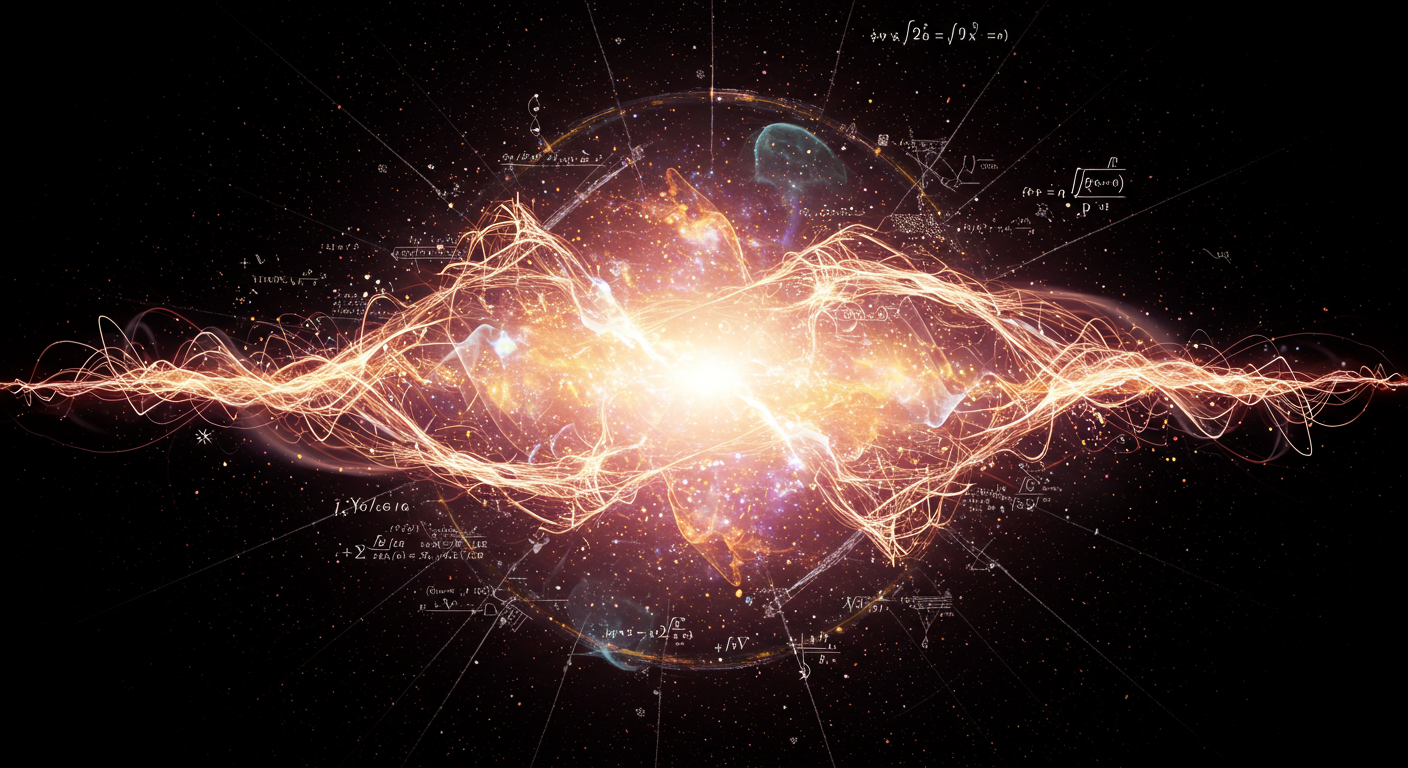
The universe, in its vast and perplexing glory, often seems to defy our most fundamental understandings. We peer into the cosmos, seeking the ultimate building blocks of existence, only to find ourselves confronted with a tapestry of contradictions. Gravity, the force that sculpts galaxies, remains stubbornly incompatible with quantum mechanics, the framework that governs the subatomic realm. In this intellectual wilderness, string theory emerges, a bold and intricate attempt to weave together these disparate threads. Though often shrouded in mathematical complexity, its implications resonate far beyond the confines of theoretical physics, touching on the very essence of our reality.
1. A Unified Vision: Bridging the Quantum Divide
The most compelling promise of string theory lies in its potential to unify the seemingly irreconcilable forces of nature. For decades, physicists have grappled with the chasm between Einstein’s general relativity, which describes gravity as the curvature of spacetime, and quantum mechanics, which depicts particles as probabilistic waves. String theory, by proposing that fundamental particles are not point-like entities but rather tiny, vibrating strings, offers a framework where gravity and quantum mechanics can coexist. This is the holy grail of theoretical physics, a “theory of everything” that could explain the universe at its most fundamental level. As Brian Greene, a prominent string theorist, notes in “The Elegant Universe,” the theory suggests a “single grand principle” from which all forces and particles arise.
2. Beyond the Standard Model: Unveiling Hidden Dimensions
The Standard Model of particle physics, while remarkably successful, leaves many questions unanswered. String theory posits the existence of extra spatial dimensions, curled up and hidden from our everyday perception. These extra dimensions, often visualized as Calabi-Yau manifolds, offer a potential explanation for the seemingly arbitrary parameters of the Standard Model. They allow for a deeper understanding of particle masses and interaction strengths, potentially revealing a more elegant and unified picture of the fundamental constituents of matter.
3. The Holographic Principle: Information and the Boundaries of Reality
One of the most profound implications of string theory is the holographic principle, which suggests that the information contained within a volume of space can be encoded on its boundary. This concept, rooted in the study of black holes, implies a deep connection between gravity and information theory. As Leonard Susskind, a pioneer in the field, has argued, this principle challenges our conventional understanding of dimensionality and suggests that our three-dimensional reality might be a projection from a two-dimensional surface. This insight has profound implications for our understanding of spacetime and the nature of information itself.
4. Black Holes and the Information Paradox: Resolving Cosmic Mysteries
Black holes, those enigmatic objects where gravity’s pull is so strong that nothing, not even light, can escape, have long presented a paradox for physicists. Quantum mechanics dictates that information cannot be destroyed, yet black holes seem to obliterate it. String theory offers a potential resolution to this paradox by suggesting that information is encoded on the black hole’s event horizon, the boundary beyond which escape is impossible. This idea, known as the holographic principle, implies that black holes are not information destroyers but rather complex repositories of information.
5. Cosmology and the Early Universe: Peering into the Cosmic Dawn
String theory provides a framework for understanding the early universe, a period when the cosmos was incredibly hot and dense. It offers insights into the inflationary epoch, a period of rapid expansion that is believed to have shaped the large-scale structure of the universe. String theory’s predictions about the primordial gravitational waves, which are ripples in spacetime, offer a potential test of its validity. These waves, if detected, would provide crucial evidence for the theory’s predictions about the early universe.
6. String Theory and Mathematics: A Symbiotic Relationship
The mathematical complexity of string theory has fostered a deep and fruitful relationship between physics and mathematics. String theorists have developed new mathematical tools and concepts, such as mirror symmetry and topological string theory, which have found applications in pure mathematics. This cross-pollination of ideas has led to breakthroughs in both fields, demonstrating the power of interdisciplinary collaboration.
7. Quantum Gravity and the Fabric of Spacetime: Weaving a New Reality
One of the central challenges in physics is the development of a consistent theory of quantum gravity, which would describe gravity at the quantum level. String theory, by incorporating gravity into a quantum framework, offers a potential solution to this problem. It suggests that spacetime itself is not a smooth, continuous entity but rather a dynamic, fluctuating network of strings. This radical idea has the potential to revolutionize our understanding of the fundamental nature of spacetime.
8. String Theory and Particle Physics: Unveiling New Particles and Forces
String theory predicts the existence of a plethora of new particles and forces, beyond those described by the Standard Model. These particles, known as superpartners, could potentially be detected at high-energy particle colliders like the Large Hadron Collider. The discovery of these particles would provide strong evidence for the validity of string theory and open up new avenues for exploring the fundamental constituents of matter.
9. The Multiverse and the Landscape of Possibilities: Exploring Alternative Realities
String theory’s landscape, a vast and complex space of possible universes, has led to discussions about the multiverse, the idea that our universe is just one among many. This concept, while speculative, offers a potential explanation for the fine-tuning of the fundamental constants of nature. It suggests that our universe’s properties are not unique but rather a result of random selection from a vast ensemble of possibilities.
10. Conceptual Revolution: Shifting Our Perspective on Reality
Perhaps the most significant impact of string theory lies in its ability to challenge our fundamental assumptions about reality. It forces us to reconsider our understanding of space, time, and matter, pushing the boundaries of our imagination. Even if string theory does not ultimately prove to be the “theory of everything,” its conceptual insights have already enriched our understanding of the universe and inspired new avenues of research. It exemplifies the human drive to comprehend the incomprehensible, to find order in chaos.
In the end, string theory is not just about tiny, vibrating strings. It’s about the relentless pursuit of knowledge, the unwavering belief that the universe, in all its complexity, is ultimately comprehensible. It is a testament to the power of human intellect and the enduring quest to unravel the deepest mysteries of existence.
Further Reading:
- Greene, Brian. The Elegant Universe: Superstrings, Hidden Dimensions, and the Quest for the Ultimate Theory. W.W. Norton & Company, 1999.
- Susskind, Leonard. The Black Hole War: My Battle with Stephen Hawking to Make the World Safe for Quantum Mechanics. Little, Brown and Company, 2008.
- Polchinski, Joseph. String Theory. Cambridge University Press, 1998.
- Becker, Katrin, Melanie Becker, and John H. Schwarz. String Theory and M-Theory: A Modern Introduction. Cambridge University Press, 2007.
- Zwiebach, Barton. A First Course in String Theory. Cambridge University Press, 2009.




Leave a Reply