
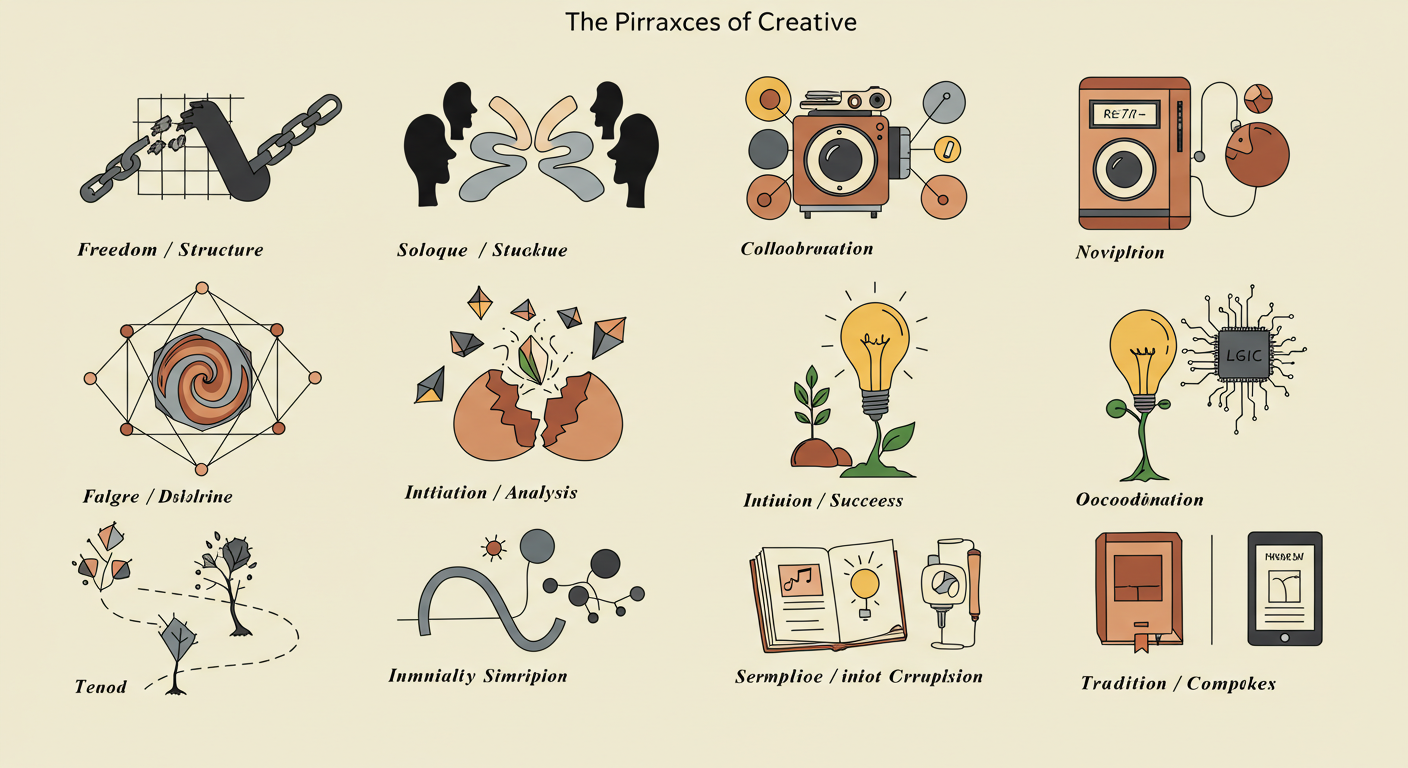
Creativity, often romanticized as a boundless expression of unfettered imagination, thrives within a delicate dance of paradoxes. These seeming contradictions, far from stifling innovation, act as fertile ground for groundbreaking ideas. To understand the true nature of creativity is to embrace these inherent tensions, recognizing that limitations can be the very catalysts for extraordinary breakthroughs.
1. The Paradox of Freedom and Structure:
We often assume that absolute freedom is the key to creativity. However, without a framework, a blank canvas can be paralyzing. Structure, in the form of deadlines, budgets, or thematic limitations, provides a scaffolding for exploration. The sonnet, with its rigid rhyme scheme and meter, has inspired centuries of poetic innovation. Constraints force us to find creative solutions within set parameters, channeling our focus and refining our vision. It is the tension between the boundless potential of freedom and the focused direction of structure that sparks true ingenuity.
2. The Paradox of Solitude and Collaboration:
While individual contemplation is essential for generating original ideas, collaboration can refine and expand those concepts. The lone artist in their studio and the bustling design team each contribute unique perspectives. The clash of differing viewpoints, the push and pull of collaborative brainstorming, can lead to unexpected and brilliant results. The creative process is a delicate balance between introspection and external input, between individual vision and collective refinement.
3. The Paradox of Familiarity and Novelty:
True innovation often arises from the recontextualization of familiar elements. The artist who blends classical techniques with contemporary themes, the musician who samples traditional melodies in a modern context, demonstrates this principle. Radical novelty, divorced from any recognizable context, can be alienating. Creativity thrives in the space between the familiar and the new, bridging the gap between what we know and what we can imagine.
4. The Paradox of Play and Discipline:
Play, with its inherent sense of exploration and experimentation, is crucial for fostering creativity. Yet, without discipline, playful exploration can become aimless. The disciplined practice of a craft, the rigorous application of technique, allows for the refinement of playful impulses. The artist who meticulously studies anatomy before abstracting the human form, the scientist who rigorously tests hypotheses born from whimsical speculation, demonstrates this interplay.
5. The Paradox of Failure and Success:
Fear of failure can stifle creativity, yet failure itself is an essential part of the creative process. The iterative nature of innovation, the constant cycle of experimentation and refinement, inevitably involves setbacks. The ability to learn from failures, to view them as stepping stones rather than roadblocks, is crucial for sustained creativity. The successful inventor who recounts a litany of failed prototypes illustrates this principle.
6. The Paradox of Intuition and Analysis:
Intuition, the “gut feeling” that guides creative decisions, is often seen as the antithesis of analytical thought. Yet, the most profound creative insights often arise from the synthesis of both. The artist who intuitively chooses a color palette and then meticulously analyzes its impact, the writer who intuitively crafts a narrative arc and then rigorously edits its structure, demonstrates this interplay. The blend of instinct and logic creates a powerful creative force.
7. The Paradox of Limitation and Abundance:
Scarcity, whether of resources, materials, or time, can force creators to find ingenious solutions. The artist who creates breathtaking sculptures from discarded materials, the chef who crafts exquisite dishes from limited ingredients, demonstrates this principle. Abundance, paradoxically, can lead to creative stagnation, as the pressure to innovate diminishes.
8. The Paradox of Intentionality and Serendipity:
While deliberate planning and focused effort are essential for creative endeavors, serendipitous discoveries often play a crucial role. The scientist who stumbles upon a groundbreaking discovery while pursuing a different line of research, the artist who finds inspiration in an unexpected encounter, demonstrates this principle. The creative process is a delicate balance between intentionality and openness to chance.
9. The Paradox of Simplicity and Complexity:
The most impactful creative works often distill complex ideas into simple, elegant forms. The minimalist design that conveys profound meaning, the concise narrative that encapsulates a universal truth, demonstrates this principle. Yet, the creation of such simplicity often requires a deep understanding of underlying complexity. The artist who masters intricate techniques to create a seemingly effortless work, the scientist who unravels complex phenomena to formulate a simple equation, illustrates this paradox.
10. The Paradox of Tradition and Disruption:
Creativity often involves both honoring and challenging tradition. The artist who builds upon the legacy of past masters while forging a new path, the scientist who refines established theories while proposing radical new hypotheses, demonstrates this principle. True innovation is not about discarding the past but rather engaging with it critically and creatively. The tension between tradition and disruption, between continuity and change, fuels the evolution of creative expression.




Leave a Reply