
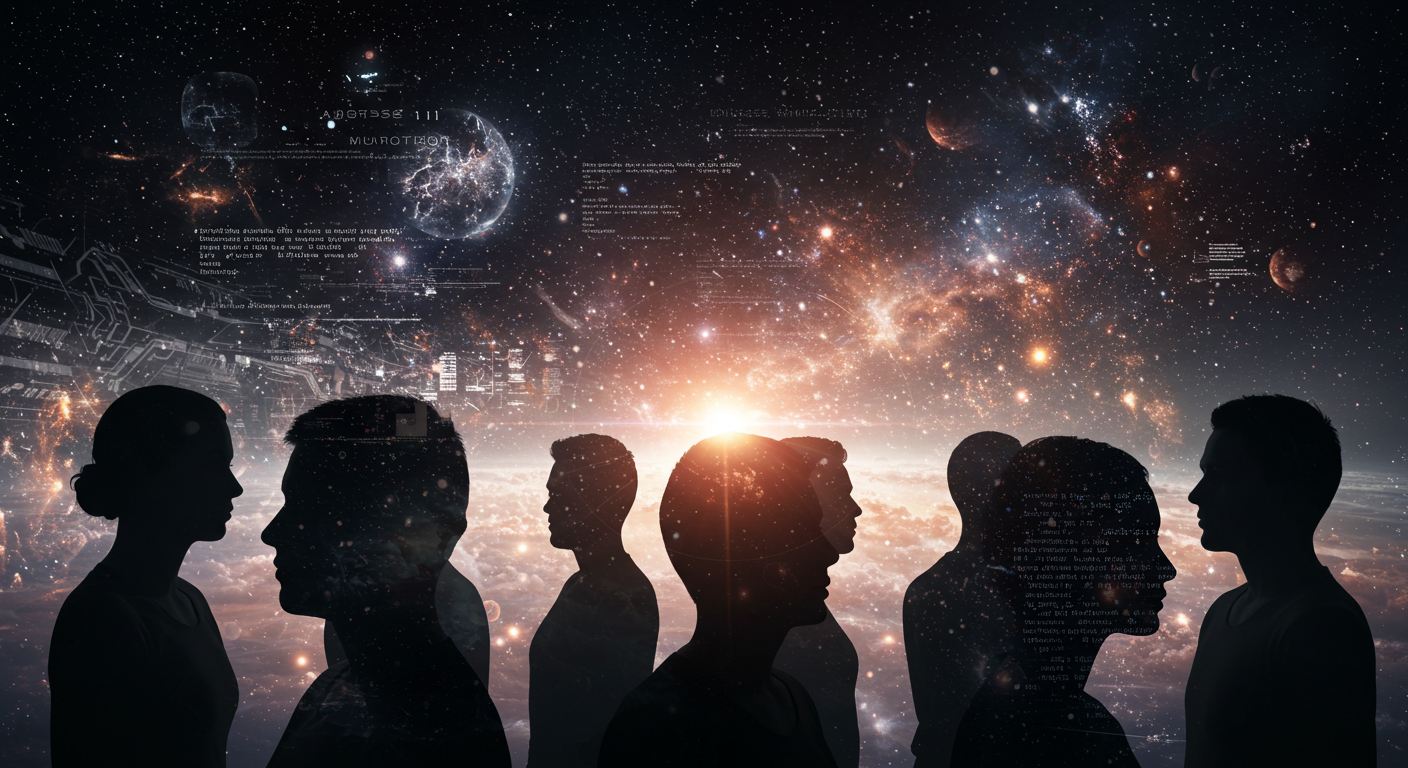
The notion that our perceived reality is a sophisticated simulation, akin to a complex video game or a meticulously crafted computer program, has permeated contemporary thought. From philosophical musings to cinematic blockbusters, the simulation hypothesis has captivated minds, sparking debates that straddle the realms of physics, computer science, and existential philosophy. While the concept might initially seem like science fiction, it rests on serious considerations about the nature of consciousness, the limits of scientific knowledge, and the potential trajectory of technological advancement. Here, we delve into ten compelling arguments for and against this intriguing proposition.
1. Argument For: The Computational Power of Future Civilizations
The argument posits that if civilizations achieve sufficient technological maturity, they could possess the computational power to create simulations indistinguishable from reality. As Nick Bostrom, a philosopher at Oxford University, argues in his seminal paper, “Are You Living in a Computer Simulation?”, the sheer scale of future computing capabilities could allow for the creation of ancestor simulations, where entire historical epochs are recreated in minute detail. This would imply that the vast majority of conscious entities would reside within these simulations, making it statistically more likely that we are among them. As Bostrom notes, “Unless we are now living in a simulation, our descendants will almost certainly run many ancestor-simulations.” This statistical argument, while probabilistic, carries weight, challenging our assumptions about the uniqueness of our reality.
2. Argument Against: The Limits of Computational Resources
Conversely, critics argue that the computational resources required to simulate a universe with the complexity of our own are unfathomably vast, potentially exceeding the limits of any conceivable technology. Even with exponential advancements in computing, the sheer volume of data and processing power needed to replicate every particle and interaction seems insurmountable. As physicist Sabine Hossenfelder points out, in her book “Existential Physics,” the simulation would require a computational resource equal to or greater than the universe itself, creating a paradox.
3. Argument For: The Quantum Nature of Reality
Quantum mechanics presents a reality that is fundamentally probabilistic and observer-dependent. Phenomena like quantum entanglement and wave-particle duality suggest that reality might not be inherently concrete but rather emerges from interactions and measurements. This aligns with the idea of a simulated reality, where the “software” renders only what is observed, optimizing computational resources. As physicist James Gates has noted, the error-correcting codes found in string theory equations have parallels to those used in computer science. This observation, while speculative, points towards a potentially deeper computational foundation to our universe.
4. Argument Against: The Lack of Empirical Evidence
Despite the theoretical allure, concrete empirical evidence supporting the simulation hypothesis is scarce. No definitive experiment has conclusively demonstrated that we are living in a simulation. The search for “glitches” or inconsistencies in the fabric of reality has yielded no irrefutable results. As philosopher David Chalmers argues, while the hypothesis is logically consistent, it remains in the realm of speculative metaphysics.
5. Argument For: The Fine-Tuning of the Universe
The universe exhibits a remarkable degree of fine-tuning, with physical constants and laws finely balanced to allow for the emergence of life. This apparent precision has led some to speculate that our universe might be deliberately designed, potentially by a highly advanced intelligence within a simulation. As physicist Max Tegmark suggests, the mathematical precision of the universe could be an indication of a programmed reality.
6. Argument Against: The Infinite Regression Problem
If we are in a simulation, who simulated our simulators? This leads to an infinite regression, raising questions about the ultimate origin of reality. If each simulation is within another simulation, the question of where the base reality lies remains unanswered. This logical conundrum, as philosopher Susan Blackmore points out, undermines the explanatory power of the hypothesis.
7. Argument For: The Phenomenological Argument
The subjective experience of consciousness is remarkably consistent across individuals, despite the vast differences in their physical circumstances. This consistency might suggest that consciousness is a fundamental aspect of the simulation, rather than an emergent property of biological brains. As philosopher Thomas Metzinger argues, our experience of self and reality might be a constructed model, a “virtual self” within a larger computational framework.
8. Argument Against: Occam’s Razor
Occam’s Razor, the principle that the simplest explanation is usually the best, favors the traditional view that reality is fundamental and not simulated. Introducing an additional layer of complexity, such as a simulated reality, requires more assumptions and thus violates this principle. As physicist Carlo Rovelli argues, in his book “Helgoland,” the beauty of physics lies in its simplicity.
9. Argument For: The Technological Singularity
The concept of a technological singularity, a hypothetical point in the future where artificial intelligence surpasses human intelligence, 1 could lead to the creation of simulations. If an AI achieves superintelligence, it might have the capacity to create simulations far more complex than anything we can currently imagine. As futurist Ray Kurzweil predicts, in “The Singularity Is Near,” this could fundamentally alter our understanding of reality.
10. Argument Against: The Ethical Implications
If we are living in a simulation, what are the ethical implications for our actions? Would our choices have real consequences, or would they be merely lines of code? The idea of a simulated reality raises profound questions about free will, morality, and the meaning of existence. As philosopher Luciano Floridi argues, the ontological shock of discovering we live in a simulation could lead to existential crises and moral relativism.
Concluding Reflections
The simulation hypothesis, while speculative, offers a fascinating lens through which to examine the nature of reality. It challenges us to question our assumptions and consider the possibility that our perceived world might be a sophisticated construct. While definitive answers remain elusive, the debate itself is a testament to humanity’s enduring quest to understand its place in the cosmos. Whether we are living in a simulation or not, the pursuit of knowledge and the exploration of these profound questions continue to enrich our understanding of existence.
Further Reading
- Bostrom, N. (2003). Are You Living in a Computer Simulation? Philosophical Quarterly, 53(211), 243-255.
- Chalmers, D. J. (2022). Reality+: Virtual Worlds and the Problems of Philosophy. W.W. Norton & Company.
- Hossenfelder, S. (2022). Existential Physics: A Scientist’s Guide to Life’s Biggest Questions. Viking.
- Kurzweil, R. (2005). The Singularity Is Near: When Humans Transcend Biology. Viking.
- Rovelli, C. (2020). Helgoland: The Strange and Beautiful Story of Quantum Physics. Riverhead Books.

Leave a Reply