
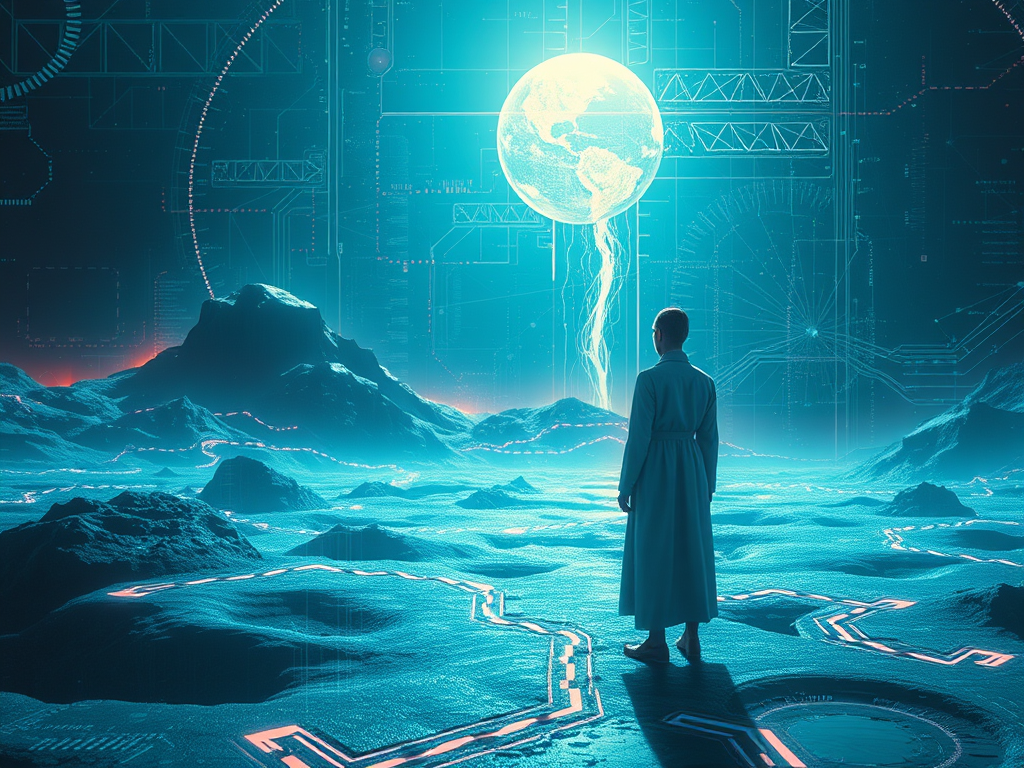
The notion that our perceived reality is not fundamental but rather a sophisticated computer simulation, a concept popularized by philosopher Nick Bostrom’s seminal 2003 paper, has moved from the fringes of science fiction to become a serious topic of philosophical and even scientific discussion. While the idea offers intriguing explanations for some of the universe’s more perplexing aspects, it also raises a host of profound and as-yet-unanswered questions that continue to vex theorists and fuel ongoing debate. Here are ten of the most persistent enigmas that plague those contemplating our potential simulated existence.
1. The Nature and Motivation of the Simulators: Perhaps the most fundamental unanswered question revolves around the very beings or entities who created and maintain this hypothetical simulation. Who are they? What is their level of technological sophistication? Are they post-humans, an advanced extraterrestrial civilization, or something entirely beyond our comprehension? Crucially, what is their motivation for running such an elaborate and resource-intensive simulation? Are they conducting scientific experiments, seeking entertainment, preserving their history, or pursuing goals entirely alien to our understanding? Without any concrete information about the simulators, any attempt to understand the simulation’s parameters and purpose remains highly speculative.
2. The Purpose and Parameters of the Simulation: If we are indeed living in a simulation, what are its specific rules, limitations, and objectives? Is it designed to be a perfect replica of a past reality, a controlled experiment with specific variables, or something else entirely? Are there inherent constraints on what can be simulated, leading to the seemingly fundamental laws of physics we observe? Why are certain constants in our universe so finely tuned for life? Is this a deliberate design feature of the simulation, or a byproduct of its underlying code? Understanding the purpose and parameters would provide crucial insights into the nature of our existence within this simulated framework.
3. The Existence and Nature of a “Base Reality”: The simulation argument inherently implies the existence of a “base reality” – the world in which the simulators themselves reside. What is the nature of this base reality? Does it operate under the same physical laws as our simulation, or are there fundamental differences? Is it also possible that the base reality is itself a simulation, leading to an infinite regress of nested realities? Exploring the potential characteristics of the base reality could offer clues about the ultimate nature of existence and our place within it.
4. The Potential for “Glitches” or Anomalies: In any complex system, errors or unexpected behaviors can arise. If our reality is a simulation, should we expect to observe “glitches” or anomalies that betray its artificial nature? Some theorists point to phenomena like déjà vu, the Mandela Effect (shared false memories), or certain quantum mechanical oddities as potential evidence of such glitches. However, these phenomena can often be explained by conventional means, and definitively identifying a genuine “glitch” in the fabric of reality remains a significant challenge. The absence of obvious, widespread glitches also raises questions about the sophistication and stability of the simulation.
5. Our Role and Significance Within the Simulation: If our lives and experiences are part of a simulation, what is our significance within it? Are we merely non-player characters (NPCs) populating the simulated world, or do we possess genuine consciousness and agency that is meaningful to the simulators? Do our actions have real consequences within the simulation, or are they predetermined by the underlying code? Understanding our role could have profound implications for our sense of purpose and the value we place on our existence.
6. The Ethical Implications of a Simulated Reality: The revelation that we are living in a simulation would raise a host of complex ethical questions. Would it change our moral obligations towards each other? Would the simulators have any ethical responsibilities towards the simulated beings within their creation? What would be the implications for concepts like free will, justice, and the meaning of life? Navigating these ethical dilemmas would require a fundamental re-evaluation of our values and principles.
7. The Possibility of Discovering the Simulation’s True Nature: Could we ever definitively prove or disprove the simulation hypothesis? If so, what methods could we employ? Would the simulators allow us to discover the truth, or would they actively prevent such a revelation? Some theorists speculate about the possibility of finding hidden code, reaching the boundaries of the simulation, or even “hacking” the system. However, these ideas remain largely theoretical, and the practical challenges of uncovering the true nature of our reality are immense.
8. The Implications for Our Understanding of Consciousness: The simulation hypothesis forces us to confront fundamental questions about the nature of consciousness. If our reality is simulated, does that mean our consciousness is also a product of the simulation’s code? Could consciousness be uploaded, transferred, or even artificially created within a simulation? Exploring the relationship between consciousness and computation is crucial for understanding the potential nature of simulated beings and our own existence within such a framework.
9. The Relationship Between Physics and Computation: The fine-tuning of the universe’s physical constants and the seemingly discrete nature of quantum mechanics have led some to draw parallels between the laws of physics and the algorithms of a computer program. Could the universe’s fundamental laws be the underlying code of the simulation? If so, how do we reconcile the continuous nature of some physical phenomena with the discrete steps of computation? Understanding the potential relationship between physics and computation is essential for developing a coherent model of a simulated reality.
10. The Potential Consequences of “Breaking” the Simulation: If we were to somehow discover definitive proof of the simulation or even attempt to interact with the simulators, what would be the potential consequences? Could it lead to the termination of the simulation, a fundamental alteration of its parameters, or even direct intervention from the simulators? The potential risks associated with “breaking” the simulation highlight the delicate and precarious nature of our hypothetical existence.
These ten unanswered questions represent just a fraction of the complex and fascinating challenges that arise when considering the possibility of a simulated reality. While the idea remains largely in the realm of philosophical speculation, the very act of grappling with these enigmas pushes the boundaries of our understanding of reality, consciousness, and our place in the cosmos. As technology continues to advance and our understanding of the universe deepens, perhaps some of these long-standing questions will one day find answers, potentially revealing a reality far stranger than we currently imagine.
Further Reading:
- Bostrom, Nick. (2003). Are You Living in a Computer Simulation? Philosophical Quarterly, 53(211), 243-255.
- Chalmers, David J. (2022). Reality+: Virtual Worlds and the Problems of Philosophy. W. W. Norton & Company.
- Putnam, Hilary. (1981). Reason, Truth and History. Cambridge University Press. (For the “brain in a vat” thought experiment, a precursor to the simulation argument).
- Tegmark, Max. (2014). Our Mathematical Universe: My Quest for the Ultimate Nature of Reality. Alfred A. Knopf. (Explores related ideas about the mathematical structure of reality).
- Yudkowsky, Eliezer. (2003). What is Fun? (Discusses potential motivations for advanced civilizations running simulations).




Leave a Reply