
Space! Just the word itself conjures up images of distant galaxies, twinkling stars, and maybe even a few friendly aliens. But beyond the usual pictures, the universe is filled with truly mind-blowing facts that will make you see the night sky in a whole new light. Get ready to have your cosmic curiosity sparked as we explore ten astonishing secrets of space!
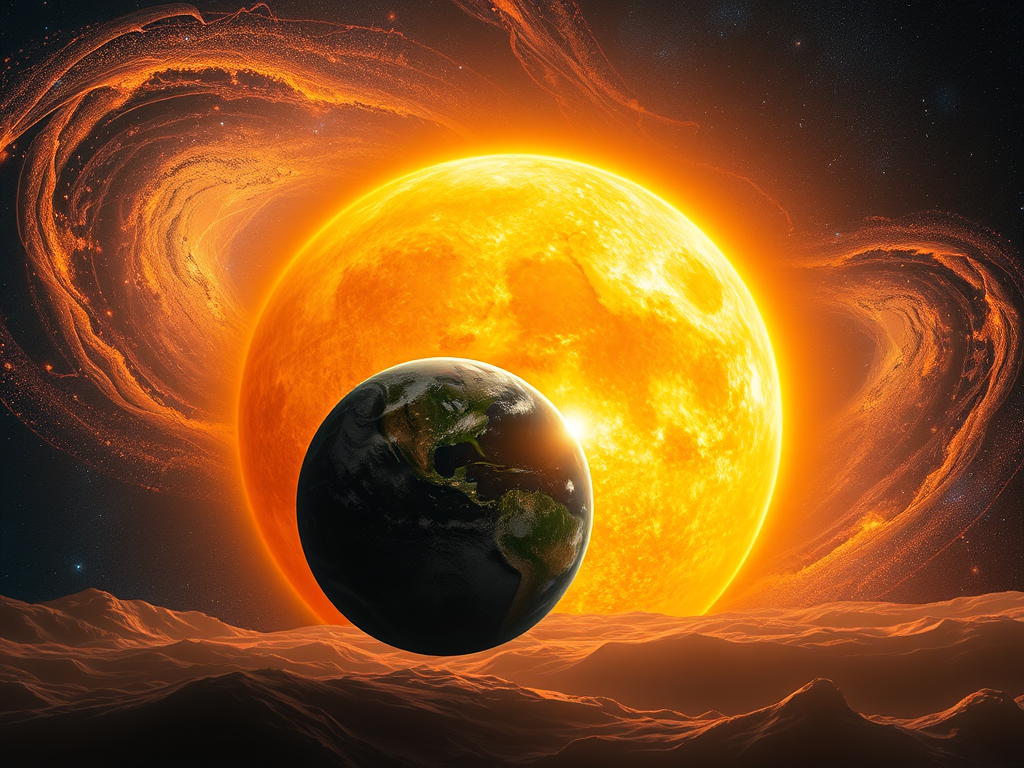
1. The Sun is So Big, You Could Fit Over a Million Earths Inside! (Sun’s Size Compared to Earth)
Imagine a giant orange, the size of a hot air balloon. That’s our Earth. Now picture a basketball. That’s still way too small compared to the Sun! Our Sun is a star, a massive ball of hot gas, and it’s so incredibly huge that if you hollowed it out, you could fit more than one million Earths inside it! Think of it like this: if Earth were a tiny marble, the Sun would be bigger than a school bus. That’s a lot of room! This immense size is what gives the Sun the power to keep us warm and provide light for our planet. Its gravity is also what keeps all the planets in our solar system, including Earth, orbiting around it in a neat and orderly way, like kids holding hands and walking in a circle.
2. There Are More Stars in the Universe Than Grains of Sand on All the Beaches on Earth! (Number of Stars in the Universe)
Have you ever tried to count the grains of sand on a beach? It seems like an impossible task, right? Well, the number of stars in the universe is even more mind-boggling! Scientists estimate that there are hundreds of billions, maybe even trillions, of galaxies, and each galaxy contains billions upon billions of stars. That means the total number of stars is likely far greater than all the grains of sand on every single beach on our entire planet. Think about looking up at the night sky and seeing just a tiny fraction of these stars. It makes our own planet feel pretty small, but also incredibly special to be a part of such a vast and amazing cosmos.
3. A Day on Venus is Longer Than Its Year! (Venus’s Rotation and Orbit)
Imagine going to school and finding out that one day lasted longer than all the holidays you get in a whole year! That’s kind of what it’s like on the planet Venus. While Earth takes about 24 hours to spin once on its axis (that’s a day) and about 365 days to orbit the Sun (that’s a year), Venus is a bit peculiar. It rotates so incredibly slowly that one day on Venus (the time it takes to spin once) is actually longer than its year (the time it takes to go around the Sun)! It’s like a spinning top that takes forever to turn but zooms around in a circle quite quickly. To make it even stranger, Venus also spins backward compared to most other planets in our solar system!
4. Jupiter’s Great Red Spot is a Storm Bigger Than Earth That Has Been Raging for Hundreds of Years! (Jupiter’s Great Red Spot)
If you look at pictures of Jupiter, the largest planet in our solar system, you might notice a giant, swirling red spot. This isn’t just a stain; it’s a colossal storm, a hurricane-like system that’s bigger than our entire planet Earth! Scientists have been observing this Great Red Spot for hundreds of years, and it shows no signs of stopping. Imagine a storm so massive that it could swallow Earth whole, and it’s been going on for longer than anyone can remember! The powerful winds within this storm can reach hundreds of miles per hour, making it a truly awe-inspiring and terrifying weather phenomenon all at the same time.
5. There’s a Planet Made Almost Entirely of Diamond! (Diamond Planet)
Imagine a planet sparkling and glittering like the most enormous jewel you can possibly think of! Scientists believe that there’s a planet called 55 Cancri e that is made up almost entirely of diamond. This “diamond planet” is about twice the size of Earth and eight times as massive. It formed under immense pressure and heat, causing carbon atoms to crystallize into diamond. While we can’t exactly visit this dazzling world and bring back souvenirs, it’s an incredible thought that somewhere out there, a giant diamond planet exists, making it one of the most precious places in the universe!
6. Space is Completely Silent Because There’s No Air to Carry Sound Waves! (Sound in Space)
Think about all the sounds you hear every day: birds chirping, cars honking, people talking. All these sounds travel through the air as waves. But in the vast emptiness of space, there is virtually no air or other matter for sound waves to travel through. This means that even if a massive explosion were happening right next to you in space, you wouldn’t hear a thing! It would be a completely silent spectacle. So, those exciting sound effects you hear in space movies are just for dramatic effect – in reality, space is a profoundly quiet place.
7. Astronauts Grow Taller in Space! (Effects of Gravity on Astronauts)
Have you ever wondered what it would be like to float around without gravity? Astronauts on the International Space Station experience this weightlessness, and one surprising effect is that they actually grow a little bit taller! On Earth, gravity constantly compresses our spines, the stack of bones in our backs. But in the absence of gravity, the spine can lengthen, causing astronauts to gain about an inch or two in height while they are in space. Don’t worry, though; they return to their normal height once they are back on Earth and gravity starts pulling on their bodies again. It’s like stretching out a spring and then letting it go back to its original size.
8. One Teaspoon of a Neutron Star Would Weigh More Than Mount Everest! (Neutron Star Density)
Stars much bigger than our Sun can sometimes collapse at the end of their lives, forming incredibly dense objects called neutron stars. These stars are so tightly packed that if you could somehow scoop up just a teaspoonful of material from a neutron star, it would weigh more than Mount Everest, the tallest mountain on Earth! This is because all the matter in a star much larger than our Sun is squeezed into an incredibly small space. The gravity on a neutron star is also unbelievably strong – it would crush anything that came near it.
9. Our Solar System Has Dwarf Planets Besides Pluto! (Dwarf Planets in Our Solar System)
For a long time, we all learned that there were nine planets in our solar system, with Pluto being the furthest one. However, scientists have since reclassified Pluto as a dwarf planet. But Pluto isn’t the only dwarf planet in our cosmic neighborhood! There are several others, including Ceres, which is located in the asteroid belt between Mars and Jupiter, and Eris, Haumea, and Makemake, which are found in the outer reaches of our solar system, beyond Neptune. These dwarf planets are smaller than the eight main planets and have some other differences in their orbits and characteristics.
10. Light From Distant Galaxies Has Been Traveling for Billions of Years to Reach Us! (Light Years and the Age of the Universe)
When you look up at the stars at night, you’re not just seeing them as they are now; you’re seeing them as they were a long, long time ago! Light travels at an incredible speed, but the universe is so vast that light from distant stars and galaxies takes billions of years to reach our eyes. The distance that light travels in one year is called a light-year. So, when we see a galaxy that is millions of light-years away, the light we are observing started its journey millions of years ago, long before humans even existed on Earth! This means that by studying the light from these distant objects, we are essentially looking back in time and learning about the history of the universe.
Further Reading
Here are some books that will help you explore the wonders of space even further:
- National Geographic Little Kids First Big Book of Space by Catherine D. Hughes
- Space: A Visual Encyclopedia by DK
- What We See in the Stars: An Illustrated Tour of the Night Sky by Kelsey Oseid
- The Girl Who Named Pluto: And Other True Stories of Astronomical Discovery by Alice B. McGinty
- DKfindout! Solar System by DK




Leave a Reply