
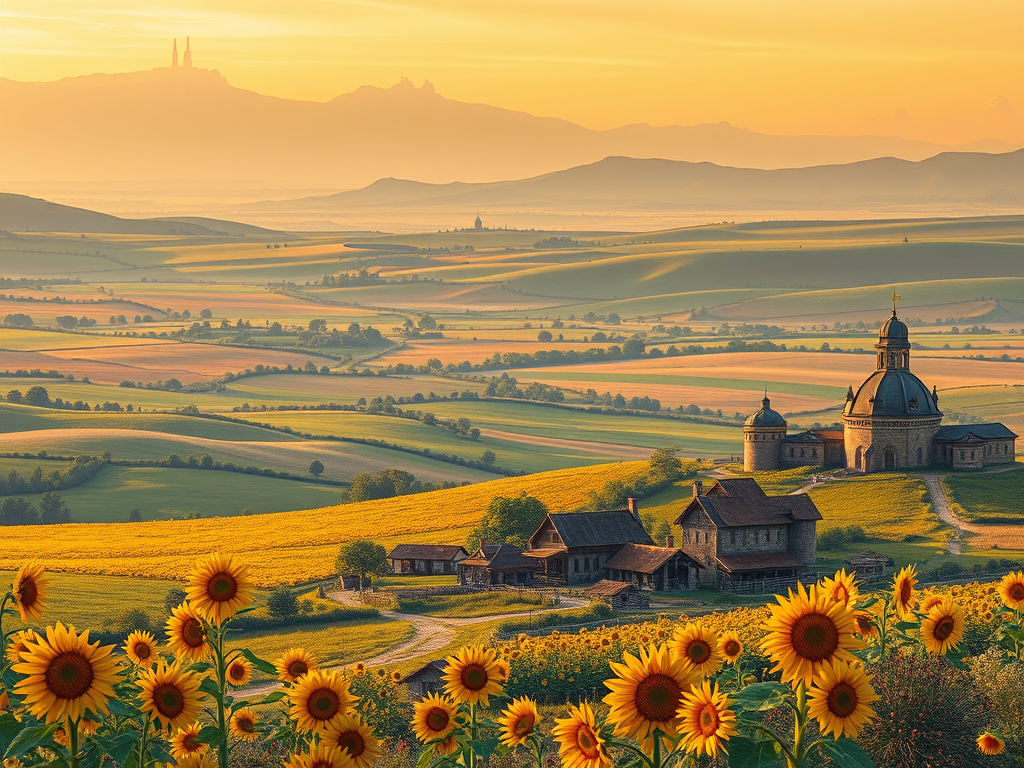
Have you ever looked at a map of Europe and wondered about the countries there? One country with a super long and interesting story is Ukraine. It’s a place with beautiful wide-open lands, strong traditions, and a history that’s seen many ups and downs, kind of like a rollercoaster!
Ukraine is in Eastern Europe and is the largest country that is entirely within Europe (meaning not partly in Asia, like Russia). Its land is mostly flat or gently rolling, perfect for farming. This rich land has been a prize that many groups have wanted to control over thousands of years. Because of its location, right between powerful neighbours, Ukraine’s history is a fascinating mix of different cultures and struggles for freedom.
Learning about history is like being a detective, piecing together clues from the past to understand how things are today. The story of Ukraine is packed with brave warriors, clever leaders, tough times, and moments of great hope. It shows how a nation can keep its spirit alive even when facing huge challenges.
So, let’s grab our history magnifying glasses and explore ten cool and important things you should know about the amazing journey of Ukraine!
1. Ukraine’s Ancient Roots Go Way Back
Long, long before cities and countries as we know them existed, the lands of what is now Ukraine were home to various ancient peoples. Imagine tribes of skilled horse riders roaming the vast grassy plains! One of the most famous groups were the Scythians. These were nomadic people, meaning they didn’t live in one place but moved around with their animals. They were fierce warriors, amazing archers, and brilliant metalworkers, creating stunning gold treasures.
The Scythians lived in the area from about the 7th century BC to the 3rd century BC. They traded with the ancient Greeks who set up colonies along the Black Sea coast. These early interactions show that the land of Ukraine has been connected to other parts of the world for thousands of years. Think of them as the very first chapters in a very long book about this land. These ancient tribes laid some of the earliest foundations for the diverse cultures that would later develop here, long before anyone called it “Ukraine.” Their legacy reminds us that the history of this land is incredibly deep and complex.
2. The Glory Days of Kievan Rus’
If Ukraine had a “golden age” early on, it would definitely be the time of Kievan Rus’. This wasn’t exactly a single country like Ukraine is today, but rather a collection of principalities (small states ruled by princes) in the 9th to 13th centuries, centred around the city of Kyiv. Kyiv became a huge, important city, much bigger and grander than many cities in Western Europe at the time.
Kievan Rus’ was founded by the Rurik dynasty, traditionally said to be Varangians (likely Vikings). They mixed with the local East Slavic tribes. It became a powerful state, controlling important trade routes connecting Scandinavia and the Baltic Sea with the Byzantine Empire (which was based around modern-day Turkey) via the Dnieper River. The rulers of Kievan Rus’ adopted Christianity in 988 AD under Prince Volodymyr the Great, which was a massive event that brought new culture, writing, and strong ties with the Byzantine world. Think of Kievan Rus’ as the medieval superpower of the region, a major early state that is considered a crucial part of both Ukrainian and Russian history. Its legacy is still seen in Kyiv today.
3. The Mongol Invasion and a Changing Map
Just as Kievan Rus’ was thriving, a massive change swept across the land. In the 13th century, powerful armies from the east, led by the Mongols (often called Tatars in this context), invaded. The Mongol Empire was huge, stretching across Asia, and their swift, effective armies conquered many lands. Kievan Rus’ was devastated by these invasions, starting in the 1230s. Cities like Kyiv were attacked and severely damaged.
The Mongol invasion didn’t just cause destruction; it completely changed the political map of the region. Kievan Rus’ broke apart, and the various principalities either came under direct Mongol control (as part of the Golden Horde) or fell under the influence of other rising powers in the west, like the Grand Duchy of Lithuania and the Kingdom of Poland. This period marks a fragmentation of the East Slavic lands and the beginning of centuries where Ukrainian territories were often divided and ruled by different foreign powers. The Mongol impact was profound, weakening the existing state structures and setting the stage for new historical paths for the different East Slavic peoples.
4. Under Different Flags: Lithuania and Poland
Following the decline of Kievan Rus’ after the Mongol invasions, large parts of the Ukrainian lands were gradually absorbed by powerful neighbours to the west: the Grand Duchy of Lithuania and later, the Kingdom of Poland. The Grand Duchy of Lithuania, initially pagan, expanded rapidly eastward in the 14th century, incorporating many former Rus’ territories. They often allowed local customs and the East Slavic language (the ancestor of Ukrainian and Belarusian) to continue, and many Lithuanian nobles adopted Christianity and local culture.
Later, through unions (like the Union of Lublin in 1569), Lithuania and Poland formed a united state called the Polish-Lithuanian Commonwealth. Under Commonwealth rule, the Ukrainian lands, particularly the right bank of the Dnieper River, became part of the Polish Crown. This brought the area firmly into the European sphere but also created tensions. Polish lords often controlled vast estates, and there were religious differences (Catholicism in Poland vs. Orthodox Christianity among the local population). This era was a mix of cultural exchange and increasing social and religious friction, contributing to later uprisings.
5. The Rise of the Cossacks: Warriors of the Steppe
One of the most iconic and important groups in Ukrainian history is the Cossacks. Think of them as frontiersmen, adventurers, and warriors who lived on the southern borders, or “steppes,” which were the wide, open grasslands. The word “Cossack” likely comes from a Turkic word meaning “freeman” or “adventurer.” They were originally runaway peasants, serfs, and others seeking freedom from strict rule.
The Cossacks formed military communities, particularly in a fortified area south of the rapids on the Dnieper River called the Zaporizhian Sich. They were famous for their military skills, bravery, and unique culture. While they often acted independently, they also sometimes served Poland, Russia, or other powers, acting as border guards. However, they valued their freedom above all else. Growing tensions with Polish rule over religious issues and social freedoms led to major Cossack uprisings in the 17th century, fundamentally changing the region’s history and leading to the establishment of a Cossack state called the Hetmanate. The Ukrainian Cossacks are seen as symbols of Ukrainian identity and resistance.
6. Divided Lands: Under Russian and Austro-Hungarian Empires
By the late 18th century, the political map of Eastern Europe shifted dramatically. The powerful Polish-Lithuanian Commonwealth weakened and was eventually partitioned (divided up) by its neighbours: the Russian Empire, the Habsburg Monarchy (later the Austro-Hungarian Empire), and Prussia. The vast majority of Ukrainian lands ended up under the control of the Russian Empire, while a smaller western portion, including the region of Galicia, fell under Habsburg rule.
This division meant that Ukrainians lived under two different empires, experiencing different political systems, economies, and cultural influences. In the Russian Empire, Ukrainian culture and language were often suppressed, and attempts were made to integrate Ukrainians into the broader Russian identity. In the Austro-Hungarian Empire, there was relatively more freedom for Ukrainian language and cultural development, although economic conditions were often difficult. This period of division, lasting until World War I, had a lasting impact on Ukrainian identity, creating regional differences and fueling aspirations for unity and independence.
7. A Brief Taste of Freedom: The Early 20th Century
World War I (1914-1918) and the revolutions that followed in the Russian Empire created a window of opportunity for Ukraine to finally pursue its dream of independence. As the Russian Empire collapsed, Ukrainian national movements gained strength. In 1918, the Ukrainian People’s Republic was declared in Kyiv. Western Ukrainian lands, which had been part of Austria-Hungary, also declared independence as the West Ukrainian People’s Republic, with hopes of uniting with the larger Ukrainian state.
However, this period of independence was incredibly difficult and short-lived. Ukraine became a battleground during the Russian Civil War and conflicts with Poland and other powers. Different political factions within Ukraine also struggled for control. Despite valiant efforts by Ukrainian patriots, the new Ukrainian states were eventually overwhelmed. By the early 1920s, most of Ukraine was absorbed into the new communist state, the Soviet Union, while some western parts were incorporated into Poland, Czechoslovakia, and Romania. This era showed the strong desire for an independent Ukraine but also highlighted the immense challenges it faced from powerful neighbours.
8. Tough Times Under Soviet Rule, Including the Holodomor
Life under Soviet rule for Ukrainians was incredibly challenging and marked by immense suffering. The Soviet government, led initially by figures like Lenin and later Stalin, aimed to build a communist state and exert tight control. Agriculture was collectivized, forcing peasants to give up their land and join collective farms, which led to widespread resistance and disruption. Ukrainian culture and national identity were often suppressed, with restrictions on language use and persecution of intellectuals and religious figures.
The most horrific event of this period was the Holodomor (meaning “death by hunger”). This was a man-made famine in 1932-1933 caused by deliberate policies of the Soviet government, including the seizure of grain and food from Ukrainian peasants. Millions of Ukrainians died from starvation. Many historians view the Holodomor as an act of genocide, aimed at breaking the will of the Ukrainian peasantry and suppressing Ukrainian national identity. It is a deeply traumatic event in Ukrainian history and a stark reminder of the brutality of totalitarian rule and the struggles Ukrainians faced under Soviet control. Learning about Holodomor facts is crucial to understanding this period.
9. The Hardships of World War II
World War II (1939-1945) was another devastating period for Ukraine, perhaps the most destructive in its entire history. Because of its location, Ukraine became a major battleground between Nazi Germany and the Soviet Union. The fighting was incredibly brutal, and millions of Ukrainian soldiers fought in the Soviet army. The civilian population suffered terribly under both Nazi and Soviet occupation.
Nazi Germany implemented horrific policies, including the mass murder of Jews (the Holocaust) and other targeted groups, and brutal treatment of the local population. Cities and villages were destroyed. The conflict also saw Ukrainian nationalist movements trying to fight for independence against both the Nazis and the Soviets, often caught in the middle of larger conflicts. The war resulted in an estimated 5 to 8 million deaths in Ukraine, massive destruction of infrastructure, and profound social and demographic changes. The scars of World War II run deep in Ukraine and are a crucial part of its modern identity and memory.
10. Ukraine Today: Independence and the Path Forward
After decades under Soviet rule, the opportunity for independence finally arrived again. As the Soviet Union weakened in the late 1980s, national movements in Ukraine gained momentum. On August 24, 1991, following a failed coup attempt in Moscow, Ukraine declared its independence. This was a truly historic moment, marking the end of centuries of foreign rule and the realization of a long-held dream for an independent Ukrainian state.
Since 1991, Ukraine has been building its own country, facing many challenges including economic difficulties, political transitions, and navigating its relationship with its powerful neighbour, Russia. Ukrainians have shown incredible determination to build a democratic society and strengthen their ties with Europe. The story of Ukraine independence 1991 is one of perseverance and the enduring desire for self-determination. Understanding these major events in Ukrainian history helps explain the challenges and resilience of the Ukrainian people as they continue to shape their future in the 21st century. The modern history of Ukraine is still being written.
Further Reading
If you want to learn more about the fascinating history of Ukraine, check out these books:
- The Story of Ukraine: An Anthem of Glory and Freedom by Olena Kharchenko
- Through the Witch’s Window: A Journey into the History and Legends of Ukraine by Laura E. James
- This is Ukraine by Krystina Opolska
- I Am from Ukraine: A Children’s Story Celebrating Home, Family, and Hope by Lesia Krutous (Focuses more on culture and modern life but provides context)




Leave a Reply