
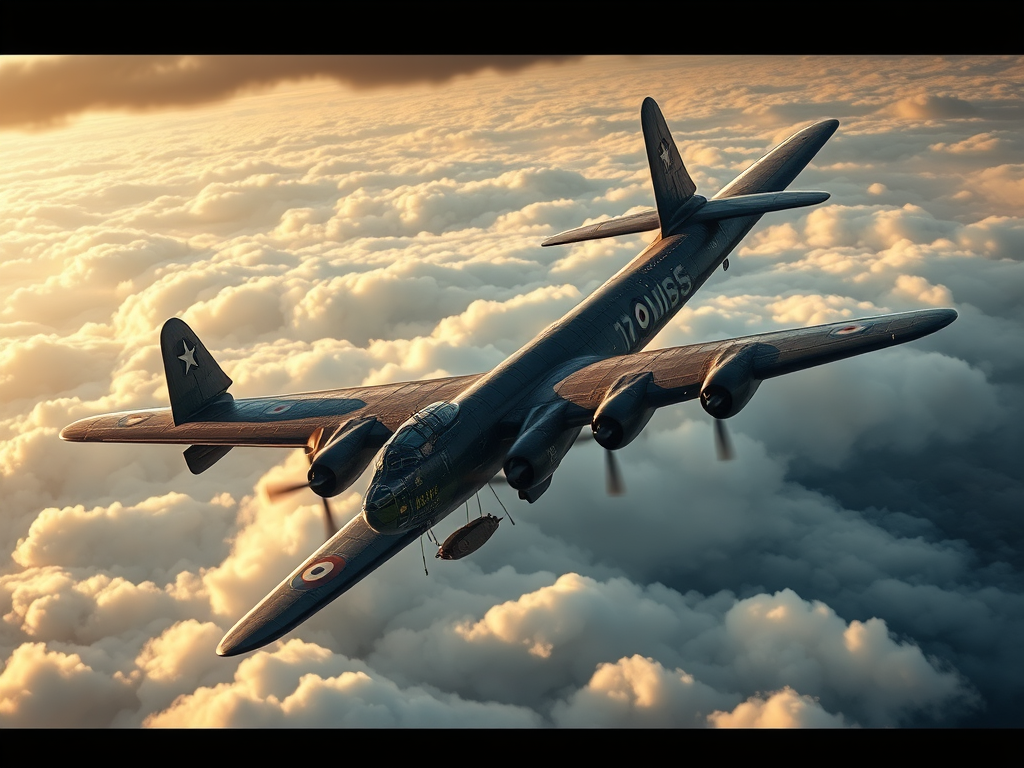
The Vickers Wellington bomber, affectionately nicknamed the “Wimpy” by its crews after a character in the Popeye cartoons, was one of the most important aircraft used by the Royal Air Force during the Second World War. While less famous than the later Lancaster, the Wellington was the backbone of Bomber Command in the early years of the conflict and continued to serve in various roles throughout the entire war.
Designed in the mid-1930s, the Wellington was a twin-engined, multi-role aircraft known for its distinctive shape and incredible toughness. It played a vital part in the air war against Germany, flying countless missions over enemy territory, protecting convoys at sea, and even hunting submarines.
This wasn’t just any bomber; it had a secret strength built right into its structure, thanks to the ingenious mind of a famous British engineer. The Wellington was a versatile workhorse, constantly adapted and improved to meet the changing demands of wartime. It was flown by crews from across the Commonwealth and Allied nations, contributing significantly to the war effort on many fronts.
Let’s explore some lesser-known and fascinating facts about this remarkable aircraft, uncovering the secrets behind its durability, its many different jobs, and the lasting legacy of the Vickers Wellington bomber.
1. It Had a Revolutionary “Geodetic” Structure
Perhaps the most unique and defining feature of the Vickers Wellington bomber was its revolutionary construction method, known as geodetic structure. This innovative design was the brainchild of the famous British engineer Barnes Wallis, the same man who later invented the bouncing bomb used by the Dambusters. Instead of a traditional internal frame with stressed metal skin, the Wellington’s fuselage and wings were built from a complex lattice-like framework of duralumin (an aluminium alloy) spars.
Think of it like a giant, lightweight basket or a woven bird’s nest made of metal strips. This network was then covered with a fabric skin, usually Irish linen treated with dope (a type of varnish) to make it taut and airtight. This geodetic structure was incredibly strong for its weight and had a remarkable ability to absorb damage. Battle-damaged Wellingtons often returned to base with huge holes in their fuselage or wings, their unique structure preventing the damage from spreading and causing the aircraft to break apart in the air. This inherent toughness was a major reason for the aircraft’s popularity with crews and its long service life throughout WW2.
2. Designed by the Inventor of the Bouncing Bomb
The connection between the Vickers Wellington bomber and the famous Dambusters raid is a direct one: both were significantly influenced by the brilliant engineer Barnes Wallis. While Wallis is most famous for his bouncing bomb, his innovative approach to engineering had a profound impact on aircraft design long before that. The geodetic structure used in the Wellington was a concept he had developed earlier, initially for airships like the R100.
Wallis believed that this lattice-like construction method offered superior strength and efficiency compared to traditional methods. He convinced Vickers-Armstrongs to use his design for their submission to a new bomber requirement, leading to the development of the Wellington. His work on the Wellington laid the groundwork for later innovations. In fact, modified Wellingtons were even used by Barnes Wallis for some of the early testing of the bouncing bomb prototypes, proving the versatility and robust nature of the aircraft he helped create. The Wellington stands as a testament to Wallis’s forward-thinking engineering principles, long before his most famous invention came into the spotlight during Operation Chastise.
3. It Was the Most Produced British Bomber of WW2
While the Avro Lancaster might be the most iconic British bomber of the Second World War, the Vickers Wellington bomber holds the title of the most produced British bomber aircraft of the conflict. A staggering 11,461 Wellingtons were built between 1936 and 1945. This massive production number highlights the aircraft’s importance and versatility throughout the war.
The Wellington was produced in various factories across the UK, including Vickers’ own plants and “shadow factories” built specifically for wartime production, such as those at Broughton and Blackpool. The ability to produce the aircraft in such large quantities was vital for sustaining the RAF’s bombing campaign and its other operational needs. Its continuous production also meant it was constantly being updated and modified, leading to many different versions, or “Marks,” tailored for specific roles and incorporating improvements based on combat experience. The sheer number of Wellingtons built underscores its role as the workhorse of the RAF’s bomber and maritime forces for a significant portion of WW2.
4. The Backbone of Bomber Command in the Early War Years
In the crucial early years of the Second World War, before the famous four-engined heavy bombers like the Lancaster and Halifax were available in large numbers, the Vickers Wellington bomber was the mainstay of RAF Bomber Command. Along with the Handley Page Hampden and the Armstrong Whitworth Whitley, Wellingtons bore the brunt of Britain’s early bombing operations against Germany.
Initially, Wellingtons were used in daylight bombing raids, but these proved to be very costly against German fighter defences due to the bomber’s limited defensive armament and speed. Following heavy losses, Bomber Command switched primarily to night operations, where the Wellington’s robust construction and reasonable range made it more survivable. For several years, large formations of Wellingtons conducted night raids against German industrial targets, ports, and cities. For instance, in the famous “Thousand Bomber” raid on Cologne in May 1942, over half of the attacking aircraft were Wellingtons. The experience gained by crews flying Wellingtons in these tough early WW2 missions was invaluable and paved the way for the later strategic bombing offensive using heavier aircraft.
5. A Vital Aircraft for Coastal Command
As the war progressed and more Lancasters and Halifaxes became available for night bombing, the Vickers Wellington bomber didn’t disappear from the front lines. Instead, it transitioned into a new and equally vital role with RAF Coastal Command. The Battle of the Atlantic, where Allied shipping was constantly threatened by German U-boats, was a critical theatre of the war, and the Wellington proved to be an excellent maritime patrol and anti-submarine aircraft.
Wellingtons were modified for their new duties, often fitted with radar (like the ASV – Air-to-Surface Vessel radar) to help them detect surfaced U-boats, and armed with depth charges or even torpedoes. Their long range allowed them to patrol vast areas of the ocean, providing air cover for convoys and actively hunting submarines. Later versions were even equipped with the “Leigh Light,” a powerful spotlight used at night to illuminate surfaced U-boats for attack. The Coastal Command Wellington played a crucial role in reducing the threat posed by U-boats, helping to keep vital supply lines open across the Atlantic and in other maritime theatres.
6. Famously Durable in Combat Due to its Structure
The geodetic structure of the Vickers Wellington bomber wasn’t just interesting from an engineering perspective; it translated into legendary durability in combat. Numerous accounts from wartime crews tell stories of Wellingtons returning to base with damage that would have likely destroyed aircraft with conventional construction. The lattice-like framework could withstand hits that would buckle the skin and compromise the structure of other bombers.
There are famous photographs and reports of Wellingtons with large sections of their fuselage or wings shot away, yet the remaining structure held together, allowing the crew to limp back to safety. This toughness undoubtedly saved the lives of many airmen throughout the war. While no aircraft was invincible, the Wellington’s ability to absorb significant battle damage gave its crews a greater chance of survival, earning it a reputation as a tough and reliable aircraft among those who flew it on dangerous WW2 missions. This inherent strength was a direct result of Barnes Wallis‘s innovative design.
7. Used in a Record-Breaking Propaganda Effort
In 1943, at a time when wartime production and morale were key, a remarkable feat involving a Vickers Wellington bomber was turned into a powerful piece of propaganda. A Wellington Mk.X aircraft was built at the Vickers factory in Broughton, near Chester, in a record-breaking time of just 23 hours and 50 minutes. This incredible achievement demonstrated the efficiency and dedication of British aircraft factory workers.
The entire process, from laying the first part of the frame to the completed aircraft rolling off the production line, was filmed and turned into a short documentary called “Worker’s Week-End.” The film showed the continuous effort of the factory staff working around the clock. Just 24 hours and 48 minutes after construction began, the aircraft, with the serial number LN514, was completed and took its first flight. This highly publicised event served to boost morale on the home front and sent a clear message to the enemy about Britain’s industrial capacity and determination during WW2. This particular Wellington aircraft became a symbol of wartime production speed and efficiency.
8. Served in Many Different Roles Beyond Bombing
While best known as a bomber, the Vickers Wellington bomber was a true multi-role aircraft that served in a wide variety of capacities throughout its long career. As mentioned, it was a crucial maritime patrol and anti-submarine aircraft with Coastal Command. But its versatility didn’t stop there.
Wellingtons were also used for training crews on navigation, bombing, and radio operation. Specialized versions were developed for mine-laying (“Gardening” in RAF slang) in enemy waters. Some were converted into transport aircraft, ferrying personnel and supplies. An unusual variant was the DWI (Directional Wireless Installation) Wellington, fitted with a large electromagnetic hoop around its fuselage, used for detonating acoustic and magnetic mines by flying low over them. Later in the war, some Wellingtons were even adapted for experimental purposes, including testing new radar systems and even early jet engines. This remarkable adaptability ensured the Vellington bomber remained in active service throughout the entirety of WW2 and even into the immediate post-war period in some roles.
9. Flown by Aircrews from Many Nations
The Vickers Wellington bomber was not just flown by British Royal Air Force crews. As a key Allied aircraft, it was operated by airmen from across the Commonwealth and other Allied nations fighting alongside Britain during WW2. This included significant numbers of Canadians, Australians, New Zealanders, South Africans, Poles, Free French, and Greeks.
For many of these airmen, the Wellington was their first operational bomber. Squadrons made up entirely or largely of crews from these nations were formed within the RAF or operated as part of their own national air forces attached to the RAF structure. These international crews flew Wellingtons in every major theatre of the war where the aircraft was deployed, including Europe, the Mediterranean, the Middle East, and the Far East. The shared experience of flying and fighting in the tough and reliable “Wimpy” forged strong bonds between airmen from diverse backgrounds, contributing significantly to the Allied war effort against the Axis powers.
10. A Recovered Wellington Rests at the Bottom of a Scottish Loch
While over 11,000 Vickers Wellington bombers were built, very few survive intact today due to the harsh conditions of wartime service and the scrapping of aircraft after the conflict. One of the most famous surviving examples has a remarkable story involving a Scottish loch. In 1986, a well-preserved Wellington bomber was recovered from the bottom of Loch Ness in Scotland.
This particular aircraft, a Wellington Mk IA with the serial number N2980, had crashed into the loch on the night of 31 December 1940 after experiencing engine failure during a training flight. The crew managed to escape, but the aircraft sank to the bottom. The cold, freshwater environment of Loch Ness helped to preserve the aircraft’s fabric skin and geodetic structure surprisingly well for over 40 years. Its recovery was a significant historical event, and after extensive conservation work, the “Wellington in the Loch” is now on display at the Brooklands Museum in Surrey, the original home of Vickers Aviation. It serves as a unique and poignant reminder of the Wellington aircraft history and the many crews who flew them.
Further Reading
If you’re interested in learning more about the incredible Vickers Wellington bomber, check out these books:
- Vickers Wellington by Ron Davies
- Database: Vickers Wellington by Tony Buttler
- Wellington Bomber by Ken Delve (part of the Crowood Aviation Series)
- Voices in Flight: The Wellington Bomber by Martin W Bowman
The Vickers Wellington bomber, known affectionately as the “Wimpy,” was a remarkable aircraft crucial to the Allied war effort in WW2. Its innovative geodetic structure, a creation of Barnes Wallis, gave it legendary durability. It served as the primary bomber for RAF Bomber Command in the early WW2 years before becoming a vital Coastal Command Wellington and undertaking many other roles. With over 11,000 built, it was the most produced British bomber and played a key part in Wellington aircraft history, flown by courageous crews from many nations. The recovery of the Wellington in the Loch is a fascinating footnote to its story.
Here at Zentara.blog, our mission is to take those tricky subjects and unlock them, making knowledge exciting and easy to grasp for everyone. But the adventure doesn’t stop on this page! We’re constantly exploring new frontiers and sharing discoveries across the digital universe.
Want to dive deeper into more mind-bending Top 10s and keep expanding your world? Come join us on our other platforms – we’ve got unique experiences waiting for you on each one!
- Get inspired by visual wonders and bite-sized facts: See the world through Zentara’s eyes on Pinterest! Pin our fascinating facts and stunning visuals to your own boards. Explore Pins on Pinterest: https://uk.pinterest.com/zentarablog/
- Discover quick insights and behind-the-scenes peeks: Hop over to Tumblr for snippets, quotes, and unique content you won’t find anywhere else. It’s a different flavour of discovery! Follow the Fun on Tumblr: https://www.tumblr.com/zentarablog
- Ready for deep dives you can listen to or watch? We’re bringing our accessible approach to video and potentially audio! Subscribe to our YouTube channel and tune into future projects that make learning pop! Subscribe on YouTube: https://www.youtube.com/@ZentaraUK
- Seeking even more knowledge in one place? We’ve compiled some of our most popular topic deep dives into fantastic ebooks! Find them on Amazon and keep the learning journey going anytime, anywhere. Find Our Ebooks on Amazon: https://www.amazon.co.uk/s?k=zentara+uk&crid=2273NA7RAJ1EU&sprefix=zentara+uk%2Caps%2C90&ref=nb_sb_noss
- Connect with us and fellow knowledge seekers: Join the conversation on BlueSky! We’re sharing updates, thoughts, and maybe even asking you what wonders we should explore next. Chat with Us on BlueSky: https://bsky.app/profile/zentarablog.bsky.social
- Perfect for learning on the move! We post multiple 10-minute podcasts per day on Spotify. Pop on your headphones and fill your day with fascinating facts while you’re out and about! Listen on Spotify: https://open.spotify.com/show/3dmHbKeDufRx95xPYIqKhJ
Every click helps us keep bringing honest, accessible knowledge to everyone. Thanks for exploring with us today – see you out there in the world of discovery!




Leave a Reply