
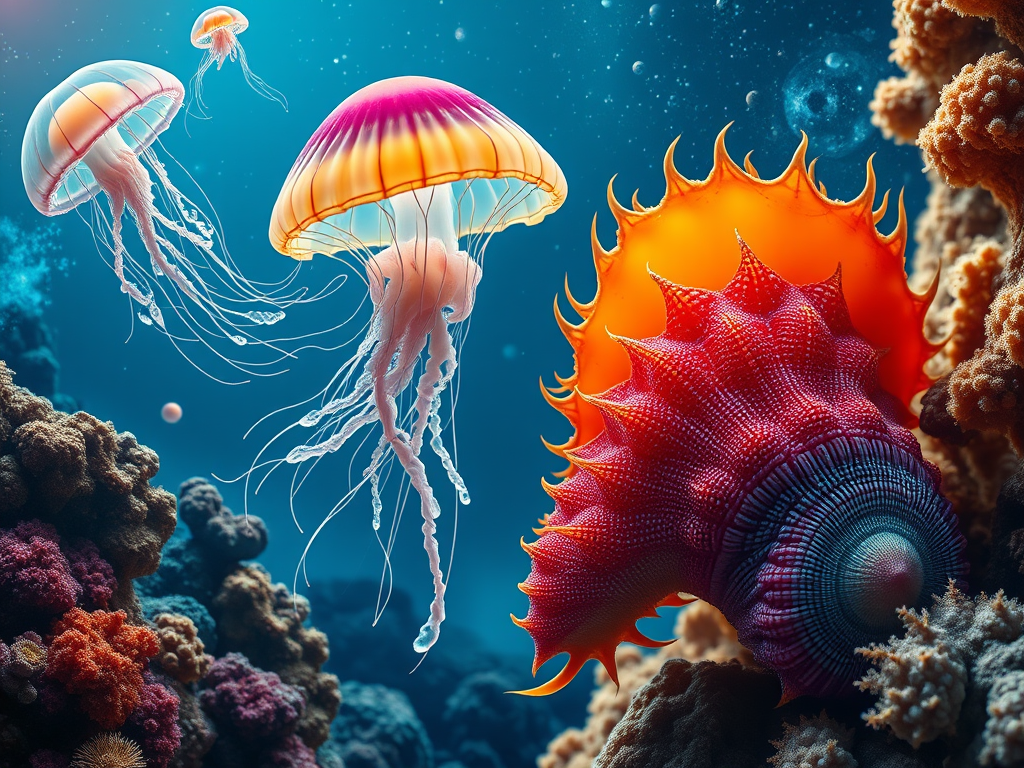
Have you ever read a fantasy book or watched a sci-fi movie and thought, “Wow, that’s wild! That could never be real!”? Well, get ready, because the real world, the one full of plants, animals, and tiny living things we can barely see, is often much, much stranger than anything people can invent! Nature is packed with creatures and life forms that have developed abilities, behaviors, and appearances so bizarre, they seem to defy logic.
Think about it: there are animals that can survive in outer space, plants that eat bugs, and tiny creatures that look like they belong on another planet. Biology, the study of life, constantly reveals new wonders that make you shake your head and marvel at how creative and surprising life on Earth can be. It’s like Earth is one giant laboratory where the most incredible experiments are happening all the time!
Let’s take a journey into the wild and weird side of the living world. Here are 10 astonishing facts about nature and biology that prove truth is definitely stranger, and often more amazing, than fiction.
1. The Immortal Jellyfish: Living Forever Is Actually a Thing!
Imagine being able to turn back time whenever you wanted. If you got old or injured, you could just reset yourself to being a baby again. Sounds like something out of a fairy tale, right? But there’s a real creature on Earth that can basically do this: the Turritopsis dohrnii jellyfish, often called the immortal jellyfish.
When most jellyfish get old, stressed, or injured, they die. But the immortal jellyfish has a truly astonishing ability. Instead of dying, it can revert its cells back to their earliest form, becoming a polyp colony again. Polyps are like the baby stage of a jellyfish, usually attached to a surface. From this polyp stage, new, genetically identical jellyfish can bud off. This means that theoretically, if not eaten or killed by disease, this jellyfish can repeat this process indefinitely, essentially living forever! This process, called transdifferentiation, allows one type of cell to become another type. It’s one of the most bizarre animal adaptations known and a truly astonishing nature fact that challenges our understanding of aging and death. It’s like a biological reset button, making this tiny creature one of the most fascinating biology wonders.
2. Tardigrades: The Toughest Animals on Earth Can Survive Space
If you were looking for an animal that could survive pretty much anything thrown at it, you’d probably picture something big and tough. But one of the most resilient creatures on the planet is also one of the smallest: the tardigrade, also known as the water bear or moss piglet. These microscopic invertebrates are less than a millimeter long but are incredibly tough.
Tardigrades can enter a state called cryptobiosis, where they dry out and their metabolism almost completely stops. In this state, they can survive extreme conditions that would kill almost any other living thing. We’re talking about temperatures near absolute zero (-272°C), temperatures above boiling (150°C), intense radiation (hundreds of times more than what would kill a human), crushing pressures found in the deepest ocean trenches, and even the vacuum of outer space! Scientists have sent tardigrades into space, and they survived exposure to the vacuum and radiation. This incredible ability to withstand the harshest environments makes tardigrades a prime example of bizarre animal adaptations and perhaps the toughest creatures on Earth. They are truly microscopic wonders that demonstrate life’s astonishing resilience and are a fantastic astonishing nature fact.
3. The Mimic Octopus: Nature’s Ultimate Impersonator
Octopuses are already super cool. They are incredibly intelligent, can change color and texture to blend in with their surroundings, and can squeeze through tiny spaces. But the mimic octopus from Indonesia takes things to a whole new level of weird and wonderful. This octopus doesn’t just camouflage itself; it actively impersonates other animals!
Using its flexible body and incredible control over its shape and movement, the mimic octopus can imitate the appearance and behavior of at least 15 different marine animals to scare away predators or sneak up on prey. It can flatten itself and move like a sole fish, puff up and swim like a poisonous lionfish, undulate its arms like a venomous sea snake, or even bury itself with two arms sticking out to look like a sea anemone. It chooses which animal to imitate based on the threat it faces. For example, if attacked by a fish that preys on octopuses, it might turn into the fish’s own predator! This astonishing ability is one of the most complex and bizarre animal adaptations ever observed, making the mimic octopus a master of disguise and a truly astonishing nature fact that highlights the clever strategies found in fascinating life forms.
4. Anglerfish Mating: A Love Story That’s Literally Skin Deep
The deep sea is full of strange and spooky creatures, but the anglerfish might have one of the weirdest love lives imaginable. In the pitch-black depths of the ocean, finding a mate can be incredibly difficult. Male anglerfish are much smaller than females and don’t have the glowing lure that the females use to attract prey. Their main goal in life is to find a female.
When a tiny male anglerfish finally finds a female, he doesn’t just mate and swim away. Instead, he bites onto her body and fuses himself to her! His mouth and body tissues merge with hers, and his blood vessels connect to her circulatory system. Over time, the male’s body degenerates, losing his eyes and fins, and he becomes a permanent, parasitic attachment on the female. He essentially turns into a living sperm packet, providing sperm whenever the female is ready to reproduce. The female can carry multiple males attached to her. This extreme form of sexual parasitism is one of the most bizarre animal adaptations in the animal kingdom and a truly astonishing nature fact found in the mysterious deep sea, making the anglerfish a fascinating, if slightly horrifying, example of biology wonders.
5. The Cuckoo Bird: The Ultimate Freeloader of the Bird World
Imagine working hard to build a home and raise your children, only for someone else to sneak in, get rid of your kids, and make you raise theirs instead! That’s essentially what some species of cuckoo birds do. They are known as brood parasites, meaning they lay their eggs in the nests of other bird species, known as host birds.
The female cuckoo bird watches the host bird build its nest. When the host bird is away, the cuckoo quickly flies in, lays an egg (often removing one of the host’s eggs to make the count seem right), and flies away. Cuckoo eggs often look remarkably similar to the host bird’s eggs, tricking the parent. When the cuckoo chick hatches, it usually does so before the host’s eggs. The cuckoo chick is programmed to push any other eggs or chicks out of the nest! The unaware host parents then work tirelessly to feed and raise the much larger cuckoo chick, sometimes even after it has grown bigger than they are. This clever and slightly cruel strategy is a remarkable bizarre animal adaptation focused on reproduction and survival, making the cuckoo bird’s life cycle an astonishing nature fact and a strange twist in bird biology wonders.
6. Venus Flytrap: A Plant That Acts Like an Animal
When we think of plants, we usually picture them standing still, soaking up the sun, and getting nutrients from the soil. But some plants have evolved incredible ways to get food, including trapping and eating animals, mostly insects. The Venus flytrap is perhaps the most famous example of a carnivorous plant, and its mechanism is truly astonishing.
Found in wetlands in the southeastern United States, the Venus flytrap has modified leaves that form a trap resembling a mouth with ‘teeth’ (actually stiff hairs called cilia) around the edges. Inside the trap are tiny trigger hairs. When an insect, like a fly or spider, lands on the trap and touches two of these trigger hairs in quick succession (or one hair twice), it signals the trap to snap shut incredibly fast – in less than a second! The teeth-like cilia interlock, preventing the prey from escaping. The trap then seals tightly, and the plant releases digestive enzymes to break down the insect, absorbing the nutrients. This active, rapid movement in a plant is unusual and fascinating, a remarkable plant behavior that seems almost animal-like. The Venus flytrap’s ingenious trapping mechanism is a prime astonishing nature fact showcasing unique plant defense mechanisms and predatory strategies in the plant kingdom.
7. Bioluminescence: Living Lights in the Darkness
Imagine if living things could produce their own light, like natural flashlights or glowing jewels. This isn’t science fiction; it’s a real biological phenomenon called bioluminescence. Many organisms, from tiny bacteria and fungi to deep-sea fish and fireflies, can create light through a chemical reaction within their bodies.
This ability is used for many different purposes. Fireflies use their flashing lights to signal to potential mates. Deep-sea creatures living in the perpetual darkness use bioluminescence to attract prey, scare away predators, communicate with each other, or even blend in with the faint light filtering down from the surface (counter-illumination). Some deep-sea anglerfish, for example, have a bioluminescent lure dangling from their heads to attract fish. The vibrant, often eerie glow produced by these organisms makes the deep sea and dark forests come alive in ways that seem magical. Bioluminescence is a widespread and diverse biology wonder, showcasing astonishing animal adaptations and plant behaviors (in some fungi) that rely on generating light. It’s a truly astonishing nature fact that adds a touch of natural wonder to our world.
8. Deep-Sea Hydrothermal Vents: Life Thrives in Extreme Heat and Chemicals
We often think of life needing sunlight, fresh air, and moderate temperatures to survive. But in the deepest, darkest parts of the ocean, where sunlight never reaches and the pressure is immense, life finds a way in the most unexpected places. Around deep-sea hydrothermal vents, cracks in the ocean floor that spew out super-hot, mineral-rich water, entire ecosystems thrive.
Instead of relying on sunlight for energy (like most life on Earth does through photosynthesis), the organisms here rely on chemosynthesis. Tiny microbes use the chemicals in the vent fluids, like hydrogen sulfide, as an energy source. These microbes form the base of the food chain, supporting bizarre and unique animals like giant tube worms (which have no mouth or digestive system and rely on symbiotic bacteria living inside them), blind shrimp, and strange mollusks. These creatures are adapted to live in incredibly hot, toxic, and high-pressure environments that would be instantly fatal to most other life forms. The existence of these thriving ecosystems around hydrothermal vents is an astonishing nature fact, revealing that life can flourish in the most extreme conditions and showcasing incredible bizarre animal adaptations in a world of biology wonders hidden beneath the waves.
9. Ant Colonies: Superorganisms With Mind-Boggling Coordination
Individually, an ant is just a tiny insect. But an ant colony can function like a single, massive organism, coordinating complex tasks with astonishing efficiency. Colonies can range from a few dozen individuals to millions, and they achieve incredible feats of engineering, foraging, and defense through intricate social organization and communication.
Ants communicate primarily through chemicals called pheromones, leaving scent trails to guide others to food sources or warn of danger. Different ants have different jobs: there are workers who forage for food and maintain the nest, soldiers who defend the colony, and the queen who lays eggs. Some ants even ‘farm’ fungus or ‘herd’ aphids for food. Certain ant species build incredibly complex underground nests with dedicated chambers for nurseries, food storage, and waste disposal. The collective intelligence and coordination displayed by an ant colony, where individuals work together for the good of the whole, is a remarkable example of biology wonders and bizarre animal adaptations in social insects. Studying ant colonies provides astonishing nature facts about how complex systems can emerge from simple individuals, showcasing the power of cooperation in fascinating life forms.
10. Mycorrhizal Fungi: The Hidden Underground Network That Connects Plants
Look at a forest or a garden, and you see individual trees and plants. But beneath the ground lies a hidden, complex network that connects many of them together. This network is formed by mycorrhizal fungi, which live in a symbiotic (mutually beneficial) relationship with the roots of most plants.
The fungi’s hyphae (thin, thread-like structures) extend far into the soil, much further than plant roots can reach, helping the plant absorb water and nutrients like phosphorus and nitrogen. In return, the plant provides the fungus with sugars produced during photosynthesis. But the connection goes even deeper. This fungal network can connect different plants, even those of different species. Plants can use this network to “communicate,” sending chemical signals to warn neighbors about pests or diseases. Larger, healthier plants can even share nutrients, like carbon (sugars), with smaller or weaker plants through the network. This underground web, sometimes called the “Wood Wide Web,” reveals a hidden world of cooperation and resource sharing among plants facilitated by fungi. It’s an astonishing nature fact that fundamentally changes how we view plant behavior and interactions, showcasing the incredible biology wonders happening constantly beneath our feet and highlighting the unseen complexity of fascinating life forms.
From immortal jellyfish and space-proof water bears to mimicking octopuses and plants that eat bugs, the world of nature and biology is filled with facts so wild, they seem like they must be fiction. These astonishing biology wonders are happening all around us, from the deepest oceans to our own backyards, proving that life on Earth is constantly surprising, ingenious, and truly stranger than anything we can imagine.
Further Reading
Want to explore more incredible facts about the living world? Check out these books:
- Odd Animals: The Weirdest and Wildest Animals on Earth by Lonely Planet Kids
- The Wondrous Workings of Planet Earth: Understanding Our Climate, Wild Weather, and Extraordinary Organisms by Rachel Ignotofsky
- Microbe Hunters by Paul de Kruif (A classic look at the scientists who discovered the microbial world, suitable for mature young readers)
- Pagoo by Holling C. Holling (A classic story about a hermit crab’s life, full of fascinating ocean facts)
Here at Zentara.blog, our mission is to take those tricky subjects and unlock them, making knowledge exciting and easy to grasp for everyone. But the adventure doesn’t stop on this page! We’re constantly exploring new frontiers and sharing discoveries across the digital universe.
Want to dive deeper into more mind-bending Top 10s and keep expanding your world? Come join us on our other platforms – we’ve got unique experiences waiting for you on each one!
- Get inspired by visual wonders and bite-sized facts: See the world through Zentara’s eyes on Pinterest! Pin our fascinating facts and stunning visuals to your own boards. Explore Pins on Pinterest: https://uk.pinterest.com/zentarablog/
- Discover quick insights and behind-the-scenes peeks: Hop over to Tumblr for snippets, quotes, and unique content you won’t find anywhere else. It’s a different flavour of discovery! Follow the Fun on Tumblr: https://www.tumblr.com/zentarablog
- Ready for deep dives you can listen to or watch? We’re bringing our accessible approach to video and potentially audio! Subscribe to our YouTube channel and tune into future projects that make learning pop! Subscribe on YouTube: https://www.youtube.com/@ZentaraUK
- Seeking even more knowledge in one place? We’ve compiled some of our most popular topic deep dives into fantastic ebooks! Find them on Amazon and keep the learning journey going anytime, anywhere. Find Our Ebooks on Amazon: https://www.amazon.co.uk/s?k=zentara+uk&crid=2273NA7RAJ1EU&sprefix=zentara+uk%2Caps%2C90&ref=nb_sb_noss
- Connect with us and fellow knowledge seekers: Join the conversation on BlueSky! We’re sharing updates, thoughts, and maybe even asking you what wonders we should explore next. Chat with Us on BlueSky: https://bsky.app/profile/zentarablog.bsky.social
- Perfect for learning on the move! We post multiple 10-minute podcasts per day on Spotify. Pop on your headphones and fill your day with fascinating facts while you’re out and about! Listen on Spotify: https://open.spotify.com/show/3dmHbKeDufRx95xPYIqKhJ
Every click helps us keep bringing honest, accessible knowledge to everyone. Thanks for exploring with us today – see you out there in the world of discovery!




Leave a Reply