
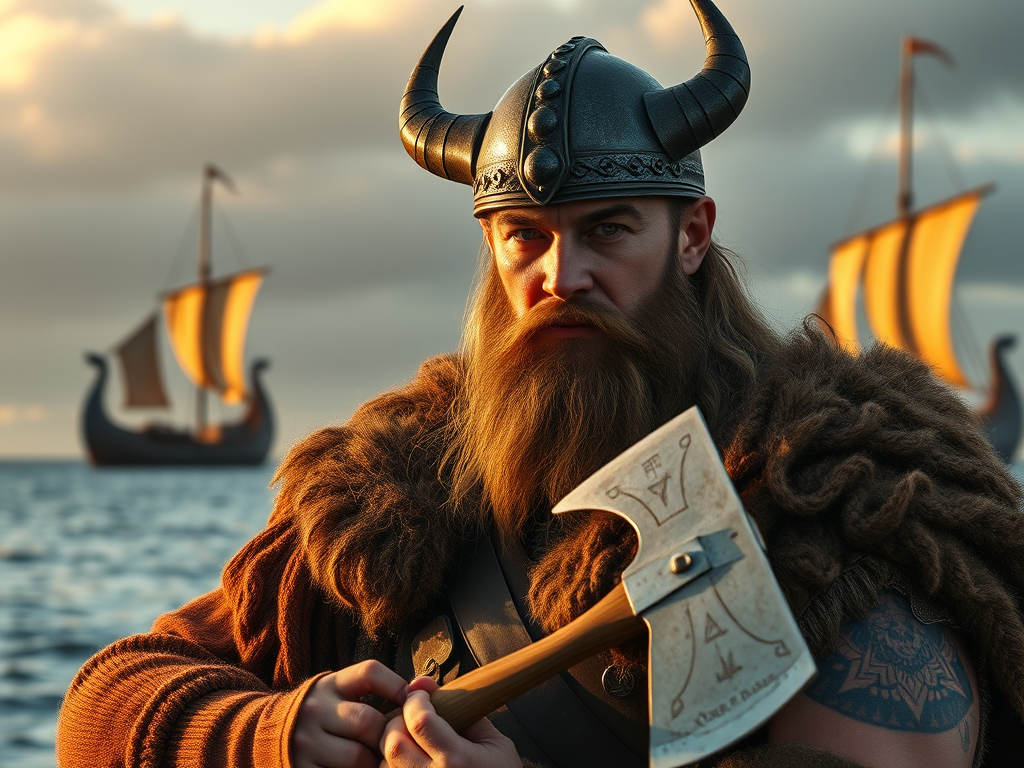
Okay, sharpen your axes and get your longships ready – metaphorically, of course! We’re about to journey into the world of the Vikings, those famous Norse seafarers from Scandinavia who made a big impact on history between the late 8th and early 11th centuries.
You’ve probably seen them in movies and TV shows, portrayed as fierce warriors with horned helmets, raiding and plundering. But just like a game of whispers, many stories about the Vikings have gotten twisted over time. Are they all just savage raiders? Did they really wear those cool horned helmets? It’s time to sort fact from fiction and uncover the truth behind some of the biggest Viking “hoaxes” or misconceptions. Get ready to be surprised!
1. Horned Helmets: The Essential Viking Battle Gear?
The Myth: The most iconic image of a Viking is a fierce warrior wearing a metal helmet adorned with impressive horns. It’s the go-to look for any Viking costume!
The Real Story: Surprise! There’s actually no good evidence that Viking warriors wore horned helmets in battle. Archaeologists have found only one nearly complete Viking Age helmet (the Gjermundbu helmet from Norway), and it’s a simple, practical iron cap with a faceguard – no horns in sight! The popular image of horned helmets was largely an invention of 19th-century artists and costume designers, especially for operas like Richard Wagner’s “Der Ring des Nibelungen.” They wanted to make the characters look more dramatic and “barbaric.” While some ancient Germanic and Bronze Age peoples (long before the Vikings) did use horned headgear for ceremonial purposes, it wasn’t a feature of Viking battle attire. Horns would have been impractical in a fight, easily getting caught or knocked off.
2. All Vikings Were Savage, Non-Stop Raiders
The Myth: Vikings were nothing more than bloodthirsty barbarians who sailed around an_d pillaged, burned, and looted everywhere they went, without any other purpose.
The Real Story: While it’s true that Vikings were formidable raiders and warriors – and some of their attacks were certainly brutal – this isn’t the whole picture. Many Norse people were also skilled traders, explorers, farmers, craftsmen, and settlers. They established vast trading networks that stretched from Canada in the west to Russia and Constantinople (modern-day Istanbul) in the east. They traded goods like furs, amber, walrus ivory, and unfortunately, slaves, for silver, silk, and spices. They also settled peacefully in many areas, like Iceland, Greenland, and parts of Britain and Normandy in France, becoming farmers and integrating with local populations. So, while raiding was a part of Viking activity, they were a much more complex society than just “savage raiders.”
3. Unhygienic Hooligans: Were Vikings Dirty and Smelly?
The Myth: With all that raiding and rough seafaring, Vikings are often imagined as being grimy, smelly, and unkempt, with matted beards and dirty clothes.
The Real Story: This is another popular misconception. Archaeological evidence suggests that Vikings actually cared a surprising amount about their personal hygiene, especially compared to some other Europeans of the time! Excavations of Viking sites have turned up grooming tools like combs (often elaborately carved), tweezers, ear picks, and even razors. Historical accounts from England mention that Vikings bathed regularly (perhaps once a week, which was frequent for the era!), combed their hair, and changed their clothes often. An Arab traveler named Ibn Fadlan, who met Vikings on the Volga River, did describe them as “the filthiest of Allah’s creatures,” but this might be due to cultural differences in hygiene standards (Muslims of that time bathed multiple times a day for prayer). For their time and place, Vikings likely put a decent effort into looking presentable.
4. Crude Navigators: Did Vikings Just Stumble Across New Lands?
The Myth: Vikings are sometimes portrayed as just happening upon new lands by luck, without truly sophisticated navigational skills, or their exploration reach is underestimated.
The Real Story: Far from it! Vikings were master shipbuilders and incredibly skilled navigators. Their longships were engineering marvels – light, strong, and flexible, with a shallow draft that allowed them to sail in deep seas and navigate shallow rivers. For navigation, they didn’t have modern GPS, but they were experts at using natural cues. They observed the position of the sun (possibly using a type of sun compass or “sunstone”), the stars (especially Polaris, the North Star), the flight patterns of birds, the behavior of sea mammals, wave patterns, and the color of the water. They also memorized coastlines and landmarks. Their skills allowed them to explore and settle vast areas, including Iceland, Greenland, and even reaching North America (Vinland, likely L’Anse aux Meadows in Newfoundland, Canada) around 1000 CE, nearly 500 years before Columbus!
5. If You Were Norse, You Were a Viking!
The Myth: The terms “Norse” (people from Scandinavia – modern-day Denmark, Norway, and Sweden) and “Viking” are often used interchangeably, meaning every person from that region during that era was a Viking.
The Real Story: This isn’t quite right. The word “Viking” (from Old Norse “víkingr”) most likely referred to a specific activity or a person who went on such an expedition – like “to go a-Viking,” meaning to go on a raid or a trading journey overseas. So, while all Vikings were Norse, not all Norse people were Vikings. The vast majority of the Scandinavian population during the Viking Age (roughly 793-1066 CE) were farmers, fishermen, merchants, craftsmen, and herders who lived relatively settled lives. Only a portion of the population, mostly young men seeking wealth or adventure, actually participated in these overseas expeditions. Using “Viking” to describe everyone from Scandinavia at that time is a bit like calling everyone from a coastal country a sailor today.
6. One Big Happy Viking Family: A United Viking Nation?
The Myth: It’s common to think of “the Vikings” as a single, unified nation or empire with one king ruling them all, like “King of the Vikings.”
The Real Story: During the Viking Age, Scandinavia was not one unified country. It was made up of many different, smaller territories ruled by local chieftains or petty kings. These groups often had their own distinct customs and sometimes even fought amongst themselves. While they shared a common Norse culture, language (Old Norse), and pagan religion (before converting to Christianity later), they were not politically united. Over time, powerful leaders did begin to consolidate larger kingdoms – like Harald Fairhair uniting parts of Norway, or Gorm the Old in Denmark – but this was a gradual process towards the end of the Viking Age. So, there was no single “Vikingland” ruled by one Viking overlord.
7. Viking Women: Just Meek Wives or All Fierce Shieldmaidens?
The Myth: Viking women are either imagined as oppressed and powerless, confined to the home, or, thanks to popular shows, as almost all being warrior “shieldmaidens” fighting alongside men.
The Real Story: The reality for Viking women was more complex and, in many ways, more progressive than in other parts of medieval Europe. Viking women had significant legal rights: they could own and inherit property, run businesses (especially when their husbands were away trading or raiding), request a divorce, and reclaim their dowries if the marriage ended. They were typically in charge of the household and farm. While the idea of shieldmaidens – female warriors – is prominent in sagas and mythology, and some archaeological finds (like a warrior grave in Birka, Sweden, identified as female) suggest some women may have fought, it probably wasn’t the norm for most. Women played vital roles in society as homemakers, producers of textiles, food preparers, and keepers of cultural traditions, holding a respected status.
8. All Vikings Were Blonde Giants
The Myth: The stereotypical Viking is tall, massively built, with flowing blonde hair and piercing blue eyes.
The Real Story: While this image is popular, it’s not entirely accurate. Genetic studies of Viking remains have shown that they were more diverse in appearance than the stereotype suggests. While blonde hair was common in Scandinavia and even admired (some darker-haired Vikings reportedly used a strong soap with lye to bleach their hair blonde!), many Vikings also had brown or red hair. Their eye color also varied. In terms of height, they were generally taller than many other Europeans of that period, but they weren’t all giants. Furthermore, as Vikings traveled, traded, and settled in new lands, there was intermingling with other populations, such as people from Southern Europe, the Slavic regions, and even the Saami people of northern Scandinavia, adding to their genetic diversity.
9. Drinking from the Skulls of Their Enemies: A Grisly Toast?
The Myth: A particularly gruesome image is that of Vikings celebrating victories by drinking ale or mead from the polished skulls of their defeated foes.
The Real Story: This gory myth is almost certainly false and likely stems from a misunderstanding or mistranslation of an old Norse poetic phrase. A 17th-century Danish scholar, Ole Worm, translated a line from a poem that described heroes in Valhalla drinking “from the curved branches of skulls” (likely referring to drinking horns) as drinking “from the skulls of those whom they had slain.” This dramatic misinterpretation stuck and contributed to the image of Vikings as exceptionally barbaric. While some ancient cultures in other parts of the world did use skulls ritually, there’s no reliable archaeological or historical evidence to suggest this was a practice among the Vikings.
10. The “Blood Eagle”: A Common and Horrific Viking Ritual?
The Myth: The “blood eagle” is a terrifyingly brutal method of ritual execution said to have been used by Vikings, where the victim’s ribs were cut from their spine and their lungs pulled out to resemble bloody wings.
The Real Story: The blood eagle is described in some Norse sagas and poetry, often as an act of extreme vengeance. However, its historical accuracy as a common, real-life practice is highly debated among scholars. There is no clear archaeological evidence that it ever actually happened. Some historians believe it was a literary invention, a gruesome metaphor, or an exaggeration created by later Christian writers to portray the pagan Vikings as particularly savage. While the sagas are valuable sources, they were often written centuries after the events they describe and can blend historical fact with legend and dramatic storytelling. So, while it’s a chilling image from Viking lore, it probably wasn’t a standard Viking execution method.
The real Vikings were a complex and influential people whose impact on history went far beyond simple raiding. They were explorers, traders, innovators, and settlers who left their mark across Europe and beyond. Understanding the truth behind the myths allows us to appreciate their fascinating culture even more!
Further Reading
Ready to explore more about the real Vikings? Check out these books:
- “DK Eyewitness Books: Viking” by Susan M. Margeson: A visually rich book with lots of information about Viking life, ships, and beliefs.
- “You Wouldn’t Want to Be a Viking Explorer!” by Andrew Langley: A fun and factual look at the challenges and adventures of Viking voyages.
- “The Penguin Historical Atlas of the Vikings” by John Haywood: Provides excellent maps and details about Viking expansion, trade routes, and settlements.
- “Norse Myths: Tales of Odin, Thor, and Loki” by Kevin Crossley-Holland: A great introduction to the fascinating world of Norse mythology that influenced Viking beliefs.
- “Who Were the Vikings?” (Usborne Starting Point History) by Jane Chisholm: An accessible book for younger readers covering the basics of Viking life.
Here at Zentara.blog, our mission is to take those tricky subjects and unlock them, making knowledge exciting and easy to grasp for everyone. But the adventure doesn’t stop on this page! We’re constantly exploring new frontiers and sharing discoveries across the digital universe.
Want to dive deeper into more mind-bending Top 10s and keep expanding your world? Come join us on our other platforms – we’ve got unique experiences waiting for you on each one!
- Get inspired by visual wonders and bite-sized facts: See the world through Zentara’s eyes on Pinterest! Pin our fascinating facts and stunning visuals to your own boards. Explore Pins on Pinterest: https://uk.pinterest.com/zentarablog/
- Discover quick insights and behind-the-scenes peeks: Hop over to Tumblr for snippets, quotes, and unique content you won’t find anywhere else. It’s a different flavour of discovery! Follow the Fun on Tumblr: https://www.tumblr.com/zentarablog
- Ready for deep dives you can listen to or watch? We’re bringing our accessible approach to video and potentially audio! Subscribe to our YouTube channel and tune into future projects that make learning pop! Subscribe on YouTube: https://www.youtube.com/@ZentaraUK
- Seeking even more knowledge in one place? We’ve compiled some of our most popular topic deep dives into fantastic ebooks! Find them on Amazon and keep the learning journey going anytime, anywhere. Find Our Ebooks on Amazon: https://www.amazon.co.uk/s?k=Zentara+UK&ref=nb_sb_noss
- Connect with us and fellow knowledge seekers: Join the conversation on BlueSky! We’re sharing updates, thoughts, and maybe even asking you what wonders we should explore next. Chat with Us on BlueSky: https://bsky.app/profile/zentarablog.bsky.social
- Perfect for learning on the move! We post multiple 10-minute podcasts per day on Spotify. Pop on your headphones and fill your day with fascinating facts while you’re out and about! Listen on Spotify: https://open.spotify.com/show/3dmHbKeDufRx95xPYIqKhJ
Every click helps us keep bringing honest, accessible knowledge to everyone. Thanks for exploring with us today – see you out there in the world of discovery!




Leave a Reply