
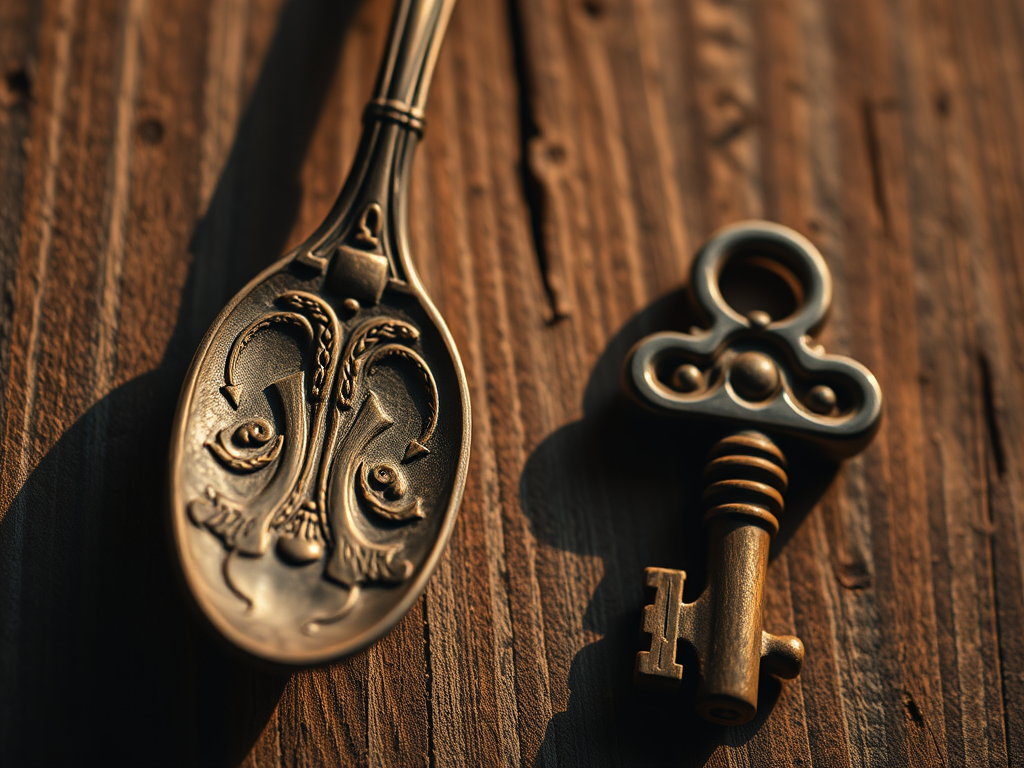
Have you ever stopped to think about the ordinary things you use every single day? That spoon you stir your cereal with, the key that unlocks your front door, or even the toothbrush you (hopefully!) use twice a day. They seem so simple, but these common objects have amazing stories! The history of everyday stuff is like a giant treasure hunt, uncovering the surprising origin of common objects for kids and revealing how clever inventors and everyday people from long ago shaped the world we live in. Many of these items weren’t invented overnight by a single genius; they evolved over thousands of years! Let’s dive into the fascinating story behind everyday things explained simply, including the history of spoons and keys for children, and discover who invented common household items that we often take for granted. Prepare for some truly amazing inventions we use daily for kids!
1. Spoons: From Scooping Shells to Silverware Staples
The humble spoon is one of humanity’s oldest eating tools, and its story starts long before fancy metal ones. In prehistoric times, people needed a way to scoop up liquids or mushy foods. What did they use? Natural objects like seashells, small pieces of curved wood, or even animal horns! The word “spoon” actually comes from an old Anglo-Saxon word “spon,” meaning a chip or splinter of wood. For thousands of years, these simple, often handmade, scoops did the job. The ancient Egyptians had beautifully carved wooden and ivory spoons, sometimes with elaborate handles. The Greeks and Romans made spoons from bronze and silver. It wasn’t until much later, around the 14th century, that spoons started to look more like the ones we use today, with an oval bowl and a handle. So next time you pick up a spoon, remember its long journey from a simple shell to your kitchen drawer – a true classic in the history of everyday stuff.
2. Keys and Locks: Securing Treasures Since Ancient Times
Imagine a time without locks and keys! People have always wanted to keep their valuable belongings safe. The history of spoons and keys for children shows keys are particularly ancient. The earliest known locks and keys, dating back around 6,000 years, were found in ancient Egypt and Mesopotamia. These were quite different from our metal keys today. They were large, wooden “keys” shaped a bit like a giant toothbrush, with wooden pegs that would lift pins inside a wooden bolt to unlock a door. The Romans were master engineers and improved on these designs, creating smaller locks and keys made of metal, like bronze and iron. They even invented “warded locks,” which had obstacles (wards) inside that the key had to pass. For centuries, locksmiths were like artists, creating intricate and sometimes secret locking mechanisms. The small, flat keys we use most often today are a more modern invention from the 19th century, but the basic idea of a unique shape opening a secure mechanism is thousands of years old!
3. Toothbrushes: From Chew Sticks to Bristly Buddies
Believe it or not, people have been cleaning their teeth for thousands of years, long before toothpaste tubes and plastic toothbrushes! One of the earliest forms of toothbrush was the “chew stick,” used in ancient civilizations like Babylon and Egypt around 3500-3000 BC. This was a small twig with one end frayed out to create bristles, which was then rubbed against the teeth. In China, around the 15th century, the first bristle toothbrush, more like what we know, was invented. These had stiff, coarse hairs from the back of a hog’s neck attached to bone or bamboo handles! These boar bristles were used for centuries. It wasn’t until 1938 that nylon bristles were introduced by DuPont, leading to the kind of toothbrushes we mostly use today. The first mass-produced toothbrush in the modern sense was made in England by William Addis around 1780. Quite an evolution for such an important daily tool, showing how where did things like toothbrushes and shoes come from often involves many steps.
4. Soap: Getting Clean Through the Ages
The origin of common objects for kids often includes things for hygiene, and soap has a surprisingly long history. Evidence suggests that a soap-like substance was being made by the Babylonians as early as 2800 BC! They made it by boiling fats with ashes. However, this early soap was probably used more for cleaning wool and cotton for textile production, or for medicinal purposes, rather than for personal bathing. The ancient Egyptians also used a form of soap. The Romans, famous for their public baths, initially used oils to clean themselves, sometimes scraping off the dirt with a tool called a strigil. While the knowledge of soap-making existed, it wasn’t until much later, around the 7th century in places like Spain and Italy, that soap-making became a craft, using olive oil. For a long time, soap was a luxury item. It only became an affordable, everyday cleaning product for most people in the 19th century with advances in chemistry and manufacturing.
5. Buttons: More Than Just Fasteners
Buttons! Those little discs that keep our clothes on. For a long time, people used pins, clasps, or simply tied their clothes with belts or cords. While button-like objects have been found dating back thousands of years (like in the Indus Valley Civilization), they were mostly used as ornaments rather than fasteners. The functional button, used with a loop or a buttonhole to fasten clothing, became common in Europe around the 13th or 14th century, especially with the rise of more fitted clothing. For a while, buttons were quite fancy and a sign of wealth – some people had buttons made of gold, silver, or jewels! King Francis I of France once had a coat adorned with 13,600 gold buttons! Over time, buttons became more practical and were made from more common materials like wood, horn, metal, and eventually, plastic. This journey from decoration to essential fastener is a fun part of the story behind everyday things explained simply.
6. Forks: From Royal Oddity to Table Essential
If you think the fork has always been a standard eating utensil, think again! For much of history, people ate with their fingers, a knife, and a spoon. Knives were used to cut food, and spoons for liquids. Early forks with two prongs were used in ancient Greece, but mainly for cooking or serving, not for individual eating. The idea of a personal dining fork slowly made its way to Europe from the Byzantine Empire, reaching Italy by the 11th century. Even then, it was considered a bit strange or overly fancy by many. Some people even thought it was an affront to God, who gave us fingers to eat with! It took until about the 16th and 17th centuries for forks to become more accepted in wealthy European households, largely thanks to figures like Catherine de’ Medici of Italy who brought them to the French court. It wasn’t until the 18th and 19th centuries that forks became common on most dining tables.
7. Shoes: Protecting Our Paws for Millennia
Where did things like toothbrushes and shoes come from? Well, shoes, in some form, have been around for a very, very long time, possibly as far back as 40,000 years ago! Early humans needed to protect their feet from rough ground, sharp rocks, and cold weather. The earliest “shoes” were probably simple wrap-arounds made of animal skins, grasses, or bark. The oldest preserved shoe, found in a cave in Armenia, is about 5,500 years old and made of a single piece of leather, laced up. Ancient Egyptians wore sandals made of papyrus or palm leaves. The Romans had various types of footwear, including sturdy military sandals called caligae. For centuries, shoes were handmade by cobblers, and often there was no difference between the left and right shoe until the 19th century! The Industrial Revolution brought machines that could mass-produce shoes, making them more affordable and varied.
8. Clocks: Marking the March of Time
Keeping track of time has always been important to humans. Early methods included observing the sun’s position (sundials), water clocks (which measured time by the flow of water), and hourglasses. The first mechanical clocks, using weights, gears, and an escapement mechanism (the part that makes the “tick-tock” sound by stopping and starting the gears), appeared in Europe in the late 13th and early 14th centuries. These early mechanical clocks were large, often found in church towers, and not very accurate – they might lose or gain many minutes a day! The invention of the pendulum clock by Christiaan Huygens in 1656 was a huge breakthrough, making clocks much more accurate. Over time, clocks became smaller, more precise, and more affordable, eventually leading to the watches and digital clocks we rely on. This evolution is a fascinating part of the invention of everyday items for students.
9. Paper: From Papyrus to Pulped Trees
Before paper, people wrote on all sorts of things: clay tablets, stone, wood, silk, and papyrus (made from the papyrus plant by the ancient Egyptians). True paper, as we know it, is credited as being invented in China by Cai Lun around 105 AD. He developed a process of mashing up things like tree bark, hemp, rags, and fishing nets with water, pressing out the liquid, and letting the matted fibers dry into sheets. This new material was much lighter and cheaper to produce than silk or bamboo strips, which were previously used for writing in China. The art of papermaking slowly spread from China along the Silk Road to the Middle East, and then to Europe by the 11th and 12th centuries. The invention of the printing press in the 15th century created a huge demand for paper, making it one of the most impactful amazing inventions we use daily for kids and adults.
10. Pencils: Making Your Mark on History
The pencil seems so simple, but it also has a rich history! The ancient Romans used a thin metal rod called a stylus to leave a light but readable mark on papyrus. For a long time, “lead” pencils (which actually used a form of lead, not graphite) were used for drawing. The modern pencil, using graphite, came about after a large deposit of solid graphite was discovered in Borrowdale, England, in the 1560s. This graphite was pure and solid, so it could be sawn into sticks. Because graphite is soft and brittle, it needed a casing. Initially, the graphite sticks were wrapped in string or sheepskin. Later, they were inserted into hollowed-out wooden sticks – the first wood-cased pencils! An Italian couple, Simonio and Lyndiana Bernacotti, are credited with creating the first wooden pencils by hollowing out juniper wood around 1560. The design was further improved, and methods for mass production were developed, giving us the trusty pencil we use today.
Isn’t it amazing how these everyday objects, which we rarely give a second thought, have such long and interesting stories? Each one is a testament to human ingenuity and our constant drive to make life a little bit easier, safer, or more comfortable!
Further Reading
If you’re curious to uncover more secrets behind the stuff you use every day, check out these books (as of May 21, 2025):
- The Way Things Work Now by David Macaulay (A fantastic, illustrated guide that explains the mechanisms and history behind all sorts of objects and machines, big and small.)
- Mistakes That Worked: 40 Familiar Inventions & How They Came to Be by Charlotte Foltz Jones (Highlights the often surprising and accidental ways everyday items were invented.)
- How Things Are Made (How ____ Is Made) by National Geographic Kids (This series often delves into the manufacturing and sometimes the history of everyday items in an accessible way.)
- The Evolution of Useful Things by Henry Petroski (While more advanced, the core ideas about how objects evolve through design and use can be fascinating, and simplified explanations might be found in related kids’ articles.)
- Totally Awesome Inventions You Use Every Day (And a Few You Don’t) by National Geographic Kids (Focuses on the fun facts and stories behind various inventions, perfect for this age group.)




Leave a Reply