
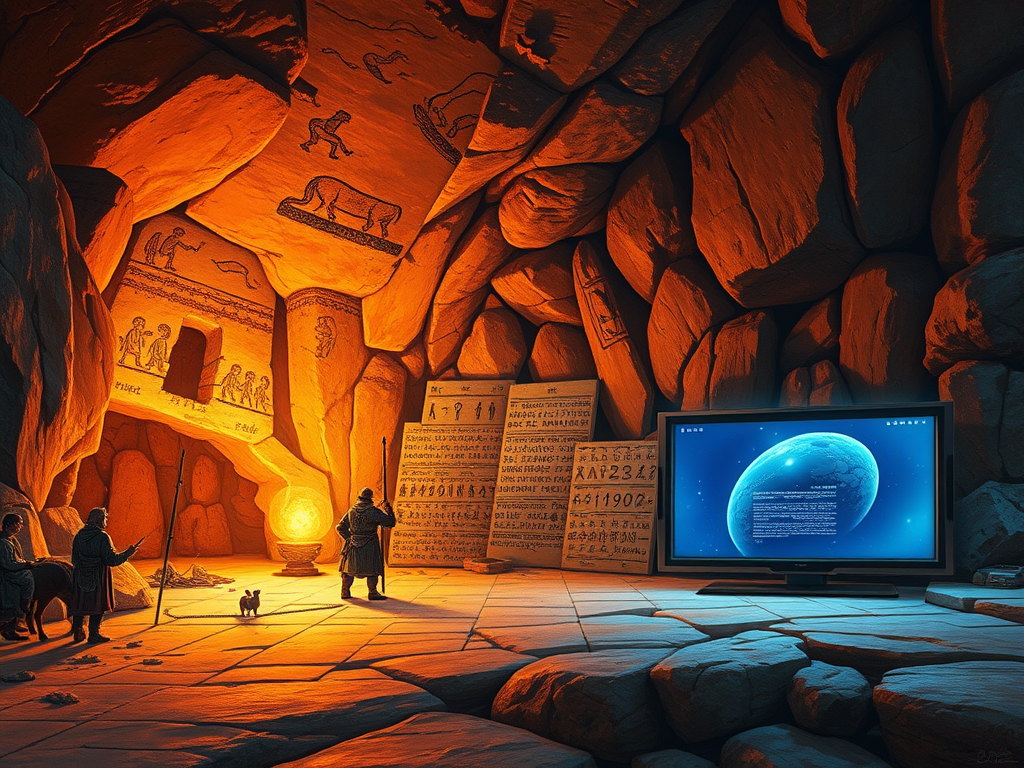
Have you ever wondered how people shared stories or remembered important facts before smartphones, computers, or even printed books? Imagine a world without your favorite websites, video games, or even the books on your shelf! For thousands of years, humans have been figuring out clever ways to record information – from secret codes on cave walls to the glowing screens we use every day.
This isn’t just a story about old, dusty objects; it’s an adventure through time, exploring the amazing inventions that changed how we learn, share, and remember. It’s the history of recording information, a journey packed with brilliant ideas and game-changing moments. So, buckle up as we explore the top 10 incredible milestones that took us from ancient scrolls to the super-fast screens in our hands! Get ready to see how each step helped build the information-packed world we live in today.
1. Cave Walls and Storytellers: The Dawn of Sharing Knowledge (30,000 BCE – 5000 BCE)
Long before anyone knew how to write, people still had big ideas, important memories, and amazing stories to share! So, how did they do it? One of the earliest ways was through cave paintings. Imagine ancient artists using crushed berries for red, charcoal for black, and animal fat to mix their paints. They’d cover cave walls with pictures of hunts, animals, and daily life. These weren’t just pretty pictures; they were a way to record what was important, perhaps to teach younger generations, or even for magical or religious reasons.
Alongside these visual records, oral tradition was super important. This means stories, histories, and knowledge were passed down by word of mouth, from person to person, generation to generation. Think of it like an epic game of telephone, but with skilled storytellers who were like living libraries! While not a physical recording, these spoken words, combined with early art, were the very first steps humans took towards preserving and sharing information, laying the groundwork for future ancient writing systems.
2. Clay Tablets and Hieroglyphs: The Birth of Writing (c. 3500 BCE – 500 CE)
Imagine wanting to keep track of how many sheep you have or send a message to someone far away, but you can’t just text them! Around 5,500 years ago in places like Mesopotamia (modern-day Iraq) and Egypt, people started figuring out a solution: writing! The Sumerians in Mesopotamia developed a system called cuneiform, which means “wedge-shaped.” They used a stylus (like a pointy pen) to press wedge-like shapes into soft clay tablets. When these tablets dried in the sun or were baked, they became hard and durable – like mini stone books! Archaeologists have found thousands of these, telling us about laws, trades, and even stories.
Meanwhile, in Egypt, they developed hieroglyphs, beautiful picture-like symbols often carved into stone monuments or painted on tomb walls. These symbols could represent sounds, objects, or ideas. This was a huge leap in the history of recording information because now ideas could be written down and last for centuries, even if the person who wrote them was long gone. It was the beginning of a more permanent way to share and store knowledge.
3. Papyrus Scrolls: Rolling Out Knowledge (c. 3000 BCE – 1000 CE)
Clay tablets were great for keeping records, but they were heavy and clunky! Imagine trying to carry a library of clay tablets around. The ancient Egyptians came up with a lighter, more portable solution: papyrus. Papyrus is a plant that grows along the Nile River. They would cut the plant’s stem into thin strips, lay them in crisscross layers, press them together, and dry them to create a smooth, light-brown writing surface, a bit like paper.
These sheets of papyrus could be glued together to make long strips, which were then rolled up into scrolls. Think of a scroll like a very long webpage that you have to keep scrolling down (or across) to read! Scrolls were much easier to carry and store than clay tablets. They became the go-to way for recording everything from religious texts and royal decrees to literature and scientific notes across Egypt, Greece, and Rome for thousands of years. This innovation was a key step in the evolution of writing materials, making information more accessible.
4. The Codex: Flipping the Page on Information (c. 100 CE – 500 CE)
Scrolls were great, but they could be a bit awkward. Imagine trying to find a specific piece of information in the middle of a 30-foot long scroll – you’d have to unroll the whole thing! Around the 1st century CE, a new invention started to appear, especially among early Christians: the codex. A codex is basically an ancient book, made of stacked sheets of papyrus or parchment (animal skin prepared for writing) that were folded and stitched together along one edge, often with a cover.
This was a game-changer! With a codex, you could flip directly to any page you wanted, much like a modern book. It was easier to read, easier to carry, and you could write on both sides of the page, which saved material. The codex made it much simpler to look up information quickly and to compare different texts. This move from scrolls to digital text (well, not quite digital yet, but a big step towards easier access!) was as revolutionary as the shift from old cassette tapes to easily navigable MP3 playlists.
5. Paper Power: A Chinese Invention Spreads (c. 105 CE – Present)
While papyrus was good, and parchment (made from animal skins) was even more durable, both were quite expensive and time-consuming to make. Then, around 105 CE in China, a court official named Cai Lun is credited with inventing or significantly improving paper as we know it. Early paper was made from things like mulberry bark, hemp, rags, and old fishing nets, mashed into a pulp, spread thin, and dried.
Paper was lighter, cheaper to produce, and more absorbent for ink than papyrus or parchment. For centuries, the secret of papermaking was closely guarded in China. However, it gradually spread along trade routes like the Silk Road, reaching the Middle East by the 8th century and Europe by the 11th century. The arrival of paper was a massive boost for literacy and record-keeping wherever it went. It provided an affordable surface for writing, drawing, and eventually, printing, becoming a cornerstone for the history of books and printing.
6. Gutenberg’s Printing Press: The Information Explosion (c. 1440 CE)
For thousands of years, if you wanted a copy of a book or a document, someone had to write it out by hand. This was slow, expensive, and errors could easily creep in. Then, around 1440, a German inventor named Johannes Gutenberg developed a printing press that used movable metal type. This meant individual letters made of metal could be arranged to form words and sentences, locked into a frame, inked, and then pressed onto paper to create a page. The type could then be reused for the next page!
This invention was like setting off an information bomb! Suddenly, books and pamphlets could be made hundreds of times faster and much more cheaply than ever before. Ideas could spread like wildfire. The impact of the printing press on information was enormous – it fueled the Renaissance, the Reformation, and the Scientific Revolution by making knowledge accessible to far more people. It was a pivotal moment in the timeline of information technology, even though it was mechanical, not digital.
7. Capturing Moments: Photography and Film (1820s – Present)
For millennia, the only way to record what something or someone looked like was through painting or drawing. But then, in the 19th century, inventors found ways to capture images using light and chemicals – the birth of photography! Early photographs, like daguerreotypes, were amazing because they showed a “real” moment frozen in time. It changed how people saw the world and how they recorded history, family, and important events.
Taking this even further, inventors soon figured out how to capture a series of photographs in quick succession and play them back to create the illusion of movement. This led to motion pictures, or film, in the late 1800s. Now, not only could static images be recorded, but also moving events, stories, and performances. From family photo albums and news reports to blockbuster movies, photography and film opened up entirely new dimensions for recording and sharing human experiences, a big leap from just text and drawings.
8. Sounds of the Past: From Phonographs to Magnetic Tape (1877 – Present)
Imagine a world where you could never hear a song unless it was played live, or never hear the voice of a loved one unless they were right there. That was reality until Thomas Edison invented the phonograph in 1877. This amazing machine could record sound onto a tinfoil-covered cylinder and play it back! Later, flat discs (records) made of shellac and then vinyl became popular. For the first time, music, speeches, and any other sounds could be captured and replayed for anyone, anywhere.
Later, in the 20th century, magnetic tape offered another way to record sound, and eventually video too (think of VHS tapes!). This technology used a thin plastic tape coated with magnetic particles. Sound waves would be converted into electrical signals that magnetized the particles on the tape. This was more versatile and allowed for easier editing and longer recordings. From your grandparents’ vinyl records to cassette tapes, sound recording preserved voices and music, adding another rich layer to how information was recorded.
9. The Digital Dawn: Computers and Early Storage (1940s – 1980s)
The mid-20th century saw the birth of something truly revolutionary: the computer. Early computers were enormous machines filling entire rooms, and they used very different methods to store information. Some used punch cards – stiff paper cards with holes punched in specific patterns to represent data. Others moved on to magnetic tape (similar to that used for audio but for computer data) and then magnetic disks, like floppy disks and early hard drives.
These methods marked the beginning of digital information storage. “Digital” means information is stored as a series of numbers (specifically, 0s and 1s, called binary code). This was a huge shift because digital information could be copied perfectly, searched easily (eventually!), and stored much more densely than physical records. While early computers were mainly for scientists and big organizations, they were paving the way for the personal computers and digital devices that would soon change everything.
10. Screens and Clouds: Information Everywhere, All the Time (1990s – Present)
And here we are, in an age of glowing screens! The invention of the internet in the late 20th century, followed by the World Wide Web, connected computers all over the globe. This, combined with powerful personal computers, smartphones, tablets, and high-speed internet, has completely transformed how we record, access, and share information. Think about it: you can access vast libraries of books, music, videos, and articles with a few taps on a screen.
Today, much of our information is stored digitally – on hard drives (HDDs), solid-state drives (SSDs) which are super fast, and increasingly in the “cloud”. Cloud storage means your photos, documents, and music are saved on powerful computer servers owned by companies, and you can access them from any device with an internet connection. It’s like having an invisible, almost limitless filing cabinet! This era of digital information storage history means we can create, share, and access more information more quickly than ever imagined, truly taking us “from scrolls to screens.”
And that’s our whirlwind tour through the incredible history of recording information! From ancient cave paintings to the powerful devices in our pockets, humans have always found ingenious ways to capture their thoughts, stories, and discoveries. Each step built on the last, leading us to the amazing, interconnected world we live in today. What do you think the next big step will be?
Further Reading
Want to dig deeper into how we’ve recorded our world? Check out these fascinating books:
- Papyrus: The Invention of Paper in Ancient Egypt by John Gaudet – A detailed look at this amazing plant and its impact. (Might be for slightly older readers or with adult help)
- The Book: A Cover-to-Cover Exploration of the Most Powerful Object of Our Time by Keith Houston – Explores the history of the book, from scroll to codex to modern printing.
- How the Internet Happened: From Netscape to the iPhone by Brian McCullough – A look at the more recent history of information technology.
- DK Eyewitness Books: Technology by DK – A visually rich book that often covers historical inventions, including those related to information.
- You Wouldn’t Want to Live Without Writing! by Fiona MacDonald (part of the “You Wouldn’t Want to Live Without…” series) – A fun, illustrated look at the importance and history of writing for younger readers.




Leave a Reply