
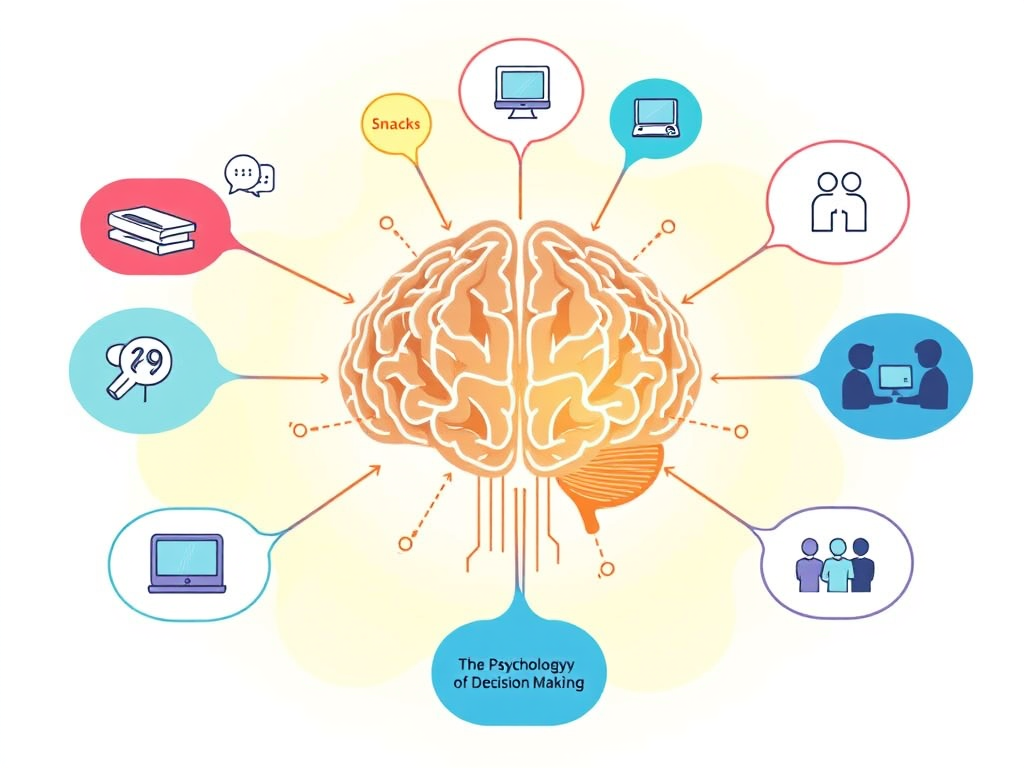
Have you ever wondered why you picked a certain snack, chose one video game over another, or decided to hang out with specific friends? Every single day, from the moment we wake up, we make hundreds, if not thousands, of decisions. Some are tiny, like what socks to wear, while others are huge, like what subjects to study for your future. The fascinating field of psychology of decision making explores exactly this: the hidden workings of our minds that guide us to choose one path over another. It’s like being a detective, but instead of solving crimes, we’re uncovering the clues behind why we make choices the way we do. Get ready to explore the amazing, sometimes surprising, reasons behind your decisions!
1. The Amazing Brain: Your Personal Decision-Making Supercomputer!
Your brain is an incredible organ, working tirelessly even when you’re not consciously thinking about it. One of its most important jobs is making decisions. Think of it like a super-powerful computer, constantly processing information from your senses, memories, and feelings to help you navigate the world. Every choice, whether it’s hitting snooze on your alarm or figuring out a tricky math problem, involves a complex mental process. The psychology of decision making helps us understand this process. It’s not just about random guesses; there are patterns and reasons behind even the simplest choices.
We make decisions to solve problems (like “What should I eat for lunch when I’m hungry?”) or to reach goals (like “How can I save enough money to buy that new game?”). Even choosing not to do something is a decision! Understanding why we make choices in certain ways can help us make better, more thoughtful decisions in the future. It’s like learning the user manual for your own amazing brain, helping you to understand its default settings and how to use its advanced features more effectively. This journey into our minds shows just how intricately we are wired to choose and act.
2. Fast vs. Slow Thinking: The Two Roads Your Brain Takes for Choices!
Imagine you’re choosing an ice cream flavor. Sometimes, you just know you want chocolate – that’s fast thinking! Other times, maybe you’re trying a new place with dozens of unusual flavors, and you carefully read each description, weigh the pros and cons, and then decide – that’s slow thinking. Psychologists often talk about these two main ways our brains make decisions, sometimes called System 1 (fast) and System 2 (slow). Understanding these is key to figuring out why we make choices and exploring the balance between rational vs emotional decision making.
System 1 is your brain’s automatic pilot. It’s quick, intuitive, and often driven by emotions and gut feelings. It’s what you use for everyday habits, like tying your shoelaces or reacting instantly to a loud noise. It’s super efficient for simple tasks but can sometimes jump to conclusions. System 2, on the other hand, is your conscious, deliberate, and analytical thinking. It requires more effort and is used for complex problems, learning new things, or when you need to carefully consider different options. For example, solving a complex puzzle or planning a detailed project would engage System 2. Both systems are incredibly useful, but knowing when your fast thinking might be taking over from your slower, more logical brain can help you make smarter choices, especially when the stakes are high.
3. Mind Traps! How Sneaky Cognitive Biases Trick Your Choices (Cognitive Biases Explained Simply)
Ever been absolutely sure about something, only to find out you were mistaken? Or perhaps you’ve noticed you tend to agree with information that already fits what you believe? These could be examples of cognitive biases at play. Cognitive biases explained simply are like little shortcuts or mental glitches in our thinking that can lead us to make less-than-perfect decisions. They are systematic patterns of deviation from norm or rationality in judgment, and they are one of the major factors influencing your choices.
One common bias is confirmation bias. This is where we tend to search for, interpret, favor, and recall information in a way that confirms or supports our pre-existing beliefs or values. For example, if you think a certain music band is the best, you’re more likely to notice and remember their hit songs and positive reviews, while ignoring their flops. Another one is anchoring bias, where we rely too heavily on the first piece of information offered (the “anchor”) when making decisions. If the first price you see for a t-shirt is £50, then a similar one for £30 seems like a great deal, even if its actual worth is only £15. These biases aren’t necessarily a sign of being unintelligent; they’re just part of how human brains work to process a lot of information quickly. Being aware of them is the first step to not letting these mind traps overly influence important decisions.
4. Mental Shortcuts: Heuristics, Your Brain’s Speedy Helpers (and Hinderers!) (Mental Shortcuts in Thinking)
Imagine you had to deeply analyze every single tiny decision you make all day – you’d be exhausted! To save time and mental energy, our brains use mental shortcuts in thinking called heuristics. These are like quick rules of thumb or educated guesses that help us make decisions rapidly and efficiently. They are a big part of the psychology of decision making and often work pretty well, but sometimes they can lead us astray.
One common heuristic is the availability heuristic. This is when we overestimate the likelihood of events that are easily recalled in our memory, often because they are recent or particularly vivid. For example, if you just saw several news reports about plane crashes, you might feel that flying is more dangerous than it statistically is, because those vivid images are readily available in your mind. Another is the recognition heuristic, where if you’re choosing between two items, and you recognize one but not the other, you’re likely to assume the recognized one has more value or is better. This is why brands spend so much on advertising – so you recognize their product! While heuristics are essential for navigating a complex world without getting bogged down, it’s good to remember they are shortcuts, not foolproof methods, and sometimes a longer, more careful thought process is needed.
5. Feelings in Charge? How Emotions Steer Your Decisions (How Emotions Affect Decisions)
Have you ever made a decision when you were really excited, super angry, or incredibly sad? If so, you’ve experienced firsthand how emotions affect decisions. Our feelings play a huge role in the choices we make, sometimes even more than logic or reason. This interaction between feeling and choosing is a core concept in understanding rational vs emotional decision making.
For instance, if you’re feeling happy and optimistic, you might be more willing to take risks or try new things. You might buy that concert ticket on a whim because you’re caught up in the excitement. On the flip side, if you’re feeling anxious or fearful, you might be more cautious and stick to safer, more familiar options. Anger can lead to impulsive decisions, perhaps saying something you later regret. Even boredom can influence choices, leading us to seek out novelty or distraction. Sometimes emotions are helpful guides; a gut feeling of unease can be a warning. However, strong emotions can also cloud our judgment, making it hard to see things clearly. Learning to recognize when your emotions are running high and how they might be influencing your choices can help you pause and ensure your decisions align with your long-term goals, not just your feelings of the moment.
6. The Power of the Crowd: How Friends and Others Sway Your Choices (Social Influence)
Why do certain fashion trends catch on? Why do you suddenly want to try a new game all your friends are playing? This is the power of social influence, one of the key factors influencing your choices. We are social creatures, and the people around us – our friends, family, classmates, and even people we see online – can have a big impact on our decisions. This is especially true during our teen years, making it an important aspect of decision making for teens.
One powerful type of social influence is conformity. This is when we change our behavior or beliefs to match those of a group, often because we want to fit in or because we believe the group knows more than we do. If everyone in your group starts wearing a certain brand of trainers, you might feel an urge to get them too. Peer pressure is a more direct form of this, where others actively encourage you to do something. Beyond just friends, societal norms – the unwritten rules about what’s considered “normal” behavior – also guide our choices, often without us even realizing it. While being influenced by others isn’t always bad (it can help us learn and cooperate), it’s important to be aware of it. This allows you to think about whether you’re making a choice because you genuinely want to, or because you feel pressured or influenced by the crowd.
7. Been There, Done That: How Past Experiences Shape Your Current Choices (Past Experiences)
Imagine you once ate a strange-looking fruit and it tasted amazing. The next time you see a similar-looking fruit, you’re probably more likely to try it. Conversely, if you touched a hot stove and got burned as a child, you learned very quickly to be careful around them. These are examples of how our past experiences are powerful factors influencing your choices today. Every experience, good or bad, teaches us something and helps shape our future decisions.
This is a fundamental part of why we make choices. Our brain is constantly learning from outcomes. If a particular choice led to a positive result (a reward, success, happiness), we’re more likely to repeat that choice in a similar situation. This is called reinforcement. If a choice led to a negative result (a punishment, failure, pain), we’re more likely to avoid it. This is how we learn to navigate the world more effectively. For example, if you studied hard for a test and got a good grade, that positive experience will likely encourage you to study hard for future tests. However, past experiences can sometimes lead to biases. A single bad experience with a certain type of food, for instance, might make you avoid it for years, even if you might enjoy it now. Recognizing how your past influences your present helps you evaluate if those learned responses are still serving you well.
8. What Really Matters to YOU? Values and Personal Beliefs in Decision Making (Personal Values)
What do you care about most? Honesty? Kindness? Adventure? Success? These are your personal values, and they act like an internal compass, guiding your decisions and shaping why we make choices that feel right to us. Along with your beliefs about the world and how it works, your values are significant factors influencing your choices, often steering you towards options that align with who you are and what you stand for.
For example, if honesty is a core value for you, you’re more likely to choose to tell the truth, even when it’s difficult. If you value environmental protection, you might choose to recycle, use less plastic, or support eco-friendly brands. Our moral beliefs also play a huge role. If you believe it’s wrong to cheat, you’ll likely decide against it, even if there’s an opportunity. These deeply held values and beliefs often operate at a subconscious level, but they become particularly important when we face big decisions or moral dilemmas. Making choices that are in line with your values generally leads to a greater sense of satisfaction and integrity. Sometimes, understanding your own core values can clarify difficult decisions – if you know what truly matters to you, the “right” path often becomes clearer.
9. Too Many Options! The Problem with Choice Overload (Choice Overload)
You walk into a sweet shop, and there are hundreds of different types of sweets. Or you open a streaming service, and there are thousands of films and shows. Sounds great, right? More choice is always better… or is it? Surprisingly, the psychology of decision making shows that too many options can actually be overwhelming, a phenomenon called choice overload. This is particularly relevant for decision making for teens who are often faced with a multitude of choices about their future, hobbies, and social lives.
When faced with too many alternatives, we can experience several negative effects. Firstly, it can lead to decision paralysis – making it so hard to choose that we end up not choosing at all. Secondly, even if we do make a choice, we might feel less satisfied with it. We might worry that we picked the “wrong” one, or wonder if one of the other hundred options would have been better (this is sometimes called “fear of missing out” or FOMO). The effort of evaluating so many options can also be mentally exhausting. To combat choice overload, it can be helpful to narrow down your options by first identifying what’s most important to you (your key criteria), or by simply limiting the number of choices you consider. Sometimes, having fewer, well-understood options can lead to happier, more confident decisions.
10. Becoming a Better Chooser: Tips for Sharper Decision Making (Improving Decision Skills)
Understanding the psychology behind our decisions is fascinating, but it can also be practical. By learning about why we make choices the way we do, we can actually improve our decision-making skills. This isn’t about always making the “perfect” choice (because that rarely exists!), but about making more thoughtful, informed, and confident decisions. This is especially valuable for decision making for teens, as you navigate increasingly complex choices.
One key tip is to pause before you decide, especially for important choices. This gives your “slow thinking” (System 2) a chance to catch up with your “fast thinking” (System 1) and consider the options more carefully. Ask yourself: What are the potential consequences of this decision, both short-term and long-term? Try to identify any biases or emotions that might be influencing you. Are you leaning towards an option just because it’s familiar, or because your friends are doing it?
Another great strategy is to gather more information and consider different perspectives. Don’t just rely on your first instinct or one source of advice. Finally, learn from your past decisions. Reflect on what went well and what didn’t – not to dwell on mistakes, but to extract lessons for the future. Becoming a better decision-maker is a lifelong skill that grows with practice and self-awareness.
The way we make decisions is a complex and wonderful dance between logic, emotion, experience, and social influence. By understanding these psychological forces, we can not only marvel at the workings of our own minds but also empower ourselves to make choices that better reflect our goals and values, leading to a more considered and fulfilling life.
Further Reading
If you’re curious to learn more about the psychology of decision making, here are a few books that offer great insights in an accessible way:
- Thinking, Fast and Slow by Daniel Kahneman (This is a classic, though quite detailed. Younger readers might find summaries or specific chapters most accessible.)
- Predictably Irrational: The Hidden Forces That Shape Our Decisions by Dan Ariely (Full of fascinating experiments and stories about why we don’t always act rationally.)
- Nudge: Improving Decisions About Health, Wealth, and Happiness by Richard H. Thaler and Cass R. Sunstein (Explores how choices can be designed to help people make better decisions.)
- The Art of Choosing by Sheena Iyengar (A brilliant look at how and why we choose, and the cultural differences in decision-making.)
- Sway: The Irresistible Pull of Irrational Behavior by Ori Brafman and Rom Brafman (Explores the psychological forces that derail rational thought.)




Leave a Reply