
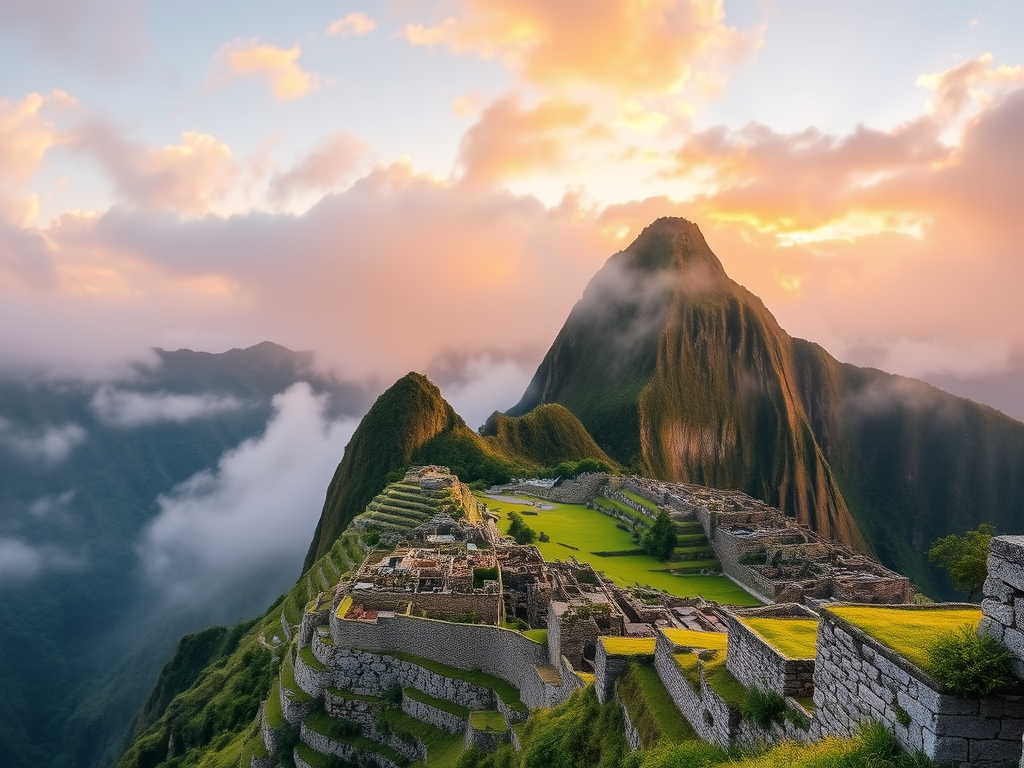
Imagine a lost city, perched high in the Andes Mountains, surrounded by mist and breathtaking scenery. That’s Machu Picchu, the incredible ancient city of the Inca civilization in Peru! It’s one of the most famous archaeological sites in the world, a true wonder that leaves millions of visitors speechless. But beyond its stunning beauty, Machu Picchu holds countless secrets and surprising truths that reveal the astonishing genius of the Inca people.
Machu Picchu isn’t just a collection of old stones; it’s a masterpiece of engineering, architecture, and astronomy, built by a civilization that didn’t even use the wheel or iron tools! How did they achieve such feats in such a challenging environment? The more we learn about Machu Picchu, the more amazed we are by the Inca’s advanced knowledge and their deep connection to the natural world.
In this article, we’re going on an exciting journey to uncover ten jaw-dropping facts about Machu Picchu. We’ll explore its clever construction, its sophisticated systems, and the astronomical wisdom hidden within its structures, bringing the incredible Inca civilization vividly to life. Get ready to be amazed by the ancient secrets of this legendary mountain citadel!
1. Earthquake-Resistant Architecture: Built to Sway, Not Crumble
One of the most astonishing truths about Machu Picchu is how it has survived for over 500 years in a highly active earthquake zone. The Inca engineers didn’t use mortar (like cement) between their precisely cut stones. Instead, they perfected a technique called “ashlar masonry,” where stones are cut so perfectly that they fit together like puzzle pieces, without any gaps.
This ingenious method, combined with trapezoidal doors and windows (wider at the bottom, narrower at the top), allowed their buildings to “dance” or sway slightly during an earthquake, rather than collapsing. When tremors hit, the stones would shift and then fall back into place, similar to how a jigsaw puzzle can be shaken without breaking apart. This incredible understanding of seismic activity, centuries before modern earthquake engineering, is a testament to the Inca’s building genius and a key reason why Machu Picchu still stands today.
2. Sophisticated Water Systems: Engineered for Life in the Clouds
Perched high on a mountain ridge, Machu Picchu needed a reliable source of fresh water for its inhabitants. The Inca engineers solved this challenge with an incredibly sophisticated water system that supplied the entire city. They captured spring water high up on the mountain, channeled it through a complex network of stone canals, and directed it into 16 beautifully carved ceremonial fountains that cascaded down the city’s terraces.
This hydraulic engineering feat was remarkable, especially considering the steep terrain and the lack of modern tools. The system provided clean, flowing water for drinking, bathing, and agricultural use, demonstrating the Inca’s mastery of hydrology and their ability to sustain a large population in a difficult environment. It’s a “hidden” marvel because you might not notice the intricate channels, but they were the lifeblood of this ancient city.
3. Astronomical Alignments: Temples as Celestial Calendars
The Inca were master astronomers, and their deep understanding of the cosmos is literally built into the very fabric of Machu Picchu. Many of the city’s most important structures, especially the temples and observatories, are precisely aligned with significant astronomical events, like the solstices and equinoxes.
The Temple of the Sun, for example, has a window specifically positioned to allow the sun’s rays to perfectly illuminate a sacred stone during the winter solstice. The Intihuatana stone, often called the “Hitching Post of the Sun,” was likely an astronomical clock or calendar, used to track the sun’s position throughout the year and determine planting and harvesting times. These alignments show that Machu Picchu was not just a city; it was also a giant, open-air observatory and ceremonial center, deeply connected to the Inca’s spiritual beliefs and agricultural cycles.
4. The Mystery of Its Purpose: Royal Estate, Sacred Site, or Both?
Despite extensive research, the exact original purpose of Machu Picchu remains one of its greatest mysteries. When Hiram Bingham “rediscovered” it in 1911, he thought it was the “Lost City of the Incas,” Vilcabamba, the last refuge of the Inca. Modern theories suggest it was likely a royal estate for the Inca emperor Pachacuti, a sacred religious site, or perhaps both.
Evidence points to it being a sophisticated retreat where the Inca emperor and his nobles could relax, hunt, and perform religious ceremonies. Its strategic location, surrounded by sacred mountains, also suggests a strong spiritual significance. The limited number of residential buildings and the large number of ceremonial structures indicate it wasn’t a densely populated city in the traditional sense. This ongoing mystery adds to the allure and wonder of Machu Picchu, inviting continuous exploration and debate among historians and archaeologists.
5. The Terraces: Not Just for Farming, But for Stability
Machu Picchu is famous for its hundreds of agricultural terraces, which cascade down the steep mountain slopes like giant green steps. While they were certainly used for farming crops like maize and potatoes, their purpose went far beyond just growing food. These terraces were also crucial for the structural stability of the entire site.
The terraces acted like a giant drainage system, preventing erosion and landslides. Each terrace wall was built with a layer of rocks and gravel underneath, allowing water to drain easily and preventing soil from washing away during heavy rains. This brilliant engineering protected the buildings above and provided stable, fertile land for agriculture in a very challenging environment. They are a testament to the Inca’s understanding of land management and their ability to work in harmony with the natural landscape.
6. The “Missing” Inca: Abandoned Before the Spanish Arrived
One of the most intriguing aspects of Machu Picchu is that it appears to have been abandoned before the Spanish conquistadors fully reached this part of the Inca Empire. When Bingham found it, it was largely overgrown and untouched by the Spanish, unlike other Inca sites that were destroyed. This suggests that the Spanish never discovered it during their conquest in the 16th century.
The reasons for its abandonment are still debated. Theories include a devastating epidemic (perhaps smallpox, brought by the Spanish, which travelled faster than the conquistadors themselves), a lack of resources to maintain the site, or perhaps a strategic retreat as the Inca Empire began to crumble. Its untouched state provides a unique glimpse into Inca life and architecture, preserved as if frozen in time, adding to its mysterious allure.
7. The Three Windows Temple: A View to the Past
Among Machu Picchu’s many impressive structures is the Temple of the Three Windows (Templo de las Tres Ventanas). This ceremonial building features three large trapezoidal windows that look out towards the eastern mountains. Its design and orientation are thought to be highly symbolic and astronomically significant.
Some archaeologists believe that the windows were deliberately placed to frame the rising sun during important ceremonial times, perhaps representing the three worlds of Inca cosmology (the upper world of the gods, the middle world of humans, and the lower world of the dead). Others suggest they face the sacred mountains that the Inca considered deities. This temple is a powerful reminder of the Inca’s deep spiritual connection to their landscape and the heavens, offering a direct “view” into their ancient beliefs and the meticulous planning behind their sacred spaces.
8. The Inca Bridge: A Hidden Trail of Peril
For the adventurous explorer, one of Machu Picchu’s lesser-known wonders is the Inca Bridge. It’s not a bridge that crosses a river but rather a narrow, daring pathway carved into a sheer cliff face. Part of the path involves wooden planks that can be removed, making it a natural defense mechanism.
This incredible feat of engineering demonstrates the Inca’s skill in manipulating extreme terrain. It’s believed to have been a secret entrance or a strategic route, possibly used only by the Inca military or messengers, providing access to or from the city in a highly defensible way. While visitors can walk part of the path today (with caution and often needing a special permit), it provides a thrilling glimpse into the perilous journeys and clever defenses that once protected this magnificent mountain citadel.
9. The Sacred Plaza: A Hub of Ceremony and Power
At the heart of Machu Picchu lies the Sacred Plaza, a large open space surrounded by some of the most important and beautifully constructed buildings, including the Temple of the Three Windows, the Principal Temple, and the House of the High Priest. This plaza was undoubtedly the ceremonial and political heart of the city.
The precise stonework and monumental scale of the surrounding structures suggest that this was a place where important rituals, gatherings, and perhaps even decisions of state took place. The positioning of these buildings, often aligned with astronomical features or sacred mountains, emphasizes the Inca’s belief system and the spiritual significance of the site. Standing in the Sacred Plaza, you can almost feel the presence of the Inca elite and imagine the vibrant ceremonies that once unfolded there, giving a tangible sense of the power and reverence that defined Machu Picchu.
10. The Llama and Alpaca Residents: Living Guardians of the Site
While not “ancient secrets” in the same way as the architecture, the llamas and alpacas that roam freely around Machu Picchu are an unexpected and charming modern marvel. These gentle, furry creatures, native to the Andes, are not just props for tourist photos; they are an integral part of the site’s atmosphere and an important link to the Inca’s past.
Llamas and alpacas were vital to the Inca civilization, providing wool, meat, and acting as pack animals. At Machu Picchu today, they help keep the grass trimmed naturally and add a sense of life to the ancient ruins. Their calm presence reminds visitors of the animals’ historical importance to the Inca and adds a unique, living element to the experience of exploring this extraordinary site. They are a delightful embodiment of how the ancient past and the present day coexist in harmony at Machu Picchu.
Machu Picchu is far more than just a beautiful ruin; it’s a testament to the extraordinary ingenuity, spiritual depth, and architectural brilliance of the Inca civilization. Every stone, every terrace, and every alignment tells a story of a people who mastered their challenging environment and left behind a legacy that continues to astound us today. Its secrets are still being uncovered, making it a truly timeless wonder of the world.
Further Reading
- “Machu Picchu: The Story of the Lost City” by Elizabeth Mann (Explores its history and rediscovery)
- “Inca Mummies: Secrets of a Lost World” by Christina Balit (Dive into Inca culture and beliefs)
- “The Ancient Maya, Aztecs, and Incas” by Michael J. O’Neal (An overview of these great civilizations)
- “Where is Machu Picchu?” by Megan Stine (Part of the “Where Is…?” series, great for young readers)
- “Lost City of the Incas” by Hiram Bingham (The classic account of its “discovery” – for older readers)
Here at Zentara.blog, our mission is to take those tricky subjects and unlock them, making knowledge exciting and easy to grasp for everyone. But the adventure doesn’t stop on this page! We’re constantly exploring new frontiers and sharing discoveries across the digital universe.
Want to dive deeper into more mind-bending Top 10s and keep expanding your world? Come join us on our other platforms – we’ve got unique experiences waiting for you on each one!
- Get inspired by visual wonders and bite-sized facts: See the world through Zentara’s eyes on Pinterest! Pin our fascinating facts and stunning visuals to your own boards. Explore Pins on Pinterest: https://uk.pinterest.com/zentarablog/
- Discover quick insights and behind-the-scenes peeks: Hop over to Tumblr for snippets, quotes, and unique content you won’t find anywhere else. It’s a different flavour of discovery! Follow the Fun on Tumblr: https://www.tumblr.com/zentarablog
- Ready for deep dives you can listen to or watch? We’re bringing our accessible approach to video and potentially audio! Subscribe to our YouTube channel and tune into future projects that make learning pop! Subscribe on YouTube: https://www.youtube.com/@ZentaraUK
- Seeking even more knowledge in one place? We’ve compiled some of our most popular topic deep dives into fantastic ebooks! Find them on Amazon and keep the learning journey going anytime, anywhere. Find Our Ebooks on Amazon: https://www.amazon.co.uk/s?k=Zentara+UK&ref=nb_sb_noss
- Connect with us and fellow knowledge seekers: Join the conversation on BlueSky! We’re sharing updates, thoughts, and maybe even asking you what wonders we should explore next. Chat with Us on BlueSky: https://bsky.app/profile/zentarablog.bsky.social
- Perfect for learning on the move! We post multiple 10-minute podcasts per day on Spotify. Pop on your headphones and fill your day with fascinating facts while you’re out and about! Listen on Spotify: https://open.spotify.com/show/3dmHbKeDufRx95xPYIqKhJ
Every click helps us keep bringing honest, accessible knowledge to everyone. Thanks for exploring with us today – see you out there in the world of discovery!




Leave a Reply