
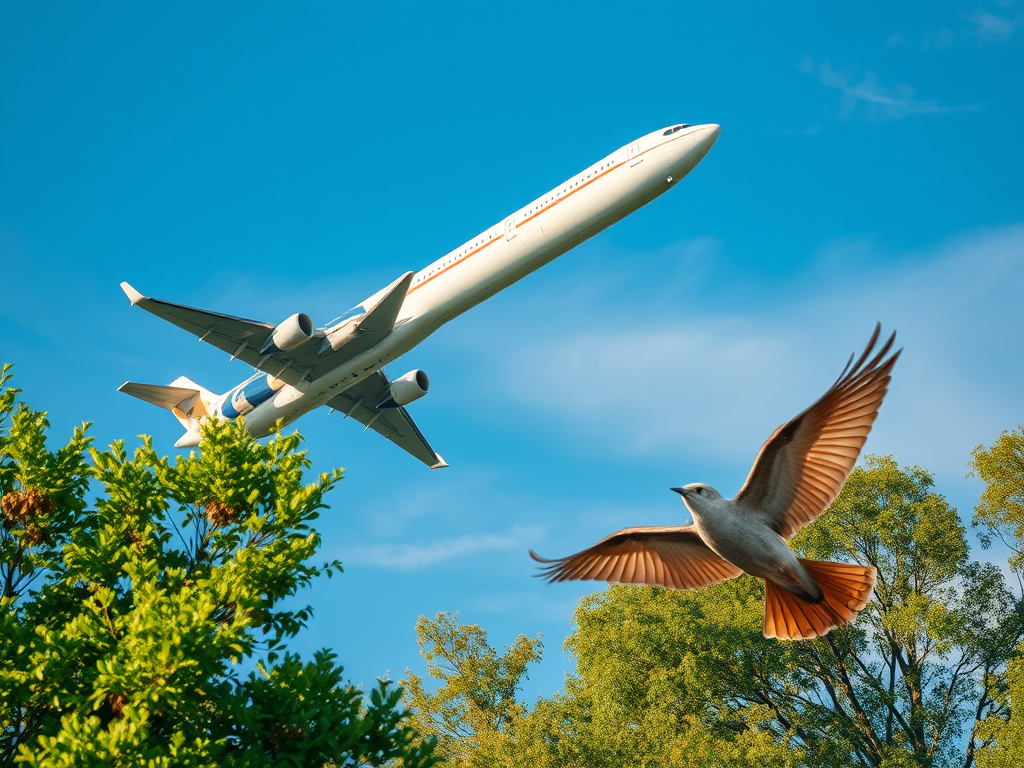
Have you ever looked up at a giant airplane soaring through the sky, or watched a tiny bird effortlessly darting between trees, and wondered, “How in the world do they do that?” It seems like magic, doesn’t it? Big, heavy machines and feathered creatures just floating in the air! But it’s not magic – it’s science! An amazing branch of science called aerodynamics for kids helps us understand what keeps these amazing fliers from falling to the ground.
The secrets of flight are all about how air moves and how objects, like airplane wings or bird wings, interact with it. It involves some clever shapes, powerful forces, and brilliant designs, both in nature and in human inventions. Whether it’s a massive jumbo jet or a speedy hummingbird, the basic rules of staying aloft are surprisingly similar. So, let’s put on our aviator goggles and take off on an adventure to discover the top 10 secrets behind the science of flight!
1. The Magic Wings: Understanding Airfoil Shape (How do wings create lift for children)
One of the biggest secrets to flight lies in the special shape of wings, whether they belong to a bird or an airplane. This shape is called an airfoil (or aerofoil). If you look at a wing from the side, you’ll notice it’s usually curved on the top and flatter on the bottom. Think of it like a thin, stretched-out teardrop. This specific design is super important for how wings create lift for children to understand.
Why this shape? It’s all about guiding the air. As the wing moves forward, its curved upper surface encourages the air flowing over it to travel a slightly longer distance than the air flowing underneath. Many people used to think this meant the air on top had to go faster to “meet up” with the air from the bottom at the back of the wing at the same time. While the air on top does often move faster, the “equal transit time” idea isn’t the whole story. The main thing is that this shape, combined with how the wing is tilted, helps to create a pressure difference, which is a key ingredient for getting off the ground. We’ll explore this more in our next points!
2. Faster Air, Less Push: Meet Bernoulli! (Bernoulli’s principle and flight for kids)
Now, let’s talk about that faster-moving air on top of the wing and what it means. There was a very smart Swiss scientist named Daniel Bernoulli who figured out something cool about fluids (and guess what? Air is a fluid, just like water!). Bernoulli’s principle and flight for kids can be explained like this: faster-moving air exerts less pressure, and slower-moving air exerts more pressure.
Imagine the air splitting at the front of the wing. Because of the airfoil shape, the air going over the curved top often speeds up. According to Bernoulli, this faster-moving air creates an area of lower pressure on top of the wing. Meanwhile, the air moving a bit slower underneath the flatter bottom of the wing creates an area of higher pressure. And what happens when you have high pressure below and low pressure above? The higher pressure pushes upwards towards the lower pressure, trying to even things out. This upward push is what we call lift! It’s like the wing is being sucked upwards by the low pressure and pushed upwards by the high pressure at the same time. This is one important part of how do airplanes fly for kids.
3. Pushing Air Down: Newton’s Powerful Lift Secret (Angle of Attack)
While Bernoulli’s idea of pressure differences is important, it’s not the only reason wings create lift. Another super-smart scientist, Sir Isaac Newton, gave us another big piece of the puzzle with his Third Law of Motion: for every action, there is an equal and opposite reaction. This is crucial for understanding how do wings create lift for children.
Think about when you bounce a basketball. You push the ball down (the action), and it bounces back up (the reaction). Wings do something similar with air! Wings are usually tilted slightly upwards at the front. This tilt is called the “angle of attack.” As the wing slices through the air, its tilted shape and underside physically push air downwards. Because the wing pushes air down (action), the air pushes the wing up (reaction). The more air the wing pushes down, or the harder it pushes it down, the greater the upward lift. This “pushing air down” effect is a really significant part of how both airplanes and birds generate the lift needed to fly, and it works hand-in-hand with the pressure differences we talked about with Bernoulli.
4. The Big Four: Balancing Act in the Sky! (What are the four forces of flight)
Staying up in the air isn’t just about lift; it’s a constant balancing act involving four main forces. Learning what are the four forces of flight is key to understanding how anything flies, from a tiny gnat to a giant A380 airplane. These forces are:
- Lift: This is the upward force we’ve been talking about, created mainly by the wings, that pushes the airplane or bird upwards, opposing gravity.
- Weight (or Gravity): This is the force pulling everything down towards the center of the Earth. To fly, an aircraft or bird needs to generate enough lift to overcome its weight.
- Thrust: This is the forward force that pushes the airplane or bird through the air. For airplanes, thrust usually comes from engines. For birds, it comes from the powerful flapping of their wings.
- Drag: This is like air resistance. It’s the force that tries to slow things down as they move through the air. Think about sticking your hand out of a moving car window – that push you feel is drag.
For an airplane to fly straight and level at a constant speed, lift must be equal to weight, and thrust must be equal to drag. If a pilot wants to climb, they need more lift than weight. To speed up, they need more thrust than drag. It’s a continuous dance of these four forces!
5. Go, Go, Go!: How Engines Give Planes Thrust! (How airplane engines produce thrust)
We know thrust is the forward push, but how do airplane engines produce thrust so powerfully? Airplanes have a couple of main types of engines. Smaller planes often use propeller engines. The propeller blades are shaped like mini-wings (airfoils!). As they spin, they “bite” into the air and push it backwards, just like a fan pushes air towards you. Thanks to Newton’s Third Law again, as the propeller pushes air back, the air pushes the propeller (and the plane) forward.
Larger planes, like jets, use jet engines. These are incredibly powerful. A jet engine sucks in a huge amount of air at the front. Inside, a part called a compressor squeezes this air, making it very dense and high pressure. Then, fuel is sprayed into this compressed air and ignited, creating a controlled explosion of hot, expanding gases. These gases then blast out of the back of the engine at extremely high speed. This backward blast of gas creates an equal and opposite forward thrust, rocketing the plane through the sky! It’s like letting go of an inflated balloon and watching it zoom off.
6. Slippery Shapes: Beating Air Resistance (Drag)
Remember drag, that force that tries to slow everything down? Well, a big part of aerodynamics for kids is figuring out how to reduce drag as much as possible. The more drag there is, the more thrust an airplane or bird needs to use to keep moving forward, and that means using more fuel or energy.
Scientists and engineers (and nature, in the case of birds!) have found that smooth, curved, and pointed shapes move through the air much more easily than boxy or rough shapes. This is called being “streamlined.” Think about the sleek, pointed nose of a jet plane, or the smooth, tapered body of a bird. Even the wings are designed to be slippery to the air. It’s like when you’re in a swimming pool: it’s much easier to glide through the water with your body straight and pointed than it is to try and push a big, flat board through it. By making airplanes and birds streamlined, they can cut through the air with less resistance, making flight more efficient. This is why reducing drag is just as important as creating lift and thrust.
7. Light as a Feather: A Bird’s Super Design! (Bird wing adaptations for flying)
Birds are the original masters of flight, and their bodies are perfectly designed for it! Many bird wing adaptations for flying make them incredibly efficient aerial acrobats. One of the most amazing things is how light they are. Bird bones are mostly hollow, with thin struts inside for support, a bit like the inside of a chocolate wafer bar – strong but super lightweight! This means they have less weight for their lift to overcome.
Then there are their feathers. Feathers are a marvel of engineering – light, strong, flexible, and they provide the perfect surface for wings and a streamlined body shape. The large flight feathers on the wings create the airfoil shape needed for lift, and birds can subtly adjust them to control their flight. Their powerful chest muscles, often anchored to a specially enlarged breastbone (called a keel), provide the strength for flapping. Even their beaks are lighter than a full set of teeth and jaws would be. It’s all part of a package that makes the science of bird flight explained so fascinating.
8. Flap, Flap, Soar: How Birds Create Their Own Power! (Science of bird flight explained)
Unlike most airplanes that rely on engines, birds create both lift and thrust mainly by flapping their wings. The science of bird flight explained through flapping is quite complex! When a bird flaps its wings downwards, it’s not just a simple up-and-down motion. The wings also twist and change their angle of attack.
On the downstroke, the wings push air downwards and backwards. Pushing air downwards creates lift (Newton’s Third Law again!), and pushing air backwards creates thrust, propelling the bird forward. The feathers at the wingtips can separate like fingers, helping to control the airflow and reduce drag. On the upstroke, the bird often folds its wings slightly or changes their angle to reduce air resistance, making it easier to bring them back up for the next powerful downstroke. Different birds flap differently depending on their size, wing shape, and what they’re trying to do – a hummingbird’s rapid figure-eight wingbeats are very different from a hawk’s slower, more deliberate flaps. It’s an incredibly efficient and adaptable way to fly!
9. Steering in the Sky: Control Surfaces and Tails!
Getting up in the air is one thing, but how do airplanes and birds turn, go up, go down, and stay stable? They can’t just rely on raw power; they need control. Airplanes have special moving parts on their wings and tail called control surfaces. On the back edge of the main wings are ailerons. If the pilot wants to roll the plane to the left, the left aileron goes up (reducing lift on that wing) and the right aileron goes down (increasing lift on that wing), causing the plane to bank.
The tail has a horizontal stabilizer (like a mini-wing) with elevators on its back edge, which control pitch (nose up or down). There’s also a vertical stabilizer (the fin) with a rudder, which controls yaw (nose left or right). Birds are masters of control too! They use their tails like rudders to steer and for balance. They can also subtly twist and adjust their wing shapes, change the angle of individual feathers, and shift their body weight to make incredibly precise movements. This fine control is vital for navigating and, for birds, for catching prey or landing on a tiny branch.
10. Gliding & Soaring: Riding the Air Waves!
Not all flight requires constant engine power or frantic flapping. Both airplanes (especially gliders, which have no engines) and many birds are experts at gliding and soaring, which is a fantastic display of understanding aerodynamics for kids. Gliding is when a plane or bird flies forward without using thrust, gradually descending as lift slowly overcomes drag and weight pulls it down. Think of a paper airplane – it glides!
Soaring takes this a step further. Large birds like eagles, vultures, and albatrosses are masters of soaring. They use rising currents of warm air called thermals. As the sun heats the ground, the air above it warms and rises. Birds circle within these thermals to gain height without flapping, saving a huge amount of energy. Albatrosses can soar for hours or even days over the ocean by using the changing wind speeds near the water’s surface. Even large airplanes can glide for surprising distances if their engines fail, giving pilots time to find a safe place to land. This shows how efficient wing design really is!
From the incredible power of jet engines to the delicate flutter of a bird’s wing, the science of flight is all about understanding and working with the air around us. Those four fundamental forces – lift, weight, thrust, and drag – along with clever designs and precise control, are what allow us to conquer the skies and what allows birds to dance on the wind. The next time you see a plane overhead or a bird in your garden, you’ll know a little more about the amazing science that keeps them up!
Further Reading
If you’re fascinated by flight and want to learn more, check out these books:
- “The Wright Brothers: How They Invented the Airplane” by Russell Freedman – A brilliant account of the invention of the first successful airplane.
- “Flight: The Complete History of Aviation” by R.G. Grant (DK) – A visually stunning book covering the history and science of flight.
- “Amazing Airplanes (Amazing Machines)” by Tony Mitton and Ant Parker – A fun and engaging introduction to airplanes for younger readers.
- “National Geographic Kids Readers: Birds (L1/Co-reader)” by National Geographic Kids – Learn all about different birds and their amazing abilities, including flight.
- “How Things Fly” by an drew nahum (part of the “How Things Work” series from the Smithsonian National Air and Space Museum) – Explores the principles of flight with clear explanations and diagrams. (Often found as “The Smithsonian National Air and Space Museum’s How Things Fly”)




Leave a Reply