
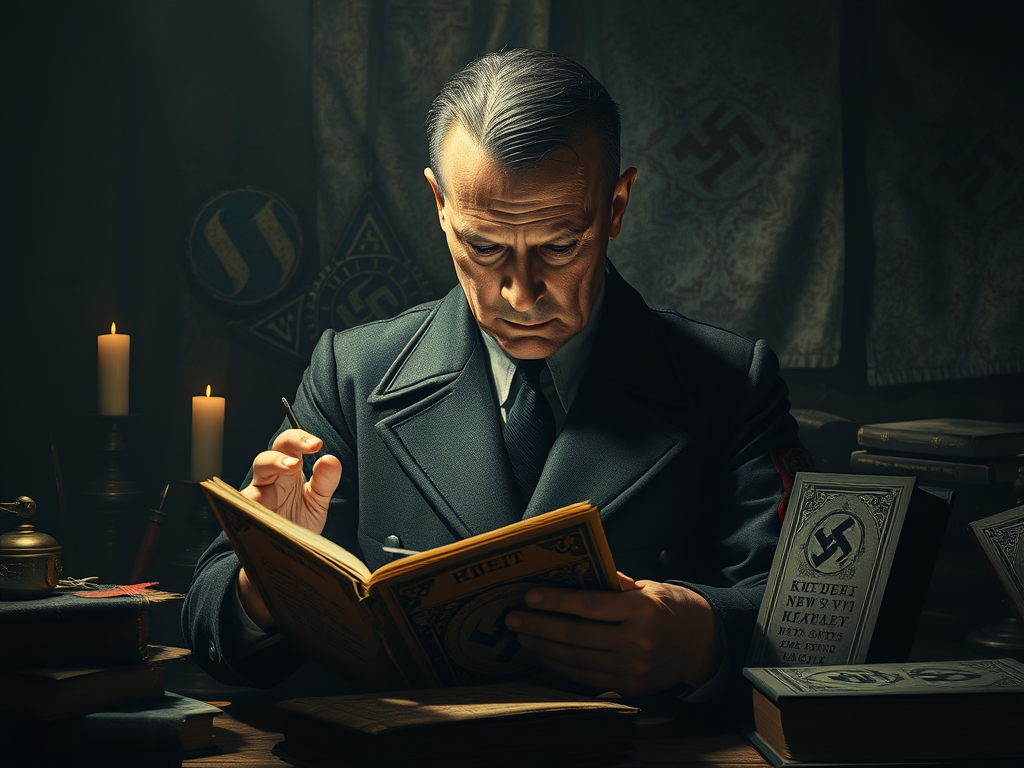
Have you ever seen movies or read stories where Nazis are searching for magical artifacts or dabbling in dark rituals? The idea of Nazi occultism has become a popular and often spooky part of our culture. It’s a fascinating and chilling thought: did one of the most evil regimes in history really believe in supernatural powers? The truth is a bit more complicated than the movies suggest, mixing a little bit of fact, a lot of fiction, and even some wild fantasy.
While Adolf Hitler himself wasn’t deeply involved in the occult, some powerful figures within the Nazi party, especially Heinrich Himmler, were very interested in strange, ancient beliefs and pseudo-scientific ideas. They hoped these ideas would prove their theories about a “master race” and give them mystical power. However, most of the extreme stories you hear are more fantasy than reality. It’s important to understand the difference to truly learn about this dark period of history. Let’s explore ten points to separate the truth from the myths about Nazi occultism.
1. What is Occultism? Understanding the Basics
First, let’s understand what occultism means. It refers to a range of beliefs and practices that involve supernatural or mystical powers, often hidden from ordinary understanding. This can include things like magic, astrology (studying stars to predict the future), alchemy (turning metals into gold), secret societies, and ancient spiritual traditions. It’s about things that are considered “hidden” or “secret knowledge” beyond mainstream science or religion.
For centuries, people have been fascinated by the occult. In the early 20th century, when Nazism was rising, there were many groups in Germany and elsewhere who were interested in these kinds of ideas. They often explored ancient myths, symbols, and spiritual practices. It’s important to remember that not all occultism is evil; it’s a broad term for various beliefs. However, when these beliefs mix with hateful ideologies, they can become very dangerous, as seen in the Nazi case.
2. Heinrich Himmler: The SS Leader’s Obsession
While Hitler wasn’t deeply immersed in the occult, Heinrich Himmler, the powerful head of the SS (the Nazi Party’s elite guard and main enforcers), was genuinely fascinated by mystical and ancient Germanic beliefs. Himmler was obsessed with the idea of a pure “Aryan” race and believed that by researching ancient Germanic history and spirituality, he could uncover hidden powers and traditions that would strengthen the SS and the Nazi regime.
He wanted the SS to be more than just a military group; he envisioned it as a kind of mystical order, rooted in ancient pagan traditions. Himmler’s personal beliefs led him to integrate some strange rituals and symbols into the SS, such as special wedding ceremonies and the use of ancient Germanic runes. His interest in Nazi occultism was a driving force behind some of the more bizarre and pseudo-scientific projects undertaken by the Nazis.
3. The Ahnenerbe: Searching for “Aryan” Roots
To support Himmler’s strange beliefs, the SS created an organization called the Ahnenerbe (meaning “Ancestral Heritage”). This was a supposedly “scientific” institute whose real purpose was to find archaeological and cultural “evidence” that would prove the superiority of the “Aryan race” and connect it to ancient, mystical origins. They researched everything from ancient runes to folklore, and even sent expeditions to places like Tibet, hoping to find evidence of an ancient “Aryan homeland” or lost wisdom.
Most of the Ahnenerbe’s research was not real science; it was pseudoscience – fake science designed to support Nazi propaganda. While some of their projects were relatively harmless (like studying folk dances), others were linked to horrific experiments on humans during the war. The Ahnenerbe represents how far the Nazis would go to twist history and science to fit their hateful ideology, all driven by a desperate search for mystical justification for their racist theories.
4. The Thule Society: An Early Influence, Not a Secret Mastermind
Many popular stories and myths about Nazi occultism mention the Thule Society as a powerful, secret occult group that supposedly controlled the early Nazi Party. The Thule Society was a real group in Munich that existed after World War 1. It was a small, right-wing, anti-Semitic (anti-Jewish) organization that shared some ideas with later Nazism, including a focus on Germanic myths and racist nationalism.
However, historians generally agree that while some early Nazis, including Alfred Rosenberg, were members, the Thule Society was not a powerful, controlling occult force behind Hitler or the Nazi Party. It was more of a local political discussion group with some members who had occult interests. The idea that it was a grand secret society pulling the strings of Nazism is largely fiction that gained popularity after the war, making the Nazis seem more mysterious and demonic than they truly were.
5. Hitler’s Role: Pragmatist, Not Practitioner
Many fictional accounts portray Adolf Hitler as a deep believer in the occult or even as a practitioner of black magic. However, historical evidence suggests that Hitler himself was not a true believer in occultism or the supernatural. While he was highly superstitious and had some strange ideas (like believing in his own destiny), his interest was mainly in how myths and symbols could be used to control and inspire the masses.
Hitler was a pragmatist; he cared more about political power and military conquest than about ancient rituals or hidden forces. He would often mock Himmler’s esoteric interests. He understood the power of propaganda and spectacle, using symbols like the swastika (an ancient symbol twisted by the Nazis) to create a powerful, almost religious, atmosphere around his regime. So, the image of Hitler as an occult master is largely fantasy, created by later authors.
6. Myths and Symbols: Twisted for Propaganda
Even if most Nazi leaders weren’t truly occultists, they certainly used symbols and myths in ways that seemed mystical or ancient. They adopted symbols like the swastika, which is an ancient good luck symbol in many cultures, and twisted it into their hateful emblem. They also heavily promoted myths about ancient Germanic warriors, Valhalla (a mythical hall of heroes), and a glorious Aryan past that never truly existed.
These symbols and myths were used to create a powerful sense of national identity, pride, and destiny for the German people, making them feel part of something grand and historic. This kind of manipulation of history and mythology is a key part of how the Nazis gained and held power. It’s important to remember that symbols themselves aren’t evil, but when they are used to promote hate and violence, they become very dangerous.
7. The Vril Society: A Pure Fantasy
One of the most persistent and wild fantasies associated with Nazi occultism is the idea of the “Vril Society.” This supposed secret society is often described as possessing advanced, hidden technology, like flying saucers, derived from a powerful energy called “Vril” (from an old science fiction novel). According to these myths, the Vril Society was the true secret power behind the Nazis, providing them with supernatural technology.
The truth is, there is no historical evidence that a secret organization called the “Vril Society” ever existed. This entire concept originated from a science fiction novel from 1871 by Edward Bulwer-Lytton, called “The Coming Race,” which described a subterranean race with amazing powers. The idea of the Vril Society being connected to Nazis is a pure fantasy that took root after the war, mixing science fiction with conspiracy theories. It’s a great example of how wild stories can become confused with real history.
8. Post-War Fiction and Films: Fueling the Myth
The popular image of Nazi occultism as depicted in movies, books, and even video games, largely took off after World War 2. Films like “Raiders of the Lost Ark” (where Nazis hunt for the Ark of the Covenant) or comic books featuring Nazis with supernatural powers have ingrained this idea deeply into popular culture. These stories are exciting and dramatic, making the Nazis seem like villains with mystical abilities.
However, these are works of fiction. While they draw inspiration from some real-life Nazi interests (like Himmler’s fascination with ancient artifacts), they greatly exaggerate and invent elements for entertainment. It’s crucial to remember that movies and books are often not accurate historical sources, especially when they deal with sensational topics. The real evil of the Nazis lay in their hateful ideology and organized brutality, not in magic or mythical powers.
9. Debunking the Myths: What Historians Say
Historians who study Nazi Germany carefully examine real documents, letters, and records from the time. Their research shows that while some individual Nazis had personal interests in the occult, these interests were a very minor part of the overall Nazi regime’s policies or decision-making. The vast majority of the Nazi Party and its leaders, including Hitler, were focused on political power, military conquest, and racist persecution.
The sensational stories of Nazi occultism often distract from the true, terrifying nature of the regime: a brutal, highly organized dictatorship built on racism, propaganda, and violence. It’s far more chilling to understand that the atrocities of the Holocaust and World War 2 were carried out by ordinary people following hateful orders, rather than by shadowy figures with supernatural powers. The reality is often more frightening than the fantasy.
10. The Real Lesson: The Dangers of Hateful Ideology
The true lesson from studying “Nazi occultism” isn’t about secret powers or magic. It’s about how dangerous hateful ideologies can be. The Nazis used twisted versions of history, science, and even some mystical ideas to justify their terrible actions. They created a cult-like devotion around Hitler and manipulated people’s emotions and beliefs.
The real “evil” of the Nazis came from their extreme racism, their thirst for power, and their ability to convince millions of people to participate in or accept horrific crimes. Understanding this helps us recognize similar dangers today: ideologies that promote hatred, prejudice, or false ideas about “superior” groups of people. It teaches us the importance of critical thinking, questioning authority, and standing up for human rights and truth, to ensure that such a dark chapter in history is never repeated.
Further Reading
- “Who Was Adolf Hitler?” by Gail Herman (Provides context on Hitler and Nazism for young readers)
- “The Holocaust: A Nonfiction Companion to the Series” by Peter Nelson (Explains the broader context of Nazi actions)
- “The Occult Roots of Nazism” by Nicholas Goodrick-Clarke (More academic, but a key source for serious study)
- “Hitler’s Monsters: A Supernatural History of the Third Reich” by Eric Kurlander (Explores the intersection of science, pseudoscience, and the supernatural in the Third Reich – for a slightly older audience)
- “The Thule Society” by Rudolf von Sebottendorff (Historical document, but approach with caution due to the content)
Here at Zentara.blog, our mission is to take those tricky subjects and unlock them, making knowledge exciting and easy to grasp for everyone. But the adventure doesn’t stop on this page! We’re constantly exploring new frontiers and sharing discoveries across the digital universe.
Want to dive deeper into more mind-bending Top 10s and keep expanding your world? Come join us on our other platforms – we’ve got unique experiences waiting for you on each one!
- Get inspired by visual wonders and bite-sized facts: See the world through Zentara’s eyes on Pinterest! Pin our fascinating facts and stunning visuals to your own boards. Explore Pins on Pinterest: https://uk.pinterest.com/zentarablog/
- Discover quick insights and behind-the-scenes peeks: Hop over to Tumblr for snippets, quotes, and unique content you won’t find anywhere else. It’s a different flavour of discovery! Follow the Fun on Tumblr: https://www.tumblr.com/zentarablog
- Ready for deep dives you can listen to or watch? We’re bringing our accessible approach to video and potentially audio! Subscribe to our YouTube channel and tune into future projects that make learning pop! Subscribe on YouTube: https://www.youtube.com/@ZentaraUK
- Seeking even more knowledge in one place? We’ve compiled some of our most popular topic deep dives into fantastic ebooks! Find them on Amazon and keep the learning journey going anytime, anywhere. Find Our Ebooks on Amazon: https://www.amazon.co.uk/s?k=Zentara+UK&ref=nb_sb_noss
- Connect with us and fellow knowledge seekers: Join the conversation on BlueSky! We’re sharing updates, thoughts, and maybe even asking you what wonders we should explore next. Chat with Us on BlueSky: https://bsky.app/profile/zentarablog.bsky.social
- Perfect for learning on the move! We post multiple 10-minute podcasts per day on Spotify. Pop on your headphones and fill your day with fascinating facts while you’re out and about! Listen on Spotify: https://open.spotify.com/show/3dmHbKeDufRx95xPYIqKhJ
Every click helps us keep bringing honest, accessible knowledge to everyone. Thanks for exploring with us today – see you out there in the world of discovery!

Leave a Reply