
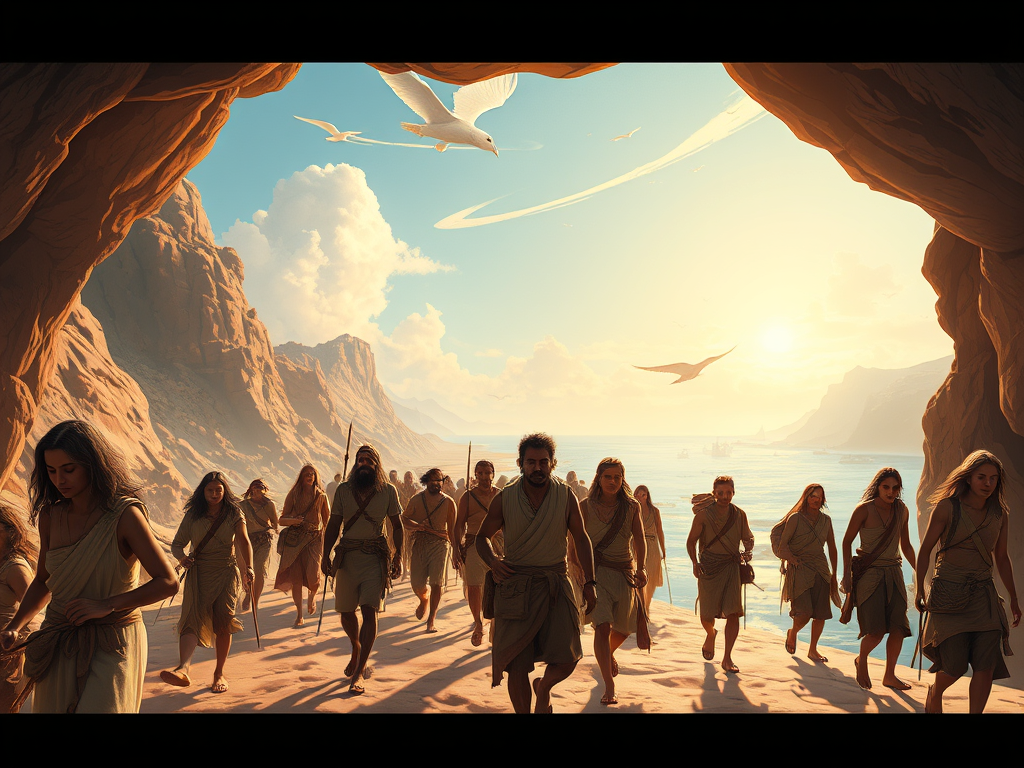
Imagine packing up everything you own and walking for hundreds, even thousands, of miles to find a new home. For most of human history, this wasn’t an extraordinary adventure; it was how our ancestors lived. Humans are natural travelers, always moving, exploring, and seeking new opportunities. These massive movements of people, known as human migrations, have done more than just shift populations around; they have completely redrawn the cultural, linguistic, and even genetic maps of our world.
From the very first steps out of Africa to the incredible journeys across continents, these migrations have led to the birth of new societies, the spread of technologies, the rise and fall of empires, and the rich tapestry of cultures we see today. In this article, we’ll journey through history to discover ten of the most impactful human migrations, exploring the incredible stories behind them and their lasting effects on the geography and cultures of our world. Get ready to see how restless human feet shaped the very map of our planet!
1. Out of Africa: Humanity’s First Great Journey
Our story begins about 60,000 to 70,000 years ago, with the ultimate human migration: the Out of Africa migration. Modern humans, Homo sapiens, originated in East Africa. For tens of thousands of years, our ancestors lived and thrived there. But then, driven by factors like climate change, population growth, and a search for new resources, small groups began to venture out of the African continent.
These early trailblazers followed coastlines and river valleys, slowly spreading across Asia, then into Australia, and eventually, much later, into Europe. This was a monumental journey, covering vast distances over many generations. It literally laid the foundation for all subsequent human populations around the globe. The global human dispersal that followed this initial exodus is the reason why humans now inhabit every continent (except Antarctica permanently) and is the root of all human genetic and cultural diversity. This early human migration is the bedrock of our shared history.
2. The Bantu Expansion: Spreading Language and Iron Across Africa
Imagine a slow but powerful wave sweeping across a continent, carrying new languages, technologies, and ways of life. This is what happened in Africa, starting around 3,000 to 5,000 years ago, with the Bantu expansion. Originating in West-Central Africa (around modern-day Cameroon and Nigeria), Bantu-speaking peoples began a gradual but persistent migration, moving southward and eastward across the African continent.
This wasn’t a single, organized invasion, but rather a series of slow movements by small groups, often involving generations. As they moved, they brought with them new agricultural techniques, like growing yams and millet, and, crucially, ironworking technology. This allowed them to make stronger tools and weapons. Their migrations displaced or absorbed many pre-existing hunter-gatherer groups and fundamentally changed the demographics and cultural landscape of much of Sub-Saharan Africa. Today, over 300 million people speak a Bantu language, making it one of the largest language families in the world and a testament to the scale of this pivotal African population movement.
3. The Indo-European Migrations: Shaping Languages from India to Europe
Have you ever noticed similarities between words in English, French, Russian, and Hindi? This isn’t a coincidence! It’s because many of the languages spoken across Europe, the Iranian Plateau, and Northern India belong to the Indo-European language family. This widespread linguistic family is believed to have spread through a series of Indo-European migrations that began perhaps 6,000 to 8,000 years ago from a probable homeland in the Pontic-Caspian Steppe (modern-day Ukraine and Russia) or Anatolia (modern-day Turkey).
These were not necessarily mass movements of entire populations, but rather the gradual expansion of groups who brought their languages, and sometimes new agricultural practices or animal husbandry (like horseback riding), with them. As they interacted with existing populations, their languages spread and diversified over millennia. The impact of these migrations is profound, shaping the linguistic and cultural identity of billions of people across vast geographical areas. This linguistic dispersal is a prime example of how human movements can leave an enduring mark on global communication patterns.
4. The Polynesian Navigators: Mastering the Pacific Ocean
Imagine setting out in a canoe, navigating by the stars, currents, and birds, across thousands of miles of open ocean with no land in sight. This is the incredible story of the Polynesian navigators, arguably the greatest maritime migration in human history. Starting around 3,000 to 4,000 years ago from Southeast Asia (likely Taiwan or the Philippines), these skilled seafarers began exploring and settling the vast islands of the Pacific Ocean.
Over many centuries, they reached incredibly remote places like Hawaii, Easter Island (Rapa Nui), and New Zealand (Aotearoa), adapting to diverse island environments and creating unique cultures. They used sophisticated double-hulled canoes and possessed an astonishing knowledge of oceanography and celestial navigation. This wasn’t just a physical journey but an incredible feat of innovation and resilience. The Polynesian expansion fundamentally changed the map of the Pacific, creating new societies across a vast oceanic region and leaving behind a legacy of remarkable seafaring skills and unique island cultures.
5. The Jewish Diaspora: Spreading a People and a Culture
The Jewish Diaspora refers to the historical scattering of the Jewish people from their ancestral homeland in ancient Israel. This process occurred over many centuries, beginning with the Assyrian and Babylonian exiles in ancient times, and significantly intensified after the Roman destruction of the Second Temple in Jerusalem in 70 CE and later Roman persecutions.
Driven by various factors, including conquest, religious persecution, and economic opportunities, Jewish communities established themselves across the Middle East, North Africa, Europe, and later, around the globe. Despite being dispersed, Jewish communities maintained strong cultural and religious ties, preserving their identity through centuries of migration. This religious and cultural dispersion demonstrates how a people can maintain their heritage across vast geographical distances, influencing the societies they settled in while also being influenced by them. The Diaspora had a profound impact on the demographics and cultural mosaic of numerous regions throughout history.
6. The Silk Road Movements: Connecting East and West
While not a single, unified migration, the Silk Road was a vast network of trade routes that connected East and West for over 1,500 years, from roughly 200 BCE to 1400 CE. Along these routes, it wasn’t just goods like silk, spices, and precious metals that traveled; people did too. Merchants, scholars, missionaries, craftsmen, and even armies moved across deserts, mountains, and steppes, carrying their cultures, languages, religions, and technologies with them.
The Silk Road movements facilitated incredible cultural exchange, leading to the spread of Buddhism into China, the exchange of scientific knowledge between the Islamic world and Europe, and the transmission of new agricultural practices. It also led to the rise and fall of powerful cities and empires that controlled parts of these vital routes. The human movements along the Silk Road were crucial in connecting disparate parts of the world, fostering a rich blend of ideas and innovations that profoundly reshaped the cultural and economic map of Eurasia.
7. The Mongol Expansions: A Nomadic Empire’s Reach
In the 13th century, the world witnessed one of the most rapid and far-reaching military expansions in history: the Mongol conquests, led by Genghis Khan and his successors. Originating from the steppes of Central Asia, the Mongol Empire rapidly conquered vast territories, stretching from Eastern Europe across Asia to the Pacific Ocean.
While primarily military, these conquests also involved significant migrations of Mongol warriors and their families, as well as forced migrations of conquered peoples. The Mongol Empire facilitated unprecedented contact between East and West, influencing everything from trade routes to the spread of technologies and ideas. They also brought devastation and demographic shifts to many regions. Though the empire eventually fragmented, its legacy included new political entities, significant shifts in power dynamics, and the laying of groundwork for future interactions between diverse cultures across Eurasia. This nomadic expansion dramatically redrew political and cultural boundaries.
8. The Great Atlantic Migrations: Reshaping the Americas
Starting in the 15th century, with the voyages of Columbus, a new and massive wave of transatlantic migration began, dramatically reshaping the Americas. This included several distinct but interconnected movements:
- European Colonization: Millions of Europeans, primarily from Spain, Portugal, Britain, France, and other nations, migrated to the Americas, driven by desires for land, wealth, religious freedom, and adventure. They established colonies and drastically altered the indigenous societies they encountered.
- Forced African Migration (Transatlantic Slave Trade): Tragically, this era also saw the brutal, forced migration of millions of Africans across the Atlantic as part of the transatlantic slave trade. This horrific movement fundamentally shaped the demographics, economies, and social structures of the Americas, creating enduring legacies of racial inequality and cultural fusion.
- Voluntary Asian Migration: Later, especially in the 19th and 20th centuries, significant numbers of people from Asia (e.g., China, Japan, India) migrated to the Americas, often for labour opportunities.
These intertwined migrations created the diverse, multicultural societies of the Americas, profoundly affecting their languages, religions, political systems, and economic development. The Columbian Exchange of people, plants, animals, and diseases fundamentally reshaped the global map.
9. The Great Famine Irish Diaspora: A Forced Exodus
Not all migrations are voluntary or driven by expansion. Some are born out of immense hardship. The Great Famine Irish Diaspora is a powerful example of a mass migration triggered by devastating circumstances. In the mid-19th century (1845-1852), Ireland experienced a catastrophic potato blight that led to widespread starvation and disease. Facing unimaginable hardship, over a million Irish people died, and another two million emigrated, primarily to the United States, Canada, Australia, and Great Britain.
This famine-driven migration drastically reduced Ireland’s population and scattered its people across the globe. Irish communities formed in cities like Boston, New York, and Liverpool, profoundly influencing the cultural and political landscapes of their new homes. This exodus not only reshaped the demographics of Ireland but also left a lasting cultural imprint on the countries that received these resilient immigrants, demonstrating how environmental and economic crises can compel vast numbers of people to seek new lives elsewhere.
10. Post-WWII Displaced Persons and Refugee Movements: A Modern Re-Mapping
The 20th century, especially after World War II, witnessed unprecedented levels of refugee crises and displaced populations. Millions of people were uprooted by conflict, genocide, and political upheaval. The end of WWII alone saw tens of millions of displaced persons (DPs) across Europe, as borders were redrawn, ethnic groups were expelled, and former prisoners of war and forced labourers sought to return home or find new places of refuge.
Since then, conflicts in places like Vietnam, Afghanistan, the Balkans, Rwanda, Syria, and Ukraine have continued to generate massive waves of forced migration. These modern refugee movements often lead to people crossing international borders, seeking asylum in new countries, and creating diverse diasporas. These movements profoundly challenge and reshape existing national boundaries, cultural identities, and international relations, constantly reminding us that the map of the world is not just fixed lines but a dynamic representation of human movement and resilience.
Further Reading
- “Sapiens: A Brief History of Humankind” by Yuval Noah Harari (Offers a broad perspective on human history, including early migrations).
- “The Human Journey: A Concise Introduction to World History” by Kevin Reilly (Provides an overview of major human migrations and their impacts).
- “1491: New Revelations of the Americas Before Columbus” by Charles C. Mann (While not solely about migration, it offers deep insight into pre-Columbian societies and their movements).
- “Africans and the Industrial Revolution: A History of the Transatlantic Slave Trade” by Walter Rodney (Focuses on the forced migration of the transatlantic slave trade and its consequences).
- “The Atlas of Human History” by Jacques Dupâquier (A visual journey through human migrations across the globe).
Here at Zentara.blog, our mission is to take those tricky subjects and unlock them, making knowledge exciting and easy to grasp for everyone. But the adventure doesn’t stop on this page! We’re constantly exploring new frontiers and sharing discoveries across the digital universe.
Want to dive deeper into more mind-bending Top 10s and keep expanding your world? Come join us on our other platforms – we’ve got unique experiences waiting for you on each one!
- Get inspired by visual wonders and bite-sized facts: See the world through Zentara’s eyes on Pinterest! Pin our fascinating facts and stunning visuals to your own boards. Explore Pins on Pinterest: https://uk.pinterest.com/zentarablog/
- Discover quick insights and behind-the-scenes peeks: Hop over to Tumblr for snippets, quotes, and unique content you won’t find anywhere else. It’s a different flavour of discovery! Follow the Fun on Tumblr: https://www.tumblr.com/zentarablog
- Ready for deep dives you can listen to or watch? We’re bringing our accessible approach to video and potentially audio! Subscribe to our YouTube channel and tune into future projects that make learning pop! Subscribe on YouTube: https://www.youtube.com/@ZentaraUK
- Seeking even more knowledge in one place? We’ve compiled some of our most popular topic deep dives into fantastic ebooks! Find them on Amazon and keep the learning journey going anytime, anywhere. Find Our Ebooks on Amazon: https://www.amazon.co.uk/s?k=Zentara+UK&ref=nb_sb_noss
- Connect with us and fellow knowledge seekers: Join the conversation on BlueSky! We’re sharing updates, thoughts, and maybe even asking you what wonders we should explore next. Chat with Us on BlueSky: https://bsky.app/profile/zentarablog.bsky.social
- Perfect for learning on the move! We post multiple 10-minute podcasts per day on Spotify. Pop on your headphones and fill your day with fascinating facts while you’re out and about! Listen on Spotify: https://open.spotify.com/show/3dmHbKeDufRx95xPYIqKhJ
- Follow us on Instagram for bytesize knowledge! We post multiple posts per day on our official Instagram account.
https://www.instagram.com/zentarablog/
Every click helps us keep bringing honest, accessible knowledge to everyone. Thanks for exploring with us today – see you out there in the world of discovery!




Leave a Reply