
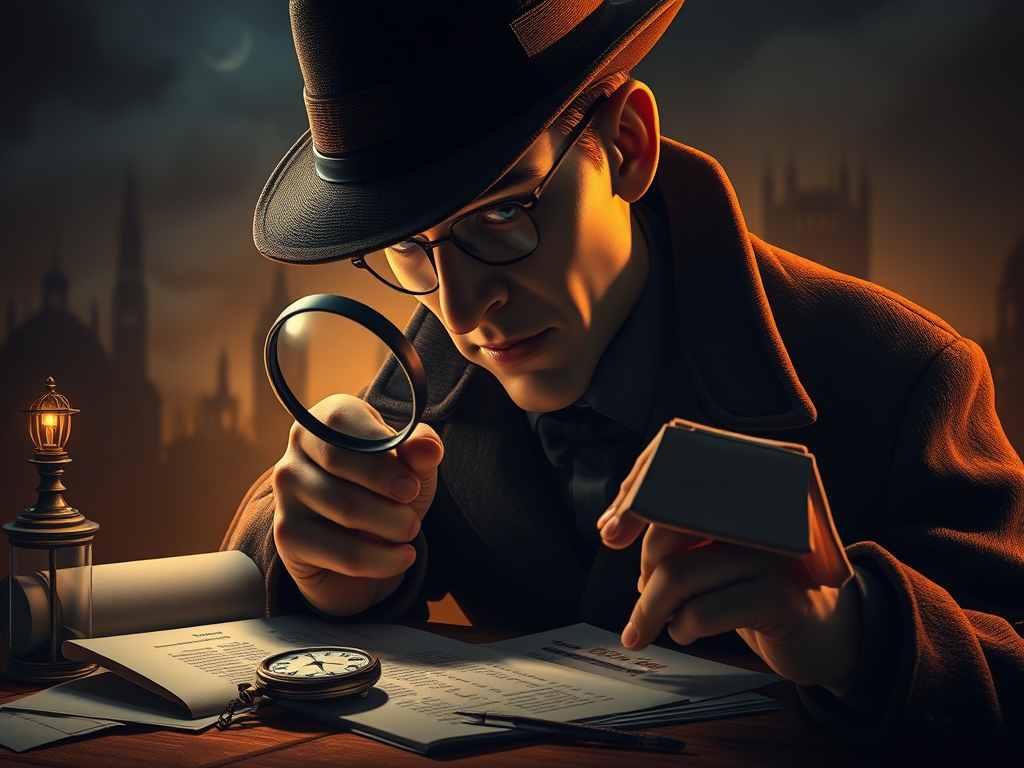
Detective fiction, a genre born from the human fascination with puzzles, justice, and the darker side of society, has captivated readers for centuries. From the gaslit streets of Victorian London to the sun-drenched boulevards of Los Angeles, the figure of the detective—be it brilliant amateur, hardened private eye, or meticulous police inspector—has become an enduring archetype in literature. More than just thrilling whodunits, these stories often reflect the societal anxieties, scientific advancements, and philosophical currents of their time, offering a unique lens through which to view history.
Tracing the evolution of detective fiction is like following a complex case, with clues and innovations emerging at different turns. This article will explore ten seminal books that didn’t just entertain, but fundamentally shaped and redefined the genre as we know it. These are not merely popular titles, but works that introduced new tropes, characters, narrative techniques, or thematic depths, leaving an indelible mark on the countless mysteries that followed. Join us as we uncover the literary fingerprints of the masterpieces that laid the groundwork for the modern crime novel, revealing the enduring appeal of the hunt for truth.
1. The Murders in the Rue Morgue by Edgar Allan Poe (1841) – The Birth of the Ratiocinative Detective
Edgar Allan Poe’s The Murders in the Rue Morgue is widely considered the genesis of modern detective fiction, introducing the world to C. Auguste Dupin, the eccentric and brilliant amateur sleuth. Poe coined the term “tales of ratiocination” to describe his stories, emphasizing Dupin’s reliance on logical deduction and keen observation rather than brute force or luck. In this pioneering work, Dupin meticulously reconstructs a seemingly impossible crime, demonstrating how intellect can unravel the most baffling mysteries. This story established many foundational elements of the genre: the armchair detective, the less astute narrator-companion (a precursor to Watson), the “locked-room mystery,” and the clear separation of the detective from official police procedure. Poe’s focus on the detective’s superior intellect set the stage for generations of literary sleuths, defining the essence of the analytical crime solver and proving that the true power lay not in strength, but in the power of the mind.
2. The Moonstone by Wilkie Collins (1868) – The First English Detective Novel
Often hailed as the first full-length English detective novel, Wilkie Collins’ The Moonstone is a monumental work that solidified many genre conventions. It tells the story of a cursed Indian diamond and its disappearance from an English country house, with the investigation unfolding through multiple narrators, each offering a biased or incomplete perspective. This innovative narrative structure added layers of complexity and psychological depth, forcing the reader to piece together the truth alongside the characters. The novel also introduced Sergeant Cuff, one of the earliest professional detectives in English literature, whose meticulous, albeit sometimes fallible, police work contrasted with Dupin’s amateur brilliance. The Moonstone masterfully weaves together elements of mystery, suspense, and social commentary, demonstrating the potential for detective fiction to be both an intricate puzzle and a sophisticated literary endeavor. Its detailed plot and character development were a significant leap forward for the nascent genre, demonstrating the power of a police procedural.
3. A Study in Scarlet by Arthur Conan Doyle (1887) – The Enduring Icon of Sherlock Holmes
With A Study in Scarlet, Arthur Conan Doyle unleashed Sherlock Holmes upon the world, creating arguably the most famous detective in literary history. While not the first, Holmes quickly became the archetype against which all others were measured. His deductive reasoning, often bordering on clairvoyance, his eccentric habits, and his iconic address at 221B Baker Street, alongside his loyal chronicler Dr. John Watson, became synonymous with detective work. This novel introduced the classic duo and the signature methodology: Holmes’s brilliant observations of seemingly insignificant details, his reliance on forensic science (then in its infancy), and his dramatic unveilings of the truth. Doyle’s meticulous plotting and Holmes’s unparalleled intellectual prowess cemented the idea of the detective as a scientific problem-solver, elevating the genre from mere entertainment to a sophisticated intellectual pursuit. Sherlock Holmes single-handedly defined the term detective fiction for many generations.
4. The Maltese Falcon by Dashiell Hammett (1930) – The Birth of the Hard-Boiled Detective
Dashiell Hammett’s The Maltese Falcon didn’t just introduce Sam Spade; it inaugurated the hard-boiled school of detective fiction, a radical departure from the genteel, intellectual puzzle-solving of earlier eras. Set in a gritty, cynical San Francisco, Spade is a private investigator who operates in a morally ambiguous world of double-crosses, corrupt police, and femme fatales. His methods are tough, pragmatic, and often violent, reflecting the harsh realities of Prohibition-era America. Hammett’s terse, unadorned prose and focus on realistic dialogue, rather than intricate descriptions, created a lean, muscular style that influenced countless crime writers. The novel stripped away romanticism, presenting crime not as an intellectual game but as a brutal struggle for survival. The Maltese Falcon redefined the detective from a detached observer to an active participant in a dangerous, morally grey landscape, ushering in the era of the modern crime thriller.
5. The Big Sleep by Raymond Chandler (1939) – The Poetry of the Private Eye
Raymond Chandler refined and poeticized the hard-boiled detective introduced by Hammett, culminating in The Big Sleep and its iconic protagonist, Philip Marlowe. While sharing Spade’s toughness and cynicism, Marlowe is also a lonely knight, guided by a personal code of ethics in a corrupt world. Chandler’s genius lay in his evocative, atmospheric prose, painting vivid pictures of Los Angeles’ underbelly and endowing the urban landscape with a dark, almost existential beauty. The plot of The Big Sleep is famously convoluted, often described as secondary to the atmosphere and Marlowe’s compelling narrative voice. Chandler’s focus shifted from the “whodunit” to the “whydunit,” and even more profoundly, to the character of the detective as a moral compass in a chaotic world. His influence on dialogue, mood, and character development is immeasurable, solidifying the literary reputation of the private eye.
6. And Then There Were None by Agatha Christie (1939) – The Masterpiece of the Locked-Room Mystery
Agatha Christie, the undisputed “Queen of Crime,” perfected the intricate puzzle mystery, and And Then There Were None stands as one of her most brilliant achievements. While not featuring a recurring detective like Hercule Poirot or Miss Marple, this novel is a masterful exercise in misdirection and claustrophobic suspense. Ten strangers are lured to a remote island, only to be systematically murdered, one by one, with no apparent culprit. The novel’s genius lies in its almost mathematically precise plotting, leaving readers utterly bewildered until the final, shocking revelation. It redefined the “locked-room” or “isolated setting” mystery by eliminating the external detective entirely, forcing the characters themselves, and the reader, to solve the puzzle from within. This book remains a benchmark for ingenious plotting and psychological tension, showcasing Christie’s unparalleled ability to manipulate clues and red herrings.
7. The Daughter of Time by Josephine Tey (1951) – Historical Mystery and Detective as Historian
Josephine Tey’s The Daughter of Time is a unique and groundbreaking work that fuses historical research with detective methodology. Confined to a hospital bed, Inspector Alan Grant of Scotland Yard becomes obsessed with the historical mystery of Richard III and the alleged murder of the Princes in the Tower. Using historical documents and modern investigative techniques, Grant re-examines centuries-old evidence, challenging long-held beliefs. This novel redefined the scope of detective fiction, demonstrating that the tools of detection could be applied not just to contemporary crimes but also to historical enigmas. Tey’s meticulous research and thoughtful exploration of historical truth vs. received wisdom elevated the genre, proving that detective work could be a means of re-evaluating history and exposing biases. It stands as a testament to the power of critical thinking and challenging established narratives, making the detective a historian as much as an investigator.
8. Strangers on a Train by Patricia Highsmith (1950) – Psychological Thriller and the Anti-Detective
Patricia Highsmith’s Strangers on a Train (and her later Ripley novels) fundamentally shifted the focus of crime fiction from “whodunit” to the psychological complexities of the criminal mind. This novel introduces a chilling premise: two strangers meet and propose to “exchange” murders, eliminating each other’s problems. Highsmith masterfully delves into the psyches of her characters, exploring guilt, obsession, and the insidious nature of evil. Instead of focusing on a detective solving a crime, the narrative immerses the reader in the internal struggles and twisted motivations of the perpetrators. This psychological depth paved the way for the modern psychological thriller, blurring the lines between victim and villain and often featuring an anti-hero or even a criminal protagonist. Highsmith’s work proved that compelling crime fiction didn’t always need a clear-cut hero, but could thrive on moral ambiguity and the dark corners of the human psyche.
9. In Cold Blood by Truman Capote (1966) – The Non-Fiction Novel and True Crime
While not strictly detective fiction in the traditional sense, Truman Capote’s In Cold Blood revolutionized the crime genre by creating the “non-fiction novel.” Through meticulous research, extensive interviews, and Capote’s literary genius, the book reconstructs the brutal murder of the Clutter family and the subsequent hunt for their killers, providing an unprecedented level of detail about the crime, the victims, and the perpetrators. This work blurred the lines between journalism and literature, elevating true crime into a serious art form. While a detective isn’t the central figure, the process of investigation and the psychological profiling of the criminals are central to the narrative. In Cold Blood had a profound impact on how true crime is approached and told, influencing countless authors and documentary makers to delve into real-life cases with a novelist’s eye for detail, character, and dramatic tension.
10. The Silence of the Lambs by Thomas Harris (1988) – Modern Psychological Thriller and Serial Killer Focus
Thomas Harris’s The Silence of the Lambs brought the psychological thriller to new, terrifying heights and solidified the serial killer as a prominent figure in crime fiction. The novel introduces Clarice Starling, a young FBI trainee who seeks the help of incarcerated cannibalistic serial killer Hannibal Lecter to catch another, active killer. This dynamic—the inexperienced protagonist seeking insight from a brilliant, manipulative villain—created an intense psychological chess match. Harris’s detailed exploration of criminal profiling, forensic psychology, and the deep dives into the minds of both the hunter and the hunted set a new standard for realism and psychological intensity in the genre. It profoundly influenced subsequent crime novels, films, and television shows, cementing the trope of the genius serial killer and the psychological cat-and-mouse game as central elements of modern detective and crime thrillers.
The evolution of detective fiction is a testament to its adaptability and enduring appeal. From its origins in logical puzzles to its contemporary exploration of complex psychology and societal issues, the genre continues to evolve, reflecting our changing understanding of crime, justice, and the human condition. These ten books are not merely stories; they are milestones that paved the way for the vibrant and diverse world of crime literature we enjoy today.
Further Reading:
- Bloody Murder: From the Detective Story to the Crime Novel: A History by Julian Symons
- The Simple Art of Murder by Raymond Chandler
- Poe’s Detective: The Crime Fiction of Edgar Allan Poe by Stephen Peithman
- Talking About Detective Fiction by P.D. James
- The Craft of the Mystery Novel: A Writer’s Guide by Robert B. Parker
Here at Zentara.blog, our mission is to take those tricky subjects and unlock them, making knowledge exciting and easy to grasp for everyone. But the adventure doesn’t stop on this page! We’re constantly exploring new frontiers and sharing discoveries across the digital universe. Want to dive deeper into more mind-bending Top 10s and keep expanding your world? Come join us on our other platforms – we’ve got unique experiences waiting for you on each one!
Get inspired by visual wonders and bite-sized facts: See the world through Zentara’s eyes on Pinterest!
Pin our fascinating facts and stunning visuals to your own boards. Explore Pins on Pinterest: https://uk.pinterest.com/zentarablog/
Discover quick insights and behind-the-scenes peeks: Hop over to Tumblr for snippets, quotes, and unique content you won’t find anywhere else. It’s a different flavour of discovery! Follow the Fun on Tumblr: https://www.tumblr.com/zentarablog
Ready for deep dives you can listen to or watch? We’re bringing our accessible approach to video and potentially audio! Subscribe to our YouTube channel and tune into future projects that make learning pop! Subscribe on YouTube: https://www.youtube.com/@ZentaraUK
Seeking even more knowledge in one place? We’ve compiled some of our most popular topic deep dives into fantastic ebooks! Find them on Amazon and keep the learning journey going anytime, anywhere. Find Our Ebooks on Amazon: https://www.amazon.co.uk/s?k=Zentara+UK&ref=nb_sb_noss
Connect with us and fellow knowledge seekers: Join the conversation on BlueSky! We’re sharing updates, thoughts, and maybe even asking you what wonders we should explore next. Chat with Us on BlueSky: https://bsky.app/profile/zentarablog.bsky.social
Perfect for learning on the move! We post multiple 10-minute podcasts per day on Spotify. Pop on your headphones and fill your day with fascinating facts while you’re out and about! Listen on Spotify: https://open.spotify.com/show/3dmHbKeDufRx95xPYIqKhJ
Follow us on Instagram for bytesize knowledge! We post multiple posts per day on our official Instagram account. https://www.instagram.com/zentarablog/ Every click helps us keep bringing honest, accessible knowledge to everyone. Thanks for exploring with us today – see you out there in the world of discovery!

Leave a Reply