
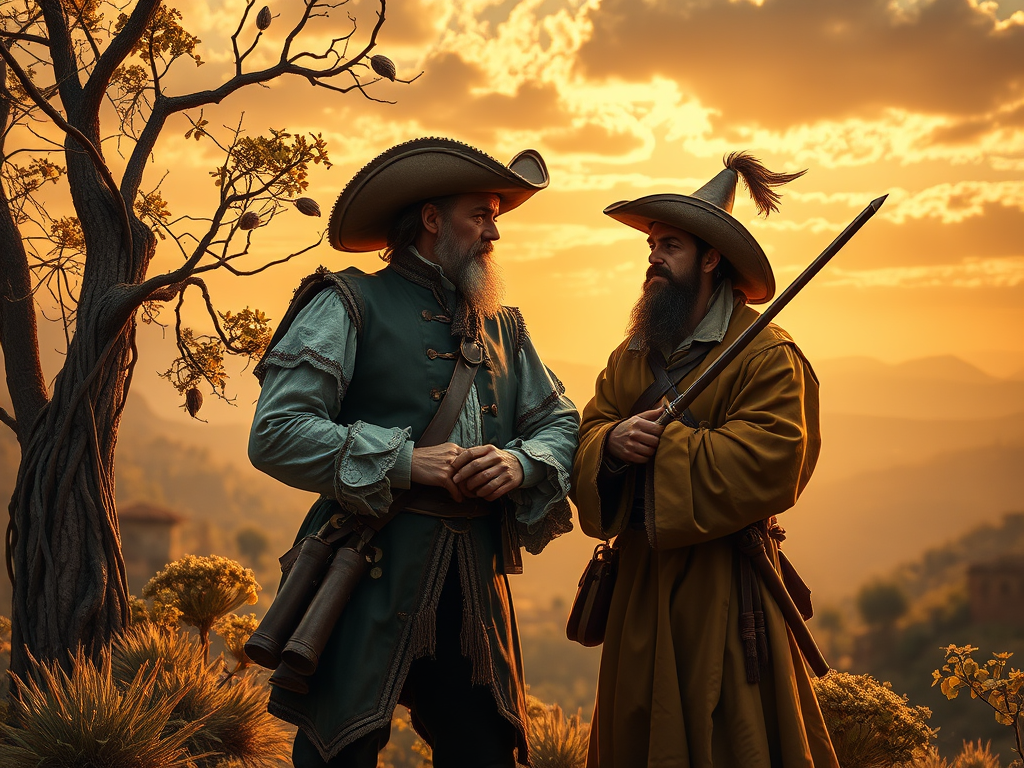
Miguel de Cervantes Saavedra, born in Alcalá de Henares, Spain, in 1547, was a towering figure of Spanish literature whose masterpiece, Don Quixote, forever changed the landscape of the novel. His adventurous, often challenging life, including military service, capture by Barbary pirates, and imprisonment, provided him with a unique breadth of experience that infused his writing with depth, wit, and profound insight into the human condition. Despite facing adversity, Cervantes’ literary genius flourished, culminating in works that brilliantly satirized chivalric romances, explored the complexities of idealism versus reality, and laid the foundations for modern prose fiction. This article delves into the ten most enduring aspects of Miguel de Cervantes’ life and the profound legacy he left, revealing why he is celebrated as the father of the modern novel and a timeless storyteller whose works continue to resonate globally.
1. Father of the Modern Novel: Innovating Literary Form
Miguel de Cervantes is widely recognized as the “father of the modern novel” due to his groundbreaking work, Don Quixote. Published in two parts (1605 and 1615), this epic narrative broke away from traditional chivalric romances by introducing complex, psychologically nuanced characters, realistic dialogue, and a self-aware narrative structure. Imagine a painter introducing perspective and depth to a flat, two-dimensional art form for the very first time. Cervantes fused humor, satire, and profound philosophical inquiry, pioneering techniques like embedded stories, metafiction, and the exploration of different points of view. His innovations in narrative technique and character development profoundly influenced subsequent novelists, establishing Don Quixote as the foundational text for the genre and forever changing the way stories could be told in prose.
2. Don Quixote: A Timeless Masterpiece of World Literature
Don Quixote de la Mancha is not just a novel; it is a timeless masterpiece of world literature that has been translated into virtually every language and continuously reprinted since its publication. Its central characters, the idealistic knight-errant Don Quixote and his pragmatic squire Sancho Panza, have become archetypes, representing the eternal struggle between idealism and realism, illusion and truth. The story’s blend of satire, humor, pathos, and philosophical depth allows it to be reinterpreted by each generation, finding new relevance in its exploration of madness, heroism, and the nature of storytelling itself. Its enduring popularity lies in its universal themes and its ability to simultaneously entertain and provoke profound thought, making it one of the most widely read and influential books ever written.
3. Exploration of Idealism vs. Reality: The Quixotic Dilemma
At the heart of Don Quixote lies the profound exploration of the conflict between idealism and reality. Don Quixote, consumed by chivalric novels, chooses to live in a world of heroic fantasy, perceiving windmills as giants and inns as castles. Sancho Panza, in contrast, represents grounded pragmatism. Their interactions highlight the human tendency to impose one’s desires and beliefs onto the world, often leading to comical or tragic consequences. This “quixotic” dilemma – the pursuit of noble goals despite overwhelming impracticality – remains a powerful lens through which to examine human folly, ambition, and the quest for meaning in a world that often defies our romanticized notions. It’s a fundamental question about how we navigate our dreams within the constraints of the real world.
4. Satire of Chivalric Romances: A Literary Turning Point
Don Quixote began as a satire of the popular chivalric romances of Cervantes’ era, which he felt had become stale and unrealistic. By presenting a protagonist who literally believes he is a knight from these stories, Cervantes playfully yet incisively mocked their clichés, improbable plots, and predictable characters. However, the novel transcends mere parody, evolving into a complex exploration of literary creation itself. Imagine a modern comedy show that starts by parodying reality TV but then becomes a profound commentary on society. This satirical approach signaled a turning point in literature, moving away from formulaic genre fiction towards a more nuanced, realistic, and psychologically rich form of storytelling that paved the way for the novel as we know it.
5. Influence on Western Literature: Shaping Future Storytellers
Cervantes’ influence on Western literature is immeasurable. Writers from Henry Fielding and Laurence Sterne to Flaubert, Dostoevsky, and Melville acknowledged Don Quixote‘s profound impact on their own work. The novel introduced techniques and thematic complexities that became central to the development of realist fiction, psychological depth, and narrative experimentation. It inspired new approaches to character development, dialogue, and the exploration of subjective reality. Its narrative structure, particularly its self-awareness and multi-layered storytelling, continues to be a source of inspiration for contemporary authors, making Cervantes a foundational figure whose innovations continue to shape literary trends four centuries later.
6. The “Cervantine” Legacy: Language and Cultural Impact
Beyond Don Quixote itself, Cervantes left a lasting “Cervantine” legacy on the Spanish language and culture, much like Shakespeare did for English. Many phrases from Don Quixote have become common idioms in Spanish, and his prose is celebrated for its richness, flexibility, and wit. His work is a cornerstone of Spanish identity and a source of immense national pride. Furthermore, the term “quixotic” has entered the global lexicon, describing someone who is idealistic and impractical. This cultural permeation demonstrates the profound way his stories and characters have seeped into the collective consciousness, reflecting his enduring impact on language and cultural self-understanding.
7. Diverse Literary Output: Beyond the Knight of the Rueful Countenance
While Don Quixote is his magnum opus, Cervantes was a prolific writer whose diverse literary output included novels, plays, and poetry, demonstrating his versatility and talent across genres. His Novelas ejemplares (Exemplary Novels), a collection of short stories, are considered groundbreaking for their realistic portrayals of Spanish society. His plays, though less frequently performed today than Don Quixote is read, contributed to the Spanish Golden Age theatre. These other works highlight his experimental spirit and his continuous effort to innovate within different literary forms, proving that his genius was not confined to a single masterpiece but spanned a broad spectrum of creative expression.
8. The Wounded Veteran’s Perspective: Life Experience and Art
Cervantes’ challenging life experiences profoundly shaped his writing. As a soldier, he participated in the Battle of Lepanto (1571), where he was wounded and lost the use of his left hand, earning him the nickname “the one-armed man of Lepanto.” Later, he was captured by Barbary pirates and held captive in Algiers for five years. These firsthand encounters with war, captivity, and hardship gave him a unique perspective on human suffering, resilience, and the absurdity of life, which he skillfully wove into his narratives. His personal adversities instilled a depth of understanding and a gritty realism that distinguished his work, making his writing resonate with a lived authenticity.
9. Master of Irony and Humor: Witty Social Commentary
Cervantes was a brilliant master of irony and humor, using wit and satire not just for entertainment but as a powerful tool for social commentary. Through the comical misadventures of Don Quixote and Sancho Panza, he subtly critiqued societal norms, the follies of human ambition, and the gap between appearances and reality. His humor is often layered, inviting readers to laugh at the characters while also empathizing with their struggles and recognizing aspects of themselves. This sophisticated blend of comedy and profound insight allowed him to engage with serious themes in an accessible and memorable way, ensuring that his social critiques remained impactful and enduring.
10. Enduring Relevance in Modern Contexts: A Mirror to Society
Centuries after its publication, Don Quixote and Cervantes’ insights maintain their enduring relevance in modern contexts. The novel’s themes of illusion versus reality, the search for meaning, the nature of heroism, and the power of narrative continue to be debated and explored. In a world grappling with fake news, virtual realities, and the challenges of distinguishing truth from fiction, Don Quixote’s struggle takes on new resonance. The novel’s timeless appeal lies in its ability to serve as a mirror, reflecting contemporary societal challenges and individual predicaments, proving that Cervantes’ profound understanding of humanity remains as pertinent today as it was in the Spanish Golden Age.
Further Reading
- Don Quixote by Miguel de Cervantes Saavedra (various translations, notably Edith Grossman or Tobias Smollett)
- Cervantes: A Life by William Egginton
- The Ingenious Gentleman and Poet Censored: Don Quixote and the Birth of the Modern Novel by Roberto González Echevarría
- Miguel de Cervantes: A Life of the Author of Don Quixote by John J. Allen
- Exemplary Novels by Miguel de Cervantes Saavedra
Here at Zentara.blog, our mission is to take those tricky subjects and unlock them, making knowledge exciting and easy to grasp for everyone. But the adventure doesn’t stop on this page! We’re constantly exploring new frontiers and sharing discoveries across the digital universe. Want to dive deeper into more mind-bending Top 10s and keep expanding your world? Come join us on our other platforms – we’ve got unique experiences waiting for you on each one!
Get inspired by visual wonders and bite-sized facts: See the world through Zentara’s eyes on Pinterest!
Pin our fascinating facts and stunning visuals to your own boards. Explore Pins on Pinterest: https://uk.pinterest.com/zentarablog/
Discover quick insights and behind-the-scenes peeks: Hop over to Tumblr for snippets, quotes, and unique content you won’t find anywhere else. It’s a different flavour of discovery! Follow the Fun on Tumblr: https://www.tumblr.com/zentarablog
Ready for deep dives you can listen to or watch? We’re bringing our accessible approach to video and potentially audio! Subscribe to our YouTube channel and tune into future projects that make learning pop! Subscribe on YouTube: https://www.youtube.com/@ZentaraUK
Seeking even more knowledge in one place? We’ve compiled some of our most popular topic deep dives into fantastic ebooks! Find them on Amazon and keep the learning journey going anytime, anywhere. Find Our Ebooks on Amazon: https://www.amazon.co.uk/s?k=Zentara+UK&ref=nb_sb_noss
Connect with us and fellow knowledge seekers: Join the conversation on BlueSky! We’re sharing updates, thoughts, and maybe even asking you what wonders we should explore next. Chat with Us on BlueSky: https://bsky.app/profile/zentarablog.bsky.social
Perfect for learning on the move! We post multiple 10-minute podcasts per day on Spotify. Pop on your headphones and fill your day with fascinating facts while you’re out and about! Listen on Spotify: https://open.spotify.com/show/3dmHbKeDufRx95xPYIqKhJFollow us on Instagram for bytesize knowledge! We post multiple posts per day on our official Instagram account. https://www.instagram.com/zentarablog/ Every click helps us keep bringing honest, accessible knowledge to everyone. Thanks for exploring with us today – see you out there in the world of discovery!




Leave a Reply