
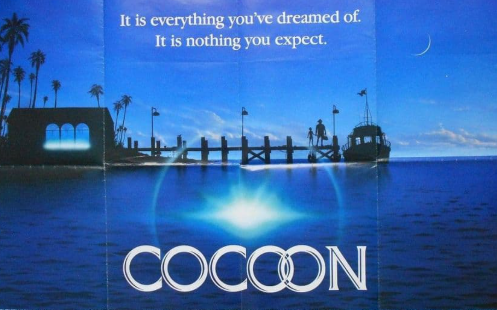
In the summer of 1985, director Ron Howard gave the world a movie that was unlike anything else: Cocoon. It was a film that blended science fiction wonder with the heartfelt realities of growing old, creating a story that was funny, touching, and profoundly magical. We were introduced to a group of spirited seniors in a Florida retirement community who accidentally stumble upon the fountain of youth, not in a mythical spring, but in a swimming pool charged with the energy of alien cocoons. The film was a runaway hit, charming audiences of all ages and even winning two Academy Awards.
Cocoon is one of those timeless 80s classics that feels like a warm hug. It explores themes of friendship, love, loss, and the incredible idea that it’s never too late for one last grand adventure. But behind the glowing aliens and rejuvenated joy-rides is a production story filled with as much heart and humor as the film itself. The journey to bring this unique tale to the screen involved fighting for the perfect cast, pushing the boundaries of special effects, and a few pranks from some of Hollywood’s most legendary actors. Here at Zentara.blog, we’ve charged up our own pool of knowledge to bring you 10 fascinating, little-known facts that will make you fall in love with this beautiful film all over again.
1. The Veteran Actors Were a Gang of On-Set Pranksters
When you assemble a cast of Hollywood legends like Don Ameche, Wilford Brimley, Hume Cronyn, and Jessica Tandy, you might expect a quiet, serious set. The reality was the complete opposite. The veteran actors, full of the same renewed vigour as their characters, created an incredibly lively and fun-loving atmosphere, often at the expense of their younger director, Ron Howard. They were notorious for playing pranks on each other and the crew, keeping everyone on their toes.
Wilford Brimley, in particular, was known for teasing Howard relentlessly. He would often pretend to be hard of hearing when Howard was trying to give him direction, only to reveal he had heard everything perfectly. The group’s real-life chemistry and mischievous energy were infectious. This wasn’t just a group of actors showing up for a job; they were genuinely enjoying each other’s company, and that authentic camaraderie shines through in every frame of the film. Howard later said that while they tested him, their playful spirit was essential to capturing the movie’s joyful tone. Their off-screen friendship is a huge reason their on-screen bonds feel so real and heartwarming.
2. An Oscar-Winning Breakdance Was Performed by a Teenager
One of the most memorable and triumphant scenes in Cocoon is when Art Selwyn, played by the dapper Don Ameche, feels the full effects of the life-force and hits a nightclub floor, stunning everyone with an electrifying breakdance routine. The scene is a pure expression of youthful joy rediscovered, and it helped Ameche win the Academy Award for Best Supporting Actor. While Ameche, then in his late 70s, performed many of the joyful spins and shuffles himself, the more acrobatic and complex moves were performed by a 19-year-old professional breakdancer named David “TKO” Cota.
Ameche had never even heard of breakdancing before the film and spent four weeks rehearsing with Cota to get the feel for it. For the final scene, director Ron Howard cleverly intercut shots of Ameche’s beaming face and upper-body movements with shots of Cota performing the intricate power moves and floor work. The seamless editing created one of the most iconic moments of 80s cinema. It was a perfect blend of an actor’s heartfelt performance and a stunt double’s incredible physical skill, resulting in a moment of pure, unadulterated movie magic.
3. The Studio Wanted to Use Younger Actors in Old-Age Makeup
It’s almost impossible to imagine Cocoon without its incredible cast of veteran actors, but 20th Century Fox executives were initially terrified of the idea. The thought of banking a multi-million dollar science fiction film on a group of actors who were mostly over the age of 60 was seen as a massive financial risk. The studio’s solution? They strongly suggested that Ron Howard cast younger, more “bankable” movie stars of the era and simply use extensive old-age makeup and prosthetics to make them look like senior citizens.
Ron Howard and producers Richard and Lili Fini Zanuck fought this idea with everything they had. Howard argued passionately that the film’s entire emotional core depended on the authenticity, grace, and lived experience that only genuine older actors could bring to the roles. He knew that no amount of makeup could replicate the subtle expressions, movements, and deep-seated emotion of actors like Hume Cronyn, Jessica Tandy, and Don Ameche. Thankfully, Howard and the Zanucks won the battle. Their insistence on casting age-appropriately not only saved the film’s soul but also resulted in a powerful and respectful on-screen representation of ageing, which was a rarity in Hollywood.
4. Wilford Brimley Was Only 49 Years Old During Filming
This is a fact that continues to astound fans of the film. Wilford Brimley delivered such a pitch-perfect performance as Ben Luckett, the gruff, weary, and deeply loving leader of the group, that everyone assumed he was well into his senior years. In reality, Brimley was only 49 when he was cast, and he turned 50 during the shoot. He was actually decades younger than most of his “peer” co-stars and even younger than Ron Howard’s own father, Rance Howard, who had a supporting role in the film.
To achieve the look of an older man, the makeup department greyed Brimley’s hair and famous moustache and painted age spots and wrinkles on his face. But the physical transformation was only part of it. Brimley had a natural gravitas and a world-weary quality that made him incredibly believable as an older character, a talent he had already demonstrated in films like The Thing. His surprisingly young age is a testament to his incredible skill as a character actor, as he completely disappeared into the role and created one of cinema’s most beloved grandfathers while still in his prime.
5. The Film Was Based on an Unpublished Novel
While the movie became a cultural phenomenon, the magical story of Cocoon began on the page. The film is based on a novel of the same name by author David Saperstein. However, in a highly unusual move, Hollywood producers Richard and Lili Fini Zanuck discovered and purchased the film rights to the story before the book was even published. They were given the manuscript and immediately saw its immense cinematic potential, recognizing that the blend of science fiction and human drama was a recipe for a truly special film.
While the core premise is the same, there are some notable differences between the book and the film. The novel is a bit darker and more focused on the science fiction elements, with the Antareans’ original purpose for the cocoons being to raise an elite army. Director Ron Howard and screenwriter Tom Benedek chose to soften these elements, focusing instead on the emotional journeys of the elderly characters and making the aliens more benevolent. This adaptation shifted the story’s focus from a sci-fi plot to a heartfelt character study, a change that was key to the film’s universal appeal and success.
6. The Glowing Antareans Were Accomplished Dancers and Mimes
The Antareans, in their true form, are beings of pure light and energy who move with a mesmerizing, otherworldly grace. To achieve this effect, Ron Howard didn’t just put actors in light-up suits; he specifically hired professional dancers, mimes, and acrobats. He knew that these performers had the unique physical control needed to convey a sense of weightlessness and elegance, making the aliens feel truly non-human. The lead Antarean, Walter (played in human form by Brian Dennehy), was portrayed in his alien form by the incredibly talented dancer and mime Tyrone “Ty” Scott.
The alien suits themselves, created by the special effects team, were a groundbreaking technical achievement. They were made of a sheer, skin-like material and intricately lined with thousands of tiny, custom-made incandescent light bulbs wired together. The suits were hot, restrictive, and delicate, but in the hands of the skilled performers, they came to life. The combination of innovative effects and graceful performance is what makes the aliens in Cocoon so believable and beautiful to watch.
7. Ron Howard Chose Cocoon Over Directing Top Gun
After the massive success of his 1984 mermaid comedy Splash, Ron Howard became one of the most in-demand young directors in Hollywood. He was flooded with offers, including the opportunity to direct a high-octane action film that was generating a lot of buzz: Top Gun. While the prospect of directing what was sure to be a blockbuster was tempting, Howard ultimately turned it down. His heart was set on another project that couldn’t have been more different.
Howard was deeply moved by the script for Cocoon. He was drawn to its powerful emotional core, its unique blend of genres, and the incredible opportunity to work with a cast of acting legends. He saw it as a chance to tell a more intimate, character-driven story that explored profound questions about life, death, and what it means to be human. Choosing Cocoon over Top Gun was a bold move that demonstrated his commitment to heartfelt storytelling over guaranteed box office spectacle. In the end, both films became iconic 80s classics, proving he made the right choice for himself.
8. The On-Screen Love Story of Hume Cronyn and Jessica Tandy Was Real
The relationship between Joe and Alma Finley, played by Hume Cronyn and Jessica Tandy, is one of the most touching and heartbreaking parts of the film. Their deep love and devotion feel incredibly authentic, and that’s because it was entirely real. Cronyn and Tandy were one of Hollywood’s most celebrated and enduring couples, having been married for 42 years at the time Cocoon was filmed. They had starred together on stage and screen dozens of times, and their shared history brought an unparalleled depth and poignancy to their performances.
Their real-life bond is palpable in every scene they share, from their playful banter to the devastating moment when Alma suffers a medical emergency after the pool is drained of its energy. Ron Howard barely had to direct them in their scenes together; he simply let their natural chemistry and profound affection for one another play out on screen. Their love story was a Hollywood legend, and its presence in Cocoon elevates the film from a simple fantasy into a beautiful meditation on lifelong partnership.
9. The Film’s Success Created a Tourism Boom for St. Petersburg, Florida
Before Cocoon, St. Petersburg, Florida, was known as a quiet beach city, popular with retirees. But after the film’s release, it was transformed into a major tourist destination. The movie was filmed almost entirely on location in and around St. Petersburg, and its worldwide success put the city on the map in a huge way. The community embraced its newfound fame, and many of the locations used in the film became popular spots for visiting fans.
The St. Petersburg Shuffleboard Club, where the guys hang out, saw a massive resurgence in popularity. The Snell Arcade building and the Coliseum, where Don Ameche performs his famous breakdance, also became points of interest. The film showcased the city’s sunny charm and beautiful scenery to a global audience, leading to a significant and lasting boom in tourism and civic pride. It’s a wonderful example of how the magic of a movie can have a very real and positive impact on the community where it was made.
10. The Special Visual Effects Won an Oscar
While Cocoon is celebrated for its powerful human drama, its visual effects were truly groundbreaking and earned the film its second Academy Award. In a time just before the CGI revolution, the wizards at Industrial Light & Magic (ILM) had to rely on brilliant practical effects and innovative optical tricks to bring the film’s fantasy to life. The team, led by Ken Ralston and Robert Legato, was responsible for creating the glowing cocoons, the ethereal look of the Antareans, and the spectacular departure of the spaceship in the finale.
As mentioned, making the Antareans glow was a huge challenge, solved with meticulously wired light-up suits. The cocoons themselves were large, detailed props that were backlit and optically enhanced to give them their pulsating, otherworldly glow. The film’s climax, which sees the fishing boat lifted into the massive alien vessel hidden in a swirling sea fog, was a masterclass in miniature work and matte painting. The effects were so seamlessly integrated into the story that they never overshadowed the characters’ emotional journeys, which is the mark of truly great visual effects.
Conclusion
Cocoon is so much more than just a science fiction fantasy. It’s a film with a giant, glowing heart that speaks to one of the most universal human desires: the wish for more time with the people we love. Its journey to the screen, championed by a director who chose emotion over spectacle and a cast of legends who brought both humour and gravitas, is a story of why authenticity matters. The behind-the-scenes secrets reveal a production filled with as much life, laughter, and love as the story it tells.
The film’s enduring power lies in its gentle, hopeful message about ageing, friendship, and second chances. It asks us to consider what makes life worth living and suggests that the ultimate adventure might not be to live forever, but to live fully. Cocoon remains a timeless classic because it reminds us that wonder can be found in the most unexpected places, and that it’s never, ever too late to reach for the stars.
So, we’ll leave you with a question to ponder: If the Antareans offered you a one-way ticket to their world for a life free of pain and old age, would you go? Let us know your choice in the comments below!
Dive Deeper
Want to explore the warm, wonderful world of Cocoon even further? These books offer deeper insights into the film, its creators, and its stars.
- Cocoon by David Saperstein: Read the original novel that started it all. Discover the slightly darker and more sci-fi-focused story that formed the basis for the classic film.
- The Boys: A Memoir of Hollywood and Family by Ron Howard and Clint Howard: A fascinating and heartfelt memoir from the director and his brother, offering incredible insight into Ron Howard’s career, his directing philosophy, and his experiences making iconic films like Cocoon.
- Hume Cronyn and Jessica Tandy: A Bio-Bibliography by Preston Neal Jones: A detailed look into the lives and careers of one of Hollywood’s most beloved couples, whose real-life love story was the heart and soul of the film.
- The Making of Star Wars: The Empire Strikes Back by J.W. Rinzler: While about a different film, this book provides an unparalleled look into the workings of Industrial Light & Magic (ILM) during the same era, showcasing the incredible practical effects techniques used to create movie magic before CGI.




Leave a Reply