
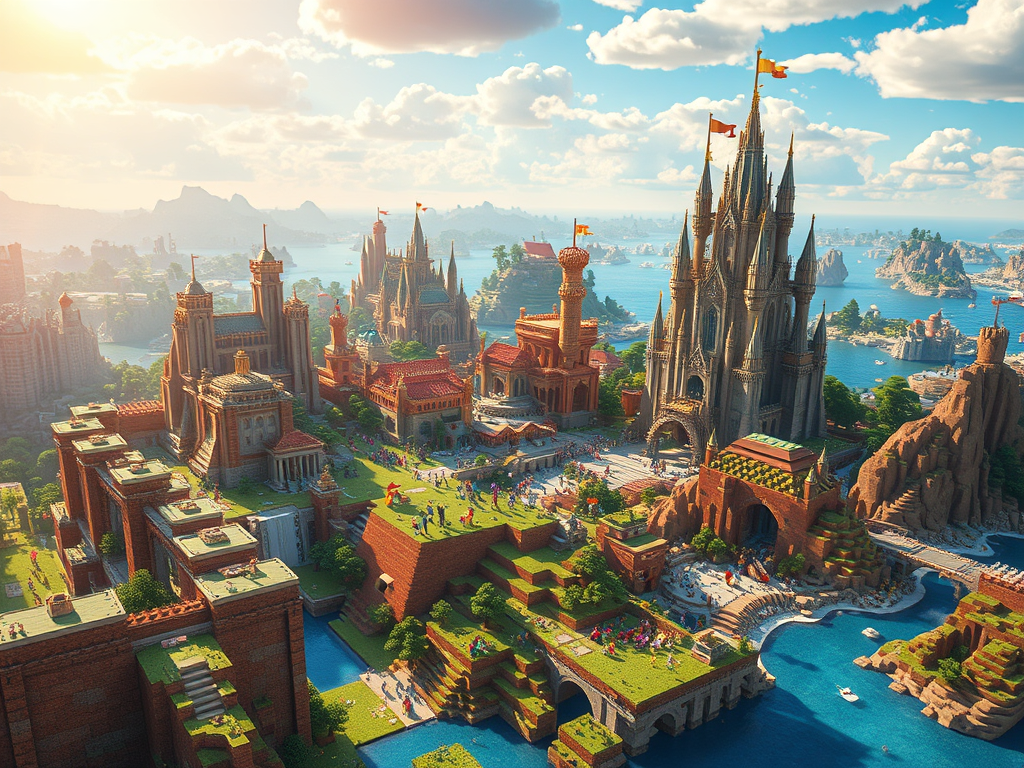
In a world saturated with hyper-realistic graphics and complex narratives, a blocky, pixelated game called Minecraft emerged from humble indie beginnings to become one of the most influential and best-selling video games of all time. More than just a game, it evolved into a cultural touchstone, a creative platform, and a global phenomenon that transcended traditional gaming demographics. Its simple premise – breaking and placing blocks – belies an astonishing depth and versatility that has captivated millions across generations.
Table of Contents
Minecraft’s success isn’t a result of a massive marketing blitz or a flashy launch; it’s an organic growth story fueled by community engagement, endless creativity, and a surprisingly profound understanding of human nature’s desire to build, explore, and connect. It offers a unique blend of freedom and structure, allowing players to define their own experiences within its infinite, procedurally generated worlds.
Its blocky aesthetic, initially a technical limitation, became an iconic signature, fostering imagination rather than dictating visual realism. This simplicity, combined with its profound depth, allowed Minecraft to permeate various aspects of culture, from education to entertainment. This article will delve into ten key reasons why Minecraft ascended to global phenomenon status, dissecting the core elements that solidified its enduring appeal and unparalleled impact on the gaming world and beyond.
1. Unparalleled Creative Freedom: The Ultimate Digital Lego Set
At its core, Minecraft offers players an almost limitless sandbox for creativity. Imagine a digital canvas where every block is a brushstroke, and your imagination is the only limit. In Creative Mode, players have infinite resources and invincibility, allowing them to build anything they can conceive – from intricate sprawling cities and breathtaking architectural marvels to complex redstone contraptions and pixel art masterpieces. This freedom to construct, dismantle, and reconstruct empowers players as digital architects and artists. It’s a fundamental appeal that resonates across all age groups, tapping into an innate human desire to create and express. This open-ended approach starkly contrasted with the linear narratives and predefined objectives of most games at the time, making Minecraft a truly unique and liberating creative outlet that fostered boundless self-expression.
2. Accessible Simplicity, Deep Complexity: Easy to Learn, Hard to Master
Minecraft’s brilliance lies in its deceptively simple entry point. Its block-based graphics and intuitive controls mean that almost anyone, from young children to seasoned gamers, can pick it up and start playing within minutes. Imagine building your first simple shelter from basic dirt blocks – anyone can do it. However, beneath this accessible surface lies an incredible depth of complexity. As players delve deeper, they discover intricate crafting recipes, advanced redstone circuitry (a virtual form of electrical engineering), elaborate farming systems, and complex mob mechanics. This tiered learning curve keeps players engaged for years, constantly discovering new possibilities and challenges. The ability to grow from a simple block placer to a master builder, engineer, or adventurer ensures that Minecraft remains fresh and rewarding, catering to both casual and dedicated players.
3. The Power of Survival Mode: A Compelling Goal in an Open World
While Creative Mode showcases limitless building, Survival Mode provides a compelling objective that adds challenge and purpose to the open-world environment. Imagine spawning into a vast, unknown world with nothing but your bare hands, the sun setting, and the threat of monsters looming. Players must gather resources, craft tools and weapons, build shelter, manage hunger and health, and fend off hostile creatures like zombies and skeletons. This blend of creative building with essential survival mechanics creates a powerful sense of accomplishment and progression. It encourages strategic thinking, resource management, and problem-solving under pressure. The constant cycle of exploration, mining, crafting, and building for survival offers a structured yet still open-ended gameplay loop that keeps players deeply invested in their world and its challenges.
4. The Thriving Community and User-Generated Content (UGC)
Minecraft’s explosive growth was largely organic, fueled by its passionate and creative community. This community didn’t just play the game; they became an integral part of its expansion and appeal. Imagine millions of players creating, sharing, and collaborating on everything from custom maps, texture packs, and character skins to elaborate multiplayer servers with unique game modes. YouTube and Twitch became prime platforms for Minecraft content creators, showcasing builds, tutorials, let’s plays, and intricate redstone contraptions, which in turn attracted new players. This vibrant ecosystem of user-generated content constantly reinvents the game, providing an endless stream of fresh experiences and fostering a powerful sense of belonging and collaboration among players, demonstrating the immense power of collective creativity.
5. Cross-Platform Accessibility: Playing Together, Everywhere
Minecraft’s commitment to cross-platform play has been a major factor in its global reach. Unlike many games confined to a single console or PC, Minecraft (especially the Bedrock Edition) allows players on various devices—PC, Xbox, PlayStation, Nintendo Switch, mobile phones, and tablets—to play together seamlessly. Imagine friends living miles apart, each on their preferred device, all able to connect and build in the same virtual world. This unprecedented accessibility removed significant barriers to entry and fostered a massive, interconnected player base. It made Minecraft a truly universal playground, enabling families and friends to connect and collaborate regardless of their hardware, significantly contributing to its widespread adoption and cementing its status as a truly global phenomenon.
6. Educational Applications: Learning Through Play
Beyond entertainment, Minecraft’s inherent mechanics lend themselves remarkably well to educational purposes, leading to the development of Minecraft: Education Edition. Imagine students learning about civil engineering by building bridges, understanding historical architecture by recreating ancient cities, or grasping basic coding concepts through Redstone logic. The game provides a hands-on, engaging environment for teaching subjects like math, science, history, computer programming, and even social studies (through collaborative building projects). Its sandbox nature encourages critical thinking, problem-solving, and teamwork in a way that traditional teaching methods often struggle to achieve. This recognition of its pedagogical value by educators worldwide has broadened its appeal beyond pure gaming, making it a valuable tool in classrooms and informal learning environments alike.
7. Constant Updates and Evolution: Keeping the World Fresh
Unlike many games that have a finite lifecycle, Minecraft has maintained its relevance for over a decade through a consistent stream of major updates and minor tweaks. Imagine a game world that continually expands, adding new biomes, creatures, blocks, mechanics, and challenges every few months or years. These regular content injections, developed by Mojang and later Microsoft, keep the game fresh and exciting, providing new reasons for veteran players to return and for new players to dive in. From the “Nether Update” to “Caves & Cliffs,” these expansions have dramatically reshaped the game world, adding layers of complexity and exploration. This commitment to ongoing development ensures that the game never truly feels “finished,” providing an endless landscape of discovery and reinvention.
8. The Modding Community: Infinite Customization and Expansion
Beyond official updates, Minecraft’s open architecture and the dedication of its player base have fostered an enormous and incredibly active modding community. Imagine a game where players can freely add new items, creatures, dimensions, and even entirely new gameplay mechanics created by other fans. These “mods” (modifications) range from simple quality-of-life improvements to massive content expansions that fundamentally transform the game. Platforms like CurseForge host millions of mods, allowing players to customize their experience to an unparalleled degree. This community-driven expansion constantly pushes the boundaries of what Minecraft can be, offering endless new ways to play and ensuring its longevity far beyond what the base game alone could provide.
9. Lack of a Fixed Narrative: Player-Driven Storytelling
Unlike many popular games that feature elaborate storylines and fixed protagonists, Minecraft deliberately eschews a strong, predefined narrative. While there’s an “end” to the game (defeating the Ender Dragon), it’s entirely optional. Imagine a world where you are the hero, and you decide the story. This lack of a fixed narrative means that players are free to create their own adventures, set their own goals, and tell their own stories within the boundless world. This player-driven storytelling fosters immense replayability and personal connection to the game. It allows for role-playing, emergent narratives, and unique experiences that differ for every player, contributing significantly to its long-term appeal and its ability to continually spark imagination.
10. The Nostalgia Factor and Enduring Cultural Relevance
Minecraft has now been around for over a decade, meaning an entire generation of players grew up with its blocky aesthetic and endless possibilities. This has created a powerful nostalgia factor, cementing its place in popular culture. Imagine a game that evokes fond memories of childhood creativity, exploration, and online friendships for millions of adults today. Its simple yet iconic visual style is instantly recognizable, permeating memes, merchandise, and even real-world education. Minecraft’s ability to remain relevant across demographic shifts, attract new players while retaining older ones, and adapt to evolving technology (e.g., VR support, educational editions) speaks to its timeless design principles and its deep cultural integration. It has become more than just a game; it’s a shared cultural experience that continues to inspire and connect people worldwide.
Further Reading
- Minecraft: The Official Guide to Minecraft (various editions, often written by Mojang)
- Block by Block: The Unofficial History of Minecraft by Lars Marius Garshol (historical accounts from the early community)
- Rebooting Education: Gaming, Learning, and the Future of the Classroom by Andrew Miller (discusses Minecraft’s role in education)
- The Art of Minecraft (features community creations and discussions on design)
Here at Zentara.blog, our mission is to take those tricky subjects and unlock them, making knowledge exciting and easy to grasp for everyone. But the adventure doesn’t stop on this page! We’re constantly exploring new frontiers and sharing discoveries across the digital universe. Want to dive deeper into more mind-bending Top 10s and keep expanding your world? Come join us on our other platforms – we’ve got unique experiences waiting for you on each one!
Get inspired by visual wonders and bite-sized facts: See the world through Zentara’s eyes on Pinterest!
Pin our fascinating facts and stunning visuals to your own boards. Explore Pins on Pinterest: https://uk.pinterest.com/zentarablog/
Discover quick insights and behind-the-scenes peeks: Hop over to Tumblr for snippets, quotes, and unique content you won’t find anywhere else. It’s a different flavour of discovery! Follow the Fun on Tumblr: https://www.tumblr.com/zentarablog
Ready for deep dives you can listen to or watch? We’re bringing our accessible approach to video and potentially audio! Subscribe to our YouTube channel and tune into future projects that make learning pop! Subscribe on YouTube: https://www.youtube.com/@ZentaraUK
Seeking even more knowledge in one place? We’ve compiled some of our most popular topic deep dives into fantastic ebooks! Find them on Amazon and keep the learning journey going anytime, anywhere. Find Our Ebooks on Amazon: https://www.amazon.co.uk/s?k=Zentara+UK&ref=nb_sb_noss
Connect with us and fellow knowledge seekers: Join the conversation on BlueSky! We’re sharing updates, thoughts, and maybe even asking you what wonders we should explore next. Chat with Us on BlueSky: https://bsky.app/profile/zentarablog.bsky.social
Perfect for learning on the move! We post multiple 10-minute podcasts per day on Spotify. Pop on your headphones and fill your day with fascinating facts while you’re out and about! Listen on Spotify: https://open.spotify.com/show/3dmHbKeDufRx95xPYIqKhJFollow us on Instagram for bytesize knowledge! We post multiple posts per day on our official Instagram account. https://www.instagram.com/zentarablog/ Every click helps us keep bringing honest, accessible knowledge to everyone. Thanks for exploring with us today – see you out there in the world of discovery!




Leave a Reply