
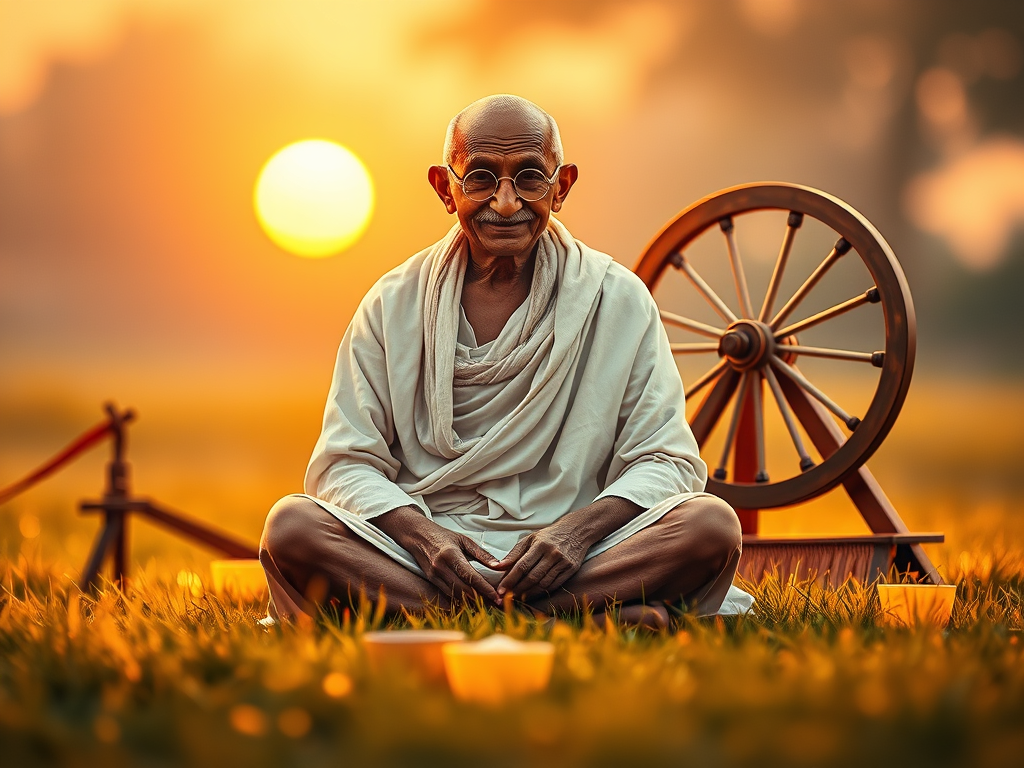
The story of India’s independence from British rule is inextricably linked with the name Mahatma Gandhi. More than a political leader, Mohandas Karamchand Gandhi was a philosopher, activist, and moral compass who galvanized millions with his unique approach to resistance. His principles of non-violent civil disobedience, known as Satyagraha, transformed a national liberation struggle into a global beacon for peace and justice. Gandhi’s leadership not only shook the foundations of the mighty British Empire but also profoundly influenced civil rights movements and leaders worldwide, from Martin Luther King Jr. to Nelson Mandela.
This article delves into ten pivotal facts about Mahatma Gandhi’s indelible legacy within the Indian Independence Movement. We will explore the core tenets of his philosophy, his most impactful campaigns, his vision for a free India, and the enduring influence of his ideas on both his nation and the world. Understanding Gandhi’s role is not just about historical recall; it’s about comprehending how one individual, armed with conviction and a belief in the power of truth, could inspire a nation to cast off colonial chains through peaceful means. From the streets of South Africa to the salt pans of Dandi, Gandhi’s journey was a testament to the transformative power of non-violence, challenging the very notion of power and resistance. Join us as we illuminate the multifaceted contributions of the man revered as the “Father of the Nation” and explore why his legacy continues to shape discourse on justice, equality, and peace today.
1. Satyagraha: The Power of Truth-Force
At the core of Gandhi’s philosophy and the Indian Independence Movement was “Satyagraha,” a term he coined himself, meaning “truth-force” or “soul-force.” It was far more than mere passive resistance; it was an active, unwavering pursuit of truth and justice through non-violent means. Gandhi believed that moral truth held immense power and that by appealing to the conscience of the oppressor through self-suffering and peaceful defiance, one could achieve a change of heart. Imagine a situation where instead of fighting back with violence, you stand firm in your moral conviction, enduring hardship willingly to expose the injustice of the oppressor. This was the essence of Satyagraha. It involved strict adherence to non-violence (ahimsa), self-discipline, and a readiness to accept suffering without retaliation. Satyagraha sought to convert, not coerce, the wrongdoer, making it a powerful moral weapon against colonial rule. It was a strategy that required immense courage, discipline, and faith, turning ordinary citizens into powerful agents of change, collectively demonstrating the moral bankruptcy of British rule without resorting to bloodshed. This innovative approach transformed the nature of political protest, inspiring millions to participate in peaceful resistance movements.
2. Non-Cooperation Movement (1920-1922): A Mass Awakening
Following the horrific Jallianwala Bagh Massacre in 1919, where British troops fired upon unarmed civilians, Gandhi launched his first major nationwide mass movement: the Non-Cooperation Movement. This campaign aimed to withdraw Indian cooperation from every aspect of British administration and economy. It was a call for Indians to boycott British goods, educational institutions, law courts, and government services. Imagine students leaving schools, lawyers abandoning their practices, and people burning foreign-made cloth to embrace homespun “khadi.” The goal was to make it impossible for the British to govern India without Indian collaboration, thereby asserting India’s demand for self-rule (Swaraj). The movement witnessed unprecedented participation from all sections of society, including women, peasants, and workers, effectively politicizing millions and transforming the Indian National Congress from an elite body into a mass organization. Although Gandhi called off the movement after the Chauri Chaura incident, where protestors turned violent, its impact was profound. It fostered a strong national consciousness, instilled a sense of fearlessness against British authority, and firmly established Gandhi as the undisputed leader of the Indian independence movement, proving the immense potential of mass non-violent resistance.
3. The Salt March (1930): Challenging an Unjust Tax
The Salt March, also known as the Dandi March, stands as one of the most iconic acts of civil disobedience led by Gandhi. In 1930, the British Raj imposed a draconian salt tax, making it illegal for Indians to produce or sell salt and forcing them to buy expensive British salt. Gandhi saw this as a symbol of colonial oppression, as salt was a basic necessity for every Indian, especially the poor. He launched a 240-mile march from his Sabarmati Ashram to the coastal village of Dandi with a handful of followers. Along the way, thousands joined, turning it into a massive procession. On April 6, 1930, Gandhi famously picked up a handful of natural salt from the seashore, symbolically breaking the unjust salt laws. This simple act sparked widespread civil disobedience across India, with people everywhere defying the salt laws. Imagine a nation uniting over a pinch of salt, transforming a common commodity into a symbol of freedom. The Salt March drew international attention to India’s struggle, exposing the moral bankruptcy of British rule and demonstrating the power of peaceful defiance. It was a masterstroke of political strategy, uniting Indians from all walks of life against a universally felt injustice and further strengthening the movement’s momentum towards independence.
4. The Quit India Movement (1942): The Final Push
As World War II raged, Gandhi launched the “Quit India” Movement in August 1942, demanding an immediate end to British rule. He gave the powerful call of “Do or Die,” urging Indians to make every effort to achieve independence. This movement was a direct response to the British refusal to grant India immediate self-governance in exchange for wartime cooperation. Gandhi and other prominent Congress leaders were immediately arrested, leading to widespread, spontaneous, and often violent protests, strikes, and demonstrations across the country. Though it lacked the strict non-violent discipline of earlier campaigns due to the leadership’s incarceration, the Quit India Movement demonstrated the Indian people’s unwavering determination for complete independence. Imagine a whole nation rising up, without its leaders, in a desperate but resolute bid for freedom. The movement severely weakened British authority and administration, making it clear that continued colonial rule was untenable. While the British suppressed it with force, the Quit India Movement created an irreversible momentum for independence, signaling to the British that their time in India was rapidly coming to an end and setting the stage for the eventual transfer of power.
5. Promotion of Khadi and Swadeshi: Economic Independence
Beyond political liberation, Gandhi deeply understood the importance of economic independence. He passionately promoted “Khadi” (hand-spun and hand-woven cloth) and the “Swadeshi” (self-reliance or indigenous production) movement. Before British rule, India was a major textile producer, but colonial policies had systematically destroyed its indigenous industries, forcing Indians to buy expensive British manufactured goods. Gandhi saw the spinning wheel (charkha) as a symbol of economic freedom, self-sufficiency, and resistance against foreign exploitation. He encouraged every Indian to spin and weave their own cloth, not just as an act of defiance against British mills but also as a means of rural upliftment and poverty alleviation. Imagine millions of people adopting a simple handloom, turning a daily chore into a powerful political statement and a source of livelihood. The promotion of Khadi aimed to revive cottage industries, provide employment to rural populations, and instill a sense of national pride and self-respect. This emphasis on local production and consumption was a practical manifestation of his vision for a decentralized, self-reliant India, showing that true independence encompassed not just political freedom but also economic autonomy.
6. Championing the Downtrodden: Uplifting the “Harijans”
One of the most significant aspects of Gandhi’s legacy, often overshadowed by his political achievements, was his tireless crusade against untouchability and his efforts to uplift the marginalized sections of Indian society. He passionately advocated for the rights of the “untouchables,” whom he lovingly called “Harijans” (children of God). He rejected the discriminatory caste system, which had historically relegated these communities to the lowest rung of society, facing severe social, economic, and religious discrimination. Gandhi undertook fasts and campaigns to bring about social reform, advocating for their temple entry, equal access to public services, and dignity. He even lived in Harijan colonies to demonstrate solidarity and challenge deeply ingrained prejudices. Imagine a national leader, revered by millions, actively challenging centuries-old social hierarchies and advocating for the rights of the most oppressed, even when it drew criticism from conservative elements. His efforts were crucial in bringing the issue of untouchability to the forefront of the national consciousness, initiating a slow but steady process of social reform. While the caste system persists in various forms, Gandhi’s unwavering commitment laid the moral groundwork for future legal and social reforms aimed at achieving equality and justice for all.
7. Hindu-Muslim Unity: A Challenged Ideal
Gandhi firmly believed in the harmonious coexistence of Hindus and Muslims, viewing their unity as essential for India’s strength and independence. Throughout his life, he tirelessly worked to bridge communal divides, often undertaking fasts to quell outbreaks of sectarian violence. He strategically linked the Non-Cooperation Movement with the Khilafat Movement, a pan-Islamic protest against the dismantling of the Ottoman Caliphate, to foster Hindu-Muslim unity against the common colonial oppressor. He participated in Muslim festivals and encouraged interfaith dialogue, embodying his vision of “Sarva Dharma Sama Bhava” (equal respect for all religions). Imagine a leader who, despite being a devout Hindu, embraced and respected all faiths, using his moral authority to unite diverse communities. However, despite his fervent efforts, rising communal tensions, fueled by British “divide and rule” policies and the growing demand for a separate Muslim state, ultimately led to the tragic Partition of India in 1947. Gandhi was deeply saddened by the Partition and the horrific violence that accompanied it, seeing it as a personal failure. His last fasts were undertaken to stop the communal riots that erupted post-independence, demonstrating his lifelong commitment to peace and interfaith harmony, even in the face of profound despair.
8. Role of Women: Mobilizing a Hidden Force
Gandhi’s leadership significantly transformed the role of women in Indian public life, bringing them out of their homes and into the forefront of the independence struggle. He recognized and actively encouraged women’s participation, believing that their inherent capacity for suffering, sacrifice, and non-violence made them ideal Satyagrahis. Women actively participated in all major campaigns, from picketing liquor shops and foreign cloth stores during the Non-Cooperation Movement to joining the Salt March and facing lathi charges and imprisonment during the Civil Disobedience Movement. Imagine women from all social strata, traditionally confined to domestic roles, marching alongside men, defying colonial laws, and demonstrating immense courage and resilience. Leaders like Sarojini Naidu, Kamala Nehru, and countless others emerged, playing crucial roles in mobilizing support and sustaining the movement, especially when male leaders were arrested. Gandhi’s inclusive approach not only bolstered the numbers and moral strength of the independence movement but also laid the groundwork for greater gender equality in independent India. His vision challenged patriarchal norms, empowering women to recognize their own strength and agency in shaping the nation’s destiny.
9. Economic Philosophy: Trusteeship and Decentralization
Gandhi’s economic philosophy was deeply intertwined with his moral and spiritual beliefs, advocating for a decentralized, self-sustaining economy focused on the well-being of all, not just the accumulation of wealth. His concept of “Trusteeship” proposed that wealthy individuals should act as trustees of their wealth, managing it for the benefit of society rather than for personal indulgence. He believed in voluntary simplicity (Aparigraha) and advocated for a village-based economy where local needs were met through local production, minimizing dependence on large-scale industrialization and foreign imports. Imagine a society where economic activity is centered around the needs of the community, where resources are shared, and where every individual can find dignified work through cottage industries. He opposed the Western model of industrial capitalism, which he saw as inherently exploitative and alienating. Gandhi’s economic vision, encompassing Swadeshi, Khadi, and village self-sufficiency (Gram Swaraj), aimed to eradicate poverty, reduce inequality, and build a more equitable and sustainable society. While independent India largely adopted a more centralized, industrial model, elements of Gandhian economic thought continue to inspire movements for sustainable development, rural empowerment, and ethical consumption globally.
10. Assassination and Enduring Global Influence
Mahatma Gandhi’s life was tragically cut short on January 30, 1948, when he was assassinated by Nathuram Godse, a Hindu nationalist who opposed Gandhi’s inclusive vision and his efforts to promote Hindu-Muslim unity, especially in the aftermath of Partition. His death sent shockwaves across the newly independent nation and the world, plunging India into mourning. However, his assassination, far from diminishing his impact, cemented his place as a martyr for peace and non-violence. Gandhi’s legacy extended far beyond India’s borders. His methods of non-violent civil disobedience inspired countless freedom struggles and civil rights movements around the world. Leaders like Martin Luther King Jr. in the United States, who adopted Satyagraha in the American Civil Rights Movement, and Nelson Mandela in South Africa, who fought apartheid, openly credited Gandhi as a profound influence. Imagine a man who, through his principles, shaped not just one nation’s destiny, but inspired generations of activists to challenge oppression peacefully across continents. Today, Gandhi remains a global symbol of peace, truth, and moral courage. His teachings on non-violence, truth, simplicity, and interfaith harmony continue to be studied and applied in contemporary movements for social justice, environmental protection, and conflict resolution, making him one of the most influential figures of the 20th century whose ideas remain incredibly relevant in the 21st.
Further Reading:
- Gandhi: An Autobiography: The Story of My Experiments with Truth by Mahatma Gandhi
- Louis Fischer’s The Life of Mahatma Gandhi by Louis Fischer
- My Life is My Message by Mahatma Gandhi
- India After Gandhi: The History of the World’s Largest Democracy by Ramachandra Guha
- Mahatma Gandhi and His Apostles by Ved Mehta
Here at Zentara.blog, our mission is to take those tricky subjects and unlock them, making knowledge exciting and easy to grasp for everyone. But the adventure doesn’t stop on this page! We’re constantly exploring new frontiers and sharing discoveries across the digital universe. Want to dive deeper into more mind-bending Top 10s and keep expanding your world? Come join us on our other platforms – we’ve got unique experiences waiting for you on each one!
Get inspired by visual wonders and bite-sized facts: See the world through Zentara’s eyes on Pinterest!
Pin our fascinating facts and stunning visuals to your own boards. Explore Pins on Pinterest: https://uk.pinterest.com/zentarablog/
Discover quick insights and behind-the-scenes peeks: Hop over to Tumblr for snippets, quotes, and unique content you won’t find anywhere else. It’s a different flavour of discovery! Follow the Fun on Tumblr: https://www.tumblr.com/zentarablog
Ready for deep dives you can listen to or watch? We’re bringing our accessible approach to video and potentially audio! Subscribe to our YouTube channel and tune into future projects that make learning pop! Subscribe on YouTube: https://www.youtube.com/@ZentaraUK
Seeking even more knowledge in one place? We’ve compiled some of our most popular topic deep dives into fantastic ebooks! Find them on Amazon and keep the learning journey going anytime, anywhere. Find Our Ebooks on Amazon: https://www.amazon.co.uk/s?k=Zentara+UK&ref=nb_sb_noss
Connect with us and fellow knowledge seekers: Join the conversation on BlueSky! We’re sharing updates, thoughts, and maybe even asking you what wonders we should explore next. Chat with Us on BlueSky: https://bsky.app/profile/zentarablog.bsky.social
Perfect for learning on the move! We post multiple 10-minute podcasts per day on Spotify. Pop on your headphones and fill your day with fascinating facts while you’re out and about! Listen on Spotify: https://open.spotify.com/show/3dmHbKeDufRx95xPYIqKhJFollow us on Instagram for bytesize knowledge! We post multiple posts per day on our official Instagram account. https://www.instagram.com/zentarablog/ Every click helps us keep bringing honest, accessible knowledge to everyone. Thanks for exploring with us today – see you out there in the world of discovery!




Leave a Reply