
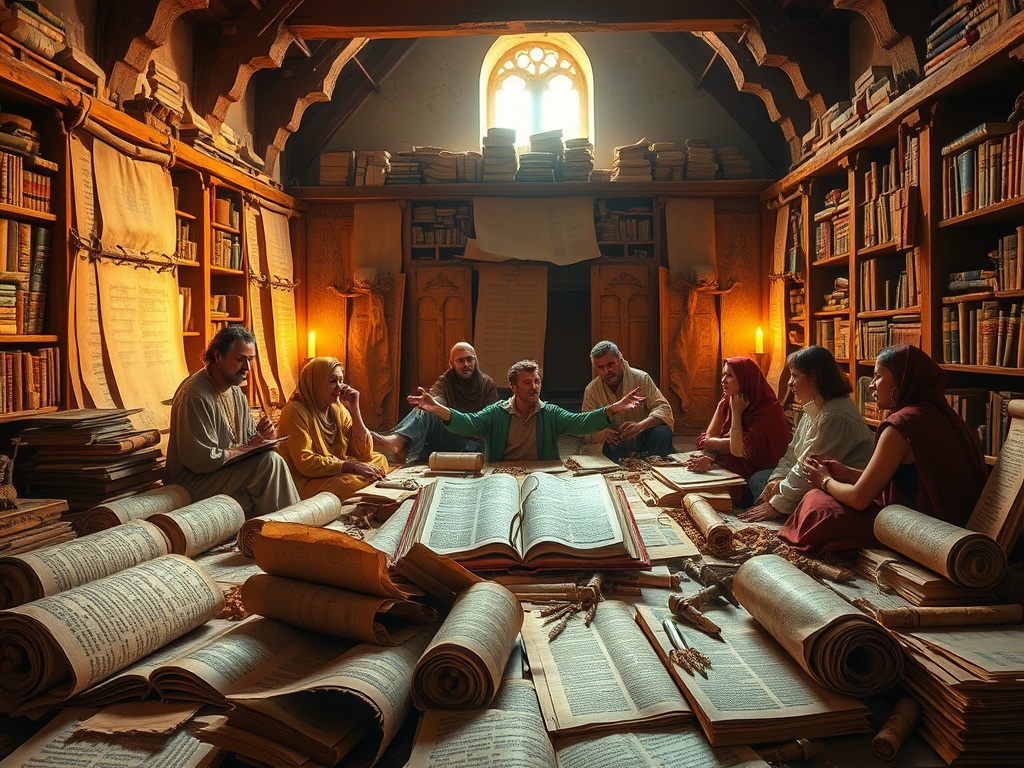
The Bible is arguably the most influential book in human history. It has shaped civilizations, inspired art, and guided the lives of billions. Yet, for all its fame, the actual story of its creation is often shrouded in myth and misconception. From a historian’s perspective, the Bible wasn’t delivered from on high as a single, complete volume. Instead, it is a library—an anthology of texts written, edited, and compiled by numerous authors across different continents over approximately 1,500 years. To understand its origins, we must trade dogma for data, looking at the book not as a theological monolith but as a fascinating archaeological and literary artifact. This is the story of the Bible’s construction, built not on faith, but on provable, historical facts.
1. It’s a Library, Not a Book: The Power of the Anthology
The first and most crucial fact to grasp is that the Bible is not one book. It is a collection of many books—66 in the Protestant canon, 73 in the Catholic—written in different genres by a multitude of authors, most of whom are anonymous. These texts were composed over a vast expanse of time, from roughly 1000 BCE to the end of the 1st century CE. The Old Testament contains law codes, chronicles, poetry, and prophetic utterances, while the New Testament includes ancient biographies (bioi), personal letters, and apocalyptic literature.
Thinking of it as a single, coherent narrative written from start to finish is like imagining a public library was written by one librarian. Instead, each book has its own unique history, its own author or authors, and its own context. The earliest writings are separated from the latest by more than a millennium—a timespan greater than that between the Norman Conquest of England and the present day. Recognizing the Bible as an anthology is the foundational step to understanding its historical creation, allowing us to examine each piece of this library on its own terms.
2. Before the Pen, There Was the Voice: The Era of Oral Tradition
Before most biblical texts were ever written down, they existed as stories, poems, and legal traditions passed down orally from generation to generation. For much of ancient history, literacy was rare; culture was transmitted through memorization and recitation. The epic tales of Abraham, Moses, and the Israelite ancestors, as well as the teachings and life events of Jesus, were all part of a vibrant oral tradition long before they were inscribed on scrolls.
This isn’t like a simple game of “telephone.” In oral cultures, specific mnemonic techniques and community repetition ensured a high degree of stability in the stories. However, this process inevitably shaped the material. Stories were likely polished, adapted for new audiences, and framed to address the concerns of the current generation. Historians can see the fingerprints of this oral prehistory in the written texts themselves, such as through repetitive structures, poetic couplets, and memorable turns of phrase that would have made the stories easier to remember and retell. The written Bible, therefore, is not the beginning of these traditions but the end product of a long and dynamic period of spoken history.
3. Assembling the Old Testament: A Patchwork of Sources
The Old Testament, or Hebrew Bible, was not written by a single author like Moses. Modern biblical scholarship, using a method called textual criticism, has revealed that the texts are a composite of various older sources. The most famous scholarly model for the first five books (the Torah or Pentateuch) is the “Documentary Hypothesis.” It posits that these books are a masterful weaving together of at least four distinct source documents, known as J (the Yahwist source), E (the Elohist source), D (the Deuteronomist source), and P (the Priestly source).
Historians can identify these sources by looking for clues in the text: different names for God (Yahweh vs. Elohim), doublets (two different versions of the same story, like the creation accounts in Genesis 1 and 2), and contradictions in the narrative. For instance, in one source, Moses’ father-in-law is named Reuel, while in another, he is Jethro. These are not “errors” but seams showing where an editor, often called a “redactor,” skillfully combined earlier, independent traditions to create the text we have today. This compositional process was the norm for ancient literature, from Homeric epics to Mesopotamian myths.
4. From Hebrew to Greek: The Septuagint, the First “Bible” Translation
A pivotal and historically verifiable moment in the Bible’s creation was its first major translation. Around the 3rd century BCE in Alexandria, Egypt—a hub of Hellenistic culture—the Hebrew scriptures began to be translated into Koine Greek. This translation is known as the Septuagint (from the Latin for seventy, based on a legend of its translators). This was a monumental event. For the first time, the sacred texts of the Israelites were accessible to a wider, non-Hebrew-speaking world.
Crucially, the Septuagint became the “Bible” for most early Christians. When the authors of the New Testament quote the Old Testament, they are most often quoting from this Greek translation, not the original Hebrew. This is a provable fact, as their Greek quotations match the Septuagint’s wording, which sometimes differs from the Hebrew manuscripts that have survived. The creation of the Septuagint demonstrates that the biblical text was already being interpreted and adapted for new cultural contexts centuries before the time of Jesus.
5. The Dead Sea Scrolls: A Verifiable Snapshot in Time
For centuries, the oldest existing manuscripts of the Hebrew Bible dated to the medieval period, around 1000 CE. This left a thousand-year gap between when they were written and our earliest copies. That all changed in 1947 with the discovery of the Dead Sea Scrolls in caves at Qumran. These scrolls, which date from roughly 250 BCE to 68 CE, are one of the greatest archaeological finds of the 20th century. They provided a verifiable snapshot of the Bible as it existed during the Second Temple period and the time of Jesus.
The scrolls contain copies of every book of the Old Testament except for Esther. They proved that the biblical text had been transmitted with remarkable accuracy over the centuries. However, they also revealed that the text was not yet absolutely fixed. The scrolls show minor variations and different versions of some books (like Jeremiah) circulating simultaneously. They offer concrete proof that the Bible was in its final stages of formation, a fluid collection of sacred texts that was solidifying but not yet set in stone.
6. The New Testament Was Written After Jesus, Not During
A common misconception is that the Gospels were firsthand, written accounts from Jesus’s immediate followers. However, historical and literary analysis proves this is not the case. The earliest writings in the New Testament are not the Gospels but the letters of the Apostle Paul, written around 50-60 CE—a good 20 years after Jesus’s crucifixion. The Gospels came even later.
The Gospel of Mark is generally considered the first to be written, around 70 CE, roughly four decades after the events it narrates. Matthew and Luke were written later still, around 80-90 CE, and John’s Gospel is the latest, dated to around 90-110 CE. This means the stories about Jesus circulated orally for decades before being written down in the biographical forms we have today. This historical timeline is essential for understanding that the Gospels are not eyewitness journalism but documents of faith written by second-generation believers, reflecting the theological concerns of their communities.
7. The Anonymous Gospels and Their Attributed Authorship
From a purely historical standpoint, the four Gospels are anonymous texts. The authors do not name themselves within the writings. The familiar titles—”The Gospel According to Matthew,” “The Gospel According to Mark,” etc.—were not part of the original manuscripts. These attributions were added in the 2nd century CE as the early church sought to link these important texts to authoritative, apostolic figures.
Historians study the Gospels by analyzing their content, language, and sources. For example, scholars know that Matthew and Luke both used two primary sources to write their accounts: the Gospel of Mark and a now-lost collection of Jesus’s sayings, which they refer to as “Q” (from the German Quelle, meaning “source”). The fact that Matthew and Luke independently incorporate material from Mark into their own, longer narratives is textual evidence that Mark was written first and that they are not independent eyewitness accounts.
8. The Pauline Epistles: Our Earliest Christian Documents
The genuine letters of the Apostle Paul are the oldest Christian documents in existence, predating the Gospels by at least two decades. Letters like 1 Thessalonians, Galatians, Romans, and 1 & 2 Corinthians give us a direct window into the theological debates, social struggles, and nascent structure of the very first Christian communities. Written in the 50s CE, they are our closest contemporary source to the initial Jesus movement.
Paul was writing to address specific problems in churches he had founded—disputes over doctrine, questions about morality, and conflicts between Jewish and Gentile believers. He offers no narrative of Jesus’s life, and he shows little knowledge of the details that would later fill the Gospels (like the virgin birth or the miracles). His focus is almost entirely on the theological significance of Jesus’s death and resurrection. These letters are invaluable historical artifacts, preserving the raw, unvarnished reality of early Christianity in its formative years.
9. Forging the Canon: The Long Process of Deciding Which Books Made the Cut
The biblical canon—the official list of books considered sacred scripture—was not decided in a single, smoke-filled room. The popular myth that the Council of Nicaea (325 CE) finalized the Bible is historically false; the council’s agenda was primarily focused on the nature of Christ’s divinity. The process of “canonization” was actually a long and organic one that stretched over centuries.
Different Christian communities in different parts of the Roman Empire held different collections of sacred texts. Some included books that are now left out, such as the Shepherd of Hermas or the Gospel of Thomas, while others questioned books that are now included, like Revelation or 2 Peter. It was a slow process of consensus building. The first known list of the 27 books that make up our modern New Testament comes from a Festal Letter written by Bishop Athanasius of Alexandria in 367 CE. Even after his letter, debates continued for some time. The canon was not imposed from the top down but emerged from the bottom up.
10. From Scribe to Print: The Transmission of the Text
Once the texts were written and the canon was largely settled, their survival depended on being copied by hand, a laborious process undertaken by scribes. For over a thousand years in the West, the standard version was the Latin Vulgate, translated by St. Jerome around 400 CE. Every copy was slightly different, as scribes inevitably made small errors, corrections, or intentional changes—a field of study known as textual criticism.
The invention of the printing press in the 15th century revolutionized the Bible’s history. It allowed for the creation of thousands of identical copies, standardizing the text for the first time. This technological leap fueled the Protestant Reformation and made the Bible accessible to a mass audience in their own languages, most famously with the King James Version of 1611. The journey from an oral tale to a papyrus scroll, to a monastic manuscript, and finally to a printed page is the final, provable chapter in the long and complex history of how the Bible was written.
Further Reading
For those who wish to delve deeper into the historical creation of the Bible, these accessible scholarly works are excellent starting points:
- “Who Wrote the Bible?” by Richard Elliott Friedman
- “Misquoting Jesus: The Story Behind Who Changed the Bible and Why” by Bart D. Ehrman
- “A History of the Bible: The Story of the World’s Most Influential Book” by John Barton
- “What Are the Dead Sea Scrolls and Why Do They Matter?” by Geza Vermes
Here at Zentara.blog, our mission is to take those tricky subjects and unlock them, making knowledge exciting and easy to grasp for everyone. But the adventure doesn’t stop on this page! We’re constantly exploring new frontiers and sharing discoveries across the digital universe. Want to dive deeper into more mind-bending Top 10s and keep expanding your world? Come join us on our other platforms – we’ve got unique experiences waiting for you on each one!
Get inspired by visual wonders and bite-sized facts: See the world through Zentara’s eyes on Pinterest!
Pin our fascinating facts and stunning visuals to your own boards. Explore Pins on Pinterest: https://uk.pinterest.com/zentarablog/
Discover quick insights and behind-the-scenes peeks: Hop over to Tumblr for snippets, quotes, and unique content you won’t find anywhere else. It’s a different flavour of discovery! Follow the Fun on Tumblr: https://www.tumblr.com/zentarablog
Ready for deep dives you can listen to or watch? We’re bringing our accessible approach to video and potentially audio! Subscribe to our YouTube channel and tune into future projects that make learning pop! Subscribe on YouTube: https://www.youtube.com/@ZentaraUK
Seeking even more knowledge in one place? We’ve compiled some of our most popular topic deep dives into fantastic ebooks! Find them on Amazon and keep the learning journey going anytime, anywhere. Find Our Ebooks on Amazon: https://www.amazon.co.uk/s?k=Zentara+UK&ref=nb_sb_noss
Connect with us and fellow knowledge seekers: Join the conversation on BlueSky! We’re sharing updates, thoughts, and maybe even asking you what wonders we should explore next. Chat with Us on BlueSky: https://bsky.app/profile/zentarablog.bsky.social
Perfect for learning on the move! We post multiple 10-minute podcasts per day on Spotify. Pop on your headphones and fill your day with fascinating facts while you’re out and about! Listen on Spotify: https://open.spotify.com/show/3dmHbKeDufRx95xPYIqKhJFollow us on Instagram for bytesize knowledge! We post multiple posts per day on our official Instagram account. https://www.instagram.com/zentarablog/ Every click helps us keep bringing honest, accessible knowledge to everyone. Thanks for exploring with us today – see you out there in the world of discovery!




Leave a Reply