
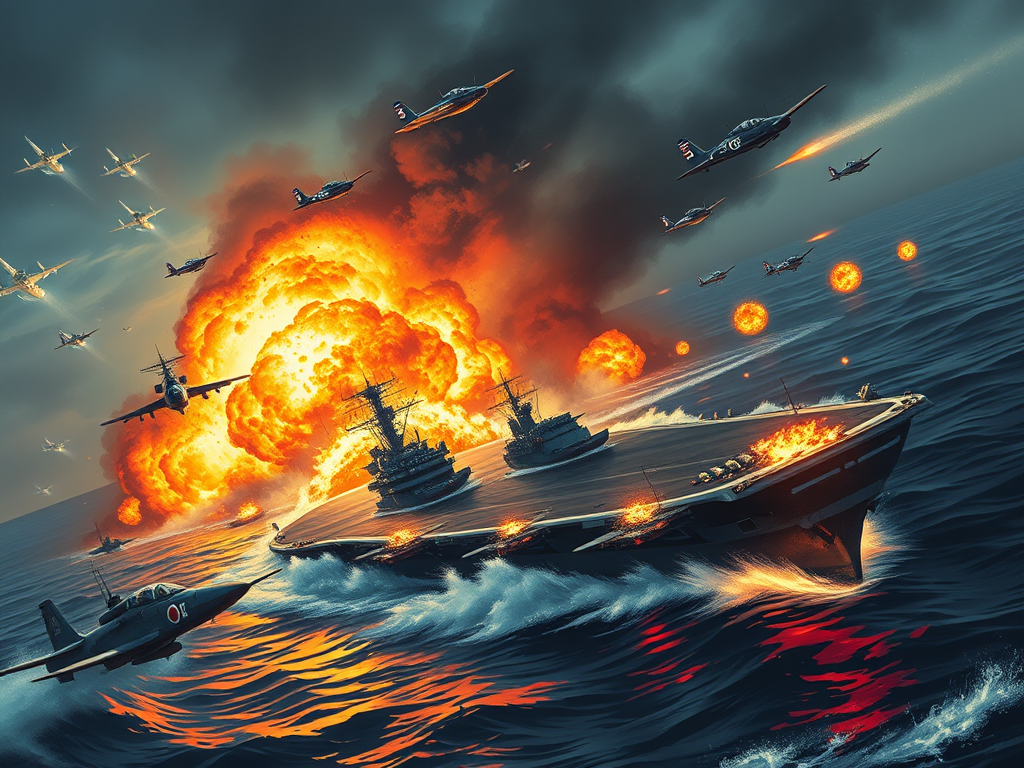
In the vast and brutal theatre of the Pacific War, a single battle, fought over four days in June 1942, stands as the undeniable turning point. The Battle of Midway, a clash of aircraft carriers and naval aviation, dramatically shifted the balance of power, halting the seemingly unstoppable Japanese advance and setting the stage for the eventual Allied victory. This wasn’t merely a significant victory; it was the moment the tide turned, a strategic and psychological blow from which the Imperial Japanese Navy would never fully recover. To understand its monumental impact, we must delve into the confluence of intelligence, technology, human courage, and fatal miscalculation that defined this pivotal engagement.
1. Shattering the Spear: The Irreplaceable Loss of Japanese Carriers
Imagine a master swordsman losing his four finest blades in a single duel. This is a fitting analogy for what happened to the Imperial Japanese Navy at Midway. The sinking of four of its most powerful aircraft carriers—the Akagi, Kaga, Soryu, and Hiryu—was a catastrophic loss. These weren’t just ships; they were the very heart of Japan’s naval power projection, the mobile airfields that had enabled the lightning-fast conquests across the Pacific, from Pearl Harbor to the Dutch East Indies. Each carrier was a complex ecosystem of technology and highly trained personnel, and their loss was a blow to the core of Japanese naval strategy, which was built around the concept of the decisive carrier battle. The United States, in contrast, lost one carrier, the USS Yorktown, which, while a significant loss, was a far more sustainable attrition rate. The industrial might of the United States was already beginning to gear up, and new Essex-class carriers were on the horizon. For Japan, with its more limited industrial capacity, replacing these four veteran carriers was an insurmountable task. This single action fundamentally altered the naval balance of power in the Pacific, stripping Japan of its offensive spearhead and forcing it onto the defensive for the remainder of the war.
2. The Intelligence Coup: Knowing the Enemy’s Hand
The Battle of Midway was as much a victory for cryptanalysts as it was for sailors and airmen. In a quiet, high-stakes game of wits played out thousands of miles from the battlefield, US Navy cryptanalysts, led by the brilliant Commander Joseph Rochefort and his team at Station HYPO in Hawaii, achieved one of the most significant intelligence breakthroughs of the war. They had partially broken the Japanese naval code, JN-25b, allowing them to decipher critical enemy communications. While they couldn’t read every message in its entirety, they pieced together enough fragments to understand that the Japanese were planning a major offensive, codenamed “AF.” The crucial question was: where was AF? Rochefort’s team suspected it was Midway Atoll. To confirm this, they devised a clever ruse, instructing the US garrison at Midway to send an unencrypted message reporting a shortage of fresh water. Shortly after, a deciphered Japanese message confirmed that “AF is short on water.” This was the smoking gun. Armed with this foreknowledge, Admiral Chester W. Nimitz, Commander-in-Chief of the U.S. Pacific Fleet, was able to set a masterful trap, positioning his outnumbered carriers to ambush the unsuspecting Japanese fleet. This intelligence advantage was a game-changer, turning a potential disaster into a decisive victory.
3. The Decimation of Naval Aviators: A Brain Drain in the Skies
The loss of the four Japanese carriers was devastating, but the loss of their experienced aircrews was arguably even more so. These were not easily replaceable pilots and airmen; they were the seasoned veterans of a string of victories, highly skilled in the demanding art of carrier operations. The pre-war training program for Japanese naval aviators was incredibly rigorous and lengthy, producing an elite but small pool of pilots. When the carriers went down, so did hundreds of these invaluable airmen. This ‘brain drain’ of experienced aviators had a profound and lasting impact on the combat effectiveness of Japanese naval aviation. While Japan could, over time, produce more aircraft, it could not quickly replace the skill, experience, and institutional knowledge of these veteran pilots. In subsequent battles, the decline in the quality of Japanese naval aviators became increasingly apparent. The United States, with its larger population and rapidly expanding training programs, was able to replace its pilot losses far more effectively. The loss of this elite cadre of pilots at Midway was a wound that continued to bleed for the remainder of the war.
4. The Halting of the Japanese Juggernaut: A Line Drawn in the Sand
Prior to Midway, the Japanese military had enjoyed an almost unbroken string of successes. From the stunning attack on Pearl Harbor to the rapid conquest of Southeast Asia and the Pacific islands, their advance had seemed relentless and unstoppable. This created an aura of invincibility around the Japanese military, both for the Allies and for the Japanese themselves. The victory at Midway shattered this myth. It was a clear and decisive defeat that brought the eastward expansion of the Japanese Empire to an abrupt halt. The strategic initiative, which Japan had held since the beginning of the war, now began to shift to the United States. No longer were the Allies simply reacting to Japanese moves; they were now able to begin planning their own offensives. The battle marked the high-water mark of the Japanese Empire. After Midway, Japan would not be able to launch any further major offensive operations in the Pacific. The line had been drawn in the sand, and the long and arduous road to Tokyo would begin from this pivotal victory.
5. A Boost to Allied Morale: A Much-Needed Taste of Victory
In the bleak early months of 1942, the Allied powers, and particularly the American public, were in desperate need of good news. The fall of the Philippines, the surrender of Singapore, and the seemingly endless string of Japanese victories had taken a heavy toll on morale. The Doolittle Raid in April 1942 had provided a temporary lift, but a decisive military victory was desperately needed to demonstrate that the Japanese were not invincible. The Battle of Midway provided that victory in spectacular fashion. It was a powerful message to the American people and to the world that the tide was beginning to turn. The news of the victory, though initially censored to protect intelligence sources, electrified the nation and provided a much-needed psychological boost. For the sailors and airmen of the Pacific Fleet, it was a validation of their training and a testament to their courage in the face of a formidable foe. This newfound confidence would be crucial in the long and bloody campaigns that lay ahead, starting with the landings on Guadalcanal just two months later.
6. The Dawn of Carrier Supremacy: The Battleship’s Reign Ends
The Battle of Midway, along with the earlier Battle of the Coral Sea, firmly established the aircraft carrier as the new queen of the seas, supplanting the battleship as the primary capital ship in naval warfare. For centuries, naval power had been measured by the number and size of a nation’s battleships. Pearl Harbor had demonstrated the vulnerability of battleships to air power, but Midway was the final nail in the coffin of the battleship’s supremacy. The entire battle was fought over vast distances by carrier-launched aircraft; the opposing surface fleets never even caught sight of each other. The ability to project air power hundreds of miles from a mobile airfield proved to be the decisive factor. This had profound implications for naval doctrine and shipbuilding for all major powers. The United States, in particular, fully embraced the new era of carrier warfare, and its industrial might would go on to produce a fleet of carriers that would dominate the Pacific for the remainder of the war. The age of the battleship was over, and the age of the aircraft carrier had begun.
7. Japanese Strategic Overreach: A Bridge Too Far
The Japanese plan for the Battle of Midway was incredibly complex and ambitious, a testament to the overconfidence that had set in after six months of stunning victories. Admiral Isoroku Yamamoto, the commander of the Combined Fleet, sought to not only capture Midway Atoll but also to lure the remaining US carriers into a decisive battle where they could be destroyed. However, the plan was overly complicated, dividing the Japanese forces into multiple groups spread out over a vast area of the ocean. This complexity created numerous points of potential failure and made it difficult for the various components of the fleet to support each other. Furthermore, the Japanese high command underestimated the resilience of the American forces and their ability to gather intelligence. This strategic overreach, born of hubris, played directly into the hands of the waiting American fleet. The simplicity and focused nature of the American plan, which was to use their intelligence advantage to ambush the Japanese carriers, proved far more effective than the elaborate and ultimately flawed Japanese grand design.
8. The Heroism and Sacrifice of Torpedo Squadron 8: A Fateful Diversion
The story of Torpedo Squadron 8 (VT-8) from the USS Hornet is one of the most heroic and tragic episodes of the Battle of Midway. Flying obsolete and slow TBD Devastator torpedo bombers, they pressed home their attack on the Japanese carriers without fighter protection. They were met by a swarm of Japanese Zero fighters and devastating anti-aircraft fire. All fifteen aircraft of VT-8 were shot down, and only one man, Ensign George Gay, survived. While their attack failed to score any hits, their sacrifice was not in vain. Along with the other torpedo squadrons from the American carriers, their low-level attacks drew the Japanese combat air patrol down to sea level, leaving the skies above the Japanese fleet exposed. This created a crucial window of opportunity for the American dive bombers from the USS Enterprise and USS Yorktown to arrive undetected and unopposed at high altitude. Their subsequent attacks, delivered with devastating accuracy, proved to be the decisive blow of the battle. The incredible bravery of the men of VT-8, in what was essentially a suicide mission, played a critical role in the American victory.
9. The Industrial Might of the United States: A War of Production
While the Battle of Midway was a stunning tactical and strategic victory, its long-term significance is also rooted in the vast industrial disparity between the United States and Japan. The loss of four front-line carriers was a blow from which Japan’s shipbuilding industry could not recover. The United States, on the other hand, was just beginning to hit its stride as the “Arsenal of Democracy.” In the years following Midway, American shipyards would produce an astonishing number of new warships, including the Essex-class carriers, which were more advanced and capable than their Japanese counterparts. This ability to not only replace but also to expand and improve its naval forces gave the United States an insurmountable long-term advantage. Midway, therefore, was not just a turning point in terms of combat, but also a turning point in the war of attrition and production. Japan had lost a battle it could not afford to lose, against an enemy that could afford to win.
10. Paving the Way for Guadalcanal and the Island-Hopping Campaign
The victory at Midway was not an end in itself, but a crucial enabler of what was to come. With the Japanese offensive capability blunted and their carrier fleet crippled, the United States was able to seize the strategic initiative and go on the offensive for the first time in the Pacific War. Just two months after Midway, in August 1942, US Marines landed on the island of Guadalcanal in the Solomon Islands. This marked the beginning of the long and brutal island-hopping campaign that would eventually lead to the shores of Japan. Without the victory at Midway, an offensive operation like Guadalcanal would have been unthinkable. The Japanese would have retained naval and air superiority, making any Allied landing a perilous and likely disastrous undertaking. By neutralizing the Japanese carrier threat, the Battle of Midway opened the door for the Allied counter-offensive and set the course for the remainder of the war in the Pacific. It was the crucial first step on the long road to Tokyo.
Further Reading
For those wishing to delve deeper into the dramatic events of the Battle of Midway, the following books offer compelling and insightful accounts:
- Incredible Victory: The Battle of Midway by Walter Lord
- Shattered Sword: The Untold Story of the Battle of Midway by Jonathan Parshall and Anthony Tully
- Miracle at Midway by Gordon W. Prange
- The First Team: Pacific Naval Air Combat from Pearl Harbor to Midway by John B. Lundstrom
- Pacific Crucible: War at Sea in the Pacific, 1941-1942 by Ian W. Toll
Here at Zentara.blog, our mission is to take those tricky subjects and unlock them, making knowledge exciting and easy to grasp for everyone. But the adventure doesn’t stop on this page! We’re constantly exploring new frontiers and sharing discoveries across the digital universe. Want to dive deeper into more mind-bending Top 10s and keep expanding your world? Come join us on our other platforms – we’ve got unique experiences waiting for you on each one!
Get inspired by visual wonders and bite-sized facts: See the world through Zentara’s eyes on Pinterest!
Pin our fascinating facts and stunning visuals to your own boards. Explore Pins on Pinterest: https://uk.pinterest.com/zentarablog/
Discover quick insights and behind-the-scenes peeks: Hop over to Tumblr for snippets, quotes, and unique content you won’t find anywhere else. It’s a different flavour of discovery! Follow the Fun on Tumblr: https://www.tumblr.com/zentarablog
Ready for deep dives you can listen to or watch? We’re bringing our accessible approach to video and potentially audio! Subscribe to our YouTube channel and tune into future projects that make learning pop! Subscribe on YouTube: https://www.youtube.com/@ZentaraUK
Seeking even more knowledge in one place? We’ve compiled some of our most popular topic deep dives into fantastic ebooks! Find them on Amazon and keep the learning journey going anytime, anywhere. Find Our Ebooks on Amazon: https://www.amazon.co.uk/s?k=Zentara+UK&ref=nb_sb_noss
Connect with us and fellow knowledge seekers: Join the conversation on BlueSky! We’re sharing updates, thoughts, and maybe even asking you what wonders we should explore next. Chat with Us on BlueSky: https://bsky.app/profile/zentarablog.bsky.social
Perfect for learning on the move! We post multiple 10-minute podcasts per day on Spotify. Pop on your headphones and fill your day with fascinating facts while you’re out and about! Listen on Spotify: https://open.spotify.com/show/3dmHbKeDufRx95xPYIqKhJFollow us on Instagram for bytesize knowledge! We post multiple posts per day on our official Instagram account. https://www.instagram.com/zentarablog/ Every click helps us keep bringing honest, accessible knowledge to everyone. Thanks for exploring with us today – see you out there in the world of discovery!




Leave a Reply