
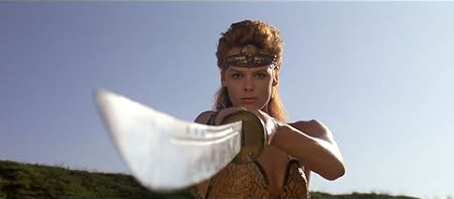
Transport yourself back to the mid-1980s, a time when the fantasy film genre was in full swing, and a new heroine was poised to take the world by storm. Red Sonja, released in 1985, was a movie that promised to deliver epic battles, fearsome monsters, and a powerful female warrior unlike any seen before. While the film may not have been the critical and commercial success its creators envisioned, it has since carved out a unique and enduring legacy as a beloved cult classic. Its vibrant visuals, memorable score, and the striking presence of its lead actors have captivated audiences for decades, earning it a special place in the hearts of fantasy fans.
But beyond the sword-swinging action and fantastical landscapes lies a treasure trove of fascinating stories and surprising facts that even the most ardent admirers of the film may not know. From last-minute casting changes and contractual obligations to on-set challenges and the creative minds who brought this world to life, the making of Red Sonja is a tale as epic as the on-screen adventure itself. Join us as we pull back the curtain and reveal 10 things you didn’t know about Red Sonja, giving you a newfound appreciation for this unforgettable piece of 80s cinema.
1. A Star Was Born from a Magazine Cover
The search for the perfect actress to embody the formidable Red Sonja was a quest in itself for legendary producer Dino De Laurentiis. He envisioned a woman with an “Amazonian” presence, someone who could convincingly command the screen and wield a sword with authority. The production was facing a tight deadline, with only eight weeks until filming was scheduled to begin, and still, no lead actress had been cast. The pressure was mounting.
In a stroke of serendipity, De Laurentiis stumbled upon a fashion magazine and was immediately captivated by the image on its cover. There, in a stunning photograph, was a 21-year-old Danish model named Brigitte Nielsen. Her statuesque frame, piercing eyes, and striking features were precisely what he had been looking for. Without hesitation, De Laurentiis arranged for Nielsen, who was in Milan for a modeling assignment, to be flown to Rome for a screen test. Despite her inexperience in acting, Nielsen’s powerful physical presence won her the role, launching her international film career and forever linking her with the iconic “she-devil with a sword.”
2. Schwarzenegger’s Reluctant Return to Barbarianism
By the mid-1980s, Arnold Schwarzenegger was a global superstar, largely thanks to his role as Conan the Barbarian. However, after two films wielding a broadsword, he was eager to move on to more contemporary roles and leave the world of fantasy behind. But a contractual obligation to producer Dino De Laurentiis stood in his way. Schwarzenegger owed De Laurentiis one more film, and the producer was determined to capitalize on the actor’s fame to bolster Red Sonja.
Schwarzenegger reluctantly agreed to appear in the film, with the understanding that it would be a brief, cameo-style role requiring only a few weeks of his time. However, as production progressed, his part as Lord Kalidor was significantly expanded to give the film more star power. This resulted in Schwarzenegger receiving top billing, despite Nielsen being the titular character. In later years, Schwarzenegger would famously—and humorously—lament his involvement, declaring Red Sonja the worst film he ever made and joking that he used it as a punishment for his children when they misbehaved.
3. Not Quite Conan: The Kalidor Compromise
Eagle-eyed fans of Robert E. Howard’s work will notice that while Arnold Schwarzenegger’s character, Lord Kalidor, bears a striking resemblance to Conan the Barbarian, he is, in fact, a different character. This was a deliberate decision born out of a tangled web of character rights. While Dino De Laurentiis held the rights to both Conan and Red Sonja, the film’s distributors did not have the rights to use the Conan name in the title or marketing.
To circumvent this, the character of Lord Kalidor was created—a noble warrior who just happens to be the Lord of Hyrkania, Conan’s homeland, and possesses a familiar burly physique and skill with a sword. This allowed the filmmakers to feature Schwarzenegger in a role that was essentially Conan in all but name, providing a recognizable anchor for audiences while technically adhering to the legal restrictions.
4. The Unsung Hero: A Legendary Composer’s Epic Score
While the film’s critical reception was lukewarm, one element that received near-universal praise was its magnificent musical score, composed by the legendary Ennio Morricone. Known for his iconic work on Spaghetti Westerns, Morricone brought a different flavor to the fantasy genre than Basil Poledouris, who had scored the Conan films. Instead of Poledouris’s more percussive and brooding themes, Morricone crafted a sweeping, romantic, and heroic score.
Interestingly, the main, bombastic theme that many associate with Red Sonja is actually the theme for Lord Kalidor, a powerful and triumphant march. Red Sonja’s own theme is a more subtle and melancholic melody, reflecting her tragic backstory and inner strength. The original soundtrack album was unconventionally released as two long “symphonic suites,” rather than individual tracks, a testament to Morricone’s artistic vision. The score remains a standout element of the film, elevating the on-screen action and imbuing it with a sense of grandeur.
5. A Queen’s Choice: From Heroine to Villain
The role of the villainous Queen Gedren, with her menacing golden mask and sadistic nature, was brought to life with chilling perfection by Sandahl Bergman. However, Bergman was initially offered the lead role of Red Sonja. Having already played the formidable warrior Valeria in Conan the Barbarian, she was a natural choice.
In a surprising move, Bergman turned down the opportunity to play the heroine, expressing a greater interest in the more complex and theatrical role of the antagonist. Her decision proved to be a stroke of casting genius, as her portrayal of the cruel and obsessive queen provided a memorable and formidable foil for our hero. This choice allowed her to explore a different facet of the fantasy genre and create a truly unforgettable villain.
6. The Annoying Prince You’re Meant to Dislike
One of the most common criticisms leveled at the film by audiences and critics alike is the character of Prince Tarn, the spoiled and obnoxious young royal, and his bumbling guardian, Falkon. Their inclusion often feels at odds with the more serious tone of Red Sonja’s quest, providing moments of slapstick comedy that some find jarring.
However, the inclusion of these characters was a deliberate, if perhaps misguided, attempt to broaden the film’s appeal. The filmmakers believed that a younger character would attract a younger audience, and the comic relief would lighten the otherwise dark and violent narrative. While their antics may not have landed with everyone, Prince Tarn and Falkon are an undeniable part of the film’s quirky charm and a talking point for fans to this day.
7. On-Set Script Rewrites and a Rushed Narrative
The screenplay for Red Sonja went through several revisions, with veteran writer George MacDonald Fraser, known for the Flashman series and his work on the James Bond film Octopussy, being brought in to work on the script during filming. This on-the-fly approach to the story may account for some of the film’s narrative inconsistencies and the somewhat disjointed introduction of certain characters.
The film’s brisk 89-minute runtime also contributes to a sense of a rushed plot. The opening sequence, which details the slaughter of Sonja’s family and her endowment with supernatural strength, is a whirlwind of exposition that some feel would have benefited from more breathing room. These production realities highlight the challenges of bringing a cohesive and compelling story to the screen under pressure.
8. A Financial Fumble and a Cult Following
With a production budget of nearly $18 million, Red Sonja was a significant investment for its time. Unfortunately, the film failed to connect with a wide audience and was a commercial failure, grossing less than $7 million at the domestic box office. The combination of mixed reviews, a perceived over-saturation of the fantasy genre, and the film’s own narrative shortcomings contributed to its disappointing performance.
However, as is often the case with films that don’t find immediate success, Red Sonja has enjoyed a vibrant second life on home video and television. Over the years, it has cultivated a dedicated cult following who appreciate its campy charm, earnest performances, and unapologetic embrace of its fantasy roots. For many, it’s a nostalgic trip back to the 80s and a “so-bad-it’s-good” classic that is best enjoyed with a sense of fun and a group of friends.
9. From the Creator of 20,000 Leagues Under the Sea
The man at the helm of Red Sonja was the veteran director Richard Fleischer, a filmmaker with a remarkably diverse and impressive career. Fleischer was no stranger to large-scale productions, having directed the Disney classic 20,000 Leagues Under the Sea, the sci-fi adventure Fantastic Voyage, and the dystopian thriller Soylent Green.
He had also directed the previous year’s Conan the Destroyer, making him a logical choice to continue the sword-and-sorcery saga. While Red Sonja may not be considered one of the high points of his filmography, his experience and steady hand are evident in the film’s impressive visuals and action sequences. It’s a fascinating entry in the career of a director who worked across numerous genres and left an indelible mark on Hollywood.
10. The Perilous Price of Authenticity
Bringing the brutal world of the Hyborian Age to life was a physically demanding task for the cast and crew. The actors performed many of their own stunts, and the elaborate fight choreography required hours of rigorous training. Brigitte Nielsen, in particular, threw herself into the role, learning to ride a horse and handle a sword with convincing skill.
This dedication to authenticity came with its own set of dangers. The remote and rugged shooting locations in Italy, while visually stunning, presented numerous challenges. The unpredictable weather, including a severe snowstorm, caused delays and difficult working conditions. The actors, often clad in minimal costumes, had to endure the elements while performing physically taxing scenes. It’s a testament to their professionalism and resilience that they were able to complete the film under such demanding circumstances.
Conclusion
Red Sonja is a film that defies easy categorization. A commercial disappointment that has blossomed into a cult phenomenon, it is a movie that is both of its time and timeless in its appeal. The behind-the-scenes story of its creation, with its blend of happy accidents, contractual wrangling, and sheer determination, is as compelling as the adventure that unfolds on screen. These ten a-ha moments reveal the fascinating layers beneath the surface of this 80s fantasy gem, offering a new perspective on the film’s strengths, its weaknesses, and its enduring charm.
The legacy of Red Sonja is not just in its memorable characters or epic score, but in its ability to continue to entertain and inspire a devoted fanbase decades after its initial release. It’s a reminder that sometimes the most interesting stories are the ones that happen when the cameras aren’t rolling. What is your favorite memory of watching Red Sonja? Share your thoughts in the comments below!
Dive Deeper
For those looking to explore the world of Red Sonja and its creators further, here are a few recommended books:
- “Robert E. Howard’s Conan the Cimmerian Barbarian: The Complete Weird Tales Omnibus” by Robert E. Howard: Go back to the source and experience the original adventures of Conan, which laid the groundwork for the world Red Sonja inhabits.
- “The Light’s on at Signpost” by George MacDonald Fraser: This memoir from the film’s screenwriter offers a fascinating glimpse into his storied career in Hollywood, with anecdotes about the many films he worked on.
“Dino: The Life and Films of Dino De Laurentiis” by Tullio Kezich and Alessandra Levantesi: A comprehensive biography of the larger-than-life producer who brought Red Sonja to the screen, detailing his incredible impact on international cinema.




Leave a Reply