
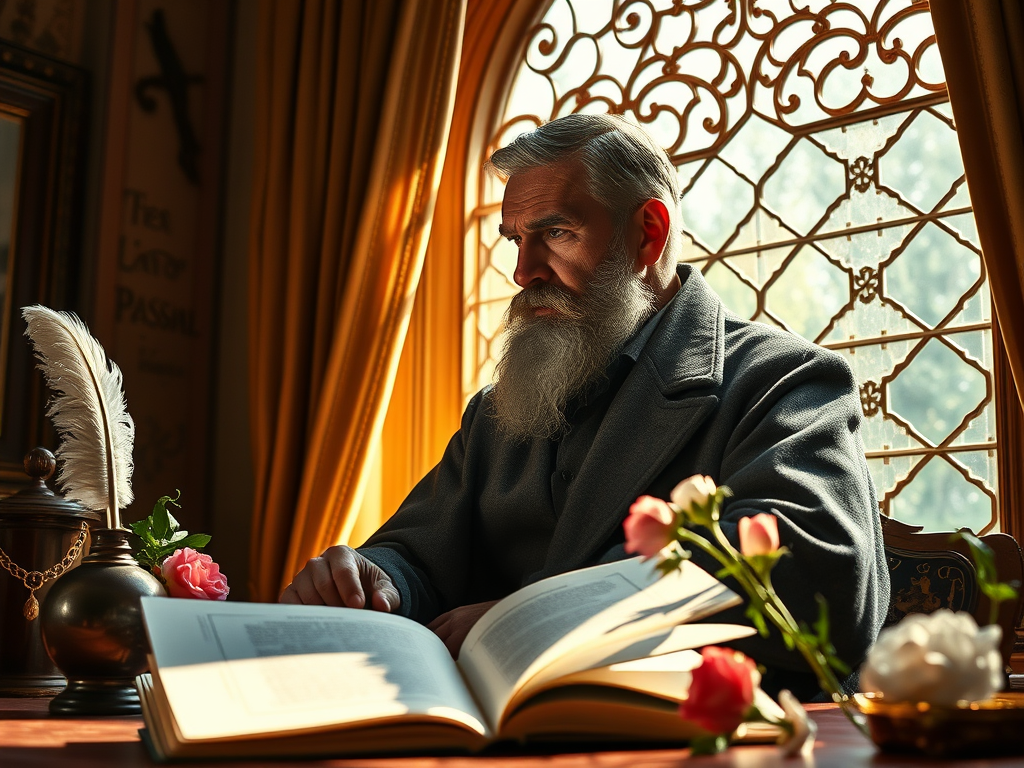
Count Lev Nikolayevich Tolstoy, known to the English-speaking world as Leo Tolstoy, was more than just a novelist; he was a literary titan, a moral philosopher, and a spiritual revolutionary whose life and work plumbed the deepest questions of human existence. As the author of the epic masterpieces “War and Peace” and “Anna Karenina,” he achieved a level of psychological realism and narrative scope that forever changed the possibilities of fiction. Yet, the man who so brilliantly chronicled the intricacies of Russian high society would ultimately reject it, embarking on a radical spiritual journey that led him to embrace Christian anarchism, nonviolent resistance, and a life of ascetic simplicity. This article explores the ten key facets of Tolstoy’s monumental life, from his unparalleled literary achievements and his profound spiritual crisis to the enduring, and often contradictory, legacy of a man who was both a giant of world literature and a tireless seeker of truth.
1. The Epic Canvas: The Unrivaled Scope of “War and Peace”
Published in its entirety in 1869, “War and Peace” is not merely a novel; it is a universe. This colossal work, with its cast of over 500 characters, defies easy categorization, weaving together historical chronicle, family drama, philosophical treatise, and psychological fiction. Set during the Napoleonic Wars, the novel sweeps across the battlefields of Europe and the aristocratic salons of St. Petersburg and Moscow, creating a panoramic portrait of Russian society in an age of crisis.
At its heart, “War and Peace” explores the lives of five aristocratic families, most notably the Rostovs, the Bolkonskys, and the Bezukhovs. Through the journeys of characters like the idealistic but bumbling Pierre Bezukhov, the proud and searching Prince Andrei Bolkonsky, and the vivacious and resilient Natasha Rostova, Tolstoy examines the eternal themes of love, loss, free will, and the search for meaning. He masterfully contrasts the grand, impersonal forces of history—the “war”—with the intimate, personal dramas of individual lives—the “peace.” Tolstoy’s theory of history, which runs through the novel, argues that great events are not shaped by “great men” like Napoleon, but by the sum of countless individual, infinitesimal choices. This sprawling, multifaceted, and profoundly human epic remains a towering achievement in world literature, a testament to Tolstoy’s ambition to capture life in its totality.
2. A Flawed Masterpiece: The Tragic Power of “Anna Karenina”
If “War and Peace” is Tolstoy’s exploration of history and society, then “Anna Karenina” is his deep, piercing look into the human heart. Published in serial form between 1873 and 1877, the novel begins with one of the most famous opening lines in literature: “All happy families are alike; each unhappy family is unhappy in its own way.” This sets the stage for a masterful and tragic exploration of love, marriage, betrayal, and societal hypocrisy.
The novel tells the parallel stories of two central characters. The first is the titular Anna, a beautiful and passionate woman trapped in a loveless marriage who embarks on a scandalous affair with the dashing Count Vronsky. Her story is a devastating critique of the stifling conventions of 19th-century society, which openly tolerates male infidelity but ruthlessly ostracizes a woman who dares to pursue her own happiness. In stark contrast is the story of Konstantin Levin, a landowner and intellectual (often seen as a stand-in for Tolstoy himself) who shuns city life and searches for a more authentic existence through faith, family, and working the land. The novel’s intricate structure and profound psychological insight are breathtaking, and Anna’s tragic fate remains one of the most powerful and moving character arcs ever written. “Anna Karenina” is often considered by critics, and even by Tolstoy himself in his later years, to be his most artistically perfect work.
3. The Search for Authenticity: Levin and the Soul of Russia
A crucial, and deeply personal, element of Tolstoy’s great novels is the character of the “seeker”—an individual wrestling with the profound philosophical questions of his time. In “War and Peace,” this is Pierre Bezukhov. In “Anna Karenina,” it is the landowner Konstantin Levin. Levin’s story is the moral and spiritual core of the novel, a reflection of Tolstoy’s own struggles and developing worldview.
Levin is an aristocrat who feels alienated from the superficiality and intellectualism of Moscow high society. He finds solace and purpose not in social gatherings or abstract debates, but in the tangible realities of country life: managing his estate, working alongside the peasants during the harvest, and building a family. He is on a relentless quest for a meaningful life and a stable faith, grappling with doubt, social inequality, and the nature of God. Levin’s journey foreshadows the spiritual crisis and transformation that Tolstoy himself would soon undergo. Through Levin, Tolstoy celebrates the virtues of simplicity, physical labour, and a connection to the natural world, articulating a vision for Russia’s soul that lay not with its Europeanized elites, but with its vast, agrarian peasant class.
4. A Profound Spiritual Crisis: The Rejection of Art and Society
In the late 1870s, at the height of his literary fame, Leo Tolstoy experienced a profound spiritual crisis that would change the course of his life. Despite having a loving family, immense wealth, and international acclaim, he was overcome by a sense of despair and meaninglessness. He became obsessed with the question of life’s purpose and was tormented by suicidal thoughts. This existential breakdown, which he chronicled in his searing memoir “A Confession” (1882), led him to reject almost everything he had previously held dear.
He found the answers he was seeking not in philosophy or science, but in the simple, unwavering faith of the Russian peasants. He renounced the Russian Orthodox Church, which he saw as corrupt and dogmatic, and developed his own radical interpretation of Christianity. He came to believe that his own great literary works, including “War and Peace” and “Anna Karenina,” were products of vanity and moral indifference. For the last three decades of his life, he largely abandoned the novel form, dedicating himself instead to writing philosophical, religious, and political essays that promoted his new-found beliefs. This dramatic turn from celebrated novelist to radical prophet stunned his contemporaries and remains one of the most fascinating transformations in literary history.
5. The Kingdom of God is Within You: A Philosophy of Nonviolence
Out of his spiritual crisis, Tolstoy developed a radical philosophy of Christian anarchism and pacifism, most famously articulated in his 1894 book, “The Kingdom of God Is Within You.” In this work, he argued that the core message of Christianity was the Sermon on the Mount, which he interpreted as a call for a complete rejection of violence in all its forms.
Tolstoy contended that all human governments are, by their very nature, violent institutions, as they rely on force—through their police, courts, and armies—to maintain power. He argued that a true Christian must refuse to participate in any state-sponsored violence, which meant refusing military service, paying taxes that support a military, or serving on a jury. This philosophy of nonviolent resistance, or non-resistance to evil with force, was a direct challenge to the authority of both the state and the church. His writings on this subject were banned in Russia, but they were smuggled abroad and had a profound and lasting influence on some of the 20th century’s most important figures, most notably Mahatma Gandhi and Martin Luther King Jr., who both cited Tolstoy as a major inspiration for their own philosophies of nonviolent civil disobedience.
6. The Yasnaya Polyana School: A Radical Vision for Education
Long before his major spiritual crisis, Tolstoy was already a passionate social reformer with a deep interest in education. In 1859, he founded a school for peasant children on his family estate, Yasnaya Polyana. The school was a radical experiment in progressive education, operating on the core principle that learning should be a voluntary and non-coercive process.
At the Yasnaya Polyana school, there was no fixed curriculum, no compulsory attendance, and no formal punishment. The children were free to come and go as they pleased, to attend the classes that interested them, and to learn at their own pace. Tolstoy believed that the role of the teacher was not to impose knowledge, but to stimulate the students’ natural curiosity and creativity. He taught alongside the other teachers, published a journal on his educational theories, and wrote his own primers and readers for children. Although the school was relatively short-lived, it was a remarkable and forward-thinking experiment that put Tolstoy decades ahead of his time, prefiguring the student-centered educational philosophies of the 20th century.
7. The Death of Ivan Ilyich: A Masterpiece of Mortal Terror
While Tolstoy largely abandoned the novel after “Anna Karenina,” he continued to write fiction in shorter forms, often as parables to illustrate his moral and philosophical ideas. Among these later works, the 1886 novella “The Death of Ivan Ilyich” stands out as a masterpiece of existential dread and spiritual inquiry. It is a stark, unflinching, and terrifyingly precise account of one man’s confrontation with his own mortality.
Ivan Ilyich is a successful, high-ranking judge who has lived a thoroughly conventional and artificial life, dedicated to social climbing and material comfort. After a trivial accident, he develops a mysterious and painful illness. As his body deteriorates, he is forced to confront the terrifying realization that his life has been meaningless and that he is facing death utterly alone. The novella strips away all social pretense, forcing both Ivan and the reader to look into the abyss. It is only in the final moments, as he lets go of his empty past and feels compassion for his family, that he finds a glimmer of spiritual light. “The Death of Ivan Ilyich” is a powerful and concise distillation of Tolstoy’s later philosophy and a universal meditation on life, death, and the possibility of redemption.
8. A Contradictory Life: The Aristocrat as Peasant
One of the great and painful contradictions of Tolstoy’s life was the immense gap between his radical beliefs and his personal circumstances. After his spiritual conversion, he preached a message of poverty, chastity, and ascetic simplicity. He tried to live this philosophy by renouncing his wealth and literary copyrights, adopting simple peasant dress, engaging in manual labour like shoemaking and ploughing, and becoming a vegetarian.
However, he remained a Count living on a large, wealthy estate, supported by the labour of others. His wife, Sonya Tolstoy, who had been his devoted partner and had hand-copied “War and Peace” multiple times, was fiercely opposed to his new ideas. She fought to protect the financial security and inheritance of their 13 children, leading to decades of bitter and escalating family conflict. Tolstoy was tormented by this hypocrisy, a “prophet” of poverty living in luxury. This internal struggle plagued his final years, creating a tense and unhappy atmosphere at Yasnaya Polyana and ultimately leading to his dramatic final act.
9. The Final Pilgrimage: A Tragic Flight and a Public Death
In the autumn of 1910, at the age of 82, a frail and tormented Leo Tolstoy could no longer bear the contradictions of his life at Yasnaya Polyana. In the middle of the night, he secretly fled his home, accompanied by his personal doctor, intending to live out his final days in a monastery or a simple peasant hut, finally free from his wealth and family conflicts. This final, desperate flight for spiritual peace became a national media event.
The world’s press tracked his journey. However, the elderly Tolstoy fell ill with pneumonia after just a few days of travel. He was forced to stop at the small railway station of Astapovo. The stationmaster gave up his own house for the dying literary giant, and for a week, the world’s attention was fixed on this tiny, remote outpost. With journalists and newsreel cameras gathered outside, and his estranged wife kept from his bedside until the very end, Leo Tolstoy died on November 20, 1910. It was a tragically public end for a man who had spent decades seeking a life of private simplicity and spiritual solitude.
10. The Enduring “Tolstoyan” Legacy
Leo Tolstoy’s legacy is twofold and immense. As a novelist, he stands alongside Shakespeare and Homer as a foundational figure of world literature. His narrative techniques, particularly his ability to move seamlessly from the epic to the intimate and his profound psychological realism, have influenced countless writers. “War and Peace” and “Anna Karenina” remain the gold standard against which other great novels are measured.
As a moral philosopher and spiritual thinker, his impact is equally profound, if more controversial. His radical Christian pacifism and his philosophy of nonviolent resistance directly inspired Mahatma Gandhi’s struggle for Indian independence and Martin Luther King Jr.’s fight for civil rights in America. Communities of “Tolstoyans” sprang up in Russia and around the world, dedicated to living out his principles of simplicity, pacifism, and communal living. He remains a towering figure of conscience, a restless and brilliant soul who used his immense literary gifts to grapple with the ultimate questions of how a human being ought to live.




Leave a Reply