
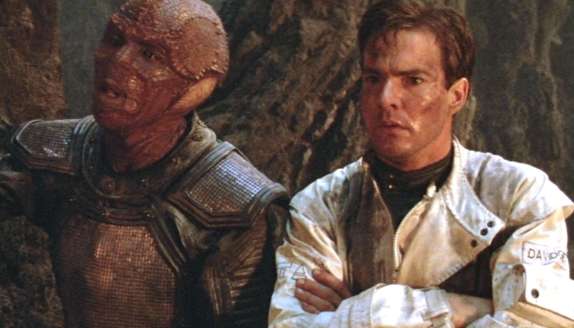
“Truth is, in here, in our hearts… we are all the same.” Welcome, fellow space travelers and fans of thoughtful science fiction, to a deep dive into one of the most underrated and heartfelt sci-fi films of the 1980s: the 1985 classic, Enemy Mine. In a decade dominated by space operas and alien horror, this film dared to be different. It was an intimate, character-driven story disguised as a space adventure, a powerful allegory about prejudice and understanding. The story of two bitter enemies—human pilot Willis Davidge and reptilian Drac soldier Jeriba Shigan—who crash-land on a desolate alien world and are forced to rely on each other for survival, is a timeless tale of how empathy can bridge even the widest of divides. Featuring incredible performances from Dennis Quaid and Louis Gossett Jr., groundbreaking makeup effects, and a powerful message, the film was a unique and ambitious project. But the story of its creation is a legendary tale of a disastrously troubled production, a fired director, and a cinematic rescue mission that ultimately produced a beloved cult classic. So, learn your Drac customs, prepare for meteor showers, and join us as we uncover 10 surprising, little-known facts about the making of Enemy Mine.
1. The Film’s First Director Was Fired Weeks Into Production
Enemy Mine is famous for its troubled production history, which began with the firing of its original director, Richard Loncraine (who would later direct Richard III and Wimbledon). Loncraine had a very specific, somewhat surreal vision for the film. He began shooting on location in the harsh, volcanic landscapes of Iceland. However, after several weeks of filming, the studio, 20th Century Fox, grew increasingly alarmed. Costs were spiralling out of control, the dailies were not what they had expected, and creative differences between Loncraine and the producers reached a breaking point. In a drastic move, the studio shut down the production, fired Loncraine, and scrapped everything that had been shot, wasting millions of dollars and leaving the film’s future in serious jeopardy.
2. Wolfgang Petersen Was Hired to Save the Film
With the project on the brink of collapse, the studio turned to acclaimed German director Wolfgang Petersen to save it. Petersen was a hot commodity in Hollywood following the massive international success of his tense and brilliant 1981 submarine thriller, Das Boot. The producers believed he had the vision and the steady hand needed to rescue the troubled production. Petersen accepted the challenge but insisted on starting over from scratch. He abandoned the remaining sets that had been built for Loncraine’s version in Budapest and moved the entire production to his home turf in Munich, Germany. He brought in his own production designer and storyboard artists, completely rethinking the look and feel of the film to create the version we know today.
3. Louis Gossett Jr.’s Drac Makeup Was a Four-Hour Ordeal
The incredible alien makeup that transformed Louis Gossett Jr. into the reptilian Drac, Jeriba “Jerry” Shigan, was a masterpiece of practical effects created by Chris Walas, who had just won an Oscar for his work on The Fly. The transformation, however, was a daily ordeal for the actor. The full-body prosthetic makeup took a team of artists over four hours to apply each morning. It was hot, claustrophobic, and incredibly restrictive. Gossett Jr., a highly expressive actor, had to learn to convey a wide range of emotions from underneath pounds of foam latex. To develop the Drac’s unique, guttural voice, he put cotton balls in his cheeks and developed a specific, raspy way of speaking that he had to maintain for the entire shoot. It was a physically and vocally demanding performance that remains one of the greatest non-human portrayals in sci-fi history.
4. It’s Based on an Award-Winning Novella
Unlike many sci-fi action films of the era, Enemy Mine was based on a highly respected piece of literature. The film is an adaptation of Barry B. Longyear’s 1979 novella of the same name, which won both the Hugo and Nebula Awards, the highest honours in science fiction writing. The original story is a powerful and tightly focused allegory for racial prejudice and the absurdity of war. While the film adaptation adds a more conventional third act involving human scavengers and a Drac mining colony, it remains remarkably faithful to the core of Longyear’s story: the development of the relationship between Davidge and Jerry, the sharing of their cultures, and the ultimate realization of their shared humanity.
5. A Massive Studio Fire Destroyed a Portion of the Sets
After the production was rescued by Wolfgang Petersen and moved to Germany, disaster struck again. The massive, alien-landscape sets were constructed at the Bavaria Studios in Munich. One night, a massive fire broke out on the soundstage, destroying a significant portion of the multi-million dollar sets. The blaze was so intense that it completely destroyed the stage, which had been the largest in Europe. This second major disaster could have been the final nail in the film’s coffin. However, Petersen and his resilient crew managed to salvage the production, rebuilding where necessary and cleverly using other parts of the studio lot and nearby locations to complete the film.
6. Dennis Quaid Spent Much of the Film Acting Opposite a Post
For the first act of the film, Davidge and Jerry are enemies who barely speak the same language. This meant that for many of his scenes, Dennis Quaid was essentially acting alone, reacting to an actor who was not only speaking a fictional language but was also covered from head to toe in a prosthetic suit. To help with his eyeline and focus during his solo scenes where he was meant to be looking at the distant Drac, the crew would often just place a simple wooden post in the distance for him to act opposite. Quaid’s ability to deliver such a powerful and nuanced performance, conveying a full range of emotions from hatred to grief to friendship, often with very little to react to, is a testament to his incredible talent as an actor.
7. Louis Gossett Jr. Developed the Drac Language Himself
The reptilian Drac language was a crucial element in creating a believable alien culture. While some words and phrases came from the source novella, it was Louis Gossett Jr. who truly fleshed out the language and gave it its unique sound. Drawing inspiration from various non-English languages, he worked to create a clicking, guttural dialect that sounded truly alien. He would often practice by speaking to himself in the Drac tongue, developing a consistent rhythm and vocabulary. This dedication to building the character from the inside out is what makes Jerry feel like a fully realized being, not just a man in a rubber suit.
8. The Film Was a Box Office Bomb
Despite its prestigious source material, acclaimed director, talented cast, and groundbreaking special effects, Enemy Mine was a major disappointment at the box office. The film’s budget had ballooned to over $40 million due to the troubled production, a massive sum for 1985. Unfortunately, the film only grossed a little over $12 million in the U.S. The marketing campaign struggled to convey the film’s unique tone, which was part sci-fi action, part survival drama, and part intimate character study. Audiences expecting a straightforward space adventure like Star Wars were often confused by the film’s philosophical themes and slow-burn narrative, leading to its poor commercial performance.
9. It Has Become a Beloved Cult Classic
Like so many ambitious films that failed to find their audience in theatres, Enemy Mine was given a second life on home video and cable television. A new audience discovered the film, unburdened by the studio’s muddled marketing. Viewers connected with its powerful message of tolerance and its incredible central performances. Over the decades, its reputation has grown immensely, and it is now widely regarded as a cult classic of 80s science fiction. Its themes of overcoming prejudice and finding common ground with one’s enemy have only become more relevant with time, solidifying its place as a thoughtful and enduring piece of filmmaking.
10. The Birthing Scene Was a Groundbreaking Moment
The scene in which the asexually-reproducing Jerry gives birth to his son, Zammis, is a pivotal and groundbreaking moment in the film. It’s a scene of incredible tenderness and vulnerability, and it completely subverts the audience’s expectations of the “male” alien character. The special effects for the scene, which show the baby emerging from Jerry’s abdomen, were incredibly complex for the time. Louis Gossett Jr.’s powerful and pained performance sells the reality of the moment, creating a scene that is not only a technical marvel but also a deeply moving depiction of the universal experience of childbirth. It remains one of the most powerful and memorable sequences in the entire film.
Conclusion
Enemy Mine is a film born from chaos and conflict, a production that battled fires, firings, and budget overruns to make it to the screen. Yet, from that turmoil emerged something truly special: a quiet, thoughtful, and deeply moving science fiction story about seeing the humanity in our enemies. It’s a testament to the resilience of its cast and crew, the clear vision of its rescuer director Wolfgang Petersen, and the incredible, transformative performances of Dennis Quaid and Louis Gossett Jr. While it may have been misunderstood in its time, its powerful message of unity and understanding has allowed it to endure, becoming a cherished classic that reminds us that no matter what we look like on the outside, our hearts are all the same. What is your favorite moment from this underrated sci-fi gem? Let us know in the comments below!
Dive Deeper
- Enemy Mine (Novella) by Barry B. Longyear: To experience the powerful, award-winning story in its original form, you must read the source material. It’s a masterpiece of science fiction literature and provides a fascinating look at the core themes that the film so beautifully adapted.
- Das Boot (1981 film): To see the incredible talent of director Wolfgang Petersen, watch his claustrophobic and critically acclaimed World War II submarine film. It showcases the same incredible skill with character development and suspense that he brought to Enemy Mine.
The Fly(1986 film): For another look at the groundbreaking makeup effects of artist Chris Walas, David Cronenberg’s sci-fi horror masterpiece is essential viewing. Walas won an Academy Award for his terrifying and tragic transformation of Jeff Goldblum, a perfect example of the incredible practical effects of the era.




Leave a Reply