
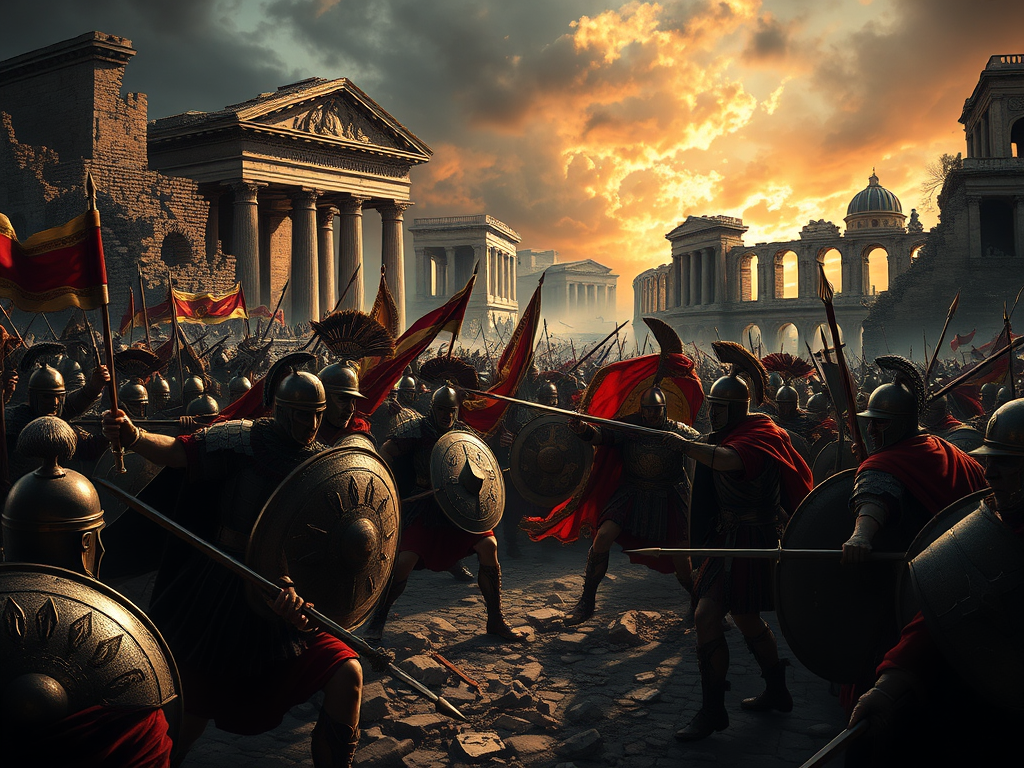
The fall of Rome wasn’t a single event. There was no cataclysmic day when the Roman Empire—a civilization that had dominated the known world for centuries—simply ceased to exist. Instead, the year 476 AD, when the last Western Roman Emperor was deposed, was merely the final tremor in a long, slow-motion collapse that had been unfolding for generations. The decline and fall of the Western Roman Empire was a complex process, a “death by a thousand cuts” brought about by a perfect storm of internal decay and external pressures.
For historians, understanding this collapse is the ultimate puzzle. How could a superpower that boasted unparalleled military might, sophisticated engineering, and a unified legal code ultimately crumble into ruin? The answer is not simple; it’s a web of interconnected factors, each one weakening the empire and making it more vulnerable to the next.
To truly grasp why Rome fell, we must look beyond the final “barbarian” invasions and examine the deep-seated problems that rotted the empire from within. From a hollowed-out economy and endless civil wars to climate change and social apathy, these are the 10 key reasons that led to the fall of the ancient world’s greatest superpower.
Table of Contents
1. Invasions by Barbarian Tribes
While not the sole cause, the final, fatal blows to the Western Roman Empire were delivered by constant and escalating incursions from various groups collectively known as “barbarians.” For centuries, Rome had managed its borders, often fighting, trading with, or assimilating Germanic tribes. However, in the late 4th century, a new and terrifying force emerged from the east: the Huns. Their westward expansion created a domino effect, pushing tribes like the Goths and Vandals to flee in unprecedented numbers, forcing their way across the Roman frontiers for survival. The Battle of Adrianople in 378 AD, where the Eastern Roman Emperor Valens was killed and a Roman army annihilated by the Goths, was a devastating psychological and military shock. From that point on, the empire was in a near-constant state of defensive warfare. The sack of Rome by the Visigoths in 410 AD and again by the Vandals in 455 AD were not just military defeats; they were symbolic events that shattered the myth of Roman invincibility.
2. Crippling Economic Troubles and Overspending
The Roman Empire was built on the spoils of war and the labour of slaves. When expansion ceased in the second century, these primary sources of income dried up. Yet, the costs of running a vast empire—especially its massive military—continued to grow. To cover their expenses, emperors began to debase the currency, minting coins with less and less precious metal content (silver or gold). This led to rampant hyperinflation, where money became almost worthless, destroying the savings of the middle class and causing a collapse in trade. To compensate, the state imposed crushing taxes on its citizens, which fell disproportionately on farmers and small landowners. Many abandoned their lands to escape the tax collectors, leading to a decline in agricultural production. The empire became trapped in a vicious cycle of military overspending, inflation, and excessive taxation that hollowed out its economy from the inside.
3. Overexpansion and an Unmanageable Territory
At its height under Emperor Trajan, the Roman Empire stretched from the moors of Scotland to the deserts of Mesopotamia. This vast size, once a symbol of its power, became a critical weakness. The empire had become a victim of its own success—a classic case of imperial overstretch. With the technology of the time, governing and defending such an immense territory was a logistical nightmare. A message from Rome could take weeks to reach a general on the British frontier. It was impossible to deploy legions quickly enough to deal with simultaneous threats on different borders, such as a Persian invasion in the East and a Germanic incursion across the Rhine. The sheer cost and manpower required to garrison thousands of miles of frontier became unsustainable, forcing the empire to spread its military resources dangerously thin.
4. Constant Political Instability and Civil War
Rome’s political structure was a ticking time bomb. It never developed a reliable system for imperial succession, leading to frequent and bloody power struggles. The Crisis of the Third Century (235-284 AD) was a period of near-total anarchy where at least 26 different “barracks emperors”—generals proclaimed emperor by their troops—rose and fell in just 50 years. These endless civil wars were profoundly damaging. Armies that should have been defending the frontiers were instead turned inward, fighting each other for political control. Each new emperor often purged the existing civil service, leading to a loss of expertise and rampant corruption. The political instability meant there was no long-term planning, the state was in constant turmoil, and the loyalty of the common person was not to a distant, ever-changing emperor in Rome, but to whichever local strongman could provide security.
5. The Rise of the Eastern Empire
In the late 3rd century, Emperor Diocletian made a fateful decision to divide the empire into two halves—a Western Empire based in Italy and an Eastern Empire with its capital in the newly founded city of Constantinople (modern-day Istanbul). This was intended to make the vast territory more manageable. However, it created a long-term division. The Eastern Empire was far wealthier, more urbanized, and had more defensible borders. Over time, the two halves began to drift apart, often acting as rivals rather than allies. The East frequently diverted barbarian invaders westward to protect its own lands or engaged in policies that benefited itself at the West’s expense. While the Western Empire crumbled under the weight of its problems, the wealthier and more stable Eastern (or Byzantine) Empire would survive and thrive for another thousand years, leaving its Western counterpart to face its fate alone.
6. Social Decay and a Loss of Civic Virtue
Many historians, beginning with the great Edward Gibbon, have argued that Rome fell partly because its people lost their way. The traditional Roman values of discipline, public duty, and civic pride (known as virtus) were gradually eroded. The ruling classes became decadent and self-serving, while the general populace was pacified by “bread and circuses”—free grain and spectacular gladiatorial games—which distracted them from the serious problems facing the empire. There was a growing sense of apathy and a decline in social cohesion. As the state became more oppressive and corrupt, people’s loyalty shifted away from the abstract idea of “Rome” towards more local concerns or, increasingly, to the Christian Church. This decline in civic engagement meant fewer citizens were willing to serve in the military or make sacrifices for the good of the state, weakening the very social fabric that held the empire together.
7. Over-reliance on Barbarian Mercenaries
As it became harder to recruit Roman citizens into the army, emperors began to rely heavily on hiring barbarian mercenaries (foederati) to fill the ranks. Entire tribes of Goths, Franks, and Vandals were paid to fight for Rome. While this provided a short-term solution to manpower shortages, it was a disastrous long-term strategy. These soldiers had little or no loyalty to the Roman Empire; their allegiance was to their tribal chieftains and the promise of pay. They were often undisciplined and brutal towards the civilian population. Over time, the Roman army became “barbarized” not just in its ranks, but in its command structure. By the 5th century, many of the most powerful Roman generals were themselves of barbarian origin. This created a situation where the defenders of Rome were culturally and ethnically indistinguishable from its attackers, and their loyalties could switch at a moment’s notice.
8. Environmental Problems and Public Health Crises
The Roman Empire was not immune to the forces of nature. A period of significant climate change, known as the Late Antique Little Ice Age, began in the 4th and 5th centuries. This brought colder, wetter weather to Europe, which likely led to crop failures and food shortages, weakening the population and straining the economy. Furthermore, the empire was periodically ravaged by devastating plagues. The Plague of Cyprian in the 3rd century and other epidemics killed millions, drastically reducing the population. A smaller population meant a smaller tax base and fewer potential recruits for the army, all while the empire’s problems were mounting. These environmental and public health disasters acted as stress multipliers, exacerbating the empire’s existing economic and military woes.
9. The Rise and Influence of Christianity
This is one of the most debated causes for the fall of Rome. In his seminal work, Edward Gibbon blamed the rise of Christianity for creating a “state within a state” and diverting human talent and focus away from serving the empire towards a concern with obtaining salvation in the afterlife. He argued that the new faith preached pacifism and obedience, making Romans less warlike and willing to defend the state. While this view is now considered overly simplistic, there is an element of truth to the idea that the rise of the Church created a new power structure that sometimes conflicted with the authority of the emperor. Church wealth and land were often untaxed, and disputes over religious doctrine could lead to civil unrest. Christianity didn’t cause the fall of Rome, but its rise fundamentally transformed Roman society and shifted loyalties away from the traditional state religion and civic cults that had supported the empire for centuries.
10. The Crumbling of Infrastructure
The roads, aqueducts, and bridges of Rome were the arteries of its empire, symbols of its power and engineering genius. The famous saying “all roads lead to Rome” was a literal truth, representing a system that enabled rapid troop movement, communication, and trade. In the later empire, the breakdown of this vital infrastructure was a physical symptom of the state’s decline. With the central government bankrupt and mired in crisis, there was no money or administrative capacity to maintain the vast network of roads and aqueducts. Roads fell into disrepair, hindering the movement of legions and choking off commerce. Aqueducts crumbled, impacting sanitation and public health in the cities. This decay symbolized the unraveling of Roman authority; the state could no longer manage its own territory, and the interconnected world the Romans had built was slowly falling apart.
Further Reading
To delve deeper into the complex and fascinating history of Rome’s decline, these books offer authoritative and readable accounts.
- The Fall of the Roman Empire: A New History of Rome and the Barbarians by Peter Heather – A modern classic that argues persuasively that the sheer scale and ferocity of the barbarian migrations were the primary cause of the Western Empire’s collapse.
- The Fall of the West: The Slow Death of the Roman Superpower by Adrian Goldsworthy – A detailed and balanced account that emphasizes the destructive impact of Rome’s endemic political instability and constant civil wars.
- The Inheritance of Rome: A History of Europe from 400 to 1000 by Chris Wickham – This book offers a brilliant perspective on what came after the fall, arguing for a process of transformation rather than a simple, catastrophic collapse.
- The History of the Decline and Fall of the Roman Empire by Edward Gibbon – The 18th-century masterpiece that started the modern debate. While its scholarship is dated in parts, its magnificent prose and sweeping vision make it an essential classic.
Here at Zentara.blog, our mission is to take those tricky subjects and unlock them, making knowledge exciting and easy to grasp for everyone. But the adventure doesn’t stop on this page! We’re constantly exploring new frontiers and sharing discoveries across the digital universe. Want to dive deeper into more mind-bending Top 10s and keep expanding your world? Come join us on our other platforms – we’ve got unique experiences waiting for you on each one!
Get inspired by visual wonders and bite-sized facts: See the world through Zentara’s eyes on Pinterest!
Pin our fascinating facts and stunning visuals to your own boards. Explore Pins on Pinterest: https://uk.pinterest.com/zentarablog/
Discover quick insights and behind-the-scenes peeks: Hop over to Tumblr for snippets, quotes, and unique content you won’t find anywhere else. It’s a different flavour of discovery! Follow the Fun on Tumblr: https://www.tumblr.com/zentarablog
Ready for deep dives you can listen to or watch? We’re bringing our accessible approach to video and potentially audio! Subscribe to our YouTube channel and tune into future projects that make learning pop! Subscribe on YouTube: https://www.youtube.com/@ZentaraUK
Seeking even more knowledge in one place? We’ve compiled some of our most popular topic deep dives into fantastic ebooks! Find them on Amazon and keep the learning journey going anytime, anywhere. Find Our Ebooks on Amazon: https://www.amazon.co.uk/s?k=Zentara+UK&ref=nb_sb_noss
Connect with us and fellow knowledge seekers: Join the conversation on BlueSky! We’re sharing updates, thoughts, and maybe even asking you what wonders we should explore next. Chat with Us on BlueSky: https://bsky.app/profile/zentarablog.bsky.social
Perfect for learning on the move! We post multiple 10-minute podcasts per day on Spotify. Pop on your headphones and fill your day with fascinating facts while you’re out and about! Listen on Spotify: https://open.spotify.com/show/3dmHbKeDufRx95xPYIqKhJFollow us on Instagram for bytesize knowledge! We post multiple posts per day on our official Instagram account. https://www.instagram.com/zentarablog/ Every click helps us keep bringing honest, accessible knowledge to everyone. Thanks for exploring with us today – see you out there in the world of discovery!




Leave a Reply