
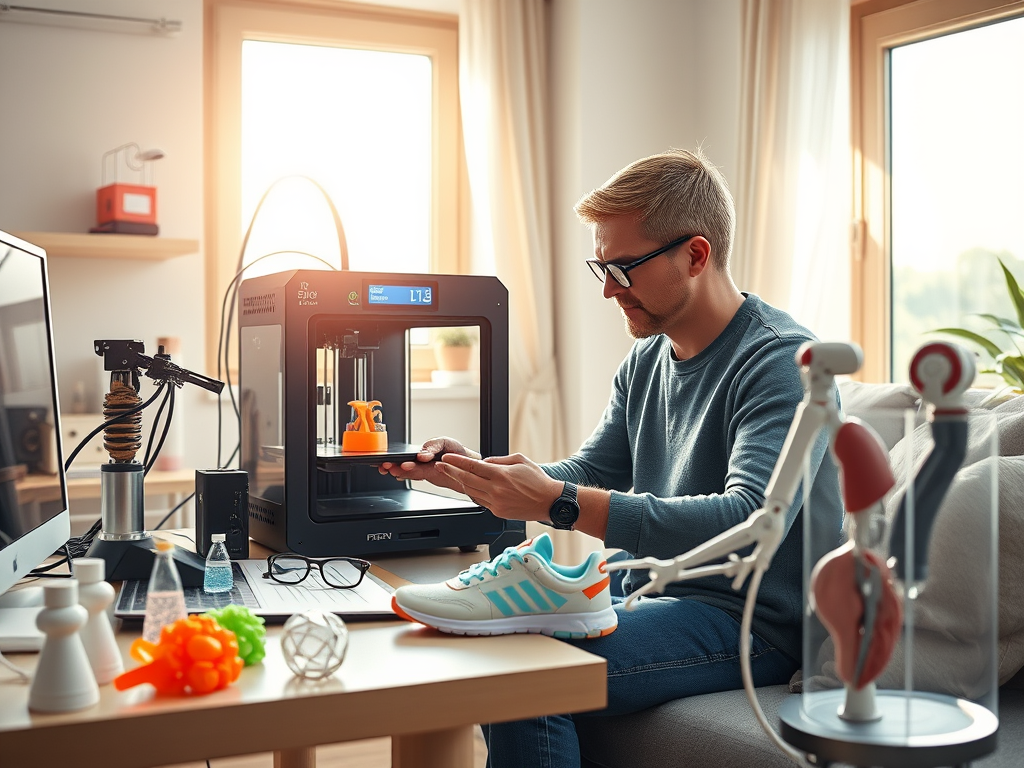
Imagine a world where replacing a broken appliance knob doesn’t mean a trip to the store, but a quick download and a print. Picture a reality where your dinner is customized to your exact nutritional needs and aesthetic preferences, materializing on your plate layer by layer. This isn’t the stuff of science fiction; it’s the tangible future being built by 3D printing, or as it’s known in industrial circles, additive manufacturing. This revolutionary technology is steadily moving from niche industrial applications and hobbyist workshops into the very fabric of our daily existence. Prepare to witness a fundamental shift in how we create, consume, and even heal. From the mundane to the miraculous, here are the top 10 ways 3D printing is set to change your daily life.
1. Hyper-Personalized Products: From Sneakers to Spectacles
In our current mass-produced world, we often settle for a “one-size-fits-most” approach. 3D printing is poised to shatter this paradigm. Imagine downloading a design for a pair of sneakers, scanning your feet with your smartphone, and printing a shoe that is a perfect, ergonomic match for you. This level of customization will extend to countless everyday items. Eyeglass frames will be printed to the precise contours of your face, eliminating slipping and discomfort. Kitchen utensils can be designed for individuals with arthritis, and children’s toys can be created with their own unique designs. This isn’t just about aesthetics; it’s about creating products that are more comfortable, efficient, and perfectly suited to our individual needs. The era of settling for “good enough” is drawing to a close, replaced by an on-demand world where the products in our lives are as unique as we are. This shift towards bespoke goods will not only enhance our comfort but also foster a deeper connection with the objects we use daily.
2. The Doctor is In (Your Printer): Revolutionizing Healthcare
The medical field is one of the most exciting frontiers for 3D printing, with innovations that promise to be life-altering. Surgeons are already using 3D-printed models of a patient’s organs to plan complex surgeries with unprecedented accuracy, reducing risks and improving outcomes. In dentistry, custom crowns, bridges, and aligners can now be printed in a fraction of the time it once took. Looking ahead, the possibilities are even more astounding. Bioprinting, the process of 3D printing with living cells, is no longer a futuristic dream. Scientists are successfully printing tissues and are on the path to creating fully functional organs, which could one day eliminate the need for organ donor waiting lists. On a more personal level, imagine a world where a prosthetic limb is not a clunky, ill-fitting device, but a lightweight, perfectly customized extension of one’s body, printed on-demand. This technology is making healthcare more personalized, effective, and accessible than ever before.
3. On-Demand Spare Parts: The End of Throwaway Culture
We’ve all been there: a small plastic part on a beloved appliance breaks, rendering the entire machine useless. The manufacturer no longer makes the part, and you’re forced to buy a whole new product. 3D printing offers a powerful antidote to this throwaway culture. With a growing online library of digital blueprints, you’ll be able to simply download the file for that broken knob, lever, or clip and print a replacement at home or at a local printing hub. This not only saves you money but also has a significant positive impact on the environment by reducing waste. This “right to repair” will be supercharged by 3D printing, empowering consumers to extend the lifespan of their products. Beyond simple repairs, this technology will also enable customization and upgrades, allowing you to modify and improve your existing gadgets and appliances. The ability to create what you need, when you need it, will fundamentally change our relationship with the products we own.
4. Culinary Creations: Printing Your Perfect Meal
The kitchen is the next frontier for 3D printing, promising to change the way we think about food. 3D food printers can extrude edible ingredients layer by layer to create intricate and customized culinary creations. Imagine decorating a cake with a complex, 3D-printed sugar sculpture, or creating perfectly shaped pasta that was once impossible to produce. The applications go far beyond novelty. For individuals with specific dietary needs, such as the elderly or those with swallowing difficulties, food can be printed in appealing shapes with a precisely controlled texture and nutritional content. Astronauts on long-duration space missions could one day print a variety of meals from a supply of nutrient-rich powders, combating menu fatigue. While the widespread adoption of home food printers is still on the horizon, the technology is rapidly advancing, offering a tantalizing glimpse into a future where our meals are as creative and personalized as our imaginations allow.
5. Building a Better World: 3D Printed Homes and Structures
The construction industry is on the verge of a 3D printing revolution. Large-scale 3D printers, some the size of a small house, can extrude layers of concrete or other building materials to construct the walls of a home in a matter of days, not months. This technology has the potential to dramatically reduce construction costs and timelines, making housing more affordable and accessible. In disaster-stricken areas, 3D printers could be deployed to quickly build emergency shelters for those who have lost their homes. Beyond housing, this technology is being used to create everything from pedestrian bridges to artificial coral reefs that help restore marine ecosystems. The design possibilities are also expanded, allowing for the creation of curved and organic shapes that would be difficult and expensive to achieve with traditional building methods. 3D printing is not just changing how we build; it’s enabling us to build a more sustainable and equitable world.
6. A Classroom Revolution: Hands-On Learning and Creativity
Education is set to be transformed by the accessibility of 3D printing. Imagine a biology class where students can print and examine a detailed model of a human heart, or a history class that brings ancient artifacts to life by printing replicas. This technology takes learning from the abstract to the tangible, allowing students to see, hold, and interact with the subjects they are studying. For students in design, engineering, and architecture, 3D printers are an invaluable tool for rapid prototyping, allowing them to quickly turn their digital designs into physical objects, test their ideas, and iterate on their creations. This hands-on approach to learning fosters creativity, problem-solving skills, and a deeper understanding of complex concepts. By making creation more accessible, 3D printing is empowering the next generation of innovators and thinkers.
7. Fashion Forward: Customized and Sustainable Clothing
The fashion industry is embracing 3D printing to create everything from avant-garde haute couture to customized footwear. This technology allows for the creation of intricate and complex designs that would be impossible to produce with traditional methods. Imagine clothing that is printed to your exact measurements, ensuring a perfect fit every time. Beyond customization, 3D printing offers a more sustainable approach to fashion. It is an additive process, meaning it only uses the material needed to create the garment, significantly reducing waste compared to the subtractive methods of traditional textile manufacturing. Furthermore, the ability to print clothing on-demand could reduce the environmental impact of fast fashion by eliminating the need for large inventories and overseas shipping. As the range of printable and wearable materials continues to expand, 3D printing is poised to weave itself into the very fabric of our wardrobes.
8. The Rise of the “Prosumer”: Localized Manufacturing
3D printing is democratizing manufacturing, shifting power from large corporations to individual creators and small businesses. This is giving rise to a new type of individual: the “prosumer” – someone who both produces and consumes. With a 3D printer and an idea, anyone can become a micro-manufacturer, creating and selling their own unique products from their home or a local makerspace. This fosters a more localized and resilient economy, where goods are produced closer to where they are needed, reducing our reliance on complex global supply chains. This shift also encourages innovation, as it lowers the barrier to entry for new entrepreneurs. The ability for individuals to design, create, and sell their own products on a small scale is a fundamental change in our economic landscape, fostering creativity and self-sufficiency.
9. Sustainable Solutions: Reducing Waste and Our Carbon Footprint
In a world increasingly concerned with environmental impact, 3D printing offers a number of sustainable advantages. As an additive process, it is inherently less wasteful than traditional subtractive manufacturing methods, which involve cutting away material from a larger block. The ability to print products on-demand and locally reduces the carbon emissions associated with transportation and warehousing. Furthermore, 3D printing is driving innovation in the use of recycled and biodegradable materials. Companies are developing filaments made from recycled plastics, wood, and even coffee grounds. This focus on sustainability is not just an added benefit; it’s a core aspect of the 3D printing ethos, paving the way for a more circular and environmentally conscious economy.
10. Unlocking New Realities: The Future of Entertainment and Hobbies
The world of entertainment and hobbies is being reshaped by 3D printing. Tabletop gamers can now design and print their own custom miniatures and scenery, bringing their imaginative worlds to life with incredible detail. Cosplayers can create intricate and accurate props and costume pieces that were once the domain of professional special effects artists. For hobbyists of all kinds, from model train enthusiasts to drone builders, 3D printing provides the ability to create custom parts and unique creations. This technology is not just about consuming entertainment; it’s about actively participating in its creation. It empowers us to personalize our leisure time, turning our passions into tangible realities and fostering a more creative and engaged relationship with our hobbies.
Further Reading
- “The 3D Printing Handbook: Technologies, design and applications” by Ben Redwood, Filemon Schöffer, and Brian Garret
- “Fabricated: The New World of 3D Printing” by Hod Lipson and Melba Kurman
- “3D Printing For Dummies” by Richard Horne and Kalani Kirk Hausman
- “The Book on 3D Printing: The Ultimate Guide to Everything You Need to Know About 3D Printing to Get Started” by Isaac D. Gibson
- “Makers: The New Industrial Revolution” by Chris Anderson
Here at Zentara.blog, our mission is to take those tricky subjects and unlock them, making knowledge exciting and easy to grasp for everyone. But the adventure doesn’t stop on this page! We’re constantly exploring new frontiers and sharing discoveries across the digital universe. Want to dive deeper into more mind-bending Top 10s and keep expanding your world? Come join us on our other platforms – we’ve got unique experiences waiting for you on each one!
Get inspired by visual wonders and bite-sized facts: See the world through Zentara’s eyes on Pinterest!
Pin our fascinating facts and stunning visuals to your own boards. Explore Pins on Pinterest: https://uk.pinterest.com/zentarablog/
Discover quick insights and behind-the-scenes peeks: Hop over to Tumblr for snippets, quotes, and unique content you won’t find anywhere else. It’s a different flavour of discovery! Follow the Fun on Tumblr: https://www.tumblr.com/zentarablog
Ready for deep dives you can listen to or watch? We’re bringing our accessible approach to video and potentially audio! Subscribe to our YouTube channel and tune into future projects that make learning pop! Subscribe on YouTube: https://www.youtube.com/@ZentaraUK
Seeking even more knowledge in one place? We’ve compiled some of our most popular topic deep dives into fantastic ebooks! Find them on Amazon and keep the learning journey going anytime, anywhere. Find Our Ebooks on Amazon: https://www.amazon.co.uk/s?k=Zentara+UK&ref=nb_sb_noss
Connect with us and fellow knowledge seekers: Join the conversation on BlueSky! We’re sharing updates, thoughts, and maybe even asking you what wonders we should explore next. Chat with Us on BlueSky: https://bsky.app/profile/zentarablog.bsky.social
Perfect for learning on the move! We post multiple 10-minute podcasts per day on Spotify. Pop on your headphones and fill your day with fascinating facts while you’re out and about! Listen on Spotify: https://open.spotify.com/show/3dmHbKeDufRx95xPYIqKhJFollow us on Instagram for bytesize knowledge! We post multiple posts per day on our official Instagram account. https://www.instagram.com/zentarablog/ Every click helps us keep bringing honest, accessible knowledge to everyone. Thanks for exploring with us today – see you out there in the world of discovery!




Leave a Reply