
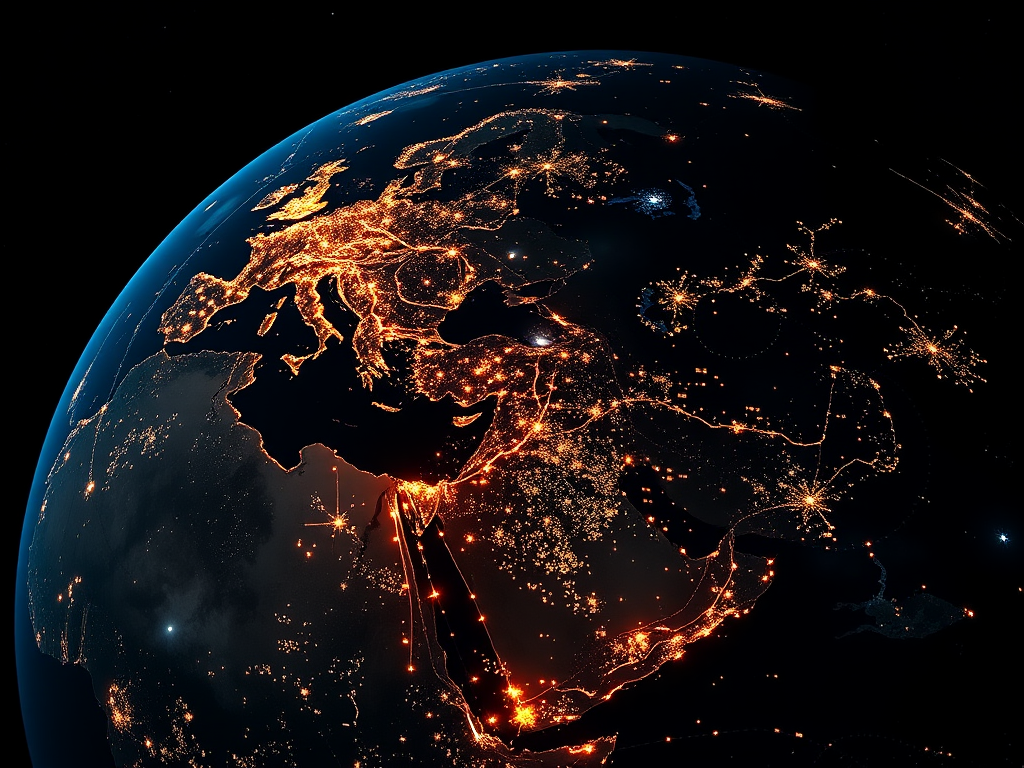
From our vantage point on the ground, the world feels vast, and our own creations, even the most imposing skyscrapers, seem small against the backdrop of mountains and oceans. But from the silent, orbital perch of the International Space Station (ISS), a different perspective emerges. Our planet transforms into a “Pale Blue Dot,” and the collective impact of 7.8 billion people begins to show. While the long-held myth that you can see the Great Wall of China with the naked eye from space has been debunked by countless astronauts, there are indeed colossal structures and patterns etched onto the Earth’s surface by human hands that are truly visible from orbit.
These are not just buildings or walls; they are testaments to our ambition, our ingenuity, our needs, and our often-unintended consequences. They are the mines that feed our industries, the artificial islands that defy the sea, the lights that banish the night, and the farms that feed our billions. Viewing these man-made wonders from space offers a unique and humbling perspective on the sheer scale of human activity and our profound ability to reshape the face of our world. Prepare for a journey into low Earth orbit to witness the 10 most incredible marks humanity has left on its home planet.
1. The Twinkling Web of City Lights
Without a doubt, the most mesmerising and widespread evidence of human presence from space is the sprawling, interconnected web of city lights that illuminates the night side of Earth. What appears on the ground as the familiar glow of streetlights, homes, and offices transforms into a breathtaking spectacle from orbit. Continents are outlined in electric constellations, with dense, brilliant clusters revealing the world’s major metropolises like London, Tokyo, and New York. Major transportation arteries like the Nile River in Egypt or the Trans-Siberian Railway become visible as luminous ribbons connecting these bright hubs.
This view is more than just beautiful; it’s a living map of human settlement and energy consumption. It tells a story of where we live, how we travel, and where industrialisation has taken root. Astronauts often describe the experience of watching the planet’s night-time terminator—the line between day and night—sweep across the globe as profoundly moving. It’s a glittering, silent testament to our collective existence, a delicate and beautiful neural network of our civilization laid across the dark canvas of the planet.
2. The Palm Islands of Dubai, UAE
In a stunning display of wealth and ambition, Dubai has literally reshaped its own coastline, and the results are so large they are easily identified from space. The most famous of these projects are the Palm Islands, specifically the Palm Jumeirah. This incredible feat of engineering consists of an artificial archipelago constructed in the shape of a giant palm tree, complete with a trunk, 16 fronds, and a surrounding crescent-shaped breakwater.
Visible as a distinct, stylized shape against the blue of the Persian Gulf, the Palm Jumeirah is a clear and unambiguous sign of human activity. From low Earth orbit, its form is unmistakable. The project required dredging and moving nearly 100 million cubic metres of sand and rock from the seabed to create the new landmass, which now houses luxury villas, hotels, and resorts. Alongside the nearby “World Islands,” another ambitious archipelago shaped like a map of the globe, the Palm Islands serve as a powerful symbol of humanity’s ability to undertake “megaprojects” that alter the very geography of our planet for commerce and luxury.
3. The Bingham Canyon Mine, Utah, USA
While some wonders are built up, others are carved down. The Bingham Canyon Mine, located southwest of Salt Lake City, Utah, is the largest open-pit mine and the deepest man-made excavation on Earth. For over a century, this massive operation has been extracting copper, gold, silver, and other minerals, and in the process, has created a colossal amphitheatre of human industry.
From space, the mine appears as a vast, rust-coloured, terraced wound in the Earth’s crust, measuring over 2.5 miles (4 kilometres) across and three-quarters of a mile (1.2 kilometres) deep. Its scale is so immense that it is one of the very few individual man-made features that can be seen with the naked eye by astronauts in low Earth orbit. The concentric circles of the pit, which spiral down into the Earth, create a stark and mesmerising geometric pattern against the natural landscape of the Oquirrh Mountains. It is a humbling and somewhat sobering reminder of the sheer volume of resources required to build our modern world.
4. The Sea of Greenhouses in Almería, Spain
On the coast of southern Spain lies a feature so vast and reflective it is often mistaken by orbiting astronauts for a giant sheet of ice. This is the “Mar de Plástico,” or Sea of Plastic, in Almería. It is the largest concentration of greenhouses in the world, a seemingly endless expanse of white plastic roofs covering around 100,000 acres (40,000 hectares). This mega-structure is dedicated to the intensive farming of fruits and vegetables, supplying a significant portion of Europe’s demand year-round.
The visual effect from space is stunning. The massive collection of white roofs reflects so much sunlight that it is clearly visible as a bright, man-made patch on the Iberian Peninsula. Scientists have even noted that this “Albedo effect” (reflecting sunlight back into space) has a localised cooling effect on the region, slightly lowering the average temperature compared to the surrounding dark-soiled land. It stands as a powerful visual representation of modern industrial agriculture and our ability to create entirely artificial ecosystems on a scale large enough to be seen from the cosmos.
5. The Great Pyramids of Giza, Egypt
While the Great Wall of China remains elusive, another ancient wonder is just large and distinct enough to be spotted from space: the Great Pyramids of Giza. It takes the right conditions—clear skies, low orbit, and a good pair of binoculars or a camera with a zoom lens—but astronauts have successfully photographed them. Their visibility is not due to sheer size alone, but to their perfect, unmistakable geometric shapes and the stark contrast they present against the flat, empty desert.
What makes the pyramids discernible is the long, sharp shadows they cast in the low-angled sun of morning or evening. These perfect triangular shadows, extending from the square bases of the pyramids, are an anomaly in the natural world. For an astronaut looking down, spotting these precise shapes in the desert is a clear sign of intelligent design. As one of the oldest structures on this list, their visibility from our most advanced vantage point creates a profound connection between our ancient ancestors and our modern explorers, bridging millennia of human ingenuity.
6. The Three Gorges Dam, China
Damming a river is one of the most dramatic ways humans can alter a landscape, and no project does it on a grander scale than China’s Three Gorges Dam. Spanning the Yangtze River, it is the world’s largest power station in terms of installed capacity. The structure itself is an enormous wall of concrete and steel, over 1.4 miles (2.3 kilometres) long and nearly 600 feet (181 metres) high.
While the dam itself is a thin line from orbit, its impact is colossal and easily visible. The dam has created the Three Gorges Reservoir, a massive artificial lake that stretches nearly 400 miles (600 kilometres) upstream. This new, vast body of water is a dramatic and permanent alteration to one of the world’s major river systems, clearly visible on satellite imagery and to astronauts. The creation of the reservoir submerged entire cities and archaeological sites and has had a measurable impact on the region’s geology and ecosystem. From space, it is a stark reminder of our civilisation’s insatiable thirst for energy and our power to tame even the mightiest of rivers.
7. Center-Pivot Irrigation Fields
In some of the most arid regions of the world, particularly in the deserts of Saudi Arabia and the plains of the United States, astronauts are treated to a peculiar and beautiful sight: vast arrays of giant green circles. These are not alien crop circles, but the result of center-pivot irrigation. This agricultural method involves a long, wheeled pipe system that rotates around a central pivot, spraying water and creating a perfect circle of irrigated, fertile land in the middle of a barren landscape.
Each circle can be up to a mile (1.6 kilometres) in diameter. When clustered together by the hundreds or thousands, they create a stunning, geometric carpet of green polka dots on a brown background. The Wadi As-Sirhan Basin in Saudi Arabia is a prime example, where a massive agricultural project has turned a swathe of desert into a grid of these vibrant green circles. This sight from space showcases human ingenuity in its purest form—the ability to bring life to the most inhospitable environments, painting the planet with the strange and beautiful geometry of survival.
8. The Netherlands’ Delta Works and Polders
The nation of the Netherlands can be described as a giant, centuries-long engineering project. With a significant portion of its land at or below sea level, the Dutch have become masters of land reclamation and flood defence. This monumental effort is clearly visible from space. The most notable features are the polders—vast tracts of land reclaimed from the sea, crisscrossed by canals and dikes in rigid, geometric patterns. Flevopolder, the largest artificial island in the world, is a massive, angular shape that clearly stands out.
Complementing the polders are the Delta Works, a massive chain of dams, sluices, locks, and storm surge barriers designed to protect the country from flooding. This intricate system, particularly the stark white line of the Oosterscheldekering (Eastern Scheldt Storm Surge Barrier), is a distinct man-made feature against the blue and green of the coastline. From orbit, you can see how an entire nation has been designed and constructed, its very existence a testament to a continuous, large-scale battle against the forces of nature.
9. The Athabasca Oil Sands, Canada
In the boreal forest of northern Alberta, Canada, lies one of the largest and most visually impactful industrial projects on the planet: the Athabasca Oil Sands. This is a massive area of surface mining dedicated to extracting bitumen (a heavy, viscous form of petroleum) from sand and clay. The scale of the operation has created a landscape of transformation so vast that it is easily identifiable from space.
From orbit, the oil sands appear as a huge, evolving patch of brown and grey earth carved out of the deep green of the surrounding forest. Satellite imagery and astronaut photography reveal the enormous open-pit mines, the vast tailing ponds (large engineered lakes containing the waste byproducts of the extraction process), and the network of industrial facilities and roads. It is a sobering, large-scale illustration of the environmental trade-offs involved in satisfying our global energy demands, a human footprint on the planet that is both economically significant and environmentally controversial.
10. The Confederation Bridge, Canada
While individual roads are too narrow to be seen from orbit, truly monumental bridges can make their mark. A prime example is the Confederation Bridge, which connects the province of Prince Edward Island to the mainland of New Brunswick, Canada. Spanning the Abegweit Passage of the Northumberland Strait, it is an 8-mile (12.9-kilometre) long, curved structure that is the longest bridge in the world over ice-covered water.
Under the right lighting conditions and with a clear atmosphere, astronauts can spot this bridge from low Earth orbit. It appears as a fine, white thread stitching an island to a continent. Its gentle, sweeping curve was specifically designed to be more aesthetically pleasing and to keep drivers alert. From space, that same curve helps it stand out from the straight, angular lines of nearby coastlines and farm grids. It represents a monumental feat of engineering designed to connect communities, a delicate yet powerful human signature on the seascape.
Further Reading
To explore the unique perspective of our planet from above and humanity’s place in the cosmos, these books offer incredible insights and stunning visuals:
- An Astronaut’s Guide to Life on Earth by Chris Hadfield
- Overview: A New Perspective of Earth by Benjamin Grant
- Pale Blue Dot: A Vision of the Human Future in Space by Carl Sagan
- Earth from Above by Yann Arthus-Bertrand
- Cosmos by Carl Sagan
Here at Zentara.blog, our mission is to take those tricky subjects and unlock them, making knowledge exciting and easy to grasp for everyone. But the adventure doesn’t stop on this page! We’re constantly exploring new frontiers and sharing discoveries across the digital universe. Want to dive deeper into more mind-bending Top 10s and keep expanding your world? Come join us on our other platforms – we’ve got unique experiences waiting for you on each one!
Get inspired by visual wonders and bite-sized facts: See the world through Zentara’s eyes on Pinterest!
Pin our fascinating facts and stunning visuals to your own boards. Explore Pins on Pinterest: https://uk.pinterest.com/zentarablog/
Discover quick insights and behind-the-scenes peeks: Hop over to Tumblr for snippets, quotes, and unique content you won’t find anywhere else. It’s a different flavour of discovery! Follow the Fun on Tumblr: https://www.tumblr.com/zentarablog
Ready for deep dives you can listen to or watch? We’re bringing our accessible approach to video and potentially audio! Subscribe to our YouTube channel and tune into future projects that make learning pop! Subscribe on YouTube: https://www.youtube.com/@ZentaraUK
Seeking even more knowledge in one place? We’ve compiled some of our most popular topic deep dives into fantastic ebooks! Find them on Amazon and keep the learning journey going anytime, anywhere. Find Our Ebooks on Amazon: https://www.amazon.co.uk/s?k=Zentara+UK&ref=nb_sb_noss
Connect with us and fellow knowledge seekers: Join the conversation on BlueSky! We’re sharing updates, thoughts, and maybe even asking you what wonders we should explore next. Chat with Us on BlueSky: https://bsky.app/profile/zentarablog.bsky.social
Perfect for learning on the move! We post multiple 10-minute podcasts per day on Spotify. Pop on your headphones and fill your day with fascinating facts while you’re out and about! Listen on Spotify: https://open.spotify.com/show/3dmHbKeDufRx95xPYIqKhJFollow us on Instagram for bytesize knowledge! We post multiple posts per day on our official Instagram account. https://www.instagram.com/zentarablog/ Every click helps ukeep bringing honest, accessible knowledge to everyone. Thanks for exploring with us today – see you out there in the world of discovery!




Leave a Reply