
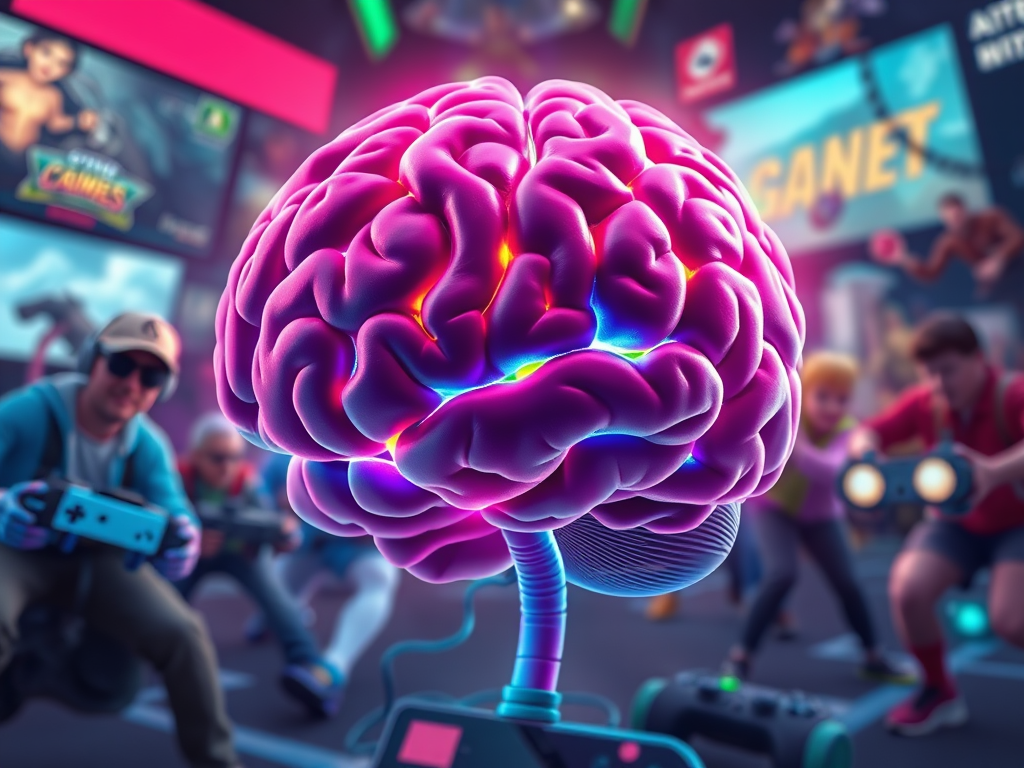
For decades, video games were often relegated to the cultural basement, dismissed as a mindless hobby or a guilty pleasure. The stereotype of the glazed-over gamer was a persistent one, suggesting that hours spent in front of a screen were hours of cognitive decay. However, as gaming has evolved from simple pixelated pastimes into complex, immersive worlds, science has begun to challenge these outdated notions. Neuroscientists and psychologists are discovering that playing video games is far from a passive activity; it’s an intense, stimulating workout for your brain.
The human brain is a remarkably adaptive organ, a principle known as neuroplasticity. It physically changes and rewires itself based on the challenges it faces and the skills it practices. When you play a video game, you’re not just moving a character on a screen; you’re forcing your brain to engage in a symphony of complex tasks. You’re processing visual information at incredible speeds, making split-second decisions under pressure, managing resources, solving multi-layered puzzles, and often, collaborating with a team to achieve a common goal. This is the equivalent of a full-body workout for your cognitive functions.
From action-packed shooters to sprawling strategy games and intricate puzzlers, different genres flex different mental muscles. The growing body of research is clear: when played mindfully, video games can be a powerful tool for enhancing our mental acuity. It’s time to look past the old stereotypes and explore the science-backed cognitive benefits waiting inside the console. Here are 10 of the most significant ways video games can positively impact your brain.
1. Supercharging Your Visual Processing: Seeing More, Faster
Fast-paced action games demand an incredible amount from your visual system. Players must simultaneously track enemy movements, watch for incoming projectiles, navigate complex environments, and keep an eye on their heads-up display (HUD). This intense visual stimulation acts like a high-intensity training program for the parts of the brain responsible for visual processing. Studies have consistently shown that experienced gamers have significantly enhanced visual acuity. This includes an improved ability to distinguish between different shades of grey (contrast sensitivity), a skill crucial for driving in foggy conditions or for a radiologist reading an X-ray.
Furthermore, gamers are better at combating “visual crowding,” the phenomenon where our ability to identify an object is hampered by other objects surrounding it. They can pick out a target from a cluttered background more efficiently. This translates to an enhanced ability to track multiple objects at once and switch visual attention rapidly without sacrificing accuracy. In essence, these games train your brain to extract more meaningful information from the visual data it receives every second, leading to a sharper, more efficient sense of sight.
2. Boosting Executive Functions: Becoming the CEO of Your Brain
Executive functions are a set of high-level mental skills that we use to plan, focus, remember instructions, and juggle multiple tasks successfully. Think of them as the CEO of your brain. Many types of games, particularly real-time strategy (RTS) games like StarCraft or grand strategy games like Civilization, are giant sandboxes for honing these exact skills. In these games, a player must manage resources, plan long-term city or army development, adapt to unforeseen enemy tactics, and make critical decisions that have cascading consequences.
This constant juggling act strengthens the brain’s prefrontal cortex, the region responsible for executive functions. Players learn to prioritise tasks, allocate resources efficiently, and think several steps ahead. This mental training isn’t confined to the game world. The improved ability to plan, organise, and strategise can translate into better performance in academic and professional settings, where managing complex projects and making well-reasoned decisions are paramount to success.
3. Accelerating Reaction Time and Decision-Making: Thinking at Game Speed
In many games, the difference between success and failure is measured in milliseconds. This forces players to process information and make accurate decisions under extreme time pressure. Research from the University of Rochester found that people who play action games make decisions up to 25% faster than non-gamers without any loss in accuracy. This isn’t just about having faster reflexes in your hands; it’s about the brain becoming more efficient at taking in sensory information (what’s happening on screen), processing it, and selecting the correct course of action.
This is a skill known as probabilistic inference. The brain learns to weigh probabilities and make the best possible guess based on the available data, and it learns to do so almost instantaneously. This ability to make quick, accurate judgments is a valuable asset in many real-world professions, from surgeons and pilots to emergency service workers, all of whom need to make critical decisions in the blink of an eye.
4. Enhancing Problem-Solving and Creativity: The Digital Puzzle Box
At their core, almost all video games are a series of problems to be solved. How do I defeat this boss? How can I solve this environmental puzzle in The Legend of Zelda? How can I build a sustainable structure in Minecraft? Unlike standardised tests, games rarely present problems with a single, obvious solution. They encourage lateral thinking and creative experimentation. Players are constantly forming hypotheses, testing them, and learning from the outcomes—a process that mirrors the scientific method.
Puzzle games like Portal directly train spatial reasoning and problem-solving, but even open-world games foster creativity by providing players with a set of tools and a world of possibilities, leaving it up to them to set and achieve their own goals. This process of facing a challenge, trying a solution, failing, and iterating with a new idea strengthens the cognitive flexibility needed to tackle novel problems in real life, fostering a more innovative and resourceful mindset.
5. Growing a Bigger, More Efficient Brain: The Neuroplasticity Effect
One of the most astonishing findings in gaming research is that playing video games can physically change the structure of your brain. Using MRI scans, a 2014 German study found that participants who played a complex 3D platformer (Super Mario 64) for 30 minutes a day over two months showed a measurable increase in grey matter. Grey matter is the part of the brain that contains neuronal cell bodies and is associated with muscle control, memory, perception, and decision-making.
The increases were seen in specific areas: the right hippocampus (linked to spatial navigation and memory formation), the right prefrontal cortex (strategic planning), and the cerebellum (fine motor skills). This demonstrates neuroplasticity in action. The brain, when consistently challenged by the rich, interactive 3D environments of a video game, physically grows and builds more connections in the regions being exercised. It’s a literal case of “use it or lose it,” and gaming provides a powerful way to “use it.”
6. Improving Attention and Taming Distraction: A Focus Workout
In our age of constant notifications and digital distractions, the ability to maintain focus on a single task—known as sustained attention—is becoming a superpower. Many video games are an excellent training ground for this skill. Whether you’re scanning the horizon for enemies in a shooter or meticulously planning your next move in a turn-based game, you are required to concentrate for extended periods. The game’s feedback loop, with its clear goals and rewards, helps to hold that attention.
Action games, in particular, have been shown to improve a player’s ability to filter out irrelevant information and focus on the important details. This enhanced selective attention can help individuals better manage distractions in their daily lives, from focusing on a report in a noisy office to paying closer attention in a lecture. By training the brain’s attentional networks, gaming can help us regain control in an increasingly distracting world.
7. Fostering Resilience and a Growth Mindset: The “Try Again” Loop
Video games are masters at teaching one of life’s most important lessons: failure is not a final destination, but a learning opportunity. The entire gameplay loop is built on a cycle of facing a challenge, failing, understanding why you failed, and trying again with a new strategy. This process, repeated hundreds of times, cultivates resilience and what psychologist Carol Dweck calls a “growth mindset”—the belief that abilities can be developed through dedication and hard work.
Games provide immediate feedback on mistakes in a low-stakes environment. When you fail to defeat a boss, you don’t give up on the game; you learn its patterns and come back stronger. This normalises failure as part of the learning process. It teaches perseverance and grit in a way that is engaging and rewarding. This mindset can be incredibly beneficial when applied to real-world challenges, helping individuals view setbacks not as a reflection of their worth, but as a necessary step on the path to mastery.
8. A Surprising Assist for Dyslexia: Improving Reading Skills
One of the most unexpected benefits of gaming has emerged from research into dyslexia. A number of studies have suggested that the intense visual demands of action games can directly help individuals with dyslexia improve their reading skills. The prevailing theory is that dyslexia isn’t just about letter reversal; it’s often linked to challenges in visual attention and processing.
Because action games are so effective at training the brain to quickly and accurately distribute its attentional resources, these benefits appear to transfer to the act of reading. After playing specially designed games, children with dyslexia have shown improvements in reading speed and accuracy, with some studies finding the effect to be more potent than traditional reading treatments. While not a cure, it’s a powerful demonstration of how skills honed in a game can have transformative effects on other areas of cognitive function.
9. Improving Working Memory: The Brain’s Juggling Act
Working memory is the brain’s “RAM” or mental notepad. It’s the ability to hold and manipulate multiple pieces of information in your mind at one time to complete a task. Think of a chef remembering an order while chopping vegetables and monitoring a sauce. Complex games are a constant workout for this faculty. A strategy game player needs to remember the location of their units, the state of their economy, their long-term goal, and the opponent’s likely strategy, all at once.
This constant mental juggling strengthens the capacity and efficiency of your working memory. A stronger working memory is linked to better performance in a wide range of tasks, including reading comprehension and mathematical ability. By pushing the limits of how much information you can handle at once, games help to expand this critical cognitive workspace.
10. Building Social Skills and Collaboration: The Teamwork Engine
The stereotype of the isolated gamer playing alone in a dark room is wildly out of date. Today, a huge portion of gaming is a deeply social and collaborative activity. Massively Multiplayer Online Role-Playing Games (MMORPGs) like World of Warcraft or team-based shooters like Valorant require intricate teamwork, clear communication, and collective strategy to succeed. Players must learn to lead, to follow, to negotiate roles, and to trust their teammates.
For many, these online worlds provide a safe space to practice complex social interactions and build meaningful relationships with people from around the globe. Players learn to resolve conflicts, manage group dynamics, and work towards a shared objective—all skills that are directly transferable to the classroom and the workplace. Far from being isolating, for millions of people, multiplayer gaming is a primary source of community and social connection.
Further Reading
For those interested in a deeper dive into the psychology and neurological impact of games, these books offer compelling insights:
- Reality Is Broken: Why Games Make Us Better and How They Can Change the World by Jane McGonigal, Ph.D.
- Superbetter: A Revolutionary Approach to Getting Stronger, Happier, Braver and More Resilient by Jane McGonigal, Ph.D.
- Extra Lives: Why Video Games Matter by Tom Bissell
The evidence is mounting: video games are not just a diversion, but a powerful medium that can shape our brains for the better. The key, like with any activity, is mindful engagement—choosing games that challenge you and playing in a way that enriches, rather than consumes, your life.
Here at Zentara.blog, our mission is to take those tricky subjects and unlock them, making knowledge exciting and easy to grasp for everyone. But the adventure doesn’t stop on this page! We’re constantly exploring new frontiers and sharing discoveries across the digital universe. Want to dive deeper into more mind-bending Top 10s and keep expanding your world? Come join us on our other platforms – we’ve got unique experiences waiting for you on each one!
Get inspired by visual wonders and bite-sized facts: See the world through Zentara’s eyes on Pinterest!
Pin our fascinating facts and stunning visuals to your own boards. Explore Pins on Pinterest: https://uk.pinterest.com/zentarablog/
Discover quick insights and behind-the-scenes peeks: Hop over to Tumblr for snippets, quotes, and unique content you won’t find anywhere else. It’s a different flavour of discovery! Follow the Fun on Tumblr: https://www.tumblr.com/zentarablog
Ready for deep dives you can listen to or watch? We’re bringing our accessible approach to video and potentially audio! Subscribe to our YouTube channel and tune into future projects that make learning pop! Subscribe on YouTube: https://www.youtube.com/@ZentaraUK
Seeking even more knowledge in one place? We’ve compiled some of our most popular topic deep dives into fantastic ebooks! Find them on Amazon and keep the learning journey going anytime, anywhere. Find Our Ebooks on Amazon: https://www.amazon.co.uk/s?k=Zentara+UK&ref=nb_sb_noss
Connect with us and fellow knowledge seekers: Join the conversation on BlueSky! We’re sharing updates, thoughts, and maybe even asking you what wonders we should explore next. Chat with Us on BlueSky: https://bsky.app/profile/zentarablog.bsky.social
Perfect for learning on the move! We post multiple 10-minute podcasts per day on Spotify. Pop on your headphones and fill your day with fascinating facts while you’re out and about! Listen on Spotify: https://open.spotify.com/show/3dmHbKeDufRx95xPYIqKhJFollow us on Instagram for bytesize knowledge! We post multiple posts per day on our official Instagram account. https://www.instagram.com/zentarablog/ Every click helps us keep bringing honest, accessible knowledge to everyone. Thanks for exploring with us today – see you out there in the world of discovery!




Leave a Reply