
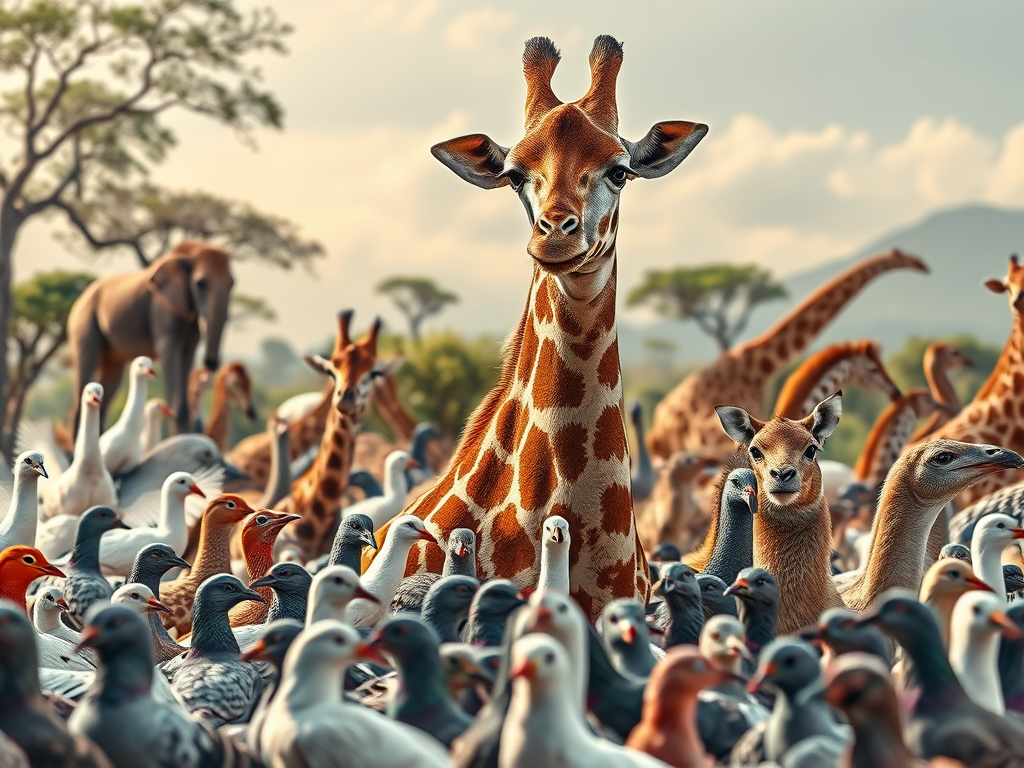
Evolution can seem like a colossal and intimidating concept, a grand narrative spanning billions of years, filled with complex biology and fossil records. At the heart of this epic story is a remarkably simple and elegant mechanism: natural selection. First articulated in breathtaking detail by Charles Darwin in his 1859 masterpiece, On the Origin of Species, natural selection is the engine that drives evolutionary change. It’s not a conscious force, a guiding hand, or a quest for perfection. Rather, it’s an inevitable outcome of a few basic conditions of life.
Think of it like a sculptor working with a block of marble. The sculptor doesn’t create the stone, but systematically chips away the pieces that aren’t part of the final vision. In the same way, natural selection doesn’t create life’s diversity from scratch; it works with the variation that already exists within a population. The “chipping away” is done by the pressures of the environment—predators, climate, competition—which remove individuals less suited to their surroundings. Over vast stretches of time, this process shapes and refines organisms, leading to the incredible array of adaptations we see in the natural world, from the intricate camouflage of a leaf-tailed gecko to the powerful wings of an eagle.
To truly grasp this profound idea, we don’t need to be expert biologists. We just need to break it down into a logical sequence of steps. By following this simple path, the seemingly complex theory of evolution by natural selection becomes clear, intuitive, and deeply powerful.
1. Start with a Population and its Inherent Variation
The first and most crucial step is to understand that natural selection doesn’t act on a single individual. It works on a population of organisms—a group of the same species living in a particular area. Now, look closely at any population, whether it’s people in a town, pigeons in a park, or bacteria in a petri dish, and you’ll notice they aren’t all identical clones. There is variation. Some pigeons are slightly larger, some have better eyesight, and some have feathers with a different pattern. This pre-existing variation is the raw material for natural selection. It arises from random processes, primarily genetic mutation—tiny, accidental changes in an organism’s DNA—and the shuffling of genes during sexual reproduction. It’s essential to remember that this variation isn’t created because an organism needs it. A giraffe doesn’t get a longer neck because it wishes it could reach higher leaves. Instead, within a population of giraffe ancestors, some were randomly born with slightly longer necks than others. This pool of diverse traits is the starting block from which the race of natural selection begins. Without this initial variety, there would be nothing for the environment to “select” from, and evolution would grind to a halt.
2. Acknowledge the “Struggle for Existence”
The natural world is not a gentle, all-providing paradise. Every organism is in a constant struggle for existence, a concept Darwin borrowed from the economist Thomas Malthus. This doesn’t always mean dramatic, tooth-and-claw combat. It simply means that more offspring are produced than can possibly survive and reproduce, leading to intense competition. Think of an oak tree producing thousands of acorns each year. If every acorn grew into a mature tree, the world would be covered in oak forests within a few generations. But that doesn’t happen. Why? Because the acorns and saplings compete for limited resources: sunlight, water, and nutrients in the soil. They are also at risk from predators (like squirrels) and diseases. This principle applies across all of nature. Animals compete for food, territory, and mates. Plants compete for light and water. This universal pressure means that not every individual gets to pass on its genes. It creates a high-stakes environment where even a tiny advantage can make the difference between living to reproduce and becoming another organism’s lunch.
3. Introduce a Selective Environmental Pressure
Now that we have a varied population in a competitive world, the next step is the arrival of a selective pressure. This is any feature of the environment that makes it harder to survive and reproduce. It’s the “test” that nature sets for the population. A selective pressure can be a predator, like a hawk hunting for mice in a field. It can be a change in the climate, such as a long drought or a harsh winter. It can be a disease that sweeps through a population, or even a change in the food supply. For our mice in the field, let’s say the soil is dark brown. The selective pressure is the hawk, which uses its keen eyesight to find prey. In this specific context, the environment is now “selecting” for mice that are harder for the hawk to spot against the dark soil. This pressure is the catalyst; it’s the force that will begin to favour certain traits over others, turning the random variation within the population into a directional trend.
4. Observe Differential Survival: “Survival of the Fittest”
This is the heart of natural selection, often summarised by the famous phrase “survival of the fittest.” It’s crucial to understand that “fittest” does not mean the strongest, fastest, or smartest in an absolute sense. It means the best fit for the current environment. It’s all about context. A big, strong polar bear is perfectly fit for the Arctic but would die quickly in the Sahara Desert. In our mouse example, the hawk is the selective pressure. The variation in the mouse population includes different fur colours—some are light tan, and some are dark brown. Against the dark soil, the dark brown mice are better camouflaged. Therefore, they are less likely to be spotted and eaten by the hawk. The light tan mice, standing out against the background, are picked off more easily. This is differential survival. The dark brown mice have a higher survival rate in this specific environment because their inherited trait (dark fur) gives them an advantage. They are the “fittest” in this context.
5. Factor in Differential Reproduction
Survival is vital, but it’s only part of the equation. To influence the next generation, an organism must not only survive but also reproduce. This is where differential reproduction comes in. The individuals who are better suited to the environment and survive longer are more likely to have opportunities to mate and produce offspring. Our dark brown mice, being more successful at avoiding the hawk, live long enough to have more babies than the light tan mice. The few tan mice that do survive might only manage to produce one litter before being eaten, while the well-camouflaged brown mice might live long enough to produce several. This means that in the next generation, there will be a disproportionately higher number of offspring from the brown-furred parents. This is a critical step: the advantage gained in survival must be translated into a reproductive advantage for the trait to become more common.
6. Understand the Power of Heredity
The process of natural selection would be meaningless without heredity. The advantageous traits that allow certain individuals to survive and reproduce more successfully must be heritable—that is, they must be capable of being passed down from parent to offspring through genes. Our dark brown mice survive and have more babies, but if their offspring were born with a random mix of fur colours, no change would occur in the population over time. However, because the trait for fur colour is genetic, the brown mice pass their “brown fur” genes on to their young. The tan mice, to the extent they reproduce, pass on their “tan fur” genes. Because the brown mice have more offspring, they pass on more copies of the brown fur genes to the next generation. This ensures that the beneficial trait doesn’t just disappear; it is preserved and carried forward, providing a foundation for future change. Heredity is the glue that makes the selection stick from one generation to the next.
7. Watch the Trait’s Frequency Change in the Population
Now, we simply let the cycle run. In each generation, the selective pressure (the hawk) continues to act on the population. And in each generation, the individuals with the advantageous, heritable trait (dark brown fur) are more likely to survive and reproduce than their peers. As this process repeats over many generations, a clear trend emerges: the frequency of the brown fur allele (gene variant) in the population’s gene pool will increase, while the frequency of the tan fur allele will decrease. The population as a whole will gradually become darker. It’s a simple numbers game. If Generation 1 was 50% tan and 50% brown, Generation 2 might be 40% tan and 60% brown. By Generation 50, the population might be 5% tan and 95% brown. The population is evolving. This change in the heritable characteristics of a population over successive generations is the very definition of evolution.
8. The Result is an Adaptation
The outcome of this entire process is an adaptation. The dark brown fur, which has become common in the mouse population, is now considered an adaptation to an environment with dark soil and sharp-eyed predators. An adaptation is any heritable trait that helps an organism survive and reproduce in its environment. It’s important to see that the mice didn’t try to adapt or will themselves to change colour. The adaptation (camouflaged fur) arose as a result of the environment filtering the pre-existing random variation in the population. The population, not the individual, adapts over time. The world is filled with countless stunning examples of adaptation driven by natural selection: the hollow bones of a bird that allow for flight, the antibiotic resistance of bacteria, or the waxy leaves of a desert plant that prevent water loss.
9. Extrapolate Over Geological “Deep Time”
The example of the mice changing colour is microevolution—evolutionary change on a small scale, within a single species. To understand how natural selection can create the vast diversity of life on Earth, we need to extrapolate this process over “deep time.” Instead of just a few dozen generations, imagine this process repeating for millions of generations. Instead of just one environmental pressure, imagine countless shifting pressures: changing climates, new predators, different food sources, and migrating competitors. As populations become isolated from each other in different environments, they will face different selective pressures. Over immense geological timescales, the gradual accumulation of these adaptations can lead to such significant changes that the new population can no longer interbreed with its ancestral population. At this point, speciation—the formation of a new and distinct species—has occurred. This is macroevolution. The same simple steps that made the mouse population darker, when repeated over eons, are powerful enough to turn an ancient land mammal into a modern whale.
10. Natural Selection is an Ongoing Process
Finally, it’s crucial to realize that natural selection isn’t something that just happened in the past. It is an ongoing, dynamic process that is happening all around us right now. The evolution of pests resistant to pesticides and bacteria resistant to antibiotics are powerful, real-time examples of natural selection in action. As humans continue to alter the planet’s environment, we are imposing powerful new selective pressures on countless species. Some, like urban pigeons and coyotes, are adapting to our cities. Others, unable to adapt quickly enough to challenges like climate change and habitat loss, face extinction. Understanding natural selection isn’t just about understanding the deep past; it’s about understanding the present and future of life on Earth. It is the fundamental organising principle of all biology, a simple set of steps that, given variation, heredity, and time, generates all the beauty, complexity, and drama of life.
Further Reading
- “On the Origin of Species” by Charles Darwin – The foundational text of evolutionary biology. While the language is of its time, reading even excerpts provides a direct look into one of the most brilliant scientific minds in history.
- “Why Evolution Is True” by Jerry A. Coyne – An clear, concise, and compelling summary of the modern evidence for evolution, written for a general audience.
- “Your Inner Fish: A Journey into the 3.5-Billion-Year History of the Human Body” by Neil Shubin – A fascinating book that explores the evidence for evolution found within our own bodies, linking us to a long line of vertebrate ancestors.
- “The Selfish Gene” by Richard Dawkins – A classic work that reframes the concept of natural selection from a gene-centered perspective, offering a powerful and thought-provoking view of evolution.
- “The Beak of the Finch: A Story of Evolution in Our Time” by Jonathan Weiner – A Pulitzer Prize-winning book that documents the real-time study of natural selection in action among Darwin’s famous Galápagos finches.
Here at Zentara.blog, our mission is to take those tricky subjects and unlock them, making knowledge exciting and easy to grasp for everyone. But the adventure doesn’t stop on this page! We’re constantly exploring new frontiers and sharing discoveries across the digital universe. Want to dive deeper into more mind-bending Top 10s and keep expanding your world? Come join us on our other platforms – we’ve got unique experiences waiting for you on each one!
Get inspired by visual wonders and bite-sized facts: See the world through Zentara’s eyes on Pinterest!
Pin our fascinating facts and stunning visuals to your own boards. Explore Pins on Pinterest: https://uk.pinterest.com/zentarablog/
Discover quick insights and behind-the-scenes peeks: Hop over to Tumblr for snippets, quotes, and unique content you won’t find anywhere else. It’s a different flavour of discovery! Follow the Fun on Tumblr: https://www.tumblr.com/zentarablog
Ready for deep dives you can listen to or watch? We’re bringing our accessible approach to video and potentially audio! Subscribe to our YouTube channel and tune into future projects that make learning pop! Subscribe on YouTube: https://www.youtube.com/@ZentaraUK
Seeking even more knowledge in one place? We’ve compiled some of our most popular topic deep dives into fantastic ebooks! Find them on Amazon and keep the learning journey going anytime, anywhere. Find Our Ebooks on Amazon: https://www.amazon.co.uk/s?k=Zentara+UK&ref=nb_sb_noss
Connect with us and fellow knowledge seekers: Join the conversation on BlueSky! We’re sharing updates, thoughts, and maybe even asking you what wonders we should explore next. Chat with Us on BlueSky: https://bsky.app/profile/zentarablog.bsky.social
Perfect for learning on the move! We post multiple 10-minute podcasts per day on Spotify. Pop on your headphones and fill your day with fascinating facts while you’re out and about! Listen on Spotify: https://open.spotify.com/show/3dmHbKeDufRx95xPYIqKhJFollow us on Instagram for bytesize knowledge! We post multiple posts per day on our official Instagram account. https://www.instagram.com/zentarablog/ Every click helps us keep bringing honest, accessible knowledge to everyone. Thanks for exploring with us today – see you out there in the world of discovery!




Leave a Reply