
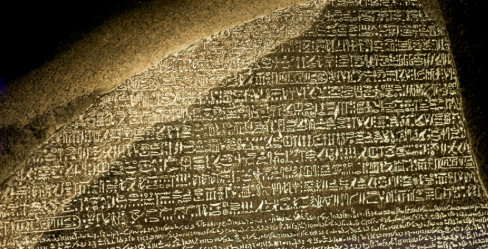
For over a thousand years, the civilization of ancient Egypt was a magnificent enigma. Its colossal pyramids, enigmatic sphinx, and tomb-lined valleys stood as silent witnesses to a lost world. The stories, beliefs, and daily lives of the people who built them were trapped behind an impenetrable wall of beautiful but baffling symbols: hieroglyphs. To the scholars of the 18th century, these intricate carvings were little more than mystical decorations, their meaning as lost as the pharaohs themselves. Then, in 1799, a chance discovery by a French soldier in a dusty Egyptian fort changed everything. He unearthed a broken slab of dark stone, inscribed with three different scripts. This was the Rosetta Stone, and it would become the key to unlocking one of history’s greatest mysteries.
The Rosetta Stone was not a magical code-breaker in itself, but a patient teacher. Its power lay in the fact that it contained the same decree written in three languages: formal Egyptian hieroglyphs, the everyday Demotic script of ancient Egypt, and ancient Greek. Since scholars could still read Greek, the stone provided a direct bridge into a forgotten world of language. The decipherment was a monumental intellectual race, culminating in the brilliant breakthroughs of Jean-François Champollion. What he and others unlocked was far more than a simple translation; it was the voice of an entire civilization. This list explores the ten greatest secrets revealed by this legendary artifact.
1. The Hieroglyphic Code Was Finally Cracked
The most fundamental secret unlocked by the Rosetta Stone was the very nature of hieroglyphs. Before its discovery, European scholars were lost in a sea of speculation. Many believed that the intricate symbols were purely allegorical or mystical, with each picture representing a complex philosophical concept. It was as if they were trying to read a sheet of music by assuming each note was a detailed painting. The Rosetta Stone proved this theory wrong. By meticulously comparing the Greek text to the hieroglyphs, Jean-François Champollion was able to identify the name of the pharaoh “Ptolemy” enclosed in an oval shape called a cartouche. This was the ‘eureka’ moment. He deduced that certain hieroglyphs were not symbolic pictures but phonetic signs representing sounds, much like the letters of our own alphabet. This single breakthrough was revolutionary. It revealed that the hieroglyphic system was a sophisticated hybrid, a combination of phonetic signs, ideograms (where a picture represents a whole word, like a picture of a sun meaning “sun”), and determinatives (signs that clarify the meaning of a word). The stone provided the rules to a game no one had known how to play for 1,400 years, transforming the mysterious symbols from arcane art into a readable language.
2. The Everyday Language of Ancient Egyptians Was Rediscovered
While the majestic hieroglyphs on temples and tombs get most of the attention, the Rosetta Stone featured another, equally important Egyptian script: Demotic. This was the cursive, everyday script used for legal documents, administrative records, and personal letters during the later periods of Egyptian history. If hieroglyphs were the formal, printed font of ancient Egypt, Demotic was its everyday handwriting. The presence of Demotic on the stone was crucial because it provided a link between the formal language of the gods and the practical language of the people. Scholars could use the known Greek to decipher the Demotic script first, which then provided additional clues to help crack the more complex hieroglyphs. Unlocking Demotic was like finding the diary of a civilization, not just its official monuments. It allowed historians to read tax receipts, marriage contracts, and legal petitions, opening a window into the mundane but fascinating details of daily life. It revealed how the bureaucracy of the Ptolemaic dynasty functioned and how ordinary Egyptians communicated. The Rosetta Stone didn’t just give us the language of pharaohs; it gave us the voice of the Egyptian street.
3. The Names and Timelines of Pharaohs Became History, Not Myth
Before the Rosetta Stone, the history of ancient Egypt was a jumble of myths, biblical references, and accounts from Greek historians like Herodotus. The actual timeline and lineage of the pharaohs were largely a matter of guesswork. The ability to read hieroglyphs changed everything. Archaeologists could now decipher the names carved into cartouches on temples, tombs, and monuments across Egypt. Suddenly, the great builders could be identified. Rameses the Great, Tutankhamun, Hatshepsut, Akhenaten—these names could be read in their own language, placed in their proper dynastic order, and linked to the specific achievements and events of their reigns. The king lists inscribed on temple walls, once meaningless decorations, became invaluable historical records. It was like finding a detailed index for the library of Egyptian history. The stone allowed scholars to construct a reliable chronology of the pharaohs, transforming legendary figures into historical actors and providing a solid framework upon which the entire history of ancient Egyptian civilization could be built. The secrets of who built what, who ruled when, and who fought whom were no longer lost to time.
4. Egyptian Religion and Mythology Could Be Understood from the Source
For centuries, our understanding of Egyptian religion was filtered through the biased and often incomplete accounts of Greek and Roman writers. They described a bizarre pantheon of animal-headed gods and strange rituals, but the deep theological meaning was lost. The decipherment of hieroglyphs unlocked a treasure trove of religious texts, allowing the gods of Egypt to speak for themselves. The walls of tombs and temples were covered in hymns, prayers, and mythological stories. Sacred texts like the Book of the Dead, a collection of spells intended to guide the deceased through the underworld, could finally be read and understood. The intricate relationship between gods like Osiris, Isis, Horus, and Ra was revealed in their original context. Scholars learned about the central concept of Ma’at (cosmic order and justice) and the profound Egyptian beliefs about the afterlife. It was like being able to read the Bible, the Torah, or the Quran after only hearing confusing second-hand summaries. The Rosetta Stone provided direct access to the spiritual heart of ancient Egypt, revealing a complex, sophisticated, and deeply human system of belief.
5. The Inner Workings of the Egyptian State Were Revealed
The decree inscribed on the Rosetta Stone itself is not a grand piece of epic poetry, but a rather dry piece of government administration. It details a series of tax exemptions and honours granted to the young pharaoh Ptolemy V Epiphanes by the Egyptian priesthood in 196 BC. While this might sound mundane, its implications were enormous. By translating this official decree, scholars gained unprecedented insight into the political and administrative structure of Ptolemaic Egypt. It revealed the complex relationship between the Greek-speaking pharaohs and the powerful native Egyptian priesthood. The decree was essentially a public relations document, designed to shore up support for the young king during a period of unrest. This single text illuminated how the government operated, how taxes were levied (and forgiven), how religious authority was used to legitimize royal power, and how propaganda was disseminated to the public. The ability to read this, and subsequently thousands of other administrative documents on papyrus, transformed our understanding of the Egyptian state from a monolithic entity ruled by a god-king into a complex bureaucracy with competing factions, economic policies, and sophisticated legal systems.
6. The Connection Between Different Egyptian Scripts Was Proven
A major secret revealed by the Rosetta Stone was the evolutionary relationship between Egypt’s different writing systems. For a long time, scholars weren’t sure if hieroglyphs, the later Hieratic script (a cursive form of hieroglyphs), and the even later Demotic script were related languages or entirely different systems. The Rosetta Stone, with both hieroglyphs and Demotic representing the same Egyptian text, proved they were two sides of the same coin. Hieroglyphs were the formal, monumental script, painstakingly carved in stone. Demotic was the highly abbreviated, rapid-writing system for day-to-day use. The relationship is similar to how we have formal, ornate calligraphy for wedding invitations and our own quick, messy handwriting for a shopping list—they look very different, but they are both ways of writing English. This realisation was a crucial piece of the puzzle. It showed that Egyptian writing had evolved over millennia to suit different needs, and it allowed scholars to use their knowledge of one script to inform their understanding of the other. The stone was the missing link that connected the sacred carvings of the Old Kingdom with the legal paperwork of the Ptolemaic era.
7. The True Meaning of the Cartouche Was Confirmed
One of the most distinctive features of hieroglyphic text is the cartouche, an oval loop that encircles a group of symbols. For years, scholars had suspected that these ovals were significant, but their exact purpose was a mystery. The Rosetta Stone provided the definitive proof. On the stone, the Greek text repeatedly mentions the king, Ptolemy. By comparing the position of Ptolemy’s name in the Greek text with the hieroglyphic section, scholars could pinpoint the corresponding group of symbols. They found that this name was always enclosed within a cartouche. This confirmed the theory that the cartouche was used to frame and highlight a royal name, effectively acting as a kind of hieroglyphic spotlight for the pharaoh. This was a critical key for decipherment. It gave scholars a starting point, a reliable way to identify proper names within a sea of unknown symbols. By identifying the sounds within the names “Ptolemy” and “Cleopatra” (from another inscription), Champollion could begin to build a rudimentary hieroglyphic alphabet, which became the foundation for cracking the entire language. The cartouche was the loose thread that, when pulled, helped unravel the whole tapestry.
8. The Extent of Greek Influence on Late Egyptian Culture Was Clarified
The Rosetta Stone dates from the Ptolemaic period (196 BC), a time when Egypt was ruled by a dynasty of Greek kings descended from one of Alexander the Great’s generals. The very existence of the stone, with its decree written in both Greek and Egyptian, is a powerful testament to the multicultural nature of this era. The translation revealed the delicate balancing act of the Ptolemaic rulers. They presented themselves to the outside world and their own administration as Greek kings, hence the use of the Greek language. However, to be seen as legitimate rulers by the native Egyptian population and the powerful priesthood, they had to embrace the traditional role of the pharaoh. The decree on the stone is a perfect example of this: a Greek king reaffirming his piety and royal authority in the ancient, sacred language of Egypt. The stone unlocked the secret of this cultural fusion, showing that it wasn’t a simple replacement of Egyptian culture by Greek culture. Instead, it was a complex process of adaptation and synthesis, where two great civilizations coexisted and influenced one another.
9. It Paved the Way for Modern Egyptology
The decipherment of the Rosetta Stone was the singular event that gave birth to the modern science of Egyptology. Before the stone, the study of ancient Egypt was the domain of treasure hunters and speculators. Afterwards, it became a serious academic discipline. With the ability to read the language, scholars could now approach Egyptian civilization with a new level of rigour and understanding. Expeditions to Egypt were no longer just about excavating tombs for their gold; they were about recovering texts, recording inscriptions, and piecing together the social, political, and religious history of the civilization. The Rosetta Stone gave archaeologists the context for their discoveries. A statue was no longer just a beautiful object; its inscription could reveal who it depicted, when it was made, and for what purpose. A tomb was not just a burial chamber; the texts on its walls could tell the life story of its occupant. The stone transformed the study of ancient Egypt from a romantic fascination into a historical science, providing the essential tool needed to analyse and interpret three millennia of human history.
10. The Voice of a Civilization Was Restored
Ultimately, the greatest secret unlocked by the Rosetta Stone was the voice of the ancient Egyptian people themselves. For over a millennium, they were silent, their stories and thoughts trapped in a script no one could read. The stone broke that silence. It allowed us to read their poetry, their love songs, their legal disputes, their medical texts, and their letters home from war. We can now understand their jokes, their fears, and their hopes for the afterlife. We learned that these people, who lived so long ago and built such monumental structures, were not so different from us. They loved their families, complained about their taxes, worried about their health, and sought to make sense of their place in the universe. The Rosetta Stone did more than just translate a language; it resurrected a civilization. It closed a 1,400-year gap in human conversation, allowing the ancient Egyptians to finally tell their own story, in their own words. That is its enduring and most profound legacy.
Further Reading
- The Rosetta Stone and the Rebirth of Ancient Egypt by John Ray
- Cracking the Egyptian Code: The Revolutionary Life of Jean-François Champollion by Andrew Robinson
- The Writing of the Gods: The Race to Decode the Rosetta Stone by Edward Dolnick
- How to Read Egyptian Hieroglyphs: A Step-by-Step Guide to Teach Yourself by Mark Collier and Bill Manley
- Ancient Egypt: A Very Short Introduction by Ian Shaw
Here at Zentara.blog, our mission is to take those tricky subjects and unlock them, making knowledge exciting and easy to grasp for everyone. But the adventure doesn’t stop on this page! We’re constantly exploring new frontiers and sharing discoveries across the digital universe. Want to dive deeper into more mind-bending Top 10s and keep expanding your world? Come join us on our other platforms – we’ve got unique experiences waiting for you on each one!
Get inspired by visual wonders and bite-sized facts: See the world through Zentara’s eyes on Pinterest!
Pin our fascinating facts and stunning visuals to your own boards. Explore Pins on Pinterest: https://uk.pinterest.com/zentarablog/
Discover quick insights and behind-the-scenes peeks: Hop over to Tumblr for snippets, quotes, and unique content you won’t find anywhere else. It’s a different flavour of discovery! Follow the Fun on Tumblr: https://www.tumblr.com/zentarablog
Ready for deep dives you can listen to or watch? We’re bringing our accessible approach to video and potentially audio! Subscribe to our YouTube channel and tune into future projects that make learning pop! Subscribe on YouTube: https://www.youtube.com/@ZentaraUK
Seeking even more knowledge in one place? We’ve compiled some of our most popular topic deep dives into fantastic ebooks! Find them on Amazon and keep the learning journey going anytime, anywhere. Find Our Ebooks on Amazon: https://www.amazon.co.uk/s?k=Zentara+UK&ref=nb_sb_noss
Connect with us and fellow knowledge seekers: Join the conversation on BlueSky! We’re sharing updates, thoughts, and maybe even asking you what wonders we should explore next. Chat with Us on BlueSky: https://bsky.app/profile/zentarablog.bsky.social
Perfect for learning on the move! We post multiple 10-minute podcasts per day on Spotify. Pop on your headphones and fill your day with fascinating facts while you’re out and about! Listen on Spotify: https://open.spotify.com/show/3dmHbKeDufRx95xPYIqKhJFollow us on Instagram for bytesize knowledge! We post multiple posts per day on our official Instagram account. https://www.instagram.com/zentarablog/ Every click helps us keep bringing honest, accessible knowledge to everyone. Thanks for exploring with us today – see you out there in the world of discovery!




Leave a Reply