
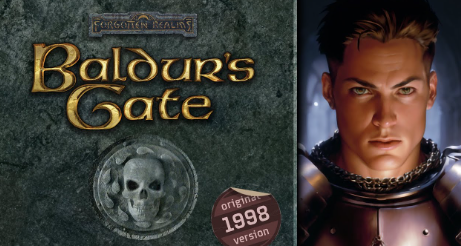
In the late 1990s, the computer role-playing game (CRPG) was a genre many thought was past its prime. The golden age of text-based adventures and grid-like dungeon crawlers had given way to the explosion of 3D action games. Then, in 1998, a small Canadian developer named BioWare unleashed a game that didn’t just revitalise the genre—it redefined it. That game was Baldur’s Gate.
Set in the sprawling and beloved Dungeons & Dragons campaign setting of the Forgotten Realms, Baldur’s Gate was a revelation. It was a game of epic scope, deep customisation, and rich, character-driven storytelling that felt like living inside a fantasy novel. It was the game that D&D fans had dreamed of for decades, a perfect marriage of tabletop freedom and digital immersion. In an era of fast-paced shooters, it was a defiant statement that story, choice, and character still mattered. With the recent triumphant return of the series in Baldur’s Gate 3, there has never been a better time to look back at the original game and understand why this 1998 classic is, and always will be, a true CRPG masterpiece.
1. The Perfect Translation of Tabletop Dungeons & Dragons
For years, video games had tried to capture the magic of a Dungeons & Dragons session, but none had truly succeeded. They often captured the combat or the stats, but missed the sense of adventure and storytelling. Baldur’s Gate was the first game to get it right. Built on a faithful adaptation of the Advanced Dungeons & Dragons 2nd Edition ruleset, it seamlessly translated the complex mechanics of THAC0 (To Hit Armor Class 0), saving throws, and spell memorisation into an intuitive and engaging digital experience.
This wasn’t just about numbers; it was about spirit. The game felt like it was being run by a master Dungeon Master. You created your character from scratch, choosing their race, class, and ability scores by “rolling” digital dice. Your alignment—Lawful Good, Chaotic Evil, and everything in between—had real consequences on how the world and its inhabitants reacted to you. For the first time, playing a CRPG felt less like a series of math problems and more like a genuine role-playing adventure, where the rich, established lore of the Forgotten Realms came to life around you. It was the ultimate D&D simulator, setting a gold standard that all future adaptations would be measured against.
2. A Breathtaking Sense of Scale and Exploration
Baldur’s Gate was enormous. The game’s world map, depicting the Sword Coast region of Faerûn, was a vast patchwork of interconnected areas, from the misty forests of the High Moor to the bustling trade routes along the Coast Way. Travelling from one edge of the map to the other was a genuine epic journey. This wasn’t a linear path; it was a world that begged to be explored. You could spend dozens of hours just wandering off the main path, uncovering hidden dungeons, stumbling upon remote villages, and getting hopelessly lost in a sprawling wilderness filled with secrets and danger.
This sense of scale was about more than just size; it was about freedom. After the initial prologue, the game sets you loose. Do you follow the main quest to investigate the iron crisis, or do you decide to become a bounty hunter, explore the mysterious Durlag’s Tower, or help a talking chicken? This freedom was intoxicating. It made the world feel real and your journey feel unique. It was the digital equivalent of a DM telling their players, “You see a road stretching to the horizon. What do you do?”
3. Unforgettable Companions Who Were More Than Just Pixels
Before Baldur’s Gate, companions in CRPGs were often little more than silent, player-controlled puppets—walking inventories and extra swords. BioWare changed that forever by creating a cast of companions who had distinct personalities, voices, and even their own conflicting agendas. They would banter with each other, offer their opinions on your actions, and would even leave or fight you if your choices clashed with their alignment.
This is the game that gave us Minsc, the kind-hearted but gloriously unhinged ranger, and his “miniature giant space hamster,” Boo. Their catchphrase, “Go for the eyes, Boo, GO FOR THE EYES!”, became legendary. It also gave us the cynical, sharp-tongued mage Edwin, the noble but conflicted paladin Ajantis, and the thieving duo of Montaron and Xzar. These characters felt alive. They weren’t just your minions; they were your party. Recruiting them, learning their stories, and managing their often-prickly relationships was as much a part of the game as killing goblins. This was the birth of the BioWare-style party, a formula they would refine in all their future masterpieces, from Knights of the Old Republic to Mass Effect.
4. An Epic, Yet Deeply Personal, Central Story
The main plot of Baldur’s Gate is a masterclass in RPG storytelling. It begins simply and personally: you are an orphan, raised in the sheltered library-fortress of Candlekeep. When your foster father is murdered, you are cast out into the dangerous world with nothing but a cryptic warning to trust no one. This intimate, mysterious beginning gradually unravels into a conspiracy of epic proportions involving an iron shortage, political assassination, and a looming war.
The genius of the plot is how it perfectly balances this grand, world-saving narrative with your character’s personal journey of discovery. You learn that you are a “Bhaalspawn,” a mortal child of the slain God of Murder, Bhaal, and that you are being hunted by your half-sibling, who seeks to kill all his brethren and claim the divine power for himself. This makes the conflict deeply personal. The fate of the Sword Coast is intertwined with your own identity and heritage. It’s not just a story you are witnessing; it’s your story, a formula that has become a hallmark of the greatest RPGs.
5. The Revolutionary Infinity Engine
The technological heart of Baldur’s Gate was BioWare’s Infinity Engine. In an era when many games were moving towards chunky, primitive 3D graphics, the Infinity Engine took a different approach. It used a 2D isometric perspective, combining highly detailed, beautifully pre-rendered backgrounds with fluid 2D character sprites. The result was a game that was, and remains, visually stunning. Each tavern, forest, and dungeon was like a hand-painted piece of concept art that you could walk through.
This engine was the perfect stage for the game’s epic scale. It allowed for huge maps and dozens of characters on screen at once without the demanding hardware requirements of 3D. The engine was so successful and flexible that it became the foundation for a golden age of CRPGs. It would go on to power a series of universally acclaimed classics, including Planescape: Torment, Icewind Dale, and the game’s own sequel, Baldur’s Gate II: Shadows of Amn. The Infinity Engine proved that technological innovation wasn’t just about adding another dimension; it was about creating the perfect tool to serve the art and the story.
6. “Real-Time with Pause” Combat: Tactical Depth Meets Fluid Action
Translating D&D’s turn-based combat into a fluid video game experience was a major challenge. Pure turn-based systems could feel slow, while pure real-time systems could be chaotic and unmanageable. Baldur’s Gate pioneered the perfect hybrid: “real-time with pause.” Combat unfolds in real-time, but at any moment, you can hit the spacebar to freeze the action. This allows you to issue specific orders to each of your six party members: tell your warrior to attack a specific target, have your cleric begin casting a healing spell, and order your mage to launch a fireball.
This system was a stroke of genius. It was like being a football coach who could pause the game at any moment to draw up a new play. It gave you the tactical depth and control of a turn-based game while maintaining the excitement and flow of a real-time battle. You had time to think, plan, and adapt your strategy to the ever-changing battlefield. This elegant solution to the combat problem became the standard for countless CRPGs for years to come and is a major reason why the game’s combat remains so compelling and playable today.
7. Baldur’s Gate: A City That Felt Alive
When you finally reach the titular city of Baldur’s Gate, it feels like a genuine arrival. This isn’t just a quest hub; it is a massive, sprawling, and deeply immersive urban environment. Divided into multiple large districts, from the grimy docks to the opulent manors of the wealthy, the city was filled with hundreds of unique buildings to enter, thousands of lines of dialogue, and a dizzying array of interconnected quests.
The city felt alive. You’d overhear gossip in the street that could lead to a new adventure. You’d get pickpocketed in the market. You’d get drawn into the bitter rivalries of the city’s competing thieves’ guilds. Just exploring the city and surviving its urban dangers could be a multi-hour adventure in itself. Few games before had ever created a city with such depth and complexity. It wasn’t just a location in the game; it was a character in its own right and a major reward for players who had survived the long journey down the Sword Coast.
8. Sarevok: A Villain Who Was Your Dark Mirror
A great hero needs a great villain, and Baldur’s Gate has one of the best in CRPG history: Sarevok Anchev. When you finally uncover the identity of the man behind the iron crisis and the plot to start a war, he isn’t some generic monster or cackling sorcerer. Sarevok is a formidable, intelligent, and charismatic warrior. He is a master manipulator who has positioned himself to become the new Grand Duke of Baldur’s Gate.
What makes him a truly masterful villain is his connection to the player. Sarevok is also a Bhaalspawn, your half-brother. He is a dark reflection of you—what you could have become if you had embraced your murderous heritage and sought power at any cost. His goals are understandable, even if his methods are monstrous. The final confrontation with him is not just a battle for the fate of the Sword Coast; it’s a battle for your own soul. This trope of the villain as the hero’s dark mirror has been used many times since, but rarely has it been executed with such perfection.
9. A World Overflowing with Secrets and Side Quests
The world of Baldur’s Gate was dense with content. The game constantly rewarded curiosity. Clicking on a bookshelf in a random house might reveal a rare spell scroll. A seemingly throwaway line of dialogue could be the start of a multi-part quest. The game was famous for its incredible array of side quests, ranging from simple monster-slaying contracts to complex, multi-stage adventures like the epic dungeon crawl through Durlag’s Tower.
This depth made the world feel rich and authentic. It wasn’t just a backdrop for the main story; it was a place with its own history, its own problems, and its own cast of memorable minor characters. This design philosophy—filling the world with meaningful, optional content—created immense replayability and made every player’s journey feel slightly different. It set a new standard for world-building in RPGs, demonstrating that the little stories you find along the way are often just as important as the main quest.
10. Its Enduring Legacy and Influence
Baldur’s Gate was not just a successful game; it was a foundational text for the modern RPG. Its success saved the CRPG from commercial obscurity and launched BioWare into the stratosphere, setting them on a path that would lead to Star Wars: Knights of the Old Republic, Dragon Age, and Mass Effect. The “BioWare formula”—a personal, cinematic main story, a cast of memorable companions, and a world where player choice matters—was born here.
The game’s influence can be seen everywhere, from the party-based tactical combat of the Pillars of Eternity series to the epic scale of The Witcher 3. It created a blueprint for how to blend deep RPG mechanics with compelling, character-driven narrative. And now, with the incredible critical and commercial success of Larian Studios’ Baldur’s Gate 3, the legacy of the original has never been more apparent. The 1998 masterpiece didn’t just tell a great story; it created a world and a style of play that would inspire a new generation of developers and captivate gamers for decades to come.
Further Reading
To learn more about the history of CRPGs, the magic of Dungeons & Dragons, and the worlds that inspired this classic game, check out these books:
- “Dungeons and Desktops: The History of Computer Role-Playing Games” by Matt Barton (A comprehensive academic history of the CRPG genre, from its origins to the modern era.)
- “Slaying the Dragon: A Secret History of Dungeons & Dragons” by Ben Riggs (A fascinating look at the business and creative history of the tabletop game that started it all.)
- “The Legend of Drizzt” series by R.A. Salvatore (These bestselling fantasy novels, also set in the Forgotten Realms, are a perfect way to immerse yourself in the lore and locations of the Baldur’s Gate world.)
- “Blood, Sweat, and Pixels: The Triumphant, Turbulent Stories Behind How Video Games Are Made” by Jason Schreier (While not specifically about Baldur’s Gate, this book provides incredible insight into the challenges and triumphs of game development, with chapters on modern BioWare games like Dragon Age: Inquisition.)
Here at Zentara.blog, our mission is to take those tricky subjects and unlock them, making knowledge exciting and easy to grasp for everyone. But the adventure doesn’t stop on this page! We’re constantly exploring new frontiers and sharing discoveries across the digital universe. Want to dive deeper into more mind-bending Top 10s and keep expanding your world? Come join us on our other platforms – we’ve got unique experiences waiting for you on each one!
Get inspired by visual wonders and bite-sized facts: See the world through Zentara’s eyes on Pinterest!
Pin our fascinating facts and stunning visuals to your own boards. Explore Pins on Pinterest: https://uk.pinterest.com/zentarablog/
Discover quick insights and behind-the-scenes peeks: Hop over to Tumblr for snippets, quotes, and unique content you won’t find anywhere else. It’s a different flavour of discovery! Follow the Fun on Tumblr: https://www.tumblr.com/zentarablog
Ready for deep dives you can listen to or watch? We’re bringing our accessible approach to video and potentially audio! Subscribe to our YouTube channel and tune into future projects that make learning pop! Subscribe on YouTube: https://www.youtube.com/@ZentaraUK
Seeking even more knowledge in one place? We’ve compiled some of our most popular topic deep dives into fantastic ebooks! Find them on Amazon and keep the learning journey going anytime, anywhere. Find Our Ebooks on Amazon: https://www.amazon.co.uk/s?k=Zentara+UK&ref=nb_sb_noss
Connect with us and fellow knowledge seekers: Join the conversation on BlueSky! We’re sharing updates, thoughts, and maybe even asking you what wonders we should explore next. Chat with Us on BlueSky: https://bsky.app/profile/zentarablog.bsky.social
Perfect for learning on the move! We post multiple 10-minute podcasts per day on Spotify. Pop on your headphones and fill your day with fascinating facts while you’re out and about! Listen on Spotify: https://open.spotify.com/show/3dmHbKeDufRx95xPYIqKhJFollow us on Instagram for bytesize knowledge! We post multiple posts per day on our official Instagram account. https://www.instagram.com/zentarablog/ Every click helps us keep bringing honest, accessible knowledge to everyone. Thanks for exploring with us today – see you out there in the world of discovery!




Leave a Reply