
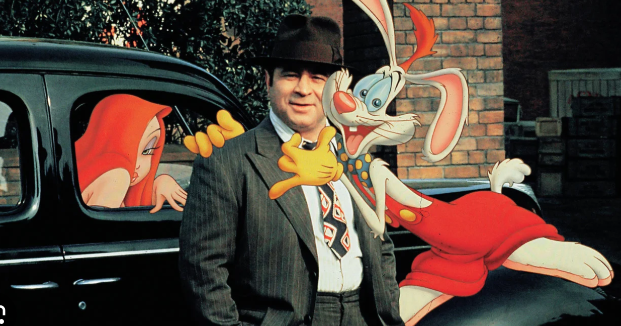
In 1988, a movie appeared that defied all logic. It wasn’t just a film with cartoons; it was a film where cartoons lived. They were tangible, three-dimensional, and breathing the same air as hard-boiled human detectives. Who Framed Roger Rabbit was not a simple evolution in filmmaking; it was a violent, paradigm-shifting revolution. Director Robert Zemeckis and animation director Richard Williams achieved the impossible by shattering every established rule of mixing animation with live-action.
Table of Contents
Before Roger Rabbit, the technique was a gimmick. Cartoons were flat, lifeless drawings matted onto a locked-down camera shot (think Mary Poppins). They couldn’t interact with real objects, they couldn’t be touched, and they certainly couldn’t exist in a gritty, three-dimensional world of film noir. Zemeckis’s vision was to create a seamless reality. The filmmaking innovations in Who Framed Roger Rabbit were so laborious and so ahead of their time that they remain one of the greatest “how did they do that?” achievements in cinema history, all accomplished decades before the safety net of CGI.
This is the story of how they pulled it off. Here are the 10 groundbreaking techniques that made Who Framed Roger Rabbit a masterpiece.
1. The “Bumping the Lamp” Philosophy: Hand-Drawn 3D Lighting
The single greatest trick in the film is making 2D cels look like 3D objects. The secret? Light and shadow. Before Roger Rabbit, cartoons were flat and bright, no matter the lighting in the live-action scene. Animation director Richard Williams pioneered a technique of “2.5D” animation, giving his characters volume and depth.
His team didn’t just animate the characters; they animated their shadows and highlights. For every single frame of animation, artists would create multiple extra cels called “tone mattes”—one for the shadow, one for the highlight, and sometimes more for reflected light. These were all composited together by Industrial Light & Magic (ILM) to create a character that looked lit by the lights in the real-world scene.
The most legendary example is the “bumping the lamp” scene, where Roger and Eddie are in a dark room with a single, swinging overhead lamp. As the lamp moves, the shadows and highlights move perfectly across Roger’s 2D-animated body. It was a self-imposed nightmare for the animators, requiring them to rotoscope the lamp’s light, calculate the shadow’s path, and redraw it frame by frame. This insane attention to detail is the film’s core illusion, and it’s why your brain accepts that Roger is truly in that room.
2. A Moving Camera That Unleashed the Toons
The number one rule of live-action/animation hybrid films was: NEVER move the camera. A locked-down camera made it easy to “paste” the animation into a static scene. Robert Zemeckis, famous for his dynamic camera work, refused. His camera swoops, pans, and dollies through scenes just as it would in any other live-action thriller.
This decision was a technical earthquake. It meant that for every frame, the animators had to manually redraw the characters and their perspective to perfectly match the moving background plate. The VistaVision cameras used for the film’s visual effects shots captured a larger, higher-resolution negative. Animators would get printouts of every single live-action frame and, using rulers and complex calculations, plot the character’s position and size relative to real-world objects. It was a mathematical and artistic ordeal that had never been attempted on this scale. This technique is the primary reason the film feels “real” and not like a static stage play.
3. Practical Puppetry and “Robotic” Props
How do you make a Toon hold a real gun? Or watch a real tray float through a club? You don’t. You use practical effects and puppetry. The special effects team, led by George Gibbs, built an arsenal of props and rigs to be manipulated on set.
When Roger holds a real gun on Eddie, that gun was a lightweight model held by a puppeteer on a rod, who was meticulously hidden out of frame. When Roger bursts through a set of blinds, the blinds were rigged to explode. The cigars Baby Herman smokes were real cigars on a complex, articulated arm. In the Ink and Paint Club, the penguin waiters are carrying real trays of drinks, all controlled by an elaborate overhead puppetry system. By having Toons interact with real, physical objects, the film created “contact points” with reality. The animators would then painstakingly draw the Toon’s hand or body to perfectly match the movement of the real-world prop, frame by frame.
4. The Art of the Eyeline: Making Bob Hoskins a Believer
The film’s entire illusion rests on the shoulders of actor Bob Hoskins (Eddie Valiant). If he didn’t believe the Toons were real, neither would we. Before Roger Rabbit, actors would just stare at a blank space. Zemeckis knew this wasn’t good enough.
To give Hoskins a physical reference, the crew used a variety of on-set tricks. For simple eyelines, they used a piece of tape on a C-stand. But for complex interactions, they used full-size, vulcanized rubber maquettes (models) of the characters. They would rehearse the scene with the rubber Roger or Jessica Rabbit so Hoskins knew exactly where they were, how much space they took up, and where to look. For scenes where Eddie had to grab Roger, Hoskins had to undergo intense mime training to convincingly hold, shake, and fight with empty air. The animators then had the Herculean task of drawing Roger to match Hoskins’s performance, even adjusting Roger’s position mid-scene if Hoskins’s eyeline was slightly off.
5. Old-School Optical Compositing (Without a Computer)
Today, this film would be made with digital compositing. In 1988, there was no “undo” button. Every single shot that combined a Toon with live-action was a masterpiece of optical printing. This pre-digital technique involved layering multiple pieces of film on top of each other in a massive, complex camera-projector hybrid.
A single, one-second shot of Roger Rabbit could involve a dozen or more individual pieces of film:
- The live-action background (the “plate”).
- A “black-and-white” matte of the Toon (to “cut a hole” in the background).
- The color animation cel of the Toon.
- A matte for the shadow.
- The shadow animation itself.
- A matte for the highlight.
- The highlight animation itself.
ILM’s optical department had to combine all these layers with perfect precision, one frame at a time, making sure nothing slipped, jittered, or lost focus. The film contained over 1,000 optical composite shots, an unprecedented number that pushed the technology to its absolute breaking point.
6. Full Animation on “Ones,” Not “Twos”
In the world of animation, animators often “cheat” to save time. They draw a new image every two frames of film (called animating “on twos”), and the human eye fills in the blanks. This is standard for Saturday morning cartoons and even many Disney classics.
Richard Williams, a notorious perfectionist, insisted that all characters in Roger Rabbit be animated “on ones.” This meant a new drawing for every single frame of film (24 drawings per second). This decision doubled the animation workload, but it was essential. The “on twos” technique creates a slightly strobing, “cartoonish” effect. Animating “on ones” creates incredibly fluid, smooth, and hyper-realistic motion that allows the Toons to keep up with the blur-free movement of the live-action camera. It’s a subtle, expensive, and back-breaking choice that makes a night-and-day difference in the final product.
7. The Unprecedented “Cartoon Cameo” Crossover
For one fleeting, 3-minute scene, Who Framed Roger Rabbit achieved the impossible: it united the entire pantheon of animation’s Golden Age. This was not a technical marvel but a legal and logistical one. For the first time in history, Warner Bros. characters like Bugs Bunny and Daffy Duck appeared on screen with Disney characters like Mickey Mouse and Donald Duck.
Executive producer Steven Spielberg personally brokered this landmark deal. The rival studios agreed, but with iron-clad stipulations. The most famous was that Mickey and Bugs had to have the exact same amount of screen time, down to the frame. The same rule applied to Donald and Daffy for their dueling piano sequence. This scene, where all the classic Toons mingle at the Ink andPaint Club, created a magical “what if” universe that not only honored animation history but cemented Roger Rabbit as a singular event in film history.
8. Immersive, Character-Driven Sound Design
The film’s innovative sound design is an unsung hero of its realism. Sound designer Ben Burtt (the genius behind Star Wars‘ lightsabers and R2-D2) didn’t just use standard “boinks” and “zips.” He created a hybrid soundscape where Toon physics and real-world physics collide.
When a Toon hits a real wall, you hear a “boing” and the thud of real plaster. When the Weasels’ Toon Patrol van screeches to a halt, you hear cartoon tire squeals blended with the sound of real rubber on pavement. This philosophy extended to the voices. Actor Charles Fleischer (Roger) was on-set for most of the shoot, wearing a rabbit costume and reading his lines off-camera so Bob Hoskins had a real voice to act against. This integration of Toon and real sounds in the final mix was crucial for tricking the audience’s ears and, by extension, their eyes.
9. Blending Practical and Animated Effects
The film’s genius lies in its clever blending of what’s real and what’s drawn. The most horrifying example? Judge Doom’s “Dip.” The Toon-melting Dip is a terrifying concoction of “turpentine, acetone, and benzene.” To create it, the effects team used a vat of this real, sludgy chemical mixture on set. When the Toon shoe is dipped, the animators simply stopped drawing the character, frame by frame, as it sank into the real-world liquid, which was bubbling and steaming.
The reverse is true in Toontown. When Eddie Valiant drives his real car into Toontown, he’s driving on a real, physical road that was part of a massive set. But when he turns a corner, that “real” road might transition seamlessly into an animated road. The line is constantly blurred. The ACME factory, the site of the final battle, was a massive, real, abandoned warehouse in London, enhanced with animated machinery and a river of animated Dip. This constant “handoff” between practical and animated effects left the audience unable to see the seams.
10. The “Toon Town” 3D Animation Set
While most of the film integrates Toons into the real world, the climax flips the script, dropping Eddie Valiant into the fully animated Toontown. This was not a simple 2D-painted backdrop. To maintain the film’s trademark camera movement, the animators had to invent a way to move a 3D camera through a 2D world.
The backgrounds for Toontown were drawn, but they were drawn “in perspective” and often on separate layers. The camera’s “movement” was then simulated in the optical printer by moving these layers at different speeds to create a “multiplane” effect, faking 3D parallax. Furthermore, some of the final chase scenes through the ACME factory used early CGI—not for characters, but to create the 3D environment (like the animated brick walls and floors) that the 2D-animated characters and live-action Eddie could interact with. This hybrid of 2D animation, live-action, and nascent 3D-modeled environments was the final, groundbreaking step in creating a world where anything was possible.
Further Reading
For those who want to dive deeper into the magic behind the film and the art of animation it perfected, here are a few essential books:
- The Animator’s Survival Kit by Richard Williams
- Who Censored Roger Rabbit? by Gary K. Wolf
- The Illusion of Life: Disney Animation by Ollie Johnston and Frank Thomas
- Industrial Light & Magic: The Art of Special Effects by Thomas G. Smith
Here at Zentara.blog, our mission is to take those tricky subjects and unlock them, making knowledge exciting and easy to grasp for everyone. But the adventure doesn’t stop on this page! We’re constantly exploring new frontiers and sharing discoveries across the digital universe. Want to dive deeper into more mind-bending Top 10s and keep expanding your world? Come join us on our other platforms – we’ve got unique experiences waiting for you on each one!
Get inspired by visual wonders and bite-sized facts: See the world through Zentara’s eyes on Pinterest!
Pin our fascinating facts and stunning visuals to your own boards. Explore Pins on Pinterest: https://uk.pinterest.com/zentarablog/
Discover quick insights and behind-the-scenes peeks: Hop over to Tumblr for snippets, quotes, and unique content you won’t find anywhere else. It’s a different flavour of discovery! Follow the Fun on Tumblr: https://www.tumblr.com/zentarablog
Ready for deep dives you can listen to or watch? We’re bringing our accessible approach to video and potentially audio! Subscribe to our YouTube channel and tune into future projects that make learning pop! Subscribe on YouTube: https://www.youtube.com/@ZentaraUK
Seeking even more knowledge in one place? We’ve compiled some of our most popular topic deep dives into fantastic ebooks! Find them on Amazon and keep the learning journey going anytime, anywhere. Find Our Ebooks on Amazon: https://www.amazon.co.uk/s?k=Zentara+UK&ref=nb_sb_noss
Connect with us and fellow knowledge seekers: Join the conversation on BlueSky! We’re sharing updates, thoughts, and maybe even asking you what wonders we should explore next. Chat with Us on BlueSky: https://bsky.app/profile/zentarablog.bsky.social
Perfect for learning on the move! We post multiple 10-minute podcasts per day on Spotify. Pop on your headphones and fill your day with fascinating facts while you’re out and about! Listen on Spotify: https://open.spotify.com/show/3dmHbKeDufRx95xPYIqKhJFollow us on Instagram for bytesize knowledge! We post multiple posts per day on our official Instagram account. https://www.instagram.com/zentarablog/ Every click helps us keep bringing honest, accessible knowledge to everyone. Thanks for exploring with us today – see you out there in theworld of discovery!




Leave a Reply