
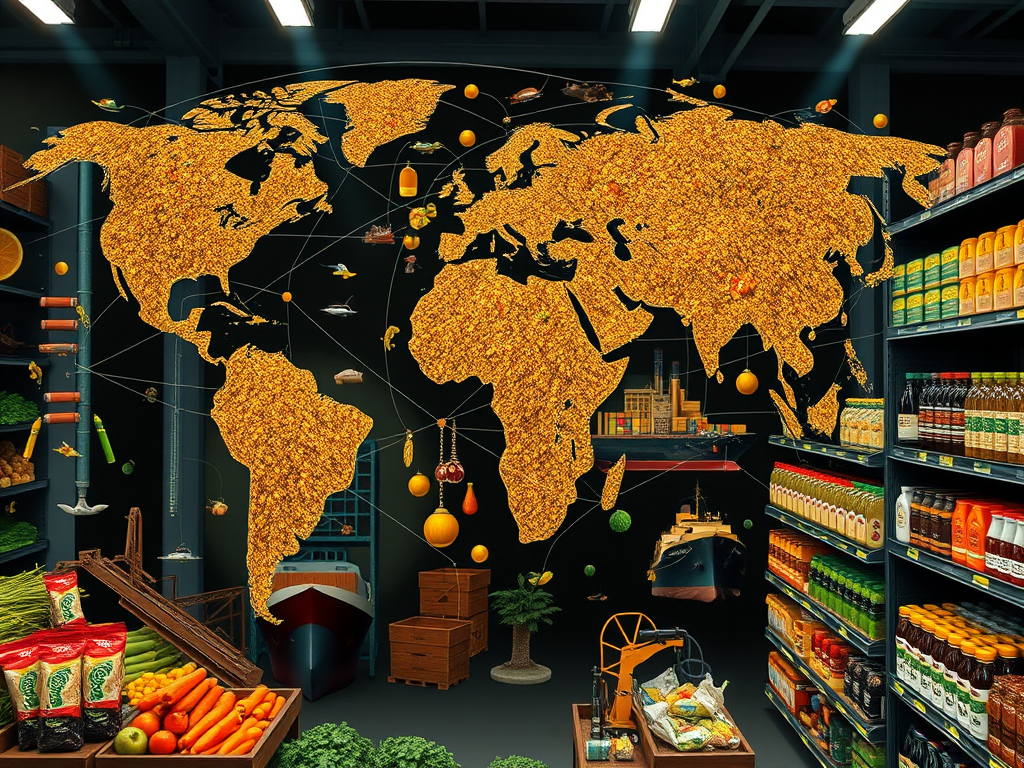
If your weekly grocery bill feels like it’s climbing, you’re not just imagining it. The entire planet is in the middle of a “global food supply squeeze.” Recent reports from financial analysts and major organizations like the 2025 World Food Forum all point to the same thing: the systems that grow our food and get it to our tables are under an unprecedented level of stress.
Table of Contents
This volatility isn’t caused by one single problem. It’s a “perfect storm” of extreme weather, geopolitical conflicts, and new economic pressures. But what does this all mean in simple terms?
Here are the 10 key facts you need to understand what’s happening to the world’s food, from the farm field to your kitchen.
1. The Giant Domino Rally: What Is the “Global Food Supply Chain”?
First, what is this system that’s under stress? The global food supply chain is the vast, interconnected network that takes food from a farm to your plate. It’s not a single “chain” but a complex web of producers, processors, shippers, and retailers.
Think of it as a planet-spanning domino rally. It starts with a farmer in Brazil planting a soybean (Domino 1). That bean is harvested and sent to a port (Domino 2), loaded onto a giant ship (Domino 3), sails to a factory in Europe (Domino 4), gets processed into animal feed (Domino 5), and is fed to livestock that eventually becomes the food in your local supermarket (Domino 6).
For decades, this system was built for maximum efficiency (i.e., making food as cheaply as possible). The problem? This “just-in-time” system is incredibly brittle. If one domino falls over at the wrong time—like a war or a drought—the entire line can come to a halt.
2. Problem 1: The New Normal of Extreme Weather
The most powerful force knocking over dominoes right now is the climate. Farmers rely on predictable weather, and that predictability is gone. The Australian Institute of International Affairs and other groups have highlighted that extreme weather is no longer a rare “shock” but a chronic, ongoing problem.
- Droughts in some regions (like the Americas) are shrinking harvests of staple crops like corn and soy.
- Floods and heavy rains in other areas (like West Africa) are devastating cocoa crops.
- Record-breaking heat waves are stressing livestock and reducing dairy production.
When a major “breadbasket” region has a bad harvest, it sends a ripple effect across the entire globe, reducing supply and pushing up prices for everyone.
3. Problem 2: How Wars and Geopolitics Block Food
Food has unfortunately become a major pawn in global conflicts. The most obvious example is the ongoing instability in the Black Sea region, which has repeatedly disrupted exports from Ukraine and Russia.
This is a massive problem because that region is one of the world’s most important breadbaskets, responsible for a huge percentage of the global supply of wheat, sunflower oil, and corn. When that supply is taken off the market or made more difficult to ship, it creates a supply shock. Dozens of countries, particularly in the Middle East and Africa that depend on that grain, are suddenly left scrambling for food, forcing them to compete for more expensive supplies elsewhere.
4. Problem 3: The “Chokepoints” That Squeeze Our Supply
A huge portion of our global food supply travels by sea on massive container ships. This system has a few critical “chokepoints”—narrow canals or straits where traffic is heavily concentrated. When these chokepoints fail, the whole system backs up.
We are currently seeing problems at two of the most important ones:
- The Panama Canal: This vital shortcut connecting the Atlantic and Pacific oceans has been suffering from a severe drought, lowering its water levels. This has forced authorities to dramatically restrict the number of ships that can pass through, creating a massive, costly traffic jam.
- The Suez Canal / Red Sea: Geopolitical tensions in the Middle East have made this key route for trade between Asia and Europe dangerous.
When ships can’t use these shortcuts, they are forced to take the “long way”—often adding weeks and millions of dollars in fuel costs to their journey. That extra cost is passed directly on to you.
5. Problem 4: The Vicious Cycle of Fertilizer Costs
You can’t have a food squeeze without talking about fertilizer. Fertilizer is to a farmer what fuel is to a car—it’s an essential, non-negotiable cost. If you can’t get it, or can’t afford it, your harvest will fail.
The problem is that the main ingredient for most nitrogen fertilizers is natural gas. When geopolitical conflicts cause energy prices to spike, fertilizer prices go right up with them. Furthermore, a huge portion of key fertilizer ingredients (like potash and phosphate) comes from a small handful of countries, including Russia, China, and Morocco.
When trade is disrupted or prices for natural gas and phosphates rise, farmers face an impossible choice: either pay sky-high prices for fertilizer (and pass that cost to you) or use less and grow less food (which shrinks supply and also raises prices).
6. Not All Food Is Squeezed Equally (Wheat vs. Coffee)
This global squeeze doesn’t affect all foods in the same way. The impact depends on where and how a crop is grown.
- Staple Crops (like Wheat): Wheat is grown all over the world, which provides some resilience. However, because it is a core staple and essential for food security, any disruption in a major exporting region (like the Black Sea or North America) has an immediate and serious global impact on the price of bread and pasta.
- Specialty Crops (like Coffee or Cocoa): These crops are often more volatile because they are only grown in very specific, climate-sensitive regions. The world’s entire supply of cocoa, for example, is heavily reliant on a few countries in West Africa. The recent extreme weather there has caused cocoa prices to more than triple, which is why your chocolate bars are getting more expensive.
7. The Human Cost: What “Food Security” Actually Means
This is the term at the heart of the entire crisis. “Food security,” as defined by the World Food Programme and the UN, isn’t just about having enough food. It has four key parts:
- Availability: Is there simply enough food being produced?
- Access: Can people actually get to the food (and can they afford it)?
- Utilization: Is the food nutritious enough for a healthy life?
- Stability: Does this access remain stable, or is it threatened by a sudden shock?
The current squeeze is a “polycrisis” that is attacking all four pillars at once. There is less food being grown (availability), it’s harder to ship (access), and the high cost of everything is pushing nutritious food out of reach for millions (utilization and affordability).
8. The Hope: How New Tech Is Trying to Help
The good news is that these high-pressure problems are sparking incredible innovation. The 2025 World Food Forum specifically highlighted the need for science and investment to build a more resilient system.
- Precision Agriculture: Instead of just “blanketing” a field with fertilizer, farmers are using AI-powered drones and GPS-guided tractors to apply the exact amount of water and fertilizer each individual plant needs. This cuts costs and reduces waste.
- New Crops: Scientists are using gene-editing technology like CRISPR to develop new strains of wheat, corn, and rice that are more resistant to drought, heat, and disease.
- Vertical Farming: In cities, companies are “growing up” instead of “out,” building indoor farms that stack crops from floor to ceiling. These “vertical farms” use 95% less water and are immune to weather and pests.
9. The Organizers: The Role of Big International Groups
When the crisis is global, the solutions have to be, too. This is where groups like the UN’s Food and Agriculture Organization (FAO), the World Food Programme (WFP), and the World Food Forum come in.
These organizations don’t run the world’s farms, but they act as the planet’s “control center.”
- They gather data to warn countries about upcoming famines or shortages.
- They host forums (like the one in 2025) to get governments, scientists, and investors in the same room to fund new solutions. The 2025 Forum, for example, generated over $17 billion in investment pledges.
- They coordinate emergency aid, ensuring that food gets to the most vulnerable populations during a crisis.
They are the “global firefighters” and “city planners” trying to manage the immediate crisis while redesigning the system to be stronger.
10. The Bottom Line: Why This Matters to Your Grocery Bill
This entire, complex global story has a very simple ending: it all lands on the price tag at your local supermarket.
Your grocery bill is the final link in the chain. The extra cost of fuel to sail a ship around Africa, the spike in fertilizer prices for an Iowa farmer, and the bad harvest from a drought in Brazil all get bundled together. By the time that bag of coffee or box of cereal gets to your shelf, it has absorbed the cost of every single one of these global shocks.
The “squeeze” you feel at the checkout is a direct reflection of the squeeze the entire planet is feeling. It’s a powerful, everyday reminder that in our modern world, there is no such thing as a “local” food market anymore.
Further Reading
For those who want to learn more about our complex food systems and the challenges they face, these books offer fantastic insights:
- The Wizard and the Prophet: Two Groundbreaking Scientists and Their Conflicting Visions of the Future of Our Planet by Charles C. Mann
- Food Security and Scarcity: Why Ending Hunger Is So Hard by C. Peter Timmer
- The Fate of Food: What We’ll Eat in a Bigger, Hotter, Smarter World by Amanda Little
- Sitopia: How Food Can Save the World by Carolyn Steel
Here at Zentara.blog, our mission is to take those tricky subjects and unlock them, making knowledge exciting and easy to grasp for everyone. But the adventure doesn’t stop on this page! We’re constantly exploring new frontiers and sharing discoveries across the digital universe. Want to dive deeper into more mind-bending Top 10s and keep expanding your world? Come join us on our other platforms – we’ve got unique experiences waiting for you on each one!
Get inspired by visual wonders and bite-sized facts: See the world through Zentara’s eyes on Pinterest!
Pin our fascinating facts and stunning visuals to your own boards. Explore Pins on Pinterest: https://uk.pinterest.com/zentarablog/
Discover quick insights and behind-the-scenes peeks: Hop over to Tumblr for snippets, quotes, and unique content you won’t find anywhere else. It’s a different flavour of discovery! Follow the Fun on Tumblr: https://www.tumblr.com/zentarablog
Ready for deep dives you can listen to or watch? We’re bringing our accessible approach to video and potentially audio! Subscribe to our YouTube channel and tune into future projects that make learning pop! Subscribe on YouTube: https://www.youtube.com/@ZentaraUK
Seeking even more knowledge in one place? We’ve compiled some of of our most popular topic deep dives into fantastic ebooks! Find them on Amazon and keep the learning journey going anytime, anywhere. Find Our Ebooks on Amazon: https://www.amazon.co.uk/s?k=Zentara+UK&ref=nb_sb_noss
Connect with us and fellow knowledge seekers: Join the conversation on BlueSky! We’re sharing updates, thoughts, and maybe even asking you what wonders we should explore next. Chat with Us on BlueSky: https://bsky.app/profile/zentarablog.bsky.social
Perfect for learning on the move! We post multiple 10-minute podcasts per day on Spotify. Pop on your headphones and fill your day with fascinating facts while you’re out and about! Listen on Spotify: https://open.spotify.com/show/3dmHbKeDufRx95xPYIqKhJFollow us on Instagram for bytesize knowledge! We post multiple posts per day on our official Instagram account. https://www.instagram.com/zentarablog/ Every click helps us keep bringing honest, accessible knowledge to everyone. Thanks for exploring with us today – see you out there in the world of discovery!




Leave a Reply