
Table of Contents
From Wall Street legends to Silicon Valley visionaries, the world of finance has always had its share of magnetic personalities. But sometimes, that “can’t-miss” opportunity or “revolutionary” idea isn’t just innovative—it’s a fabrication. The promise of easy money is one of the oldest lures in human history, and financial scams are just a story that people want to believe.
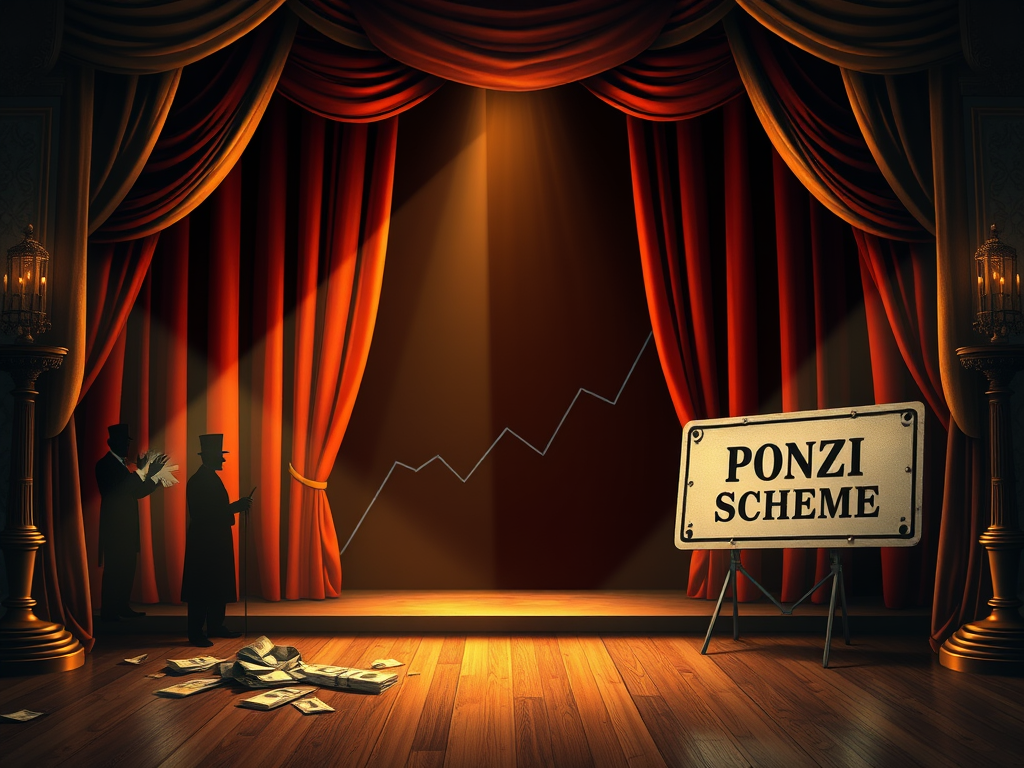
A scam, at its heart, is a theatre production. It has a compelling star (the con artist), a fantastic plot (the “secret” to wealth), and an audience (the investors) who are willing to suspend their disbelief. The technology changes—from trading postal coupons to programming blockchain—but the core mechanics of human greed, fear, and trust remain the same.
To understand how to protect ourselves, we must first understand the game. We’re pulling back the curtain on ten of the most infamous financial scams in history to reveal the raw mechanics of how they were built, and why they all, inevitably, came crashing down.
1. The Original: Charles Ponzi and the “Impossible” 50% Return
This scam is so foundational, it’s the one they all get named after. In 1920, an Italian immigrant named Charles Ponzi promised investors in Boston a “fantastic” 50% return in 45 days. The (supposed) mechanism was brilliant in its plausibility: postal reply coupons.
How It Worked: Ponzi claimed he was engaging in “arbitrage.” He’d found that international postal reply coupons (bought in, say, Spain) could be purchased cheaply and then redeemed in the United States for stamps worth more than the original purchase price. This was, in theory, true.
The lie was in the execution. Ponzi wasn’t buying and redeeming coupons; he was just recycling money.
Think of it as a leaky bucket. To keep it full, you need a constant stream of new water.
- Investor A gives Ponzi $1,000.
- Investor B and C give Ponzi $1,000 each.
- Ponzi uses $1,500 of this new money to pay Investor A their “profit,” making Investor A a walking advertisement.
- Investors B and C are now at the bottom, and Ponzi needs Investors D, E, F, and G to pay them off.
A Ponzi scheme is a simple con: it pays “profits” to early investors with the money from later investors. It’s a house of cards that stands only as long as new, “greater fool” investors keep piling in. When the new money dried up, the entire $20 million ($300 million in today’s money) scheme collapsed in a matter of days.
2. The King of Ponzis: Bernie Madoff and the “Affinity Fraud”
If Ponzi built the prototype, Bernie Madoff built the billion-dollar luxury model. For decades, Madoff, a Wall Street legend, ran the largest and longest-lasting Ponzi scheme in history, stealing an estimated $65 billion.
How It Worked: Madoff’s genius was in what he didn’t promise. He didn’t offer Ponzi’s 50% returns. Instead, he offered something far more seductive to the wealthy: impossibly consistent returns of 10-12% every single year, whether the market was up or down. This is a massive red flag in finance, but Madoff had an answer: a “secret” strategy called a “split-strike conversion.”
The truth? He wasn’t trading at all. The numbers on his clients’ account statements were pure fiction.
His other dark genius was pioneering “affinity fraud.” He targeted his own community, using his reputation at Jewish country clubs and charities to build a mountain of unshakeable trust. He created an exclusive, members-only “hedge fund” that people begged to get into. His scam wasn’t just a financial betrayal; it was a social one. He wasn’t a “money manager”; he was just a bookkeeper for a high-society ghost company.
3. The Enron Scandal: Hiding Billions with “Mark-to-Market”
Enron was once the seventh-largest company in America, a beacon of “New Economy” innovation. But its entire billion-dollar valuation was a complex mirage built on audacious accounting fraud. This wasn’t a Ponzi scheme; it was a lie told on a balance sheet.
How It Worked: Enron’s executives were obsessed with their stock price. To keep it climbing, they used two primary tricks:
- Mark-to-Market Accounting: This (legal) accounting practice allows a company to book projected future profits as current income. Enron abused this, signing a 20-year deal and claiming all 20 years of “hoped-for” profits on day one. When the deals failed, they never corrected the books.
- Special Purpose Entities (SPEs): This was the real evil. Enron created thousands of “off-book” shell companies. They would then “sell” their toxic, non-performing assets and massive debts to these shadow companies.
It was an accounting magic trick. Imagine you maxed out ten credit cards. To hide the debt, you “sell” it to your dog, then declare yourself “debt-free” and tell your boss you deserve a raise. That’s what Enron did. Their SPEs were the “dogs,” hiding billions in losses while Enron’s stock soared. When a whistleblower finally exposed the trick, the company (and its accounting firm, Arthur Andersen) collapsed, vaporizing the life savings of 20,000 employees.
4. The Theranos Blood Test: Silicon Valley’s Fake-It-‘Til-You-Make-It Fraud
Theranos and its founder, Elizabeth Holmes, promised to revolutionize healthcare. Their “Edison” machine would run hundreds of blood tests from a single, painless drop from your finger. It was a $9 billion story that was, almost entirely, a lie.
How It Worked: The scam was a classic “fake-it-’til-you-make-it” con that went too far. The technology simply did not work. But Holmes, who idolized Steve Jobs, was a master storyteller. She sold a vision, not a product.
- The Lie to Investors: She raised nearly $1 billion by faking demos and showing investors results from machines that were not the Edison.
- The Lie to Partners: She secured massive deals with Walgreens and Safeway, promising a future her technology could never deliver.
- The Lie to the Public: While claiming her “Edison” machines were running tests, her company was secretly using standard, off-the-shelf machines from Siemens… and even then, the results were often dangerously wrong.
It was a fraud built on the intoxicating power of a good story in Silicon Valley. Investors wanted to believe in the next Steve Jobs, so they ignored every red flag. The “product” was the hype itself.
5. The “Pump and Dump”: The Wolf of Wall Street Manipulation
This is a classic form of stock market manipulation, made infamous by Jordan Belfort’s “Stratton Oakmont” firm, as depicted in The Wolf of Wall Street. It’s a simple, two-step con.
How It Worked:
- The Pump: The scammers (like Stratton Oakmont) buy up a massive position in a worthless “penny stock” (a tiny company with no real business). They then use high-pressure, boiler-room sales tactics to “pump” the stock, creating a fog of lies and hype. They cold-call thousands of unsuspecting investors, telling them this “is the next Microsoft” and creating a “feeding frenzy” of demand.
- The Dump: This new demand artificially inflates the stock’s price. Once the price is high, the original scammers “dump” all of their shares at once, making a massive profit and instantly crashing the stock’s price back to zero.
Every investor who bought into the “pump” is left holding a worthless bag. It’s a raw, predatory scam that preys on the fear of missing out (FOMO) and the dream of finding a “10-bagger” stock.
6. The South Sea Bubble: When the British Government Bailed Out a Scam
In 1720, the South Sea Company was the hottest stock on Earth. It had a “monopoly” on all trade with Spanish South America. People from all walks of life—from servants to Sir Isaac Newton—poured their life savings into it.
How It Worked: There was one tiny problem with the company’s “monopoly”: there was no trade. Spain and Britain were at war, and the “South Sea” was a closed, hostile territory. The company’s actual business was a complex financial deal with the British government to take over the national debt.
It was a speculative bubble, pure and simple. The stock’s price wasn’t based on any real-world profit. It was based on the “Greater Fool Theory”—the idea that you can buy a worthless asset because you’re confident you can sell it to a “greater fool” for a higher price later. The bubble was inflated by wild rumours, political corruption, and a national mania. When the public finally realized there was no “there” there, the bubble burst, shattering the British economy and bankrupting thousands.
7. Tulip Mania: The Speculative Bubble That Was… Complicated
The story we all know is that in Holland in the 1630s, people went “mad for tulips,” trading single bulbs for the price of a house. This is often cited as the first “speculative bubble,” but the reality is more nuanced.
How It Worked: The mania was real, but it wasn’t for all tulips. It was for rare, “broken” tulips—bulbs that, due to a virus, produced stunning, flame-like petals. These became the ultimate status symbol in the Dutch Golden Age.
The “bubble” formed in the futures market. People weren’t trading actual bulbs; they were trading contracts to buy bulbs next season, often in taverns with no money changing hands. It was a high-stakes, unregulated gambling game. When the plague hit and a few high-profile buyers defaulted, the public’s confidence evaporated overnight, and the contract market collapsed. While it didn’t destroy the entire Dutch economy (as legend states), it remains a perfect, early example of how human desire and status-seeking can briefly decouple an asset’s price from its intrinsic value.
8. The “Spanish Prisoner”: The Great-Grandfather of the “Nigerian Prince”
If you’ve ever received an email from a “Nigerian Prince” who needs your help to move $40 million, you’ve seen the modern version of this classic con. The “Spanish Prisoner” scam dates back to the 1800s.
How It Worked: This is the original advance-fee fraud. The “mark” (victim) receives a letter from a “scammer” who claims to be in contact with a wealthy aristocrat (the “Spanish Prisoner”). This nobleman is falsely imprisoned and needs your help. All you have to do is provide a small sum of money (the “advance fee”) to bribe a guard.
In return, the prisoner promises you his daughter’s hand in marriage and, of course, a massive share of his hidden fortune. The moment you send the money, the con artist, the prisoner, and the fortune all vanish. The scam works by preying on the victim’s greed and their sense of romantic, heroic adventure.
9. The Ultimate Con: The Man Who “Sold” the Eiffel Tower… Twice
Some scams are complex. This one was just pure, audacious “chutzpah.” In 1925, a Czech-born con man named Victor Lustig read that the Eiffel Tower was in disrepair and was becoming a massive financial burden to Paris.
How It Worked: Lustig, a master of social engineering, forged official government credentials and invited six of the city’s top scrap metal dealers to a secret meeting at a luxury hotel. He “confessed” to them that the government had made the secret, controversial decision to demolish the Eiffel Tower.
He was “in charge” of selling the 7,000 tons of scrap. He played on their greed, their desire for an “inside deal,” and their egos. He even solicited a “bribe” to ensure one dealer got the winning bid. After collecting the bribe and the “payment,” Lustig fled to Vienna. The dealer was so publicly humiliated that he never reported the crime… allowing Lustig to return to Paris a month later and try the exact same scam on a different set of dealers.
10. The MMM Pyramid Scheme: The Scam That Fooled Millions, Repeatedly
This is a textbook pyramid scheme that scammed millions of people, primarily in Russia, in the 1990s. And it’s crucial to know the difference between this and a Ponzi.
How It Worked: In a Ponzi (like Madoff), the con man lies about an external investment. In a pyramid, there is no pretense of investment. The only “business” is recruiting.
Run by Sergei Mavrodi, the MMM company told members they could get returns of 1,000%+ per year. To join, you had to buy “Mavro” (a worthless, private currency). To get your “profits,” you had to recruit new members who would also buy “Mavro.” Your money came only from the people you recruited.
This is a chain letter with money. It’s a system that is mathematically doomed to collapse. It can only survive as long as it finds an exponentially growing number of new recruits, and it quickly runs out of people on Earth. MMM collapsed, Mavrodi was jailed, and after his release, he re-launched the same scam globally, successfully scamming millions more in Africa, India, and China.
Conclusion
The con artist’s greatest tool is not a complex algorithm or a forged document; it’s a good story. Scams work by exploiting our most human impulses: the desire for a better life, the fear of missing out, and our willingness to trust a compelling narrative.
From Charles Ponzi’s bucket to Bernie Madoff’s “black box,” the lesson is the same. The best defense is not financial genius, but a healthy dose of skepticism. Because in the end, the old, boring adage remains the most powerful financial advice ever given: If it sounds too good to be true, it almost certainly is.
Further Reading
Want to dive deeper into the psychology of the con and the mechanics of the crime? These books are the definitive accounts.
- The Wizard of Lies: Bernie Madoff and the Death of Trust by Diana B. Henriques
- The definitive, detailed biography of Bernie Madoff and his decades-long con, written by the journalist who knew him best.
- The Smartest Guys in the Room: The Amazing Rise and Scandalous Fall of Enron by Bethany McLean and Peter Elkind
- The book that exposed the Enron scandal. A thrilling, deep dive into the complex accounting and oversized egos that brought the company down.
- Bad Blood: Secrets and Lies in a Silicon Valley Startup by John Carreyrou
- The Pulitzer Prize-winning journalist’s jaw-dropping account of the Theranos scandal, which reads more like a thriller than a business book.
- Extraordinary Popular Delusions and the Madness of Crowds by Charles Mackay
- Written in 1841, this is the classic (and still relevant) study of bubbles and mass hysteria, featuring the definitive accounts of the South Sea Bubble and Tulip Mania.
Here at Zentara.blog, our mission is to take those tricky subjects and unlock them, making knowledge exciting and easy to grasp for everyone. But the adventure doesn’t stop on this page! We’re constantly exploring new frontiers and sharing discoveries across the digital universe. Want to dive deeper into more mind-bending Top 10s and keep expanding your world? Come join us on our other platforms – we’ve got unique experiences waiting for you on each one!
Get inspired by visual wonders and bite-sized facts: See the world through Zentara’s eyes on Pinterest!
Pin our fascinating facts and stunning visuals to your own boards. Explore Pins on Pinterest: https://uk.pinterest.com/zentarablog/
Discover quick insights and behind-the-scenes peeks: Hop over to Tumblr for snippets, quotes, and unique content you won’t find anywhere else. It’s a different flavour of discovery! Follow the Fun on Tumblr: https://www.tumblr.com/zentarablog
Ready for deep dives you can listen to or watch? We’re bringing our accessible approach to video and potentially audio! Subscribe to our YouTube channel and tune into future projects that make learning pop! Subscribe on YouTube: https://www.youtube.com/@ZentaraUK
Seeking even more knowledge in one place? We’ve compiled some of our most popular topic deep dives into fantastic ebooks! Find them on Amazon and keep the learning journey going anytime, anywhere. Find Our Ebooks on Amazon: https://www.amazon.co.uk/s?k=Zentara+UK&ref=nb_sb_noss
Connect with us and fellow knowledge seekers: Join the conversation on BlueSky! We’re sharing updates, thoughts, and maybe even asking you what wonders we should explore next. Chat with Us on BlueSky: https://bsky.app/profile/zentarablog.bsky.social
Perfect for learning on the move! We post multiple 10-minute podcasts per day on Spotify. Pop on your headphones and fill your day with fascinating facts while you’re out and about! Listen on Spotify: https://open.spotify.com/show/3dmHbKeDufRx95xPYIqKhJFollow us on Instagram for bytesize knowledge! We post multiple posts per day on our official Instagram account. https://www.instagram.com/zentarablog/ Every click helps us confidence to everyone. Thanks for exploring with us today – see you out there in the world of discovery!




Leave a Reply