
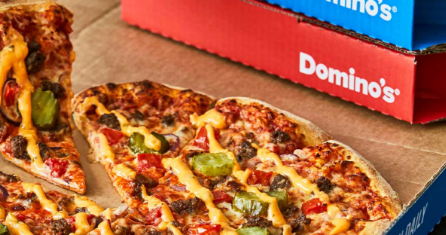
The Pizza Empire Built on Speed, Technology, and a Volkswagen Beetle
Table of Contents
When you hear the word “pizza,” there is a high probability that the first image popping into your mind is a blue and red domino. With over 17,000 stores in more than 90 countries, Domino’s Pizza is not just a food chain; it is a global logistics superpower. It is the company that taught the world to expect dinner on their doorstep in 30 minutes or less. It is the brand that fueled late-night study sessions, office parties, and Friday family nights for generations.
However, the journey from a single small shop in Ypsilanti, Michigan, to a multi-billion dollar empire was far from a straight line. The history of Domino’s is a fascinating case study in American entrepreneurship, filled with near-bankruptcies, bizarre hostage situations, revolutionary technology, and radical transparency. It is a company that once admitted its own product tasted like “cardboard” just to win back customers, and a company that employs more software engineers than chefs.
Beyond the pepperoni and the garlic crust, there are stories hidden in the dough that most customers never hear. From the worst trade in automotive history to the tragic fate of a claymation mascot, here are 10 interesting facts you probably didn’t know about Domino’s Pizza.
1. Half the Company Was Traded for a Used Volkswagen Beetle
The story of Domino’s began in 1960 when two brothers, Tom and James Monaghan, bought a small pizzeria called “DomiNick’s” in Ypsilanti, Michigan. They borrowed $900 to make the purchase. However, after just eight months of kneading dough and managing the chaotic schedule of a pizza shop, James Monaghan wanted out. He didn’t want to quit his full-time job as a postman to focus on the risky pizza venture.
In what is now considered one of the most lopsided trades in business history, James offered to sell his 50% stake in the business to his brother Tom. The price? A 1959 Volkswagen Beetle. Tom accepted the trade, giving him full control of the company. James got his car and returned to the post office.
While the VW Beetle was a reliable car, that 50% stake would be worth billions of dollars today. It rivals the story of Ronald Wayne selling his 10% stake in Apple for $800. Tom Monaghan went on to build the empire, proving that sometimes, staying in the kitchen when the heat turns up is the most profitable decision you can make.
2. The Logo Was Supposed to Have Thousands of Dots
Have you ever looked closely at the Domino’s logo? It features a domino tile with three dots—one on the bottom square and two on the top. Most people assume this is just a random design choice, but it was originally a dynamic scoreboard.
When Tom Monaghan rebranded from “DomiNick’s” to “Domino’s” in 1965, he had a grand vision. The three dots represented the three stores he owned at the time. His plan was to add a new white dot to the logo every single time they opened a new franchise location. It was a charming idea meant to showcase their growth.
However, the company grew much faster than Monaghan anticipated. Within a few years, the logo would have required dozens of dots. By the 1980s, it would have been a white blur. Today, with over 17,000 locations, the logo would look like television static. Realizing the impracticality, they froze the design at three dots, forever immortalizing the humble beginnings of the first three pizzerias.
3. The Tragedy of “The Noid” Mascot
In the late 1980s, Domino’s launched one of the most successful advertising campaigns in history. They introduced “The Noid,” a claymation character in a red rabbit suit who was the physical embodiment of a cold, ruined pizza. The slogan was “Avoid the Noid,” implying that Domino’s heat-wave bags protected your pie from this villain.
The campaign was a cultural phenomenon, spawning video games and merchandise. However, it ended in a bizarre and tragic real-world event. On January 30, 1989, a mentally ill man named Kenneth Lamar Noid entered a Domino’s in Chamblee, Georgia, armed with a .357 magnum revolver. He took two employees hostage for over five hours.
Kenneth Noid was convinced that the “Avoid the Noid” campaign was a personal attack directed at him by the corporation. He believed the TV commercials were mocking him specifically. While the hostages eventually escaped unharmed and Noid was arrested (and found not guilty by reason of insanity), the incident killed the campaign. Domino’s quietly retired the mascot shortly after, realizing that the fun character had unintentionally triggered a real-world crisis.
4. The “30 Minutes or Free” Guarantee Caused Legal Chaos
For decades, Domino’s wasn’t just selling pizza; they were selling a promise: delivery in “30 minutes or it’s free” (later tweaked to $3 off). This guarantee was the cornerstone of their marketing and the reason they crushed the competition. It forced the company to optimize every step of the pizza-making process for speed.
However, the guarantee had a dark side. It incentivized teenage delivery drivers to drive recklessly to beat the clock. In 1993, a St. Louis woman named Jean Kinder was severely injured when her car was broadsided by a Domino’s driver who had run a red light. She sued the company, and the jury awarded her a staggering $78 million in punitive damages.
The jury argued that the 30-minute policy constituted “gross negligence” by prioritizing speed over public safety. Facing this verdict and a slew of other similar lawsuits, Domino’s officially dropped the national guarantee in the United States later that year. While you still get your pizza fast, the drivers are no longer racing against a stopwatch that threatens their paycheck.
5. They Admitted Their Pizza Tasted Like Cardboard
Corporate PR usually involves spinning positives and hiding negatives. But in 2009, Domino’s executed the most brutally honest marketing campaign in history, known as “The Pizza Turnaround.” The company’s stock price had tanked, and customer satisfaction was at an all-time low. People bought Domino’s because it was cheap and fast, not because it was good.
Under the leadership of then-CEO Patrick Doyle, Domino’s ran national TV ads featuring real focus groups trashing their product. Customers were shown saying the crust tasted like “cardboard” and the sauce tasted like “ketchup.” Instead of defending the product, Doyle appeared on screen and essentially said, “You are right. We can do better.”
They scrapped their 49-year-old recipe. They created a new garlic-seasoned crust, a sweeter sauce, and used real shredded cheese. It was a massive gamble to admit your core product was terrible, but the transparency resonated with the public. Sales skyrocketed, and the stock price went from around $3 in 2008 to over $400 a decade later, marking one of the greatest corporate turnarounds of the century.
6. They Are Technically an E-Commerce Company
If you look at the corporate structure of Domino’s today, it looks less like a kitchen and more like a Silicon Valley tech firm. At their headquarters in Ann Arbor, Michigan, they employ hundreds of software engineers and data scientists.
Domino’s was the first major pizza chain to launch an online “Pizza Tracker” in 2008, allowing customers to follow their order from the oven to the front door. It seemed like a gimmick, but it revolutionized the industry by reducing customer anxiety (“Where is my food?”) and increasing trust.
Today, well over 75% of their transactions occur via digital channels. They have pioneered ordering via tweet, via smartwatch, via voice command, and even via car dashboard. They view themselves as an “e-commerce company that happens to sell pizza.” This tech-first mindset allowed them to dominate the market when the COVID-19 pandemic hit, as their digital infrastructure was already lightyears ahead of mom-and-pop shops and rival chains.
7. The O.J. Simpson Chase Spiked Sales
There is a strange correlation in the pizza industry: when people are glued to their televisions for breaking news, pizza sales go up. But the event that cemented this statistic was the infamous O.J. Simpson white Bronco chase on June 17, 1994.
As millions of Americans tuned in to watch the slow-speed pursuit on live TV, they didn’t want to cook, and they didn’t want to leave the house. They called Domino’s. The company reported record sales that night, with delivery orders surging to levels usually reserved for Super Bowl Sunday.
This event helped analysts understand the “cocooning” phenomenon. When stressful or gripping national events occur, people seek comfort food that can be eaten without utensils while staring at a screen. Domino’s became the unofficial sponsor of the 24-hour news cycle.
8. They Started Paving Roads to Save Pizzas
In 2018, Domino’s launched a campaign that blurred the line between marketing and public service. They realized that potholes in American roads were causing irreversible damage to pizzas during delivery—cheese sliding to one side, toppings getting crushed.
So, they launched the “Paving for Pizza” initiative. Domino’s offered grants to towns across the United States to fill potholes, on the condition that they could spray-paint the Domino’s logo and the phrase “Oh yes we did” on the repaired patch of asphalt.
It was a brilliant PR stunt that highlighted a crumbling infrastructure problem while emphasizing their commitment to product integrity. Towns from Burbank, California to Athens, Georgia accepted the money. It was a rare instance where a private corporation fixed public roads just to ensure your pepperoni stayed in place.
9. The Founder Built a Catholic Town
Tom Monaghan, the surviving brother who built the empire, is a devout Catholic with a fascinating second act. After selling a controlling stake in Domino’s to Bain Capital in 1998 for an estimated $1 billion, he retired to focus on religious philanthropy.
Monaghan used his pizza fortune to found a new town in Florida called Ave Maria. Centered around a massive oratory (church) and a Catholic university (Ave Maria University), the town was designed to be a community focused on traditional Catholic values.
At one point, Monaghan stirred controversy by suggesting that the town would not sell condoms or pornography, though he later clarified that he couldn’t legally enforce that on retailers. It is a stark contrast to the fast-paced, secular world of fast food, but the town stands today as a testament to where all those pizza profits eventually went.
10. Japan’s Menu is wild (and Expensive)
While Americans are used to paying $19.99 for a deal on two pizzas, Domino’s in international markets is often a luxury product with toppings that would confuse a New Yorker. The most distinct market is Japan.
In Japan, Domino’s is considered a high-end treat, with some pizzas costing upwards of $40 or $50. To justify the price, the toppings are extravagant. You can order pizzas topped with Hokkaido camembert cheese, roasted pork, mayonnaise, corn, and even crab.
They once released a “Tsundere” pizza (referencing an anime character archetype) that was covered in jalapeños (the harsh side) and extra cheese (the sweet side). They also famously attempted to use real reindeer to deliver pizzas in snowy Hokkaido during Christmas in 2016. The plan was scrapped because the reindeer were too difficult to control and kept eating the boxes, but the footage remains a hilarious piece of Domino’s lore.
Further Reading
If you are hungry for more details on the business of pizza, these books serve up the full story:
- “Pizza Tiger” by Tom Monaghan – The autobiography of the founder himself. It offers a firsthand look at the scrappy early days and his unique philosophy on business and life.
- “Domino’s Effect” by Donald Vlcek – Written by a former executive, this book dives into the systems and logistics that allowed the franchise to scale so rapidly.
- “InGenius: A Crash Course on Creativity” by Tina Seelig – While not exclusively about pizza, this Stanford professor uses the Domino’s “Pizza Turnaround” as a primary case study for how businesses can reinvent themselves through radical honesty.
- “Salt Sugar Fat: How the Food Giants Hooked Us” by Michael Moss – For a critical look at the industry, this book explains the science behind why fast food, including pizza, is engineered to be addictive.
Keep the Discovery Going!
Here at Zentara, our mission is to take tricky subjects and unlock them, making knowledge exciting and easy to grasp. But the adventure doesn’t stop at the bottom of this page. We are constantly creating new ways for you to learn, watch, and listen every single day.
📺 Watch & Learn on YouTube
Visual learner? We publish 4 new videos every day, plus breaking news shorts to keep you smarter than the headlines. From deep dives to quick facts, our channel is your daily visual dose of wonder. Click here to Subscribe to Zentara on YouTube
🎧 Listen on the Go on Spotify
Prefer to learn while you move? Tune into the Zentara Podcast! We drop a new episode daily, perfect for your commute, workout, or coffee break. Pop on your headphones and fill your day with fascinating facts. Click here to Listen on Spotify
Every click, view, and listen helps us keep bringing honest knowledge to everyone. Thanks for exploring with us today—see you out there in the world of discovery!




Leave a Reply