
Table of Contents
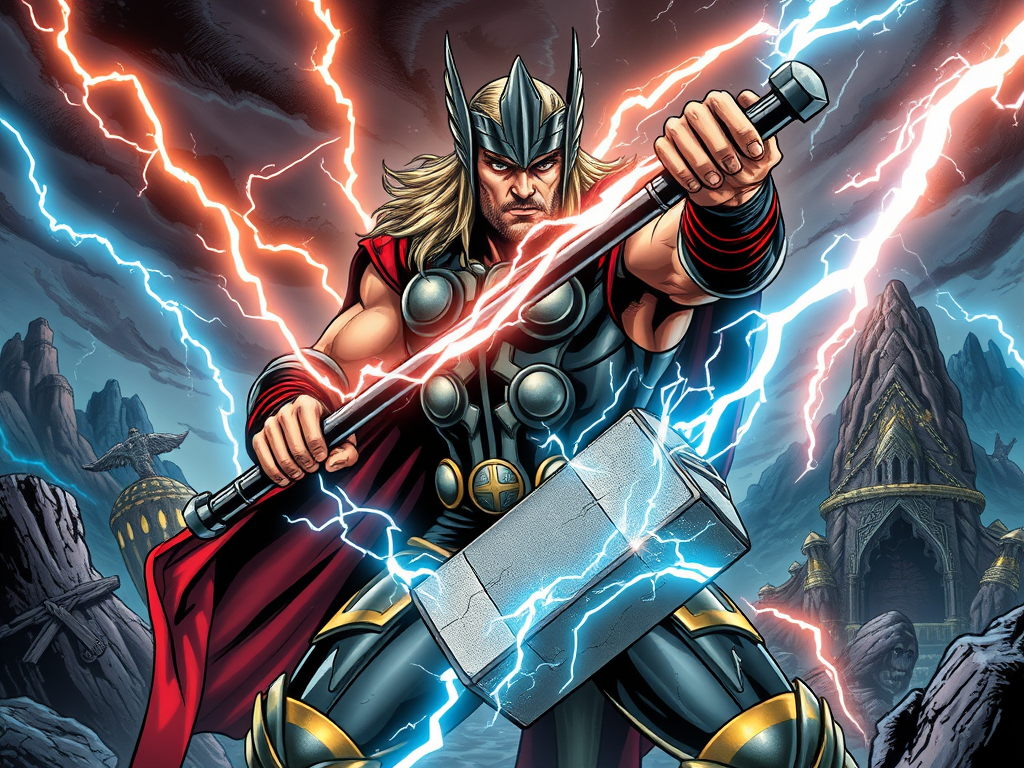
From the silver screen, he is a global icon: the handsome, boisterous, space-faring Avenger who calls down lightning. But the Thor of the Marvel Cinematic Universe is merely one interpretation of a character with over 60 years of incredibly strange, grand, and mythic comic book history.
The Thor of the printed page is a different beast. He is a god of epic poetry, a humble, disabled doctor, a king of a dying realm, and, at times, even a frog. His story is not just one of punching villains; it’s a sprawling, multi-generational saga about power, sacrifice, and the eternal, shifting burden of being “worthy.” Created by the legendary trio of Stan Lee, Larry Lieber, and Jack Kirby, the comic book Thor took the raw material of Norse mythology and hammered it into a superhero framework, creating one of the most unique and enduring characters in fiction.
To understand the real Odinson, you must journey back, not just to Asgard, but to the “Age of Marvels.” So, grab your enchanted uru hammer as we explore ten essential facts from the comic book history of The Mighty Thor.
1. His Electrifying Debut Was in a Sci-Fi “Monster” Book
Before the Marvel Universe had a name, the company (then called Atlas Comics) was a factory for anthology titles, pumping out dozens of sci-fi, horror, and monster stories every month. When Stan Lee and Jack Kirby launched the “Age of Marvels” with the Fantastic Four in 1961, they began seeding their new heroes in these existing, (if flagging) titles. Spider-Man got Amazing Fantasy, Iron Man got Tales of Suspense, and in 1962, Thor got Journey into Mystery.
His debut in Journey into Mystery #83 was not the epic of a god-king. It was a bizarre, sci-fi/fantasy hybrid. The story, “The Stone Men from Saturn!”, featured the invading aliens landing in Norway. This first issue wasn’t about Asgard at all; it was a classic “monster-of-the-week” tale. The hero wasn’t a god, but a frail human doctor who stumbles upon a stick that, when struck, transforms him into the Norse god of thunder. It was an experiment, a strange blend of high-fantasy and B-movie sci-fi. But the experiment was a massive hit. Thor quickly took over the entire book, and the title was officially renamed The Mighty Thor in 1966.
2. He Wasn’t Just a God; He Was a Frail Doctor Named Donald Blake
The MCU gave us a simple, if funny, explanation for Thor’s human life: Odin banished him to Earth as Thor, and Jane Foster’s team gave him the fake name “Donald Blake.” The original comic book story is far stranger and more complex. For decades, the hero was Dr. Donald Blake, a partially-disabled American physician. While on vacation in Norway, Blake fled from the aforementioned “Stone Men” into a cave, where he found an old wooden walking stick. Trapped, he angrily struck the stick against a boulder.
In a flash of light, the frail doctor was replaced by the thunder god, and the stick became the hammer Mjolnir. This was the central hook: he wasn’t just pretending to be Blake; he was Blake. Thor was the secret identity. Even more, Mjolnir was enchanted so that if Thor was separated from it for more than 60 seconds, he would revert, against his will, back to the human doctor. This existential duality—a god trapped in the form of a mortal—was a classic Marvel theme, providing decades of angst and drama that the films completely bypassed. Years later, it would be retconned that Odin created the Blake persona to teach his arrogant son humility, but for the first 20 years, they were one and the same.
3. His “Shakespearean” Language Was a Clever Trick by Stan Lee
“Have at thee, varlet!” “Verily, I say thee nay!” Thor’s unique, pseudo-Elizabethan dialogue is one of his most defining—and most parodied—character traits. But it wasn’t just a random creative quirk. It was a brilliant, intentional move by writer Stan Lee to solve a specific problem: how do you make a god sound distinct from a smart-mouthed teenager like Spider-Man or a gruff-but-lovable monster like The Thing?
Lee, wanting to imbue the Asgardians with a sense of grandeur, history, and “otherness,” reached for the only high-language most Americans knew: Shakespeare. He (and his brother, scripter Larry Lieber) peppered Thor’s speech with words like “thee,” “thou,” “hark,” “perchance,” and “ere.” It was a magnificent cheat. It wasn’t “Old English,” and it certainly wasn’t “Old Norse,” but it felt epic. It gave Thor and the Asgardians an instant, identifiable air of royalty and antiquity, separating their high-fantasy world from the grounded, street-level melodrama of Marvel’s other heroes. This “thee/thou” speech pattern became a foundational part of the character, a signature as powerful as his hammer.
4. The “Worthiness” Enchantment: Mjolnir’s Core Moral Code
“Whosoever holds this hammer, if he be worthy, shall possess the power of Thor.” This is the single most important sentence in Thor’s history. Etched onto the side of Mjolnir by Odin himself, this enchantment is the character’s entire moral engine. The key, of course, is the profound ambiguity of the word “worthy.” What, exactly, does “worthy” mean to a 10,000-year-old Norse god-king?
The comics have spent decades exploring this. “Worthiness” is not simply “being a good person.” It’s a complex, fluid, and often brutal standard. It requires a noble heart, a willingness to sacrifice, and a warrior’s spirit—a spirit that, crucially, is willing to kill to protect the Nine Realms. This is why a pure-hearted pacifist might not be able to lift it, but a warrior like Captain America can. The enchantment is a perfect narrative device. When Thor is arrogant, selfish, or lost, he loses his worthiness, becoming depowered. The hammer is his conscience, a physical manifestation of his moral standing. It’s a journey of constant self-evaluation, as Thor must always prove, to his father and to himself, that he is worthy of his own power.
5. He’s a God of Thunder, Not a “God of Hammers” (And He Has the Odinforce)
The Thor: Ragnarok movie had a lot of fun with the line “Are you Thor, the God of Hammers?” It was a great gag, but in the comics, this has always been a core, non-negotiable concept. Mjolnir is a tool, a “conduit” for his power, but the power itself is innate. Thor is a god, the son of two of the most powerful beings in the Marvel Universe: Odin, the All-Father and king of Asgard, and Gaea, the elder goddess who is the literal-living-sentience of Planet Earth.
This dual-heritage gives Thor a “god-force” that is all his own. He is, by birth, a cosmic-level powerhouse. Beyond this, he is the heir to the Odinforce (sometimes called the “Thorforce” when he wields it). This is the vast, incalculable magical energy that manifests in the ruler of Asgard. When Odin dies and Thor takes the throne, he inherits this power, which grants him abilities far beyond thunder and lightning. As “Rune King Thor,” he becomes a reality-warper, a being who can perceive the entire tapestry of fate, stop time, and even destroy all-powerful cosmic entities. Mjolnir is what makes him a superhero; the Odinforce is what makes him a king.
6. Yes, He Was Once a Frog (And It Was an Epic Saga)
In the 1980s, writer/artist Walt Simonson took over The Mighty Thor and began one of the most legendary runs in comic book history. He was fearless, creative, and utterly brilliant. His greatest, and strangest, creative swing was “The Ballad of Frog Thor.” Yes, for three full issues, Thor, the mighty God of Thunder, was turned into a frog by his ever-mischievous brother, Loki.
What could have been a silly, throwaway gag became a miniature epic. Trapped in his tiny, amphibious body, Thor lands in Central Park and is immediately pulled into a vicious war between the frogs and the rats. Unable to speak, he nonetheless leads the frog army to a glorious victory. The arc climaxes when he finds a tiny sliver of Mjolnir, which he barely manages to lift. He is transformed, not back into a human, but into a six-inch-tall, god-powered warrior… Throg, the Frog of Thunder. The arc is a perfect encapsulation of Simonson’s genius, blending high-fantasy stakes, genuine-if-absurd character stakes, and a sense of humour that never once disrespected the hero.
7. The First Hero to Be “Worthy” Besides Thor Was a Horse-Faced Alien
For over 20 years, the “worthiness” enchantment was an unbreakable rule. Only Thor (and, briefly, Odin) could lift Mjolnir. That all changed in The Mighty Thor #337 (1983), the very first issue of Walt Simonson’s run. Simonson wanted to start with a bang, and he did so by shattering the book’s biggest rule. The story introduces Beta Ray Bill, a monstrous, horse-faced alien from a dying race. In a brutal misunderstanding, Bill battles Thor and, in the process, proves himself a noble, selfless, and ferocious warrior.
During the fight, Thor is separated from Mjolnir for 60 seconds and reverts to Donald Blake. Bill, seeing the “enemy’s weapon,” picks up the hammer. And he doesn’t just hold it. He lifts it. He is deemed worthy. He is granted the power of Thor. This was a narrative atom bomb. Bill was not a villain, and he was not a trick. He was, simply, worthy. Odin, realizing this, could not take the hammer from Bill, nor could he leave his son powerless. So, he ordered the Dwarves of Nidavellir to forge a new enchanted hammer, Stormbreaker, for Beta Ray Bill. This act proved the “Thor” mantle was bigger than one man and opened the door for all who would come after.
8. The “Unworthy” Arc: What Happens When a God Loses His Faith?
What is Thor if he is not “worthy”? This question became the central theme of the 2010s. During the 2014 crossover event Original Sin, Thor confronts Nick Fury, who is temporarily imbued with the cosmic knowledge of the Watchers. Fury, in a desperate last-ditch effort, whispers three words into Thor’s ear: “Gorr was right.”
Gorr the God Butcher was a villain who believed that all gods were selfish, vain, and unworthy of the love their mortal followers gave them. The “whisper” was not a magic spell; it was a simple, devastating philosophical truth that shattered Thor’s faith in himself and his entire mission. Instantly, he drops Mjolnir. He screams, he cries, he begs, but he cannot lift it. He is, for the first time in his life, truly “Unworthy.” This was not a short-term problem; it was a multi-year status quo. He gives up his name, calling himself only “Odinson,” and begins wielding his old, unenchanted battle-axe, Jarnbjorn. It was a profound exploration of identity, failure, and the search for purpose after your entire reason for being is taken from you.
9. The Goddess of Thunder: How Jane Foster Became the “Mighty Thor”
The whisper that made Thor unworthy had a direct, and powerful, consequence. The hammer, Mjolnir, lay on the moon for months, a testament to Odinson’s failure. But the inscription still held: “Whosoever holds this hammer…” The hammer called out, and someone answered. A new figure, a masked woman, picked up Mjolnir and became the new “Mighty Thor,” Goddess of Thunder.
Her identity was a closely guarded secret for nearly a year. In the end, it was revealed to be Jane Foster. But this was not a triumphant return. Jane was dying of terminal breast cancer. Her human body was frail and undergoing brutal chemotherapy. The twist was a work of heroic tragedy: every time she transformed into the all-powerful Thor, the divine magic purged her body of all toxins… including the life-saving chemotherapy. In short, becoming Thor was keeping her healthy for a few hours, but it was accelerating her death as a human. Jane’s saga, written by Jason Aaron, became one of the most acclaimed in Marvel’s history, a profound story of self-sacrifice and what it truly means to be worthy.
10. Ragnarok Is Not Just an Apocalypse; It’s a Recurring Cosmic Cycle
In Norse mythology, Ragnarok is the “Twilight of the Gods,” a final, apocalyptic battle that ends the world. In the Marvel comics, it’s far more sinister. For eons, Thor and the Asgardians have been trapped in a Ragnarok Cycle. They are born, they live their epic lives, they fight the final battle and die… and then they are reborn, with no memory of their past lives, doomed to repeat the cycle all over again, forever.
In the 2004 Thor: Disassembled storyline, Thor learns the horrifying truth: this cycle is not natural. It’s an artificial “story” created and maintained by god-like cosmic beings known as “Those Who Sit Above in Shadow.” These beings feed on the energy created by the Asgardians’ endless suffering. Ragnarok isn’t fate; it’s a cosmic farm. This revelation gives Thor the ultimate purpose: not just to survive Ragnarok, but to end it, permanently. He guides his people through a true death, breaking the cycle and destroying his creators, finally freeing his people from their pre-written destiny.
📚 Further Reading
Thor’s history is vast, but if you want to dive into the core epics that define him, these collections are where you should start.
- Thor by Walt Simonson, Vol. 1 by Walt Simonson
- This is the one. The definitive run that all other Thor stories are measured against. It introduces Beta Ray Bill, features the “Frog of Thunder” saga, and perfectly blends cosmic-level stakes with mythic, personal drama.
- Thor by J. Michael Straczynski, Vol. 1 by J. Michael Straczynski & Olivier Coipel
- This 2007 series is the perfect modern starting point. It’s the direct follow-up to the Ragnarok storyline, showing Thor’s return to Earth as he, a god, must rebuild Asgard, a piece at a time, in the middle of a small town in Oklahoma.
- Thor: God of Thunder, Vol. 1: The God Butcher by Jason Aaron & Esad Ribic
- This is the beginning of the modern epic that defined the 2010s. It introduces the villain Gorr the God Butcher and sets up the central themes of godhood and worthiness that lead directly into the “Unworthy Thor” and “Jane Foster” storylines.
Here at Zentara.blog, our mission is to take those tricky subjects and unlock them, making knowledge exciting and easy to grasp for everyone. But the adventure doesn’t stop on this page! We’re constantly exploring new frontiers and sharing discoveries across the digital universe. Want to dive deeper into more mind-bending Top 10s and keep expanding your world? Come join us on our other platforms – we’ve got unique experiences waiting for you on each one!
Get inspired by visual wonders and bite-sized facts: See the world through Zentara’s eyes on Pinterest!
Pin our fascinating facts and stunning visuals to your own boards. Explore Pins on Pinterest: https://uk.pinterest.com/zentarablog/
Discover quick insights and behind-the-scenes peeks: Hop over to Tumblr for snippets, quotes, and unique content you won’t find anywhere else. It’s a different flavour of discovery! Follow the Fun on Tumblr: https://www.tumblr.com/zentarablog
Ready for deep dives you can listen to or watch? We’re bringing our accessible approach to video and potentially audio! Subscribe to our YouTube channel and tune into future projects that make learning pop! Subscribe on YouTube: https://www.youtube.com/@ZentaraUK
Seeking even more knowledge in one place? We’ve compiled some of our most popular topic deep dives into fantastic ebooks! Find them on Amazon and keep the learning journey going anytime, anywhere. Find Our Ebooks on Amazon: https://www.amazon.co.uk/s?k=Zentara+UK&ref=nb_sb_noss
Connect with us and fellow knowledge seekers: Join the conversation on BlueSky! We’re sharing updates, thoughts, and maybe even asking you what wonders we should explore next! Chat with Us on BlueSky: https://bsky.app/profile/zentarablog.bsky.social
Perfect for learning on a move! We post multiple 10-minute podcasts per day on Spotify. Pop on your headphones and fill your day with fascinating facts while you’re out and about! Listen on Spotify: https://open.spotify.com/show/3dmHbKeDufRx95xPYIqKhJFollow us on Instagram for bytesize knowledge! We post multiple posts per day on our official Instagram account. https://www.instagram.com/zentarablog/ Every click helps us keep bringing honest, accessible knowledge to everyone. Thanks for exploring with us today – see you out there in the world of discovery!




Leave a Reply