
Table of Contents
We like to think of ourselves as logical, rational beings. We believe that we analyze the world objectively, make decisions based on facts, and remember the past exactly as it happened. We view our brains as high-end supercomputers, processing data with precision.
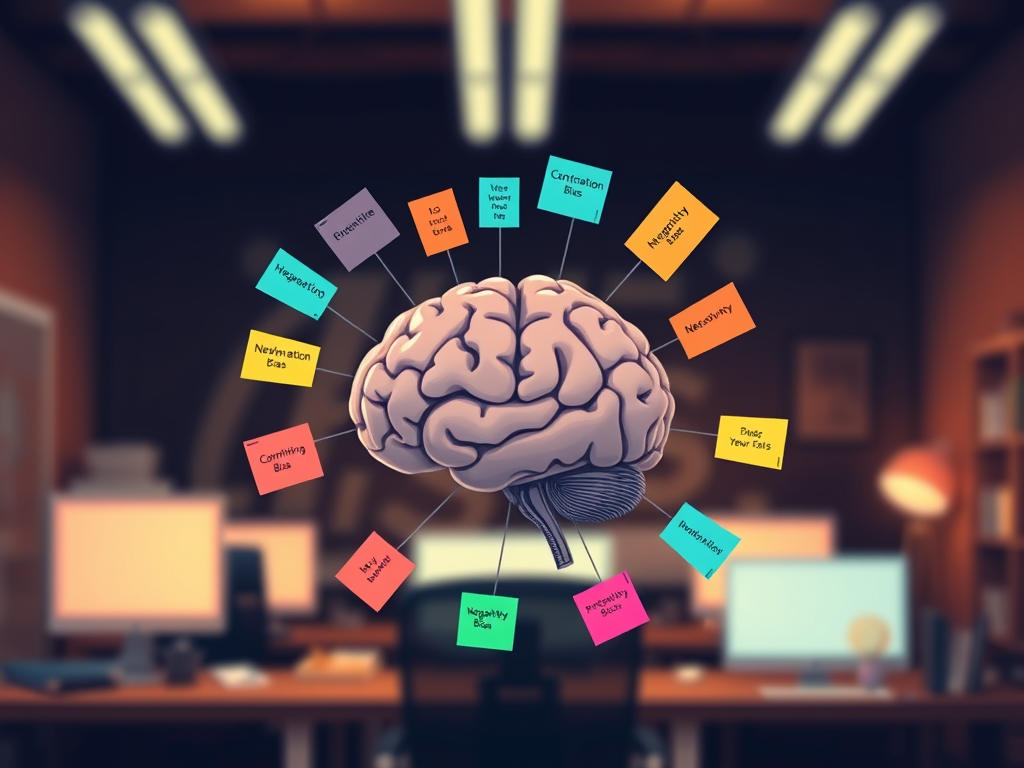
The reality, however, is that your brain is less like a supercomputer and more like a messy desk covered in sticky notes and coffee stains. To survive the complexities of the world, human evolution didn’t prioritize “accuracy”—it prioritized “speed” and “efficiency.” As a result, our minds rely on shortcuts, known in psychology as heuristics and cognitive biases. These are mental hacks that allow us to make snap decisions without burning too much glucose.
While these shortcuts kept our ancestors from getting eaten by lions, in the modern world, they often lead to errors in judgment, anxiety, and irrational behavior. Your brain is constantly filtering, editing, and distorting reality without your permission. Here are the top 10 ways your own brain tricks you every single day, and the science behind why it happens.
1. The Echo Chamber: Confirmation Bias
The Trick: You only see evidence that supports what you already believe, and you actively ignore evidence that disproves it.
The Reality: Have you ever wondered why it is impossible to win an argument on the internet? It’s because of Confirmation Bias, the grandfather of all cognitive errors. Your brain hates being wrong. Changing a deeply held belief requires a significant amount of cognitive energy and emotional regulation. To conserve energy and protect your ego, your brain acts like a bouncer at a club, only letting in information that agrees with the “vibe” inside.
If you believe that “left-handed people are more creative,” you will notice every time a left-handed person draws a picture. However, you will completely ignore the thousands of right-handed artists you see, or the clumsy left-handed people. You aren’t analyzing data; you are cherry-picking it to build a narrative. In the age of social media algorithms, this is weaponized, as feeds serve us content that reinforces our biases, convincing us that the whole world agrees with us, when in reality, we are just talking to a mirror.
2. The Imaginary Audience: The Spotlight Effect
The Trick: You spill a drop of coffee on your shirt or have a bad hair day, and you are convinced that everyone in the office is staring at you and judging you.
The Reality: We are the main characters in our own movies, so we naturally assume we are a significant extra in everyone else’s. This is the Spotlight Effect. It is the egocentric bias that causes us to vastly overestimate how much other people notice our appearance or behavior.
In a famous study at Cornell University, students were asked to wear an embarrassing t-shirt (featuring the singer Barry Manilow) and walk into a crowded classroom. The students estimated that 50% of the class would notice the shirt. In reality, less than 10% did. The truth is, other people are too busy worrying about their own coffee stains and bad hair to notice yours. Your brain creates this social anxiety to keep you in line with tribal norms, but it creates a level of scrutiny that simply doesn’t exist.
3. Throwing Good Money After Bad: The Sunk Cost Fallacy
The Trick: You sit through a terrible movie just because you paid $15 for the ticket, or you stay in a bad relationship because you’ve already invested two years into it.
The Reality: Logic dictates that you should make decisions based on the future: “Will the next hour be better spent watching this bad movie or leaving to do something else?” But your brain is obsessed with the past. This is the Sunk Cost Fallacy. Your brain views the “investment” (time, money, effort) as something that can be “saved” if you just keep going.
In reality, the money is gone. The time is spent. You cannot get it back. By staying in the bad situation, you are not “saving” the investment; you are just adding more loss to it. It’s an emotional trap where the fear of admitting a loss causes us to dig the hole deeper. Economists call this “loss aversion”—the psychological pain of losing $10 is twice as powerful as the joy of finding $10.
4. The Wikipedia Edit: Reconstructive Memory
The Trick: You have a vivid, crystal-clear memory of a childhood birthday party. You can see the cake, smell the candles, and hear the music. You are 100% sure it happened exactly that way.
The Reality: Memory is not a video recording; it is a Wikipedia page that you can edit. Every time you recall a memory, you are not “playing it back”; you are reconstructing it from scattered neurons. And in the process of pulling it up, your current mood, new information, or someone else’s suggestion can alter the file.
When you put the memory back (reconsolidation), you save the edited version, not the original. Over years, you might insert people who weren’t there or change the color of a car. This is why eye-witness testimony is notoriously unreliable in courtrooms. You aren’t lying; your brain is just filling in the gaps with plausible fiction to make the story feel complete.
5. The Sticker Price Trap: Anchoring Bias
The Trick: You see a designer jacket marked “$1,000,” and you think it’s ridiculous. Then you see it on sale for “$400.” Suddenly, it looks like a steal, and you feel compelled to buy it.
The Reality: Your brain struggles to determine the intrinsic value of things in a vacuum. To figure out if a price is “good,” it looks for a reference point. This is called Anchoring. The first number you see (the anchor) sets the baseline for the rest of the negotiation or decision.
Retailers use this against you constantly. The “$1,000” price tag was likely artificial—it was never meant to sell at that price. It existed solely to make the $400 price tag look reasonable. If you had walked in and the jacket was just labeled $400 with no “discount,” you might have thought it was expensive. Your brain latches onto the first piece of data it receives and interprets everything else relative to that anchor, preventing you from assessing the true value.
6. Faces in the Clouds: Pareidolia
The Trick: You see a man in the moon, a face on a burnt piece of toast, or a monster in the pile of clothes on your chair at night.
The Reality: This is Pareidolia, a specific form of apophenia (seeing patterns in random data). This isn’t a glitch; it is a survival feature. For our ancestors, failing to see a tiger hiding in the grass was fatal. Seeing a tiger where there was only a rock was just a false alarm.
Evolution decided it was safer to be paranoid. Your brain is hardwired with a “face detection” software that is extremely sensitive—so sensitive that it misfires constantly. It scans the environment looking for two eyes and a mouth because recognizing faces is the most critical social and survival skill humans have. So, when you see a spooky face in a dark window, it’s just your over-eager brain trying to keep you from being eaten.
7. Teflon for Good, Velcro for Bad: The Negativity Bias
The Trick: You receive ten compliments on your presentation and one minor criticism. You go home and spend the entire night obsessing over the one criticism, completely forgetting the compliments.
The Reality: Your brain processes negative and positive stimuli differently. Negative events are processed in the amygdala (the fear center) and are stored in long-term memory more quickly than positive ones. This is the Negativity Bias.
From a survival standpoint, a beautiful sunset is nice, but a poisonous snake is urgent. Therefore, your brain assigns more “weight” to negative experiences. It takes roughly five positive interactions to outweigh one negative interaction in a relationship. This trick leads to rumination and anxiety, as your brain forces you to replay your failures in 4K resolution while your successes fade into the background.
8. The Beauty Goggles: The Halo Effect
The Trick: You meet someone who is physically attractive and well-dressed, and you immediately assume they are also smart, kind, and funny, despite having zero evidence of their personality.
The Reality: This is the Halo Effect. It is the tendency for an impression created in one area to influence opinion in another unrelated area. Because “good looking” is a positive trait, your brain lazily fills in the rest of the person’s report card with other positive traits to create a consistent narrative.
This is why tall, attractive people are statistically more likely to be hired and paid more, and why we often struggle to believe that a charismatic celebrity could commit a crime. Your brain craves consistency (cognitive ease) and assumes that “good” traits cluster together, blinding you to the complex reality that attractive people can be incompetent, and charismatic people can be cruel.
9. The Red Car Syndrome: The Baader-Meinhof Phenomenon
The Trick: You learn a new word, or you decide to buy a specific model of car (say, a red Subaru). Suddenly, you see that word or that car everywhere. You think the universe is sending you a sign.
The Reality: The universe didn’t change; your attention did. This is the Frequency Illusion (or Baader-Meinhof Phenomenon). Your brain is bombarded with millions of bits of data every moment. To keep you sane, a part of your brain called the Reticular Activating System (RAS) filters out 99% of the “background noise.”
Those red Subarus were always on the road. You just ignored them because they weren’t relevant to you. Once you decided to buy one, your RAS tagged that shape and color as “important.” Now, every time one drives by, your brain flags it. It feels like a coincidence or magic, but it’s really just your brain’s spam filter letting a new sender through to your inbox.
10. Mount Stupid: The Dunning-Kruger Effect
The Trick: You watch one YouTube video on plumbing and decide you can re-pipe your entire house. You feel incredibly confident. Three hours later, your basement is flooded, and you are crying.
The Reality: This is the Dunning-Kruger Effect. It is a cognitive bias where people with low ability at a task overestimate their ability. Essentially, you don’t know enough about the subject to know how much you don’t know.
True competence requires recognizing the complexity of a skill. Beginners often stand atop “Mount Stupid”—a peak of inflated confidence. As you actually learn more, your confidence crashes (the “Valley of Despair”) because you realize how difficult the task actually is. This trick explains why the most ignorant people in a comment section are often the loudest and most certain, while actual experts speak with caution and nuance.
Further Reading
To learn how to outsmart your own brain and make better decisions, check out these essential books on behavioral psychology:
- “Thinking, Fast and Slow” by Daniel Kahneman – The seminal work by a Nobel Prize winner that defines the two systems of the brain and how they conflict.
- “Predictably Irrational: The Hidden Forces That Shape Our Decisions” by Dan Ariely – A fun and accessible look at why we cheat, overspend, and procrastinate.
- “You Are Not So Smart” by David McRaney – A humorous and humbling tour through the delusions and biases that we all suffer from.
- “The Invisible Gorilla: How Our Intuitions Deceive Us” by Christopher Chabris and Daniel Simons – A fascinating look at how little we actually perceive of the world around us.
Formatting Rules for Outro: Use an H2 Header for “Keep the Discovery Going!” Use H3 Headers for “Watch & Learn on YouTube” and “Listen on the Go on Spotify”. Ensure there is a full blank line between every paragraph and link. Embed the links into the text where indicated.
Keep the Discovery Going!
Here at Zentara, our mission is to take tricky subjects and unlock them, making knowledge exciting and easy to grasp. But the adventure doesn’t stop at the bottom of this page. We are constantly creating new ways for you to learn, watch, and listen every single day.
Watch & Learn on YouTube
Visual learner? We publish 4 new videos every day, plus breaking news shorts to keep you smarter than the headlines. From deep dives to quick facts, our channel is your daily visual dose of wonder.
Click here to Subscribe to Zentara on YouTube
Listen on the Go on Spotify
Prefer to learn while you move? Tune into the Zentara Podcast! We drop a new episode daily, perfect for your commute, workout, or coffee break. Pop on your headphones and fill your day with fascinating facts.
Click here to Listen on Spotify
Every click, view, and listen helps us keep bringing honest knowledge to everyone. Thanks for exploring with us today—see you out there in the world of discovery!




Leave a Reply