
Table of Contents
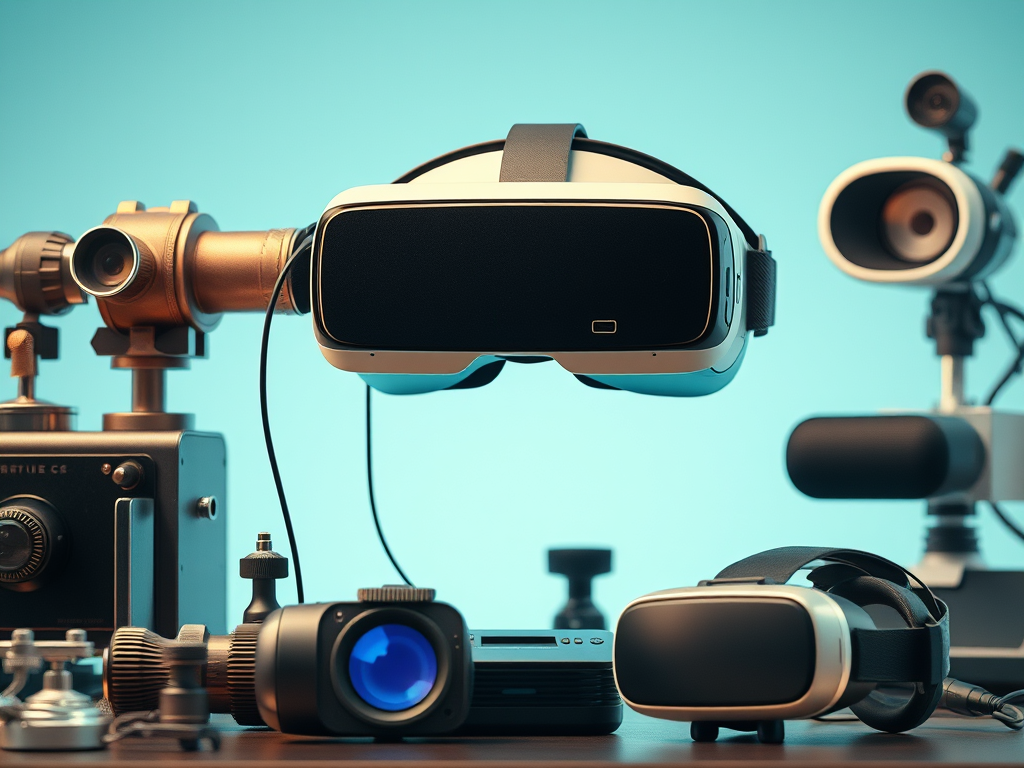
When we strap on a modern VR headset today, we are transported to alien worlds, hyper-realistic flight cockpits, or quiet meditation beaches. It feels like cutting-edge magic—a technology firmly rooted in the 21st century. We tend to associate Virtual Reality (VR) with the recent boom of the Oculus Rift, the HTC Vive, or the vision of the “Metaverse.”
However, the quest to trick the human brain into believing it is somewhere else is not a new phenomenon. It is a journey that spans nearly two centuries, involving Victorian scientists, eccentric cinematographers, Cold War military experiments, and failed 90s gaming consoles. The road to the sleek, wireless goggles of today is paved with duct tape, motion sickness, and massive heavy machinery hanging from ceilings.
Understanding the history of virtual reality reveals that this technology is not just about better graphics; it is about understanding human perception. It is the story of how we learned to hack our own senses. From wood-and-glass binoculars to haptic suits, here are 10 fundamental things you likely didn’t know about how VR evolved from a sci-fi dream into a living reality.
1. It Started in the 1830s with “Stereoscopic” Photos
Long before computers existed, scientists were already figuring out the fundamental trick behind VR: stereoscopic vision. In 1838, Sir Charles Wheatstone described the phenomenon where the human brain processes two slightly different 2D images (one from each eye) to create a single 3D perception of depth.
Wheatstone invented the stereoscope, a device that used mirrors to present two offset drawings to the user’s eyes. When looked through, the drawings popped into 3D. This is the great-grandfather of every VR headset sold today. The concept is identical: whether it’s a Victorian parlor toy or a Meta Quest 3, the device is feeding a slightly different angle to each eye to trick your brain into perceiving depth.
This evolved into the View-Master in the 20th century—that red plastic binocular toy you might have played with as a child. While these devices didn’t track motion, they proved that immersion was possible simply by manipulating the parallax of images. The hardware has changed, but the biological hack remains exactly the same.
2. The First VR Machine Was Mechanical, Not Digital
We assume VR requires code, processors, and pixels. However, the first true “experience machine” was an electromechanical device built in the 1950s called the Sensorama. Created by cinematographer Morton Heilig, it looked like a large arcade cabinet where you buried your face in a hood.
Heilig believed that cinema should engage all the senses, not just sight and sound. The Sensorama played 3D film (stereoscopic color), but it went further. It featured stereo sound, a vibrating chair to simulate motion, and even fans and smell generators. If you were watching a film about a motorcycle ride through Brooklyn, you would feel the rumble of the engine, the wind in your hair, and smell the exhaust fumes and pizza.
It was a brilliant, functioning prototype of multi-sensory immersion. Unfortunately, it was too expensive and complex to mass-produce, and Heilig couldn’t find investors. The Sensorama remains a fascinating “steampunk” ancestor to modern VR—a vision of total immersion achieved with gears and scents rather than polygons.
3. The First Headset Was Terrifyingly Named “The Sword of Damocles”
In 1968, computer scientist Ivan Sutherland created what is widely considered the first true Head-Mounted Display (HMD) connected to a computer system. While revolutionary, it was incredibly impractical.
The graphics were primitive—simple glowing wireframe rooms with no textures or surfaces. But the real issue was the weight. The display unit was so heavy that it couldn’t be worn comfortably on a human neck. To solve this, Sutherland suspended the entire tracking mechanism from the ceiling with a mechanical arm that clamped onto the user’s head.
Because of its menacing appearance and the way it hung over the user, the team nicknamed it “The Sword of Damocles,” referencing the Greek myth of the sword hanging by a single hair. Despite its terrifying look, it introduced head tracking, meaning when you turned your head, the wireframe room moved with you. This was the “Big Bang” moment for computer-generated VR.
4. NASA Made VR Viable for Training
During the 1980s, while the public was playing Pac-Man, NASA was quietly advancing VR technology to help train astronauts. The costs of sending humans to space are astronomical, and the margin for error is zero, making simulation a necessity.
NASA’s VIVED (Virtual Visual Environment Display) project took the raw concepts of Sutherland and began miniaturizing them using off-the-shelf technology like LCD screens from portable televisions. They created functional headsets that allowed astronauts to train for extravehicular activities (spacewalks) and manipulate robotic arms in a safe, digital environment.
This era highlighted a crucial divergence: consumer VR vs. enterprise VR. For decades, VR was too expensive for gamers but invaluable for the military and aerospace industries. This high-stakes funding kept the technology alive through the “VR winters” when the public lost interest, refining the tracking systems that would eventually trickle down to your living room.
5. Jaron Lanier and the “DataGlove”
If you wonder where the term “Virtual Reality” actually came from, you can thank Jaron Lanier. In the mid-1980s, Lanier founded VPL Research (Virtual Programming Languages), the first company to sell VR goggles and gloves to the public.
Lanier didn’t just sell the tech; he sold the philosophy. He popularized the term “Virtual Reality” to describe this new plane of existence. His company created the DataGlove, a futuristic gauntlet that tracked hand movements, allowing users to reach out and manipulate virtual objects. This technology was famously licensed to Nintendo to create the “Power Glove,” a peripheral that looked cool but functioned poorly.
VPL Research was ahead of its time. Their full systems cost tens of thousands of dollars, limiting them to researchers and the wealthy. However, Lanier’s work established the idea of the avatar—the digital representation of the self—and the concept that VR was about interaction, not just observation.
6. The “Puke Factor”: Solving Latency
One of the biggest hurdles in VR evolution wasn’t graphics, but biology. For decades, users would strap on a headset and almost immediately feel nauseous. This is often called “simulation sickness” or “VR sickness.”
The culprit was latency (lag). In the real world, if you turn your head, your view changes instantly. In early VR, there was a tiny delay—often just milliseconds—between your physical movement and the screen updating. This disconnect caused a sensory conflict: your inner ear (vestibular system) said “we are moving,” but your eyes said “we haven’t moved yet.” The brain interprets this sensory mismatch as a sign of poisoning (hallucination) and induces vomiting to expel the toxin.
The evolution of VR stalled until processors became fast enough to lower latency below 20 milliseconds, the threshold where the human brain perceives motion as continuous. The introduction of predictive tracking algorithms, which guess where your head will be in the next split second, was a major breakthrough in making VR stomach-friendly.
7. The Great Crash of the 90s (Sega and Nintendo)
We often forget that VR had a massive hype cycle in the 1990s that crashed and burned spectacularly. Major gaming companies tried to force the technology before it was ready, leading to high-profile disasters.
Sega announced the Sega VR headset for the Genesis console in 1993. They promoted it heavily, but it was quietly cancelled before release, reportedly because it caused severe headaches and motion sickness in testers.
Nintendo actually released their attempt: the Virtual Boy in 1995. It was a commercial catastrophe. It wasn’t true VR (it was a tabletop tripod you looked into), it had no head tracking, and it displayed everything in harsh red and black vector lines. It caused eye strain and failed to provide immersion. These failures poisoned the well for consumer VR, making investors and the public skeptical of the technology for nearly 20 years.
8. Smartphones Resurrected VR
The resurgence of VR in the 2010s didn’t happen because of a breakthrough in VR labs; it happened because of the iPhone. The smartphone wars of the late 2000s drove a massive acceleration in display technology and miniaturized sensors.
Suddenly, the world had access to cheap, high-resolution screens (high pixel density), tiny accelerometers, and gyroscopes—the exact components needed for a lightweight VR headset. Palmer Luckey, the founder of Oculus, realized this connection. His first prototype, the PR1, was essentially held together with duct tape, but it utilized these mobile components to fix the “screen door effect” (where you can see the black lines between pixels) and reduce weight.
This led to the “mobile VR” era (Samsung Gear VR, Google Cardboard), where you literally slotted a phone into a plastic shell. While we have moved back toward dedicated headsets, the modern VR revolution owes its existence to the supply chain created by the mobile phone industry.
9. The $2 Billion Validation
For years, VR was seen as a garage hobbyist project. That changed overnight in 2014 when Facebook (now Meta) acquired Oculus VR for $2 billion. This was a pivotal moment in the evolution of the industry.
Before this acquisition, developers were hesitant to build games or apps for VR because there was no user base. Investors were scared because of the 90s failures. When a tech giant like Facebook put billions of dollars on the table, it signaled to the world that VR was the “next computing platform,” not just a peripheral.
This injection of capital accelerated R&D (Research and Development) exponentially. It moved the industry from solving basic hardware problems to tackling complex software challenges, like inside-out tracking (where the headset uses cameras to see the room, removing the need for external sensors) and hand tracking, making the technology accessible to the average consumer.
10. Beyond Sight: The Rise of Haptics and Omnidirectional Treadmills
The final frontier in the evolution of VR is the sense of touch. Visuals and audio are now near-photorealistic, but the “ghost hand” problem remains—you reach out to touch a virtual wall, and your hand goes right through it.
The current evolution is focused on haptic feedback. Early rumble packs have evolved into sophisticated gloves and vests (like the TeslaSuit) that use electrical impulses or air pressure to simulate the feeling of rain, a gunshot impact, or the resistance of a solid object.
Furthermore, the issue of locomotion—how to walk in VR without walking into your living room wall—is being addressed by omnidirectional treadmills. These “slip-mills” allow users to physically run in any direction while staying in place. While still bulky and expensive, these devices represent the closing of the final gap: full-body immersion where your physical exertion matches your digital avatar’s movements, fulfilling the promise of the “Holodeck.”
Further Reading
To explore the fascinating history and future of Virtual Reality, these books provide essential insights:
- “The History of the Future: Oculus, Facebook, and the Revolution That Swept Virtual Reality” by Blake J. Harris.
- Why read it: A gripping, cinematic account of how Palmer Luckey started the modern VR revolution in his camper trailer and the corporate drama that followed.
- “Dawn of the New Everything: Encounters with Reality and Virtual Reality” by Jaron Lanier.
- Why read it: A memoir by the “father of VR” himself, blending autobiography with philosophy on what technology means for human consciousness.
- “Ready Player One” by Ernest Cline.
- Why read it: While fiction, this book (and movie) defined the cultural expectation of the “Metaverse” and explores the potential societal consequences of total immersion.
- “Experience on Demand: What Virtual Reality Is, How It Works, and What It Can Do” by Jeremy Bailenson.
- Why read it: Written by a Stanford professor, this book explores the psychological effects of VR and its potential for education, empathy, and therapy.
Keep the Discovery Going!
Here at Zentara, our mission is to take tricky subjects and unlock them, making knowledge exciting and easy to grasp. But the adventure doesn’t stop at the bottom of this page. We are constantly creating new ways for you to learn, watch, and listen every single day.
📺 Watch & Learn on YouTube
Visual learner? We publish 4 new videos every day, plus breaking news shorts to keep you smarter than the headlines. From deep dives to quick facts, our channel is your daily visual dose of wonder.
Click here to Subscribe to Zentara on YouTube
🎧 Listen on the Go on Spotify
Prefer to learn while you move? Tune into the Zentara Podcast! We drop a new episode daily, perfect for your commute, workout, or coffee break. Pop on your headphones and fill your day with fascinating facts.
Click here to Listen on Spotify
Every click, view, and listen helps us keep bringing honest knowledge to everyone. Thanks for exploring with us today—see you out there in the world of discovery!


Leave a Reply