
Table of Contents
The Gold Standard of the Music Industry
Every year, the music world descends upon Los Angeles (or occasionally New York or Las Vegas) for “Music’s Biggest Night.” The Grammy Awards are the industry’s most prestigious honor, a global spectacle featuring high-octane performances, emotional speeches, and the occasional unscripted controversy. For artists, a Grammy is not just a trophy; it is a validation of their craft by their peers and a permanent seal of quality on their careers.
However, behind the red carpet glamour and the “Grammy moments” lies a complex, bureaucratic, and historically fascinating organization. The Recording Academy, which administers the awards, has a history filled with quirks, scandals, and evolving rules that the average viewer rarely sees. As of June 12, 2025, the Grammys have had to adapt to everything from streaming algorithms to artificial intelligence, proving that the institution is fighting to stay relevant in a rapidly changing digital landscape.
Whether you tune in for the fashion, the performances, or the awards themselves, understanding the machinery behind the show changes how you watch it. From the secret alloy used to make the statues to the one time the Academy took an award back, here are ten fundamental facts that reveal the true story of the Grammy Awards.
1. It Was Almost Called “The Eddie”
The name “Grammy” is iconic, but the award came very close to having a much less glamorous moniker. When the awards were being planned in 1958, the organizers wanted a name that honored the history of recorded sound. The frontrunner was “The Eddie,” named after Thomas Edison, the inventor of the phonograph.
However, there was a problem. “The Eddie” sounded a bit too casual, perhaps even a bit silly for a black-tie affair. The committee eventually decided to hold a contest to name the award. A contest entrant suggested “Grammy” as an affectionate shorthand for the “gramophone,” the device depicted on the trophy.
The name stuck because it felt both historical and catchy. It’s hard to imagine superstars like Beyoncé or Taylor Swift fighting back tears while accepting an “Eddie,” but had that early decision gone the other way, the lexicon of music history would be entirely different today. It serves as a reminder that branding is just as important as the product, even in the arts.
2. The Statues Are Made of a Secret Alloy Called “Grammium”
The golden gramophone trophy is one of the most recognizable objects in pop culture, but it is not solid gold. In fact, if it were solid gold, it would be prohibitively heavy and expensive. Instead, the statues are crafted from a proprietary zinc alloy that the makers have dubbed “Grammium.”
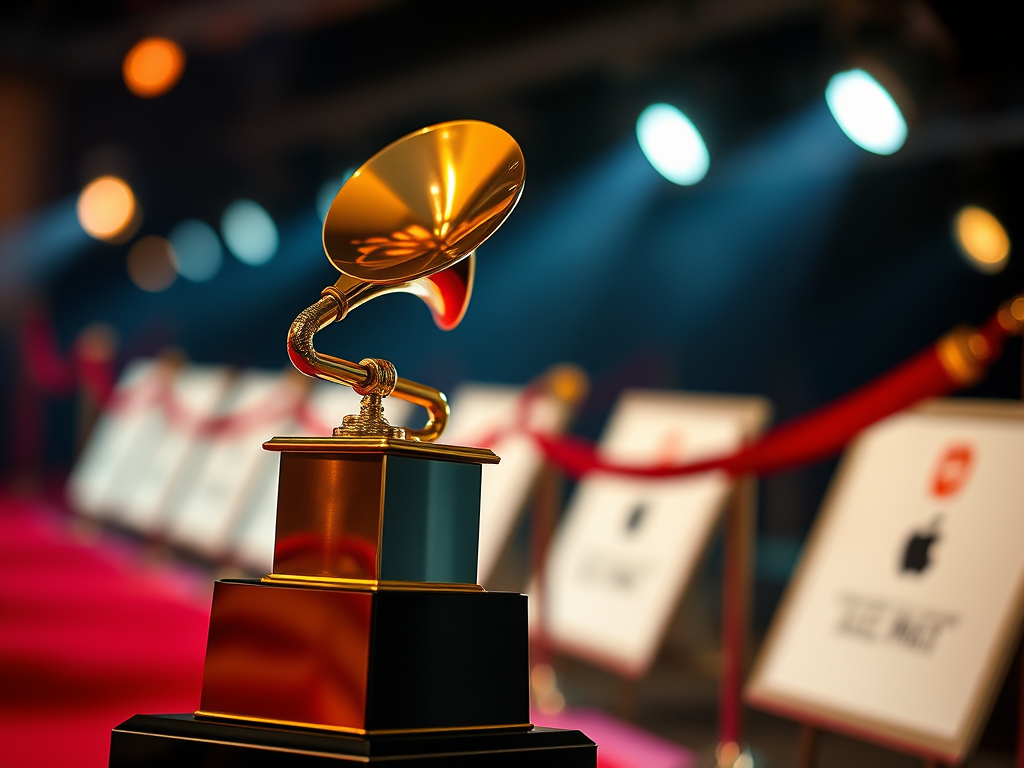
Each statue is made by hand at Billings Artworks in Colorado. The “Grammium” is cast, filed, and polished before being plated in 24-karat gold. This gives the award its lustrous finish while maintaining a manageable weight (though they are still surprisingly heavy, weighing about 5 pounds).
Interestingly, the trophies handed out on live television are “stunt doubles.” Because the winners are not known until the envelope is opened, the statues used on stage are generic props. The actual winners receive their personalized, engraved trophies months later via mail. This prevents the awkwardness of a winner dropping their specific award or a mix-up backstage, ensuring the real hardware arrives in pristine condition.
3. “Record of the Year” and “Song of the Year” Are Not the Same
One of the most common points of confusion for casual viewers is the difference between these two top categories. They sound identical, but they honor completely different aspects of music creation. Understanding the distinction is key to understanding what the Academy values.
Song of the Year is a songwriter’s award. It honors the composition—the lyrics and the melody. If a song is a cover, the original writer wins, not the singer. It is about the “paper and pen” (or “notes app”) process of creating the song.
Record of the Year, on the other hand, is a performance and production award. It honors the recording—the singer, the producer, the recording engineer, and the mixer. It recognizes the final audio product that you hear on the radio. Theoretically, a terribly written song could win “Record of the Year” if the production and vocal performance were spectacular, while a beautifully written song with a poor recording could win “Song of the Year.”
4. Milli Vanilli Is the Only Act to Be Stripped of a Grammy
The Grammy Awards have had their share of controversial winners, but only once has the Academy taken the drastic step of revoking an award. This infamy belongs to the pop duo Milli Vanilli. In 1990, they won the Best New Artist award after a string of massive hits like “Girl You Know It’s True.”
However, rumors had been swirling that the two frontmen, Rob Pilatus and Fab Morvan, did not actually sing on their album. Later that year, the producer confirmed the fraud: the duo were lip-syncing models fronting for session vocalists. The backlash was immediate and severe.
The Recording Academy vacated the award, demanding the statues back. To this day, the 1990 Best New Artist slot remains empty in the record books. This scandal forced the industry to tighten its rules regarding vocal credits and live performances, standing as a cautionary tale about the importance of authenticity in an industry often obsessed with image.
5. Beyoncé Holds the All-Time Record for Wins
For years, the record for the most Grammy wins in a lifetime was held by the Hungarian-British conductor Georg Solti, who amassed 31 awards. It seemed like an unbreakable record, held by a figure from the classical world where categories are less competitive than pop. However, in 2023, that ceiling was shattered by Beyoncé.
As of the current standing in 2025, Beyoncé sits alone at the top of the mountain with 35 Grammy Awards. Her wins span across R&B, Pop, Dance/Electronic, and Surround Sound categories, reflecting her evolution as an artist. This achievement is significant because it shifts the center of gravity of Grammy history from classical music to contemporary pop and R&B.
Despite this record, a point of contention remains: Beyoncé has famously never won “Album of the Year,” the night’s biggest honor, despite multiple nominations. This statistical anomaly—being the most awarded artist ever while missing the top prize—fuels ongoing debates about how the Academy evaluates Black women’s contributions to the album format versus singles.
6. The “Big Four” Sweep is Nearly Impossible
There are currently over 90 categories at the Grammys, but only four are considered the “General Field,” open to artists of all genres: Album of the Year, Record of the Year, Song of the Year, and Best New Artist. Winning all four in a single night is the “Holy Grail” of the Grammys, and it is statistically incredibly rare.
In the entire history of the awards (over 65 years), only three artists have ever accomplished this “sweep.” Christopher Cross was the first to do it in 1981. The feat went unmatched for nearly 40 years until Billie Eilish did it in 2020 at age 18. Adele also swept the top three in 2012 and 2017 but was not eligible for Best New Artist those years.
The difficulty of the sweep lies in the voting structure. The voters who appreciate a great country song might not vote for the same artist as the voters who appreciate a great rap album. To win all four requires a level of universal appeal that transcends genre biases, making it the ultimate test of an artist’s dominance in a specific year.
7. AI Generated Music is Banned from Winning
As technology evolves, so do the rules of the Academy. With the explosion of Artificial Intelligence in creative spaces, the Grammys had to draw a hard line in the sand. As of the rules solidified in 2024 and 2025, only human creators are eligible to win a Grammy Award.
The rule states that a work that contains no human authorship is not eligible in any category. However, music that features elements of AI is eligible, provided that the human authorship component is “meaningful.” For example, if a human writes a song and performs it, but uses an AI to generate a background beat, the human can win for the songwriting and performance. But if an AI writes the lyrics and melody, the song cannot win a songwriting Grammy.
This distinction is crucial for the future of the awards. It positions the Grammys as a defender of human creativity, ensuring that the highest honor in music remains a celebration of the human spirit, not algorithmic efficiency.
8. The “Grammy Bump” is Real Economics
While artists often talk about the artistic honor of winning, the managers and labels are looking at the bottom line. The “Grammy Bump” is a documented economic phenomenon where winning—or even performing—at the ceremony leads to a massive spike in sales and streams.
Data consistently shows that following the broadcast, winners of the major categories can see their sales increase by anywhere from 100% to 500% overnight. For lesser-known artists who win Best New Artist or perform in a prime slot, the exposure can launch a touring career that lasts decades.
This is why the campaigning for a nomination is so intense. Labels spend thousands of dollars on “For Your Consideration” ads, billboards, and direct mailers to voters. They view the cost of campaigning as an investment; a win is not just a trophy, it is a marketing tool that increases the artist’s booking fee and catalog value for years to come.
9. Sinead O’Connor Was the First to Refuse the Award
While many artists have criticized the Grammys for being out of touch or commercialized, Sinead O’Connor was the first to actually boycott the ceremony and refuse her award. In 1991, she won Best Alternative Music Performance for her album I Do Not Want What I Haven’t Got.
O’Connor did not attend the ceremony and issued a letter stating that she refused the award because she believed the Grammys fostered “false and destructive materialist values” rather than artistic ones. She argued that the industry was more concerned with record sales than artistic truth.
Her refusal was a shocking moment of rebellion that predated her famous SNL protest. It highlighted the tension between the Grammys as a trade organization (designed to sell records) and the Grammys as an artistic arbiter. While others (like Pearl Jam’s Eddie Vedder) have since expressed ambivalence on stage, O’Connor remains the most prominent example of an artist rejecting the institution entirely.
10. The Latin Grammys Are a Separate Universe
Casual fans might assume the Latin Grammys are just a category within the main show, but they are a completely separate entity with their own ceremony, own voting body, and own broadcast. They were established in 2000 because the main Recording Academy realized they could not adequately honor the diversity and volume of Latin music within the existing structure.
The Latin Recording Academy focuses on music recorded in Spanish or Portuguese. This distinction is important because it acknowledges that “Latin Music” is not a genre; it is a universe of genres—from Salsa to Reggaeton to Rock en Español.
By creating a separate academy, the industry allowed Latin artists to be judged by their peers who understand the cultural nuances of the music, rather than by a general US-centric voting body. It was a move that anticipated the global explosion of Latin music, ensuring that when stars like Bad Bunny or Karol G crossover to the main Grammys, they are doing so as established titans of their own industry.
Further Reading
- Broken Record: The History of the Grammy Awards by Henry Schipper.
- The Grammy Awards Best Country Song 1964-2011 by Hal Leonard Corp.
- Explosion of Delayed Entry: The Music Business and the Grammy Awards by O.L. Duke.
- Everything You Need to Know About the Music Business by Donald S. Passman (For context on how awards impact contracts).
- And the Winner Is…: The History and Politics of the Oscar and Grammy Awards by Emanuel Levy.
Keep the Discovery Going!
Here at Zentara, our mission is to take tricky subjects and unlock them, making knowledge exciting and easy to grasp. But the adventure doesn’t stop at the bottom of this page. We are constantly creating new ways for you to learn, watch, and listen every single day.
Watch & Learn on YouTube
Visual learner? We publish 4 new videos every day, plus breaking news shorts to keep you smarter than the headlines. From deep dives to quick facts, our channel is your daily visual dose of wonder.
Click here to Subscribe to Zentara on YouTube
Listen on the Go on Spotify
Prefer to learn while you move? Tune into the Zentara Podcast! We drop a new episode daily, perfect for your commute, workout, or coffee break. Pop on your headphones and fill your day with fascinating facts.
Click here to Listen on Spotify
Every click, view, and listen helps us keep bringing honest knowledge to everyone. Thanks for exploring with us today—see you out there in the world of discovery!




Leave a Reply