
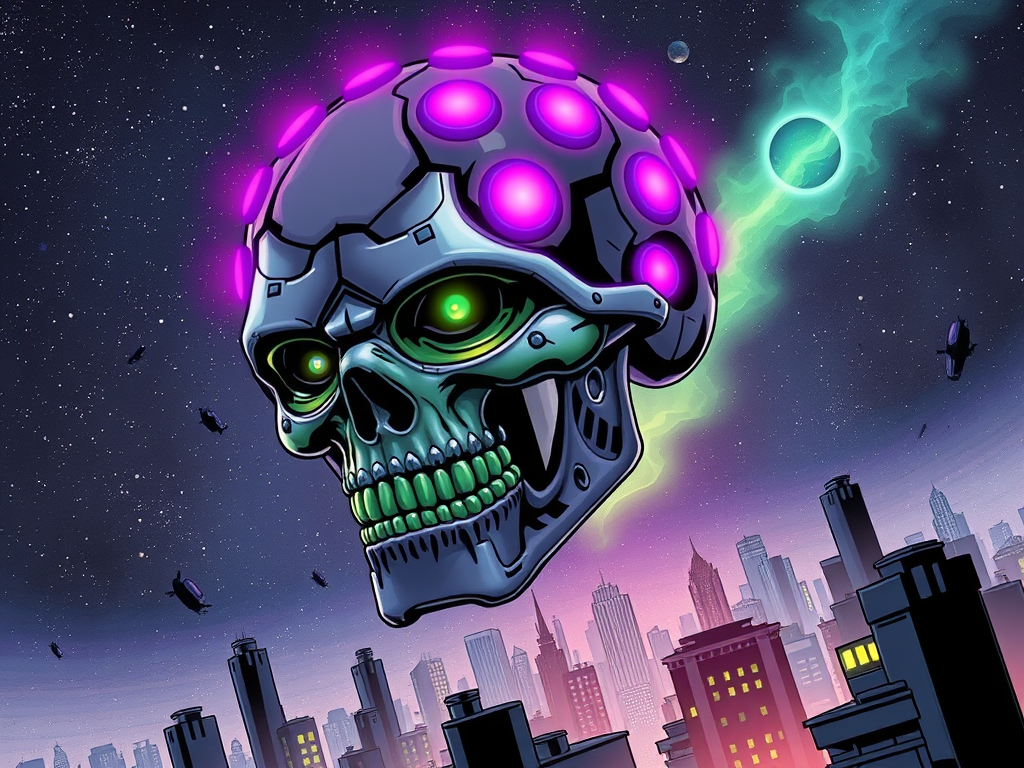
In the pantheon of Superman’s rogues gallery, Lex Luthor represents the evil of human ego, and General Zod represents the sins of Krypton’s past. But Brainiac represents something colder and more terrifying: the ultimate alien intellect, devoid of empathy. Recognized by his green skin, purple diodes, and skull-shaped spaceship, Brainiac is the “Collector of Worlds,” a being who shrinks cities to preserve their knowledge before destroying the rest of the planet.
However, if you try to pin down exactly who or what Brainiac is, you will quickly find yourself lost in a maze of retcons, reboots, and upgrades. Is he an alien? A robot? A cloud of nanites? A carnival mentalist? The answer, frustratingly, is “yes.” Brainiac has undergone more drastic revisions than almost any other DC villain, reflecting the changing fears of technology and alien invasions over the decades.
He is a character who has been both a goofy Silver Age nuisance with a pet monkey and a terrifying cosmic horror capable of wiping out galaxies. His history is a testament to the comic medium’s ability to evolve a concept until it reaches perfection. Here are 10 things you didn’t know about the convoluted, fascinating comic book history of Brainiac.
1. His Name Caused a Real-World Legal Battle
The Origin Oddity: The DIY Computer Kit
When Brainiac debuted in Action Comics #242 in 1958, the name seemed like a perfect blend of “brain” and “maniac.” However, DC Comics inadvertently stepped into a legal minefield. Just three years prior, an engineer named Edmund Berkeley had released a “Geniac” and a “Brainiac”—simple computer kits designed to teach teenagers the basics of logic and coding.
Berkeley, understandably, wasn’t thrilled that his educational product now shared a name with a mass-murdering space villain. To avoid a lawsuit, DC Comics had to get creative. They added a footnote in the comics claiming that the character Brainiac was a “Computer Cognition” machine, subtly legitimizing the comparison to the kit. In a strange twist of fate, this legal dodging eventually influenced the character’s evolution, pushing writers to depict him more as a living computer than a biological alien to justify the name.
2. He Originally Had a Pet Space Monkey
The Silver Age Silliness: Koko the Monkey
Modern depictions of Brainiac show him as a cold, solitary figure surrounded only by silent robots. But in his earliest Silver Age appearances, Brainiac had a sidekick: a space monkey named Koko. This wasn’t a menacing alien beast; it was a small, cute monkey wearing a little t-shirt.
Koko was often the comic relief, scampering around the skull ship while Brainiac plotted the doom of Earth. The presence of Koko highlights the stark tonal difference of the 1950s—Brainiac was a “12th-level intellect” capable of shrinking cities, yet he seemingly needed the companionship of a primate. While Koko has been largely erased from modern continuity (save for the occasional Easter egg), he stands as a reminder that even the multiverse’s greatest villain once had a soft spot for a pet.
3. He Didn’t Kill Krypton (Originally)
The Mandela Effect: The City Bottler
Ask a casual fan what Brainiac did, and they will likely say, “He blew up Krypton.” This is a misconception fueled by Superman: The Animated Series and later retcons. In his original comic book appearances, Brainiac had nothing to do with Krypton’s destruction. The planet exploded due to natural tectonic instability, just as Jor-El predicted.
Brainiac’s crime was simply that he visited Krypton before it blew up, shrunk the city of Kandor, and stole it for his collection. For decades, Brainiac was merely a thief, not a destroyer. It wasn’t until the 2008 “Brainiac” story arc by Geoff Johns that the character was officially retconned to be directly involved in the planet’s doom, actively destabilizing the core or refusing to share the data that could have saved them, cementing him as Superman’s most personal enemy.
4. He Was Possessed by a Carnival Mentalist
The Post-Crisis Reboot: The Era of Milton Fine
After the Crisis on Infinite Earths reboot in 1985, DC wanted to make Superman’s villains less “sci-fi” and more grounded. They erased the alien Brainiac entirely. In his place, they introduced Milton Fine, a human sideshow mentalist who performed under the stage name “The Amazing Brainiac.”
Fine was possessed by the disembodied consciousness of a Vril Dox (an alien scientist), which slowly mutated his human body. This version of Brainiac didn’t have a spaceship; he had psychic powers and a beard. He was a psychological horror villain, struggling with the alien mind taking over his human form. This “Milton Fine” era lasted for years until advanced technology eventually turned him into a more recognizable, robotic version of the character, finally shedding the human host.
5. All Previous Versions Were Just “Probes”
The Grand Unification Theory: Geoff Johns’ Retcon
For fifty years, Brainiac looked different in almost every decade. He was a green man in a pink shirt, a metallic skeleton, a cloud of nanites, and a hulking brute. Fans chalked this up to artistic license or bad continuity. In 2008, writer Geoff Johns brilliantly fixed this mess with a single explanation: they were all just probes.
In the Action Comics “Brainiac” arc, Superman finally encounters the real Brainiac. It turns out the true Brainiac—a massive, muscular Coluan hooked up to a bio-shell—had never left his ship. Every version Superman had fought since 1958 was merely a remote-controlled drone with a fraction of the original’s intelligence. This revelation instantly upgraded Brainiac’s threat level; Superman realized he had struggled to beat the puppets, and now he had to face the master.
6. He Is the Grandfather of a Hero
The Legacy: Brainiac 5
It is one of the great ironies of the DC Universe that the lineage of its smartest villain produced one of its greatest heroes. In the 31st Century, Brainiac 5 (Querl Dox) is a leading member of the Legion of Super-Heroes. He possesses the same “12th-level intellect” as his ancestor but uses it to cure diseases and protect the United Planets.
Brainiac 5 is constantly fighting against the stigma of his name and the fear that he might succumb to his grandfather’s madness. This dynamic creates a fascinating “nature vs. nurture” narrative within the Brainiac family tree. The original Brainiac despises his descendant’s altruism, viewing it as a waste of superior cognitive function, while Brainiac 5 views his ancestor as a cautionary tale of intellect without morality.
7. He Created a Son to Run a Space Police Force
The Rebellion: Vril Dox II
Brainiac doesn’t just have descendants in the future; he has a clone “son” in the present named Vril Dox II. Brainiac created him as a lab assistant, but Vril Dox II (often just called Dox) rebelled against his father. However, Dox didn’t become a superhero like Superman.
Instead, Dox formed L.E.G.I.O.N., an intergalactic police force that was essentially a privatized version of the Green Lantern Corps. Dox is an anti-hero: manipulative, cold, and Machiavellian, but ultimately opposed to chaos. He shares his father’s arrogance and green skin but uses his intellect to impose order rather than to collect trophies. The relationship between Brainiac and Vril Dox II is a tense game of cosmic chess, with the son desperate to prove he is superior to his creator.
8. Brainiac 13: The Y2K Upgrade
The Tech Horror: The Future Virus
As the year 2000 approached, fears of the Y2K bug and technological singularity influenced pop culture. DC Comics capitalized on this with the Y2K event, where Brainiac revealed a terrifying new form: Brainiac 13.
This version of Brainiac came from the 64th century. He was a towering construct of pure future-tech who didn’t just want to bottle Metropolis; he wanted to become it. He infected the city with a technological virus, transforming Metropolis into a futuristic cityscape overnight. Brainiac 13 represented the fear of technology outpacing humanity. He was arguably the most powerful version of the villain ever seen, requiring Superman to essentially bargain with Lex Luthor and even Darkseid to find a way to stop him.
9. The “Computer Tyrants” Retcon
The Origin Shift: Man vs. Machine
In the 1960s, to align with the “computer” description mentioned in point #1, DC retconned Brainiac’s origin. They revealed that he was not a biological alien named Vril Dox, but a computer built by the Computer Tyrants of Colu.
According to this backstory, the tyrants built Brainiac as a spy to gather information on other worlds. To make him blend in, they gave him a humanoid appearance. This retcon explained why he was so emotionless and logical. However, Brainiac eventually became too smart, realized he was superior to his creators, and overthrew the Tyrants. This “rogue AI” origin stood for decades before being muddled by the Crisis reboot, but it established the core theme of Brainiac as a being of pure logic rebelling against servitude.
10. He Merged With Lex Luthor
The Ultimate Villain: Whatever Happened to the Man of Tomorrow?
In Alan Moore’s legendary “final” Superman story, Whatever Happened to the Man of Tomorrow?, the writer needed a villain terrifying enough to end the Man of Steel’s career. His solution? Merge the two greatest threats.
Brainiac, reduced to a robotic skull, found a dying Lex Luthor in the snow. He attached himself to Luthor’s nervous system, taking control of his body. The resulting hybrid possessed Luthor’s hate and Brainiac’s power. This concept was so popular it was later adapted into the Justice League Unlimited animated series, where the Brainiac/Luthor fusion served as the final boss for the entire DC Animated Universe. It represents the perfect storm of Superman’s rogues: the raw physical power of alien tech combined with the petty, human cruelty of his arch-nemesis.
Further Reading
- “Superman: Brainiac” by Geoff Johns and Gary Frank – The definitive modern origin that consolidated all previous versions into a cohesive, terrifying threat.
- “Justice League: No Justice” by Scott Snyder – A modern story featuring Brainiac forcing the Justice League and villains to team up to save the universe.
- “Panic in the Sky” by Dan Jurgens – A classic 90s crossover where Brainiac takes over Warworld to attack Earth.
- “Superman: The Black Ring” by Paul Cornell – Focuses on Lex Luthor’s hunt for power, featuring a fascinating confrontation with a Brainiac drone.
- “Showcase Presents: Superman Team-Ups” – Contains early Silver Age appearances of Brainiac, including the shrinking of Kandor.
Keep the Discovery Going!
Here at Zentara, our mission is to take tricky subjects and unlock them, making knowledge exciting and easy to grasp. But the adventure doesn’t stop at the bottom of this page. We are constantly creating new ways for you to learn, watch, and listen every single day.
📺 Watch & Learn on YouTube
Visual learner? We publish 4 new videos every day, plus breaking news shorts to keep you smarter than the headlines. From deep dives to quick facts, our channel is your daily visual dose of wonder.
Click here to Subscribe to Zentara on YouTube
🎧 Listen on the Go on Spotify
Prefer to learn while you move? Tune into the Zentara Podcast! We drop a new episode daily, perfect for your commute, workout, or coffee break. Pop on your headphones and fill your day with fascinating facts.
Click here to Listen on Spotify
Every click, view, and listen helps us keep bringing honest knowledge to everyone. Thanks for exploring with us today—see you out there in the world of discovery!




Leave a Reply