
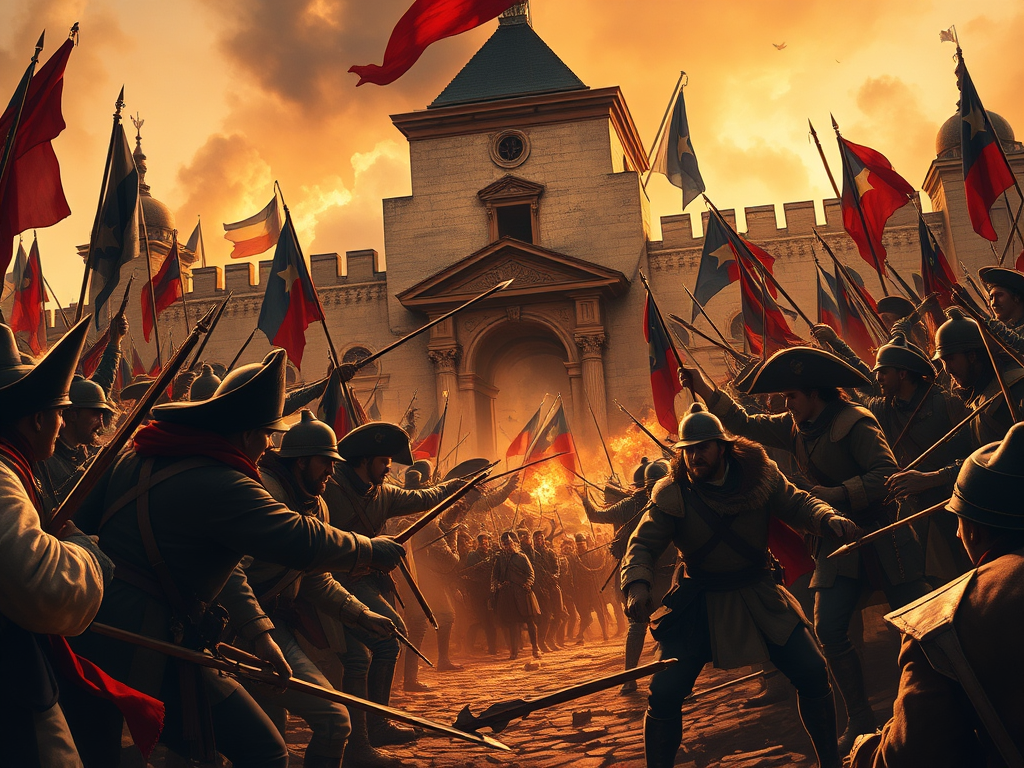
The French Revolution was a seismic shift in human history, a period of social and political upheaval that tore down the centuries-old structures of absolute monarchy and feudal privilege. It was a time of radical ideas, where the concepts of liberty, equality, and fraternity transitioned from Enlightenment philosophy into blood-soaked reality. The revolution didn’t just change France; it provided the blueprint for modern secular democracies and redefined the relationship between the state and its citizens.
As we look back from the vantage point of 2025, the French Revolution causes—ranging from crippling national debt to a rigid class system—serve as a timeless warning about the dangers of systemic inequality. The movement was a complex series of “points of no return,” where small concessions led to grand demands, and eventually, a complete reimagining of the world order. Understanding these French Revolution facts is essential for anyone wishing to grasp the origins of contemporary human rights and political activism.
In this article, we will examine the ten most critical moments that defined this era. From the defiance of the Tennis Court Oath to the rise of Napoleon Bonaparte, these events represent the chaotic, inspiring, and often terrifying birth of the modern age.
1. The Calling of the Estates-General (May 1789)
By 1789, France was bankrupt. Years of lavish spending by the monarchy and expensive support for the American Revolution had left the treasury empty. King Louis XVI was forced to do something no French king had done in over 100 years: call a meeting of the Estates-General. This was an assembly representing the three “estates” of French society: the First Estate (the clergy), the Second Estate (the nobility), and the Third Estate (the commoners, who made up 98% of the population).
The meeting was a disaster from the start. Each estate had only one vote, meaning the clergy and nobility could always outvote the commoners 2-to-1 to keep their tax exemptions. This was the spark that ignited the French Revolution causes. The Third Estate, inspired by Enlightenment ideals, demanded that votes be counted “by head” rather than by estate. This wasn’t just a procedural argument; it was a challenge to the entire social hierarchy. When the King refused to budge, the Third Estate realized they could no longer work within the old system, setting the stage for a radical breakaway.
2. The Tennis Court Oath (June 20, 1789)
After being locked out of their meeting hall by the King’s guards, the representatives of the Third Estate—now calling themselves the National Assembly—refused to go home. They marched to a nearby indoor tennis court and swore a solemn oath: they would not disband until they had written a new constitution for France. This event, known as the Tennis Court Oath, was a revolutionary act of defiance that effectively stripped the King of his absolute power.
This moment is a perfect example of interpersonal communication and group solidarity. These men were risking their lives; by declaring themselves the true representatives of the nation, they were committing treason. The oath transformed a protest into a revolution. It signaled that the people were no longer subjects of a king, but citizens of a nation. The King eventually caved and ordered the other two estates to join the National Assembly, but the trust between the monarch and his people was permanently shattered.
3. The Storming of the Bastille (July 14, 1789)
While the politicians argued in Versailles, the people of Paris were starving and terrified. Rumors spread that the King was gathering the army to crush the National Assembly. On July 14, a mob of Parisians marched on the Bastille, a medieval fortress and prison that symbolized the tyranny of the “Ancien Régime.” They weren’t just looking for prisoners; they were looking for gunpowder to defend themselves.
The Storming of the Bastille is perhaps the most famous of all French Revolution facts. When the prison fell, it wasn’t just a military victory; it was a symbolic destruction of royal authority. The people had taken up arms and won. Today, July 14 is celebrated as Bastille Day, the French national holiday. This event proved that the revolution was no longer just a debate among intellectuals in suits—it was a popular uprising fueled by the “Sans-Culottes” (the working-class radicals) that would use violence to ensure its survival.
4. The Abolition of Feudalism (August 4, 1789)
As news of the Bastille spread, the countryside erupted in what became known as the “Great Fear.” Peasants, fearing a noble crackdown, attacked manor houses and burned the ancient records that tied them to the land and their lords. In a frantic attempt to restore order, the National Constituent Assembly met on the night of August 4 and did something unthinkable: they abolished the entire feudal system in a single night.
This event ended centuries of feudal privilege. Suddenly, the nobility lost their rights to forced labor, their exclusive hunting grounds, and their tax exemptions. Tithes to the Church were also abolished. It was an “all-or-nothing” moment where the Assembly realized they had to satisfy the peasants to prevent a total collapse of society. By destroying the legal framework of the old world, the Assembly cleared the ground for a new society based on legal equality.
5. Declaration of the Rights of Man and of the Citizen (August 1789)
Following the abolition of feudalism, the Assembly adopted the Declaration of the Rights of Man and of the Citizen. This document was a “manifesto of the revolution,” heavily influenced by Enlightenment thinkers like Rousseau and the American Declaration of Independence. It declared that “men are born and remain free and equal in rights.” It protected freedom of speech, freedom of religion, and the right to a fair trial.
This was a landmark in the history of human rights. It shifted the source of power from the “divine right of kings” to the “sovereignty of the nation.” However, it’s important to note the limitations: it did not grant rights to women or address the issue of slavery in French colonies. Despite these flaws, the Declaration provided the moral and legal justification for the revolution, serving as a template for constitutional monarchy and later, a republic. It turned abstract philosophy into a binding social contract.
6. The Women’s March on Versailles (October 1789)
Bread was the lifeblood of 18th-century France, and by October 1789, it was scarce and expensive. Thousands of Parisian market women, armed with pikes and knives, began a march to Versailles to demand bread from the King. They were joined by the National Guard and eventually reached the palace, breaking in and nearly killing Queen Marie Antoinette.
The Women’s March on Versailles was a turning point because it forced the Royal Family to leave the isolation of Versailles and return to Paris, where they could be watched by the people. The mob’s chant—”We are bringing back the baker, the baker’s wife, and the baker’s boy”—showed that they still looked to the King for survival, but they were now the ones in control. This event shifted the center of power from the royal court to the streets of Paris, making the King a virtual prisoner of the revolution.
7. The Flight to Varennes (June 1791)
For two years, France attempted to function as a constitutional monarchy, with the King as a figurehead. However, Louis XVI felt humiliated and sought to regain his power. In June 1791, the Royal Family attempted to flee Paris in disguise, hoping to reach the border and join an army of counter-revolutionaries. They were recognized and captured in the small town of Varennes.
The Flight to Varennes was a catastrophic blow to the monarchy. Before this, many people believed the King was a “good man” being misled by bad advisors. Now, he was seen as a traitor who had abandoned his people. This event effectively killed the dream of a peaceful constitutional monarchy and fueled the rise of radical groups like the Jacobins, who began to argue that France could only be free if the King was removed entirely. It turned the moderate revolution into a race toward a republic.
8. The Execution of Louis XVI (January 21, 1793)
After France declared war on Austria and Prussia, and after a second revolution in August 1792 established the First French Republic, the fate of the King became the central question. The newly formed National Convention put “Citizen Louis Capet” on trial for high treason. By a narrow margin, they voted for his death. On January 21, 1793, Louis XVI was executed by guillotine in the center of Paris.
This was a “regicide” that shocked the world. By killing the King, the revolutionaries were burning their bridges; there was no going back to the old ways. It sent a message to the monarchs of Europe that the people were now the masters. However, it also deeply divided France. Many in the provinces were horrified by the King’s death, leading to civil war and providing a justification for the surrounding European powers to invade, further radicalizing the government in Paris.
9. The Reign of Terror (1793–1794)
Faced with internal civil war and external invasion, the revolutionary government took a dark turn. Led by Maximilien Robespierre and the Committee of Public Safety, the government launched the Reign of Terror. The goal was to protect the revolution from “enemies within” by using state-sanctioned violence. During this period, an estimated 17,000 people were officially executed by guillotine, and thousands more died in prison or during massacres.
The Terror is a haunting example of psychological manipulation and political paranoia. Anyone suspected of being “unenthusiastic” about the revolution could be denounced and killed. It was a time of “virtue through terror,” where the ideals of liberty were suspended to save the republic. Eventually, the Terror consumed its own leaders; in July 1794, Robespierre himself was sent to the guillotine, an event known as the Thermidorian Reaction, which finally brought the most radical phase of the revolution to an end.
10. The Rise of Napoleon Bonaparte (1799)
After years of chaos, corruption, and a weak government known as the Directory, the French people were exhausted. They craved stability. In 1799, a young, brilliant military general named Napoleon Bonaparte staged a coup d’état (the Coup of 18 Brumaire) and seized power. While he initially claimed to be preserving the revolution, he soon declared himself First Consul, and later, Emperor of the French.
Napoleon’s rise marks the end of the revolutionary period. He codified many of the revolution’s gains—such as legal equality and the abolition of feudalism—into the Napoleonic Code, but he also restored authoritarian rule. His military leadership would soon spread revolutionary ideals across Europe through conquest, forever changing the continent’s borders. Napoleon proved that while a revolution can tear down a king, the vacuum left behind is often filled by a strongman who promises order in exchange for absolute control.
Further Reading
To explore the complex layers and personal stories of the French Revolution, these books offer a deep yet accessible understanding:
- “Citizens: A Chronicle of the French Revolution” by Simon Schama
- “The French Revolution: From Enlightenment to Tyranny” by Ian Davidson
- “The Terror: The Merciless War for Freedom in Revolutionary France” by David Andress
- “Napoleon: A Life” by Andrew Roberts
Keep the Discovery Going!
Here at Zentara, our mission is to take tricky subjects and unlock them, making knowledge exciting and easy to grasp. But the adventure doesn’t stop at the bottom of this page. We are constantly creating new ways for you to learn, watch, and listen every single day.
📺 Watch & Learn on YouTube
Visual learner? We publish 4 new videos every day, plus breaking news shorts to keep you smarter than the headlines. From deep dives to quick facts, our channel is your daily visual dose of wonder.
Click here to Subscribe to Zentara on YouTube
🎧 Listen on the Go on Spotify
Prefer to learn while you move? Tune into the Zentara Podcast! We drop a new episode daily, perfect for your commute, workout, or coffee break. Pop on your headphones and fill your day with fascinating facts.
Click here to Listen on Spotify
Every click, view, and listen helps us keep bringing honest knowledge to everyone. Thanks for exploring with us today—see you out there in the world of discovery!




Leave a Reply